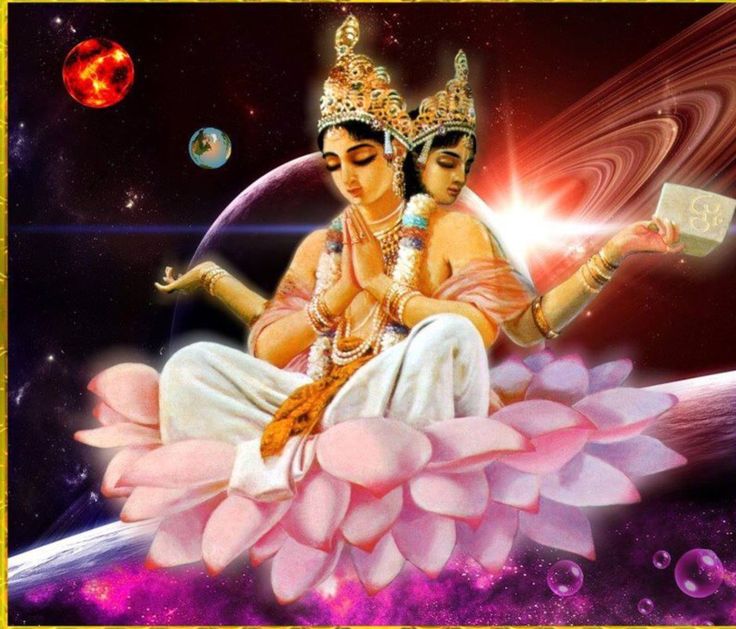
Brahma opened his eyes for the first time and saw nothing he recognised. The lotus that had produced him floated on dark water in every direction, and there was no one anywhere whom he could ask a single question. In Gaudiya Vaishnava understanding, what follows is the very first search for spiritual knowledge in the history of this universe. The answer to that search was the catur-shloki Bhagavatam. It is one of the most important short scriptural passages this tradition has.
Searching in Every Direction #
Srimad-Bhagavatam describes Brahma hearing a sound and trying to find who had spoken it. "When he heard the sound, he tried to find the speaker, searching on all sides," the text records at Srimad-Bhagavatam 2.9.7, "but when he was unable to find anyone besides himself, he thought it wise to sit down on his lotus seat firmly and give his attention to the execution of penance, as he was instructed." Srila Prabhupada's purport adds a detail easy to miss: Brahma "was the only living being at that time because there was no other creation," so the voice could not have come from any external speaker. The Lord Himself, present within Brahma's own heart, had spoken.
At Srimad-Bhagavatam 2.9.6, Brahma actually heard two syllables: "ta" and "pa," joined together into tapa, the root of tapasya, austerity. Srila Prabhupada's purport calls this the wealth of the renounced order of life. It also adds that others can reach the same result: "One who is thus initiated in the disciplic succession is able to achieve the same result or power of creation... Simply by such tapasya, or penance, the devotee of the Lord achieves all perfections like Lord Brahma." In other words, Brahma was initiated. No human guru stood before him, since none existed. The Lord initiated him directly, from within.
| Detail | Description |
|---|---|
| The instruction Brahma received | Two syllables, "ta-pa," meaning tapasya (austerity) |
| Scriptural source | Srimad-Bhagavatam 2.9.6-7 |
| What followed | Extended austerity, then a direct revelation of the Lord |
| The revelation | Four verses (catur-shloki), Srimad-Bhagavatam 2.9.32-35 |
| Their significance | Said to contain, in seed form, the philosophy of the entire 18,000-verse Bhagavatam |
The Four Verses #
After Brahma's austerity, the Lord appeared before him in a personal form and spoke four verses. Since then, Gaudiya Vaishnavas have called them the catur-shloki, "the four verses," and treat them as the seed from which the rest of Srimad-Bhagavatam grew. In the first verse, the Lord tells Brahma that His own eternal form, qualities and activities will become known to Brahma "by causeless mercy" alone, not by any ordinary material education. In the second, He declares that He exists eternally, before creation, during it, and after its destruction: "That which you see now is also I, the Personality of Godhead, and after annihilation what remains will also be I." In the third, He explains that anything which seems to have value apart from a relationship with Him is illusion. This illusion is His own energy, "like the reflection which appears to be in darkness." In the fourth, He describes how He is present both within and beyond every element of creation at the same time, just as the sky is present inside and outside every object.
Srila Prabhupada's purport to the fourth of these verses, Srimad-Bhagavatam 2.9.35, states the result very clearly: "Brahmaji explained the same mystery to Narada, Narada explained it to Vyasa, Vyasa explained it to Sukadeva Gosvami, and that same knowledge is coming down in the unalloyed chain of disciplic succession." This sentence is the reason this entire tradition, at its root, calls itself the Brahma-sampradaya. That claim is examined in full on The First Link in the Parampara.
Taught Directly by Krishna #
This account tells us something important about Brahma's own life. He had no spiritual master in the ordinary sense. Srila Prabhupada explained this directly in a 1973 Los Angeles lecture on the opening verse of Srimad-Bhagavatam. That verse describes Krishna as the one who "imparted Vedic knowledge unto the heart of Brahmaji, the original living being," tene brahma hrida. "Although Brahma was alone, he was getting the knowledge, dictation, from the Supreme," Prabhupada said. "Krishna is helping us from within... Without, He's spiritual master. And within He's Supersoul, chaitya-guru." Every other acharya in this lineage has a named human or deva predecessor. Brahma is different, and this is not an oversight. It simply follows what the scripture itself says happened.
