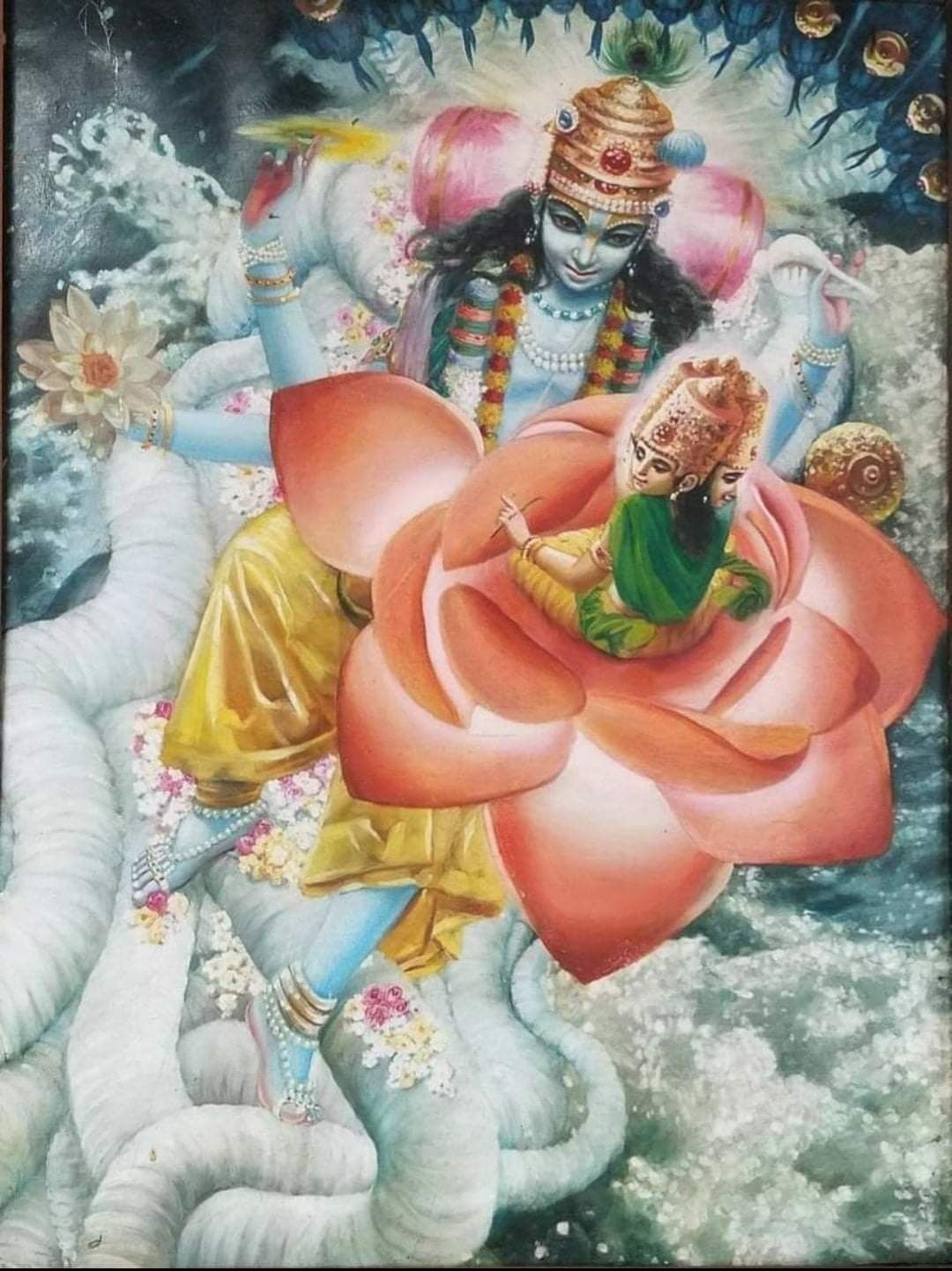
Vaishnava scripture always makes one point clear. Whatever role Brahma plays in building the universe, he is not the one who makes the universe possible. This page explains that difference, and tells how the first living being actually came into existence.
The Lotus From the Navel #
Srimad-Bhagavatam describes an entire universe as resting, at the start of its existence, inside the body of Garbhodakashayi Vishnu. This is the form of the Lord who lies on His side on the Garbhodaka Ocean within each individual universe. There are countless such universes, and each one has its own Garbhodakashayi Vishnu. A single lotus stem grows from His navel, rising up through the water until it opens into a vast lotus flower, radiant with all the material qualities the coming creation will need. Srila Prabhupada's purport to Srimad-Bhagavatam 3.8.15 puts it simply: "Into that universal lotus flower Lord Vishnu personally entered as the Supersoul, and when it was thus impregnated with all the modes of material nature, the personality of Vedic wisdom, whom we call the self-born, was generated." That self-born being, svayambhu, is Brahma. He has no mother or father in the ordinary sense.
| Detail | Description |
|---|---|
| Where | Inside the lotus that grows from the navel of Garbhodakashayi Vishnu |
| When | At the beginning of the present cosmic creation (kalpa) |
| Scriptural source | Srimad-Bhagavatam, Canto 3, Chapter 8 |
| Brahma's own name for this | Svayambhu, "self-born" |
| Theological category | Jiva-tattva (a living being), never vishnu-tattva (God Himself) |
A Post, Not a Person #
This point is easy to get wrong, so it must be stated with great care. Brahma is a living entity, a jiva, just as any soul is a jiva. He is a very exalted jiva, the first of all created beings, but he is in no way the Supreme Personality of Godhead. Srila Prabhupada made the point very strongly in a 1973 lecture in Los Angeles while discussing Srimad-Bhagavatam 1.8.34. He quoted a verse from Chaitanya-charitamrita that calls anyone who looks upon Narayana as equal to Brahma or Lord Shiva an offender, a pashandi. "Brahma, Vishnu, Rudra, Lord Shiva, they are actually sitting on the same platform," Prabhupada explained, "still, Vishnu is the Supreme. Nobody should equalize Brahma and Rudra even. What to speak of others?"
Vaishnava tradition takes this one step further than most readers expect. It understands that Brahma is the name of a post, or office. In different cosmic cycles, different qualified souls are placed in the post of Brahma to carry out the same work of secondary creation. This is much like different officers holding the same government position in different terms. The person changes, but the duty stays the same, and so does the fact that every Brahma serves under Vishnu.
Why "Secondary" Creator #
Brahma brings forth the demigods, the sages, the first humans and the planetary systems. But nothing he does in filling the universe happens independently of the Supreme Lord. Brahma works with the material ingredients and the intelligence Vishnu has already placed within the lotus. He does not bring the universe into existence. He only fills it with life and manages it in detail, inside a plan that has already been given to him. This is why Vaishnava theology consistently calls him the secondary creator. He is a real and active creator, and his work is necessary. Still, he depends entirely on the one Creator behind him.
Brahma is powerful and first-born, yet completely dependent. This is why what happens next in his life is so important. Before he could do any of this creative work, he first had to understand who he was and where his own existence had come from. That search is told in full on Brahma's Quest for Knowledge and the Catur-Shloki Bhagavatam.
Countless Universes, Countless Brahmas #
Gaudiya Vaishnava scripture describes not one universe but unlimited universes. This shows how far this cosmology reaches beyond any single story. Each universe is contained within its own covering, each floats in the Causal Ocean, and each has its own Garbhodakashayi Vishnu lying within it. By this same description, there is not one Brahma but a Brahma for every universe. There are countless self-born, four-headed secondary creators, each carrying out the same appointed work inside his own universe. The Brahma discussed here is the one born within our own universe. His search for knowledge, his disciple, and his composition of the Brahma-samhita all belong to the specific chain of teaching that this tradition traces back to him.
