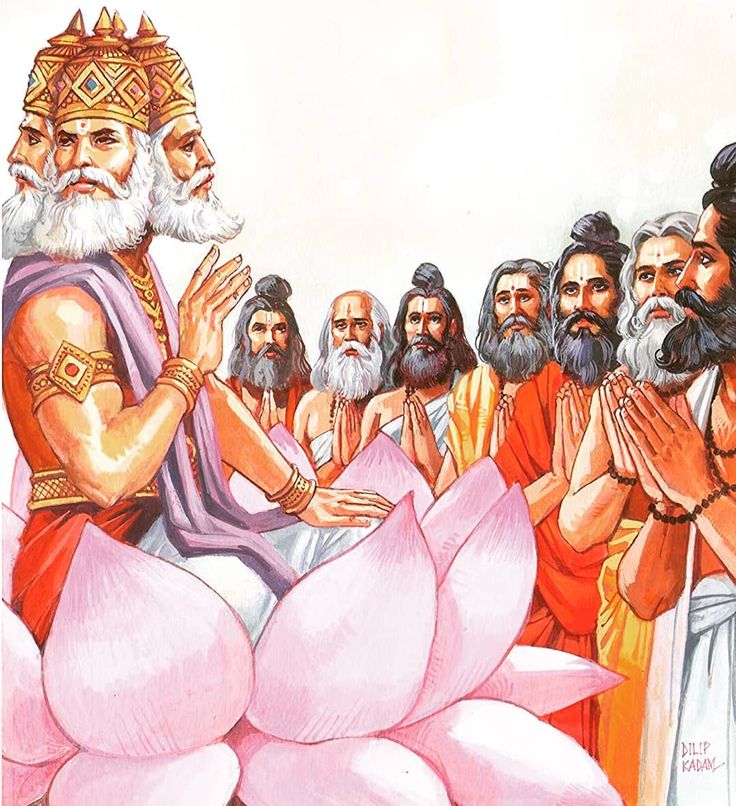
Taken together, the earlier pages show one consistent teaching in Brahma's life. It is repeated in different forms at every stage. Real spiritual authority comes from submission to the Lord. It never comes from position or power, or even from being the first to receive knowledge directly.
Position Is Not Qualification #
Brahma held the most powerful post that any living being can hold in this universe, and by Vaishnava understanding he still holds it. It is the post of secondary creator of everything in it. That position did not free him from having to search, in confusion, for basic knowledge of his own existence. Nor did it save him from a direct and humbling correction by Krishna Himself in Vrindavana. Srila Prabhupada drew exactly this lesson from the pashandi verse of Chaitanya-charitamrita, which is discussed on the page linked above. However high a post someone holds, that post can never take the place of the Supreme Lord's own, unique position. For ordinary devotees, the lesson is simple. Neither worldly achievement nor even advanced spiritual realisation removes the need for humility before Krishna.
Knowledge Must Be Transmitted, Not Just Received #
Brahma is remembered as adi-guru not only because he received the catur-shloki first. It is also because he then taught it to Narada Muni, who taught it to Vyasadeva, and so on down an unbroken chain. This tradition still claims to stand within that chain. Srila Prabhupada treated this point as central to how Krishna consciousness itself works. If knowledge stops with one person, however elevated, it has not yet done its work. The same principle lies behind every guru-disciple relationship in this parampara. It runs from Brahma and Narada at the beginning of the chain to Srila Prabhupada's own disciples at the most recent end of it that we can see.
| Detail | Description |
|---|---|
| Central teaching | Position and knowledge do not exempt anyone from submission to the Lord |
| Practical instruction | Received knowledge must be transmitted onward, disciple to disciple |
| Enduring text | Brahma-samhita, translated into English by Bhaktisiddhanta Sarasvati Thakura in 1932 |
| Best-known verse still recited | Brahma-samhita 5.1: ishvarah paramah krishnah |
| Modern reach | A 1970 recording of its "Govinda" prayer, produced by George Harrison |
A Text Still in Daily Use #
The Brahma-samhita has become an ordinary part of daily Gaudiya Vaishnava life. This is the clearest evidence that Brahma's teaching still works the way it was meant to. Verses from its recovered fifth chapter are sung as part of temple worship in ISKCON centres and other Gaudiya Vaishnava institutions worldwide, including this temple's own. These verses are discussed at length on The Brahma-Samhita and Its Rediscovery. Bhaktisiddhanta Sarasvati Thakura judged the text important enough to give it a first full English translation in 1932, together with Srila Jiva Goswami's commentary. This edition is still standard today. Four decades later, a recording of its central prayer carried Brahma's own words to an entirely new audience. It was produced outside any Vaishnava institution, by former Beatle George Harrison, and sung by a disciple of Srila Prabhupada. It likely reached people who had never heard the name Brahma-samhita before.
Why Brahma Comes First in This Chain #
The acharyas in this history are arranged roughly in the order in which their teaching reaches a Gaudiya Vaishnava disciple today. Brahma is placed at the very beginning of that order on purpose. This is not because he founded Gaudiya Vaishnavism, which he did not. It is because every acharya honoured in this history ultimately traces their own authority back through a single chain. The first link in it that faces the human world is Narada Muni. The very first link of all is Brahma himself. He received knowledge directly from Krishna at a moment when no one else existed to receive it. Everything recorded here about every later acharya's own guru depends, in the end, on one claim examined across these pages. The claim is that the chain truly began here and has never been broken since.
Still Living, By Tradition's Own Account #
One detail sets Brahma apart from every other figure in this history. Vaishnava tradition does not record a disappearance date for him, because it holds that he has not yet disappeared. A single day of Brahma's life is said to equal 4.32 billion years by human counting. He is understood to be living out his appointed hundred-year lifespan even now, still governing the same universe he was born into at its beginning. Every other acharya honoured here lived a limited life that came to an end, and left a legacy behind. Following what the tradition itself says, this account of Brahma has no closing date to give.
