Lord Brahma
Adi-Guru: First Spiritual Master and Secondary Creator of the Universe
The complete life, on one page: The main biography and every pastime page, in order, in one place
Introduction
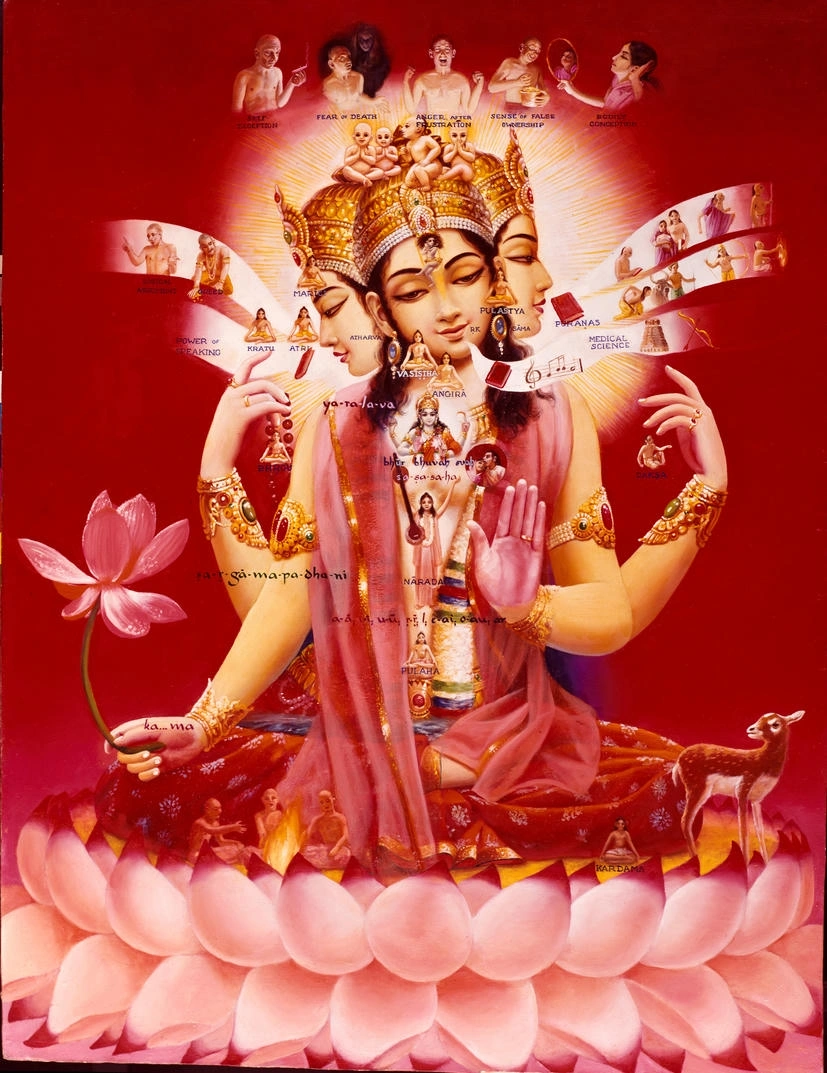
Every acharya in this Vaishnava lineage leads back, in the end, to one starting point. This is a single being who received transcendental knowledge directly from the Supreme Lord at the dawn of creation and then passed it on. That being is Brahma. He is not God Himself, but the first living entity within this universe, entrusted with the work of secondary creation. In this same role, he also became the first spiritual master (adi-guru) of an unbroken chain now called the Brahma-sampradaya. This temple's own tradition, the Gaudiya Vaishnava line of Sri Chaitanya Mahaprabhu, is formally known as the "Brahma-Madhva-Gaudiya sampradaya," and this name has a real meaning. Gaudiya Vaishnavas trace their guru-parampara, generation by generation, back through Madhvacharya to Brahma himself. Srila Prabhupada explained this many times in his lectures and purports.
Brahma is a vast subject in Vedic literature: the four Kumaras, the government of the universe, the counting of cosmic time. This page does not cover those topics. It asks one devotional question: how did Brahma become the first guru, and what exactly did he pass down?
| Detail | Description |
|---|---|
| Also known as | Brahmaji, Svayambhu ("self-born"), Prajapati, Viranchi, Chaturmukha ("four-faced"), Aja, Hiranyagarbha |
| Position | Secondary creator of the universe; a jiva (living being) placed in the highest post of this creation, not the Supreme Lord Himself |
| Origin | Born from a lotus flower that grew from the navel of Garbhodakashayi Vishnu, at the start of the present cosmic creation |
| First teaching received | The catur-shloki, four seed verses of Srimad-Bhagavatam (SB 2.9.32-35), spoken directly by the Lord |
| Disciple | Narada Muni, who in turn taught Vyasadeva |
| Sampradaya | Founder of the Brahma-sampradaya, one of four Vaishnava disciplic lines and the root of the Brahma-Madhva-Gaudiya sampradaya |
| Composed | Sri Brahma-samhita, whose surviving fifth chapter was rediscovered in South India by Sri Chaitanya Mahaprabhu |
At a Glance
- Not God, but the first living being, appointed to the work of universal creation on Krishna's behalf, and honoured as a guru only because he first received and then transmitted real knowledge.
- Woke up alone and confused at the start of time, searched for the source of his own existence, and was instructed by the Lord Himself to perform austerity.
- Received four verses from the Lord that contain, in seed form, the entire philosophy of Srimad-Bhagavatam, then passed that knowledge to his own disciple, Narada Muni.
- Once tried to test Krishna's divinity in Vrindavana by stealing His cowherd friends and calves, and was humbled into composing some of the most quoted prayers in Vaishnava literature.
- His own hymn of surrender, the Brahma-samhita, lay lost for centuries until Sri Chaitanya Mahaprabhu found and copied a portion of it during His South India tour.
Scriptural evidence for the introduction (1)
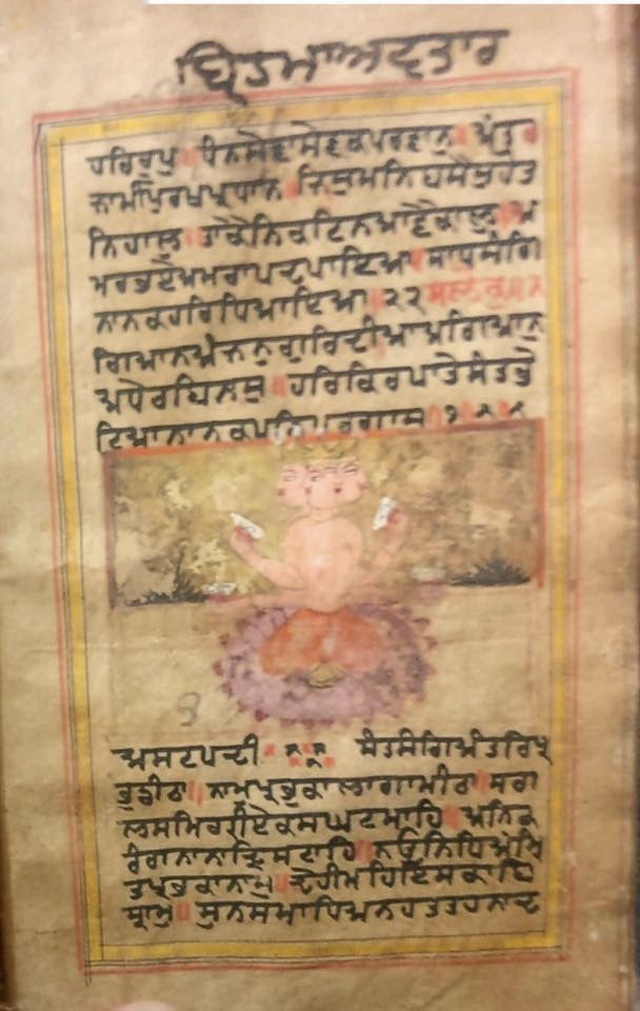
ॐ नमो भगवते वासुदेवाय जन्माद्यस्य यतोऽन्वयादितरतश्चार्थेष्वभिज्ञः स्वराट् तेने ब्रह्म हृदा य आदिकवये मुह्यन्ति यत्सूरयः । तेजोवारिमृदां यथा विनिमयो यत्र त्रिसर्गोऽमृषाधाम्ना स्वेन सदा निरस्तकुहकं सत्यं परं धीमहि ॥ १ ॥
om namo bhagavate vasudevaya
janmady asya yato 'nvayad itaratas carthesv abhijnah svarat
tene brahma hrda ya adi-kavaye muhyanti yat surayah
tejo-vari-mrdam yatha vinimayo yatra tri-sargo 'mrsa
dhamna svena sada nirasta-kuhakam satyam param dhimahi
Word for word
om: O my Lord; namah: offering my obeisances; bhagavate: unto the Personality of Godhead; vasudevaya: unto Vasudeva (Lord Sri Krishna); janma-adi: creation, sustenance and destruction; asya: of the manifested universes; yatah: from whom; abhijnah: fully cognizant; svarat: fully independent; tene: imparted; brahma: Vedic knowledge; hrda: through the heart; ya: who; adi-kavaye: unto the original created being; muhyanti: are illusioned; yat: about whom; surayah: great sages and demigods.
O my Lord, Sri Krishna, son of Vasudeva, O all-pervading Personality of Godhead, I offer my respectful obeisances unto You. I meditate upon Lord Sri Krishna because He is the Absolute Truth and the primeval cause of all causes of the creation, sustenance and destruction of the manifested universes. It is He only who first imparted the Vedic knowledge unto the heart of Brahmaji, the original living being.
From the purport: Purport excerpt: "And Brahma, the original living being, has explained the subject of Sri Krishna substantially in his treatise named Brahma-samhita."
The Bhagavatam's own opening verse: Krishna imparts knowledge directly to Brahma's heart, which is why Brahma is called adi-kavi, the first poet-sage, and why he is given no guru of his own.
Chapter 1
The Secondary Creator of the Universe
Born from a lotus grown out of Vishnu's navel, Brahma is entrusted with populating the universe, but Vaishnava theology insists he is a living being, never God Himself.
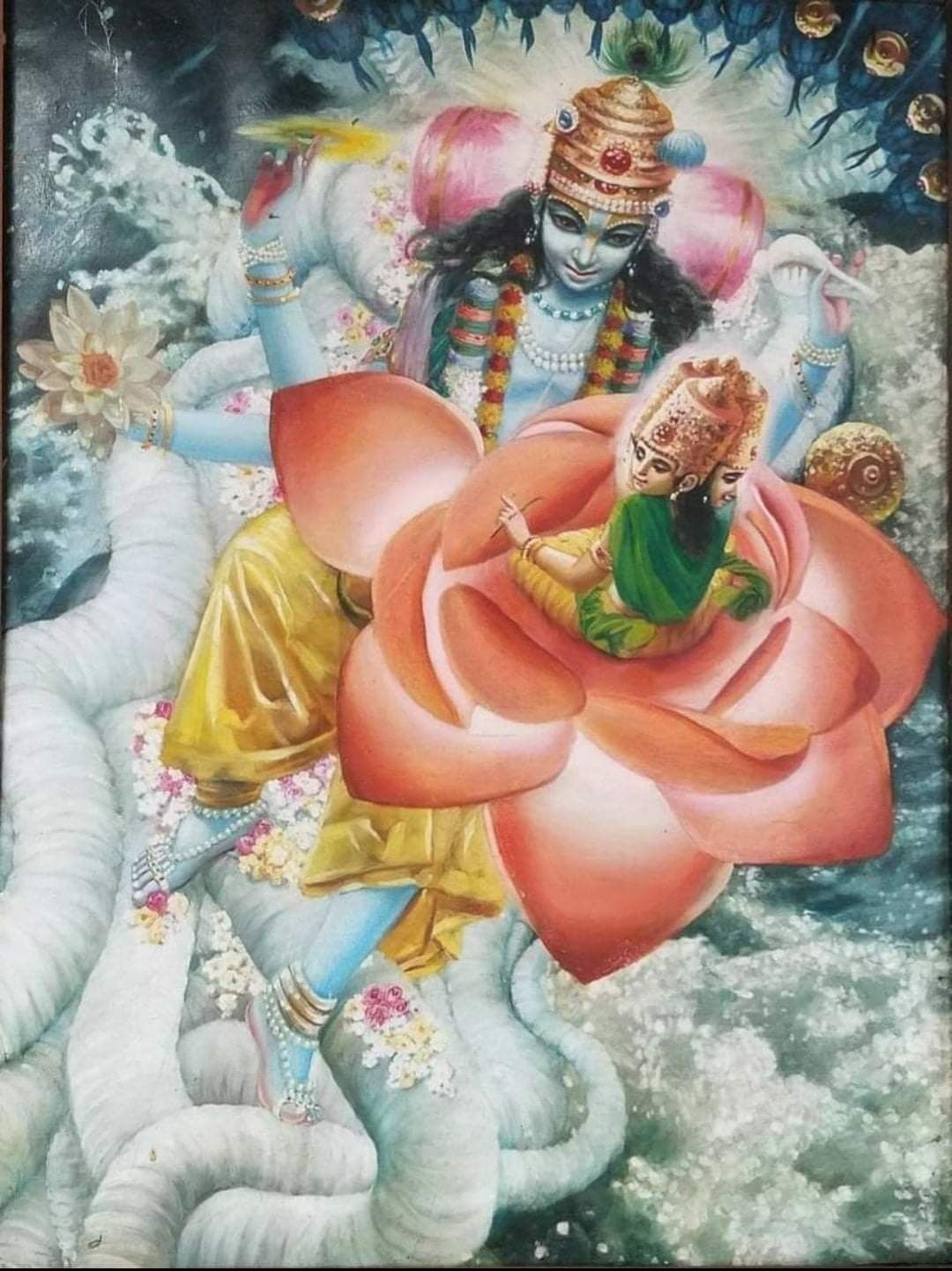
Vaishnava scripture always makes one point clear. Whatever role Brahma plays in building the universe, he is not the one who makes the universe possible. This page explains that difference, and tells how the first living being actually came into existence.
The Lotus From the Navel #
Srimad-Bhagavatam describes an entire universe as resting, at the start of its existence, inside the body of Garbhodakashayi Vishnu. This is the form of the Lord who lies on His side on the Garbhodaka Ocean within each individual universe. There are countless such universes, and each one has its own Garbhodakashayi Vishnu. A single lotus stem grows from His navel, rising up through the water until it opens into a vast lotus flower, radiant with all the material qualities the coming creation will need. Srila Prabhupada's purport to Srimad-Bhagavatam 3.8.15 puts it simply: "Into that universal lotus flower Lord Vishnu personally entered as the Supersoul, and when it was thus impregnated with all the modes of material nature, the personality of Vedic wisdom, whom we call the self-born, was generated." That self-born being, svayambhu, is Brahma. He has no mother or father in the ordinary sense.
| Detail | Description |
|---|---|
| Where | Inside the lotus that grows from the navel of Garbhodakashayi Vishnu |
| When | At the beginning of the present cosmic creation (kalpa) |
| Scriptural source | Srimad-Bhagavatam, Canto 3, Chapter 8 |
| Brahma's own name for this | Svayambhu, "self-born" |
| Theological category | Jiva-tattva (a living being), never vishnu-tattva (God Himself) |
A Post, Not a Person #
This point is easy to get wrong, so it must be stated with great care. Brahma is a living entity, a jiva, just as any soul is a jiva. He is a very exalted jiva, the first of all created beings, but he is in no way the Supreme Personality of Godhead. Srila Prabhupada made the point very strongly in a 1973 lecture in Los Angeles while discussing Srimad-Bhagavatam 1.8.34. He quoted a verse from Chaitanya-charitamrita that calls anyone who looks upon Narayana as equal to Brahma or Lord Shiva an offender, a pashandi. "Brahma, Vishnu, Rudra, Lord Shiva, they are actually sitting on the same platform," Prabhupada explained, "still, Vishnu is the Supreme. Nobody should equalize Brahma and Rudra even. What to speak of others?"
Vaishnava tradition takes this one step further than most readers expect. It understands that Brahma is the name of a post, or office. In different cosmic cycles, different qualified souls are placed in the post of Brahma to carry out the same work of secondary creation. This is much like different officers holding the same government position in different terms. The person changes, but the duty stays the same, and so does the fact that every Brahma serves under Vishnu.
Why "Secondary" Creator #
Brahma brings forth the demigods, the sages, the first humans and the planetary systems. But nothing he does in filling the universe happens independently of the Supreme Lord. Brahma works with the material ingredients and the intelligence Vishnu has already placed within the lotus. He does not bring the universe into existence. He only fills it with life and manages it in detail, inside a plan that has already been given to him. This is why Vaishnava theology consistently calls him the secondary creator. He is a real and active creator, and his work is necessary. Still, he depends entirely on the one Creator behind him.
Brahma is powerful and first-born, yet completely dependent. This is why what happens next in his life is so important. Before he could do any of this creative work, he first had to understand who he was and where his own existence had come from. That search is told in full on Brahma's Quest for Knowledge and the Catur-Shloki Bhagavatam.
Countless Universes, Countless Brahmas #
Gaudiya Vaishnava scripture describes not one universe but unlimited universes. This shows how far this cosmology reaches beyond any single story. Each universe is contained within its own covering, each floats in the Causal Ocean, and each has its own Garbhodakashayi Vishnu lying within it. By this same description, there is not one Brahma but a Brahma for every universe. There are countless self-born, four-headed secondary creators, each carrying out the same appointed work inside his own universe. The Brahma discussed here is the one born within our own universe. His search for knowledge, his disciple, and his composition of the Brahma-samhita all belong to the specific chain of teaching that this tradition traces back to him.
Scriptural evidence for this chapter (2)
Quoted in the text above:
- SB 3.8.15 Srimad-Bhagavatam
Further verses:
yas tu narayanam devam
brahma-rudradi-daivataih
samatvenaiva viksheta
sa pashandi bhaved dhruvam
Word for word
yah tu: any person who; narayanam devam: the Supreme Personality of Godhead, master of demigods like Brahma and Shiva; brahma-rudra-adi-daivataih: with such demigods as Brahma and Shiva; samatvena eva: on an equal level; viksheta: observes; sah: such a person; pashandi bhavet dhruvam: must certainly be an offender, or pashandi.
A person who considers demigods like Brahma and Shiva to be on an equal level with Narayana is to be considered an offender, or pashandi.
The verse Srila Prabhupada quoted in a 1973 Los Angeles lecture to insist that Brahma, however elevated, must never be equated with Vishnu/Krishna Himself.
Chapter 2
Brahma's Quest for Knowledge and the Catur-Shloki Bhagavatam
Alone at the start of time, Brahma searched for the source of a voice within, and received four verses that summarize the entire Bhagavatam.
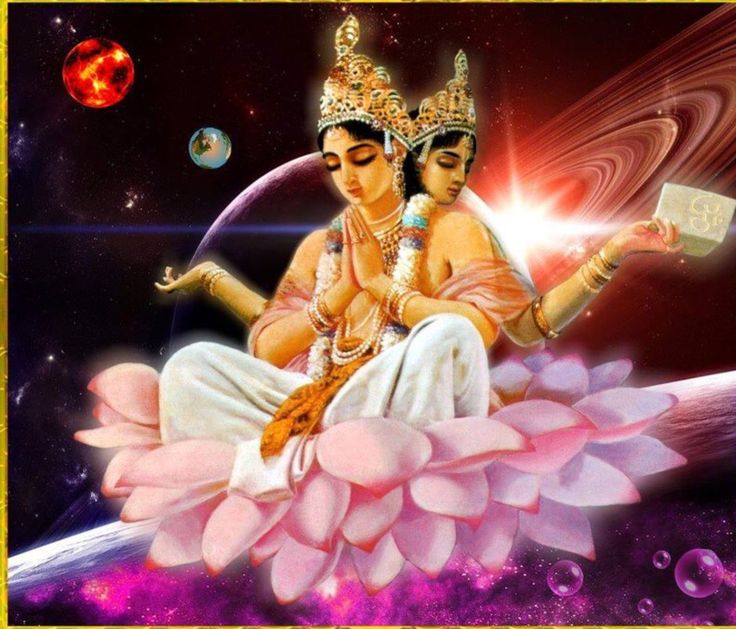
Brahma opened his eyes for the first time and saw nothing he recognised. The lotus that had produced him floated on dark water in every direction, and there was no one anywhere whom he could ask a single question. In Gaudiya Vaishnava understanding, what follows is the very first search for spiritual knowledge in the history of this universe. The answer to that search was the catur-shloki Bhagavatam. It is one of the most important short scriptural passages this tradition has.
Searching in Every Direction #
Srimad-Bhagavatam describes Brahma hearing a sound and trying to find who had spoken it. "When he heard the sound, he tried to find the speaker, searching on all sides," the text records at Srimad-Bhagavatam 2.9.7, "but when he was unable to find anyone besides himself, he thought it wise to sit down on his lotus seat firmly and give his attention to the execution of penance, as he was instructed." Srila Prabhupada's purport adds a detail easy to miss: Brahma "was the only living being at that time because there was no other creation," so the voice could not have come from any external speaker. The Lord Himself, present within Brahma's own heart, had spoken.
At Srimad-Bhagavatam 2.9.6, Brahma actually heard two syllables: "ta" and "pa," joined together into tapa, the root of tapasya, austerity. Srila Prabhupada's purport calls this the wealth of the renounced order of life. It also adds that others can reach the same result: "One who is thus initiated in the disciplic succession is able to achieve the same result or power of creation... Simply by such tapasya, or penance, the devotee of the Lord achieves all perfections like Lord Brahma." In other words, Brahma was initiated. No human guru stood before him, since none existed. The Lord initiated him directly, from within.
| Detail | Description |
|---|---|
| The instruction Brahma received | Two syllables, "ta-pa," meaning tapasya (austerity) |
| Scriptural source | Srimad-Bhagavatam 2.9.6-7 |
| What followed | Extended austerity, then a direct revelation of the Lord |
| The revelation | Four verses (catur-shloki), Srimad-Bhagavatam 2.9.32-35 |
| Their significance | Said to contain, in seed form, the philosophy of the entire 18,000-verse Bhagavatam |
The Four Verses #
After Brahma's austerity, the Lord appeared before him in a personal form and spoke four verses. Since then, Gaudiya Vaishnavas have called them the catur-shloki, "the four verses," and treat them as the seed from which the rest of Srimad-Bhagavatam grew. In the first verse, the Lord tells Brahma that His own eternal form, qualities and activities will become known to Brahma "by causeless mercy" alone, not by any ordinary material education. In the second, He declares that He exists eternally, before creation, during it, and after its destruction: "That which you see now is also I, the Personality of Godhead, and after annihilation what remains will also be I." In the third, He explains that anything which seems to have value apart from a relationship with Him is illusion. This illusion is His own energy, "like the reflection which appears to be in darkness." In the fourth, He describes how He is present both within and beyond every element of creation at the same time, just as the sky is present inside and outside every object.
Srila Prabhupada's purport to the fourth of these verses, Srimad-Bhagavatam 2.9.35, states the result very clearly: "Brahmaji explained the same mystery to Narada, Narada explained it to Vyasa, Vyasa explained it to Sukadeva Gosvami, and that same knowledge is coming down in the unalloyed chain of disciplic succession." This sentence is the reason this entire tradition, at its root, calls itself the Brahma-sampradaya. That claim is examined in full on The First Link in the Parampara.
Taught Directly by Krishna #
This account tells us something important about Brahma's own life. He had no spiritual master in the ordinary sense. Srila Prabhupada explained this directly in a 1973 Los Angeles lecture on the opening verse of Srimad-Bhagavatam. That verse describes Krishna as the one who "imparted Vedic knowledge unto the heart of Brahmaji, the original living being," tene brahma hrida. "Although Brahma was alone, he was getting the knowledge, dictation, from the Supreme," Prabhupada said. "Krishna is helping us from within... Without, He's spiritual master. And within He's Supersoul, chaitya-guru." Every other acharya in this lineage has a named human or deva predecessor. Brahma is different, and this is not an oversight. It simply follows what the scripture itself says happened.
Scriptural evidence for this chapter (2)
sa cintayan dvy-aksharam ekadambhasy
upashrinod dvir-gaditam vaco vibhuh
sparshesu yat shodasham ekavimsham
nishkincananam nrpa yad dhanam viduh
Word for word
sah: he; cintayan: while thinking; dvi-aksharam: of two syllables; ambhasi: in the water; upashrinot: heard nearby; dvih gaditam: uttered twice; vacah: words; sparshesu: among the sparsha letters; nishkincananam: of the renounced order; yat dhanam viduh: which is known as the wealth.
While thus engaged in thinking, in the water, Brahmaji heard twice from nearby two syllables joined together — the wealth of the renounced order of life.
From the purport: Purport excerpt: "Simply by such tapasya, or penance, the devotee of the Lord achieves all perfections like Lord Brahma."
The two syllables are ta-pa, the root of tapasya (austerity), the very first spiritual instruction Brahma received, heard from within rather than from any external teacher.
yathā mahānti bhūtāni
bhūteshu uccāvacesv anu
pravishtāny apravishtāni
tathā teshu na teshv aham
Word for word
yathā: just as; mahānti bhūtāni: the universal elements; bhūteshu ucca-avaceshu: in the minute and gigantic; anu pravishtāni: entered after; apravishtāni: not entered; tathā: so; teshu na teshu aham: I am in them and not in them.
O Brahma, please know that the universal elements enter into the cosmos and at the same time do not enter into it; similarly, I Myself also exist within everything created, and at the same time I am outside of everything.
From the purport: Purport excerpt: "Brahmaji explained the same mystery to Narada, Narada explained it to Vyasa, Vyasa explained it to Sukadeva Gosvami, and that same knowledge is coming down in the unalloyed chain of disciplic succession."
The fourth verse of the catur-shloki, whose purport is the single clearest statement that the Brahma-Narada-Vyasa chain is an unbroken disciplic succession.
Chapter 3
The Humbling of Brahma in Vrindavana
To test whether the cowherd boy Krishna was truly God, Brahma stole His friends and calves. Humbled, he then offered some of the most quoted prayers in Vaishnava scripture.
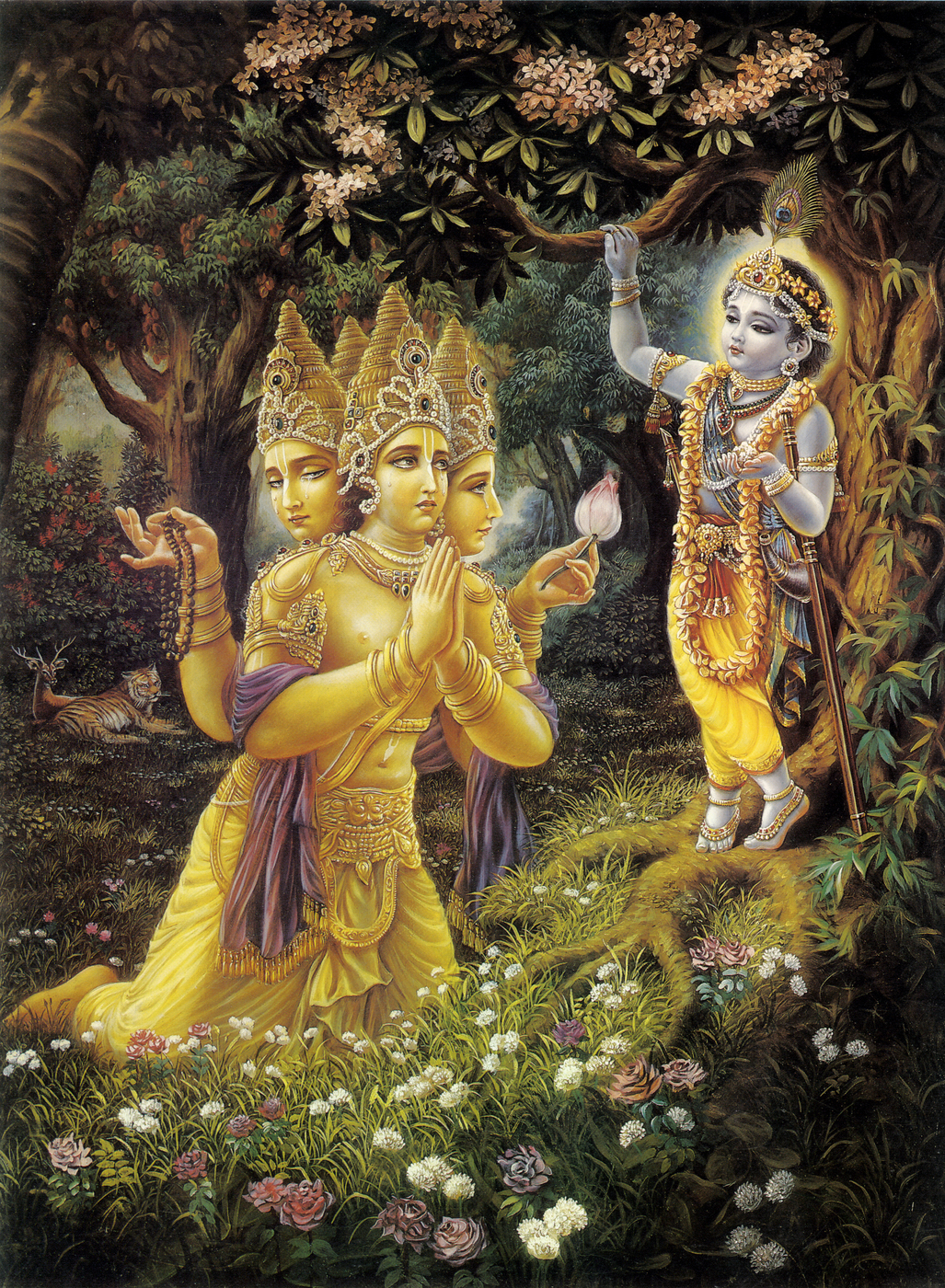
Brahma had received the catur-shloki directly from the Lord, and he stood at the head of the disciplic succession bearing his name. Even so, he still needed to be taught a further lesson. Krishna taught it to him personally, as a small boy in Vrindavana. Gaudiya Vaishnavas call this episode Brahma-vimohana-lila, "the bewilderment of Brahma," and it occupies all of Srimad-Bhagavatam's Canto 10, Chapters 13 and 14.
A Test of the Supreme Lord #
One day, Krishna and His cowherd friends were out grazing their calves in the forest. Brahma wanted to test for himself whether this cowherd boy was truly the Supreme Personality of Godhead he had heard described. So he used his mystic power to steal away every single boy and every calf, and hid them out of sight. Brahma's act looked like an experiment, but it really came from doubt. The very being entrusted with secondary creation was testing the Lord to whom he owed his own existence.
Krishna's Answer #
Krishna's response was not to search, argue, or expose what had happened. He simply expanded Himself into exact replicas of every missing boy and every missing calf. They looked exactly the same in every feature, so no one in Vrindavana could tell the difference. Krishna led them home as though nothing at all were wrong. As the residents of Vrindavana counted time, these Krishna-expansions lived as everyone's own sons and calves for a full year. They did this so completely that the cows and mothers are said to have loved them even more than before. None of them knew that the Supreme Lord Himself stood directly in the place of their own children.
Brahma's own scale of time is vastly different from ours. To him, only a moment seemed to have passed when he returned. He expected to find Vrindavana in an uproar. He found nothing of the kind. This bewildered him even more. He looked again with his own mystic vision, and saw that every one of the boys and calves he thought he had hidden had become a four-armed form of Vishnu, surrounded by demigods offering worship. Only then did Krishna withdraw the illusion. Krishna restored the original boys and calves exactly as they had been. They had been sleeping under Brahma's spell the entire time, and no time had passed for them at all.
| Detail | Description |
|---|---|
| Setting | Vrindavana, during Krishna's childhood pastimes |
| Scriptural source | Srimad-Bhagavatam, Canto 10, Chapters 13-14 |
| What Brahma stole | The cowherd boys and calves grazing with Krishna |
| Krishna's response | Expanded Himself into identical replicas of each one |
| Outcome | Brahma's test failed completely; he fell at Krishna's feet in prayer |
Brahma's Prayers #
Brahma understood that he had been thoroughly defeated in the very test he himself had planned. He fell at Krishna's feet and offered a long series of prayers, recorded in Srimad-Bhagavatam 10.14. Vaishnava commentators consider these prayers among the deepest passages in the entire text. At their heart is a confession. Brahma is the first-born, the adi-guru, and the direct recipient of the catur-shloki. Yet he confesses that even a soul as elevated as he is cannot understand the Supreme Lord's glories by any effort of his own. He can know the Lord at all only by receiving a trace of His causeless mercy. "If one is favored by even a slight trace of the mercy of Your lotus feet," Brahma says at Srimad-Bhagavatam 10.14.29, "he can understand the greatness of Your personality. But those who speculate... are unable to know You, even though they continue to study the Vedas for many years." At verse 10.14.8 he goes further still. He describes the devotee who simply endures the reactions of his own past deeds while offering obeisances with heart, words, and body. Such a devotee is like someone who has earned an inheritance he did not have to demand.
Why This Episode Matters #
The main lesson of this pastime lies in a contrast. Brahma received Krishna's own summary of Vedic philosophy at the dawn of creation, and he is honoured throughout this parampara as its first teacher. Yet this same pastime shows that he was limited, that he could doubt, and that he needed correction directly from the Lord, in His most intimate, human-like form. Gaudiya Vaishnava theology takes this as evidence that the personal, playful Krishna of Vrindavana is the fullest revelation of Godhead that any soul can receive. It is fuller even than Brahma's own earlier vision of the Lord's majesty in Vaikuntha. Brahma's own hymn of praise to Krishna, the Brahma-samhita, is traditionally said to have been spoken at the dawn of creation, before any of the events described here. It is the subject of The Brahma-Samhita and Its Rediscovery.
Scriptural evidence for this chapter (2)
अथापि ते देव पदाम्बुजद्वय-
प्रसादलेशानुगृहीत एव हि ।
जानाति तत्त्वं भगवन् महिम्नो
न चान्य एकोॲपि चिरं विचिन्वन् ॥
athāpi te deva padāmbuja-dvaya-
prasāda-leshānugrhīta eva hi
jānāti tattvam bhagavan-mahimno
na cānya eko 'pi ciram vicinvan
Word for word
atha api: therefore, indeed; te deva: Your, my Lord; pada-ambuja-dvaya: of the two lotus feet; prasāda-lesha: by only a trace of the mercy; anugrhītah eva hi: certainly favored; jānāti tattvam: one knows the truth; bhagavat-mahimnah: of the greatness of the Personality of Godhead; na ca anyah: and not another; ekah api ciram vicinvan: even one who speculates for a long time.
My Lord, if one is favored by even a slight trace of the mercy of Your lotus feet, he can understand the greatness of Your personality. But those who speculate to understand the Supreme Personality of Godhead are unable to know You, even though they continue to study the Vedas for many years.
Brahma's own confession, after being humbled in Vrindavana, that even he cannot fathom Krishna's glories except by the Lord's causeless mercy.
tat te 'nukampam su-samikshamano
bhunjana evatma-kritam vipakam
hrd-vag-vapurbhir vidadhan namas te
jiveta yo mukti-pade sa daya-bhak
Word for word
tat te anukampam: Your compassion; su-samikshamanah: earnestly hoping for; bhunjanah eva atma-kritam vipakam: while enduring the reactions of his own past deeds; hrt-vak-vapurbhih: with heart, words and body; vidadhan namah te: offering obeisances to You; jiveta: lives; yah mukti-pade sa daya-bhak: he is the rightful heir to liberation.
My dear Lord, one who earnestly waits for You to bestow Your causeless mercy upon him, all the while patiently suffering the reactions of his past misdeeds and offering You respectful obeisances with his heart, words and body, is surely eligible for liberation, for it has become his rightful claim.
Part of Brahma's extended prayers of surrender after being defeated in his own test of Krishna's divinity in Vrindavana.
Chapter 4
The Brahma-Samhita and Its Rediscovery
Brahma's own hymn of surrender to Krishna lay lost for centuries until Sri Chaitanya Mahaprabhu found and copied it on the southern tip of India.
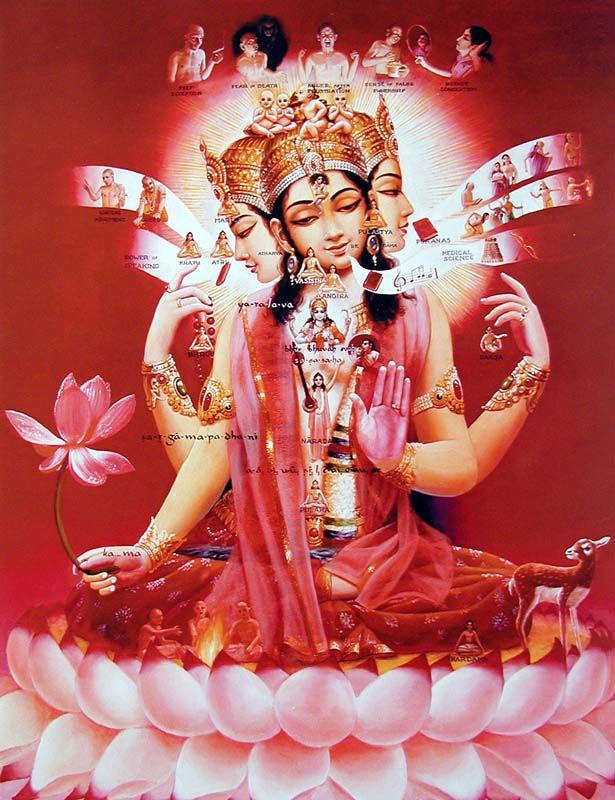
Of everything traditionally attributed to Brahma, nothing is quoted by Gaudiya Vaishnavas more often than a short Sanskrit text called the Brahma-samhita. Almost the only reason anyone can quote it today is that Sri Chaitanya Mahaprabhu discovered a single manuscript of it on the southern coast of India.
A Hymn Spoken at the Dawn of Creation #
The Brahma-samhita is traditionally described as a hymn of prayer that Brahma himself spoke to glorify Krishna. Later tradition says it once had as many as one hundred chapters. Only the fifth chapter, with sixty-two verses, is known to survive. Its opening line is the verse most closely linked with the whole text. It is translated simply: "Krishna who is known as Govinda is the Supreme Godhead. He has an eternal, blissful, spiritual body. He is the origin of all. He has no other origin, and He is the prime cause of all causes." The verse comes from Brahma, the being entrusted with secondary creation. In a lesser theology, he might have claimed the highest position for himself. Instead, the verse is a deliberate act of humility. It names Krishna, not Brahma or even Vishnu's other forms, as the cause of all causes.
| Detail | Description |
|---|---|
| Attributed author | Brahma, at the dawn of creation |
| Surviving portion | Chapter five, sixty-two verses (of a text tradition says once ran far longer) |
| Most quoted verse | Chapter 5, verse 1: ishvarah paramah krishnah |
| Rediscovered by | Sri Chaitanya Mahaprabhu, during His South India tour, c. 1510 CE |
| First English translation | Bhaktisiddhanta Sarasvati Thakura, 1932, with Jiva Goswami's commentary |
Found on the Far Southern Coast #
For centuries the text existed, at most, as scattered fragments and a title devotees had heard of but could not read. That changed during Sri Chaitanya Mahaprabhu's South India tour, when He came to the temple of Adi-keshava on the banks of the Payasvini river. Later tradition and modern scholarship both identify this site with the Adi Keshava Perumal Temple at Thiruvattar, near Kanyakumari, at the very southern tip of India. There, among a gathering of advanced devotees discussing spiritual subjects, Mahaprabhu found a manuscript chapter of the Brahma-samhita. By then the text was practically lost. In Chaitanya-charitamrita, Krishnadasa Kaviraja Goswami recorded his own judgement of what was found, and he praises it without any reservation. He calls it essential among all Vaishnava literatures, with no scripture equal to it on the final philosophical conclusion. His judgement is examined further on Sri Chaitanya Mahaprabhu's South India Tour. Mahaprabhu had the chapter copied by hand and carried it back with Him to Odisha. The tour's biographer calls two manuscripts the two jewels He brought home. This chapter was one of them, and the other was Bilvamangala Thakura's Krishna-karnamrita.
From Manuscript to Modern Kirtana #
For nearly four centuries after that, the text remained known mainly within Gaudiya circles who had access to hand-copied manuscripts. Bhaktisiddhanta Sarasvati Thakura changed that in 1932. He published the first English translation of the surviving fifth chapter together with Srila Jiva Goswami's Sanskrit commentary. This work is still in print and is still the standard English edition today. Its verses are now sung as part of daily temple worship across the Gaudiya Vaishnava world. They reached an unexpected wider audience in 1970, when George Harrison produced a modern recording of the prayer titled "Govinda," sung by a disciple of Srila Prabhupada. Its title comes from the same chorus line, "govindam adi-purusham tam aham bhajami," that closes so many of the text's individual verses.
An Honest Note on Dating #
There is one real difficulty here, and it should be stated plainly and honestly, not talked away. Gaudiya Vaishnava tradition holds that Brahma spoke these verses at the very beginning of the universe. It also holds that Sri Chaitanya Mahaprabhu did not help to compose this text. He only rediscovered a text that was already many ages old. But some modern academic study of Pancharatra literature is in real conflict with that traditional dating. Mitsunori Matsubara's study of this kind of literature places the writing of the surviving text at around 1600 CE. That is closer to the century after Mahaprabhu's own discovery than to the dawn of creation. We report this gap here without trying to resolve it. A scholar works from the evidence of manuscripts and the history of literature. A devotional tradition works from an unbroken chain of received teaching. They are simply asking different questions and reaching different answers. This page does not try to judge between them.
Chapter 5
The First Link in the Parampara
How 'Brahma taught Narada, who taught Vyasa' became the founding claim of an entire disciplic line, down to Sri Chaitanya Mahaprabhu and this tradition today.
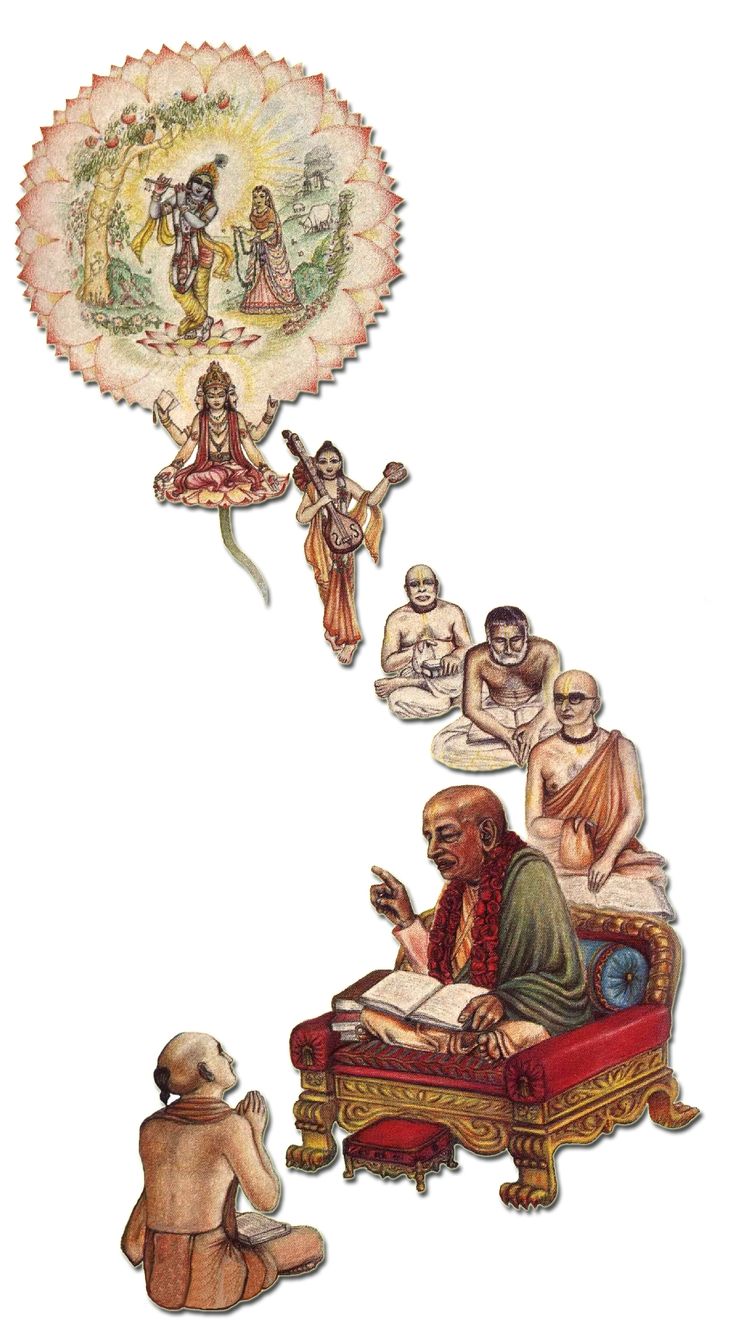
The very first verse of Srimad-Bhagavatam describes Krishna as the one who "imparted Vedic knowledge unto the heart of Brahmaji, the original living being," tene brahma hrida ya adi-kavaye. That single phrase, adi-kavaye, "unto the first poet," is why Brahma carries the title adi-guru, and why an entire disciplic succession bears his name. This page sets out that succession link by link. It also speaks honestly about the parts of it that scholars still debate.
Knowledge Without a Human Teacher #
Every other acharya in this lineage has a named guru, someone they met in person who initiated them. Brahma does not. Srila Prabhupada explained exactly why in a 1973 Los Angeles lecture on this same opening verse of Srimad-Bhagavatam: "Original guru is Krishna, as Krishna is teaching Arjuna. Similarly, He also taught Brahma... Although Brahma was alone, he was getting the knowledge, dictation, from the Supreme." The knowledge came to Brahma directly, heart to heart, with no one in between. For this reason, Vaishnava tradition does not name anyone before Brahma in the line, as it does for every acharya who came after him. He is the first link because there was nothing before him to link to.
Brahma Teaches Narada #
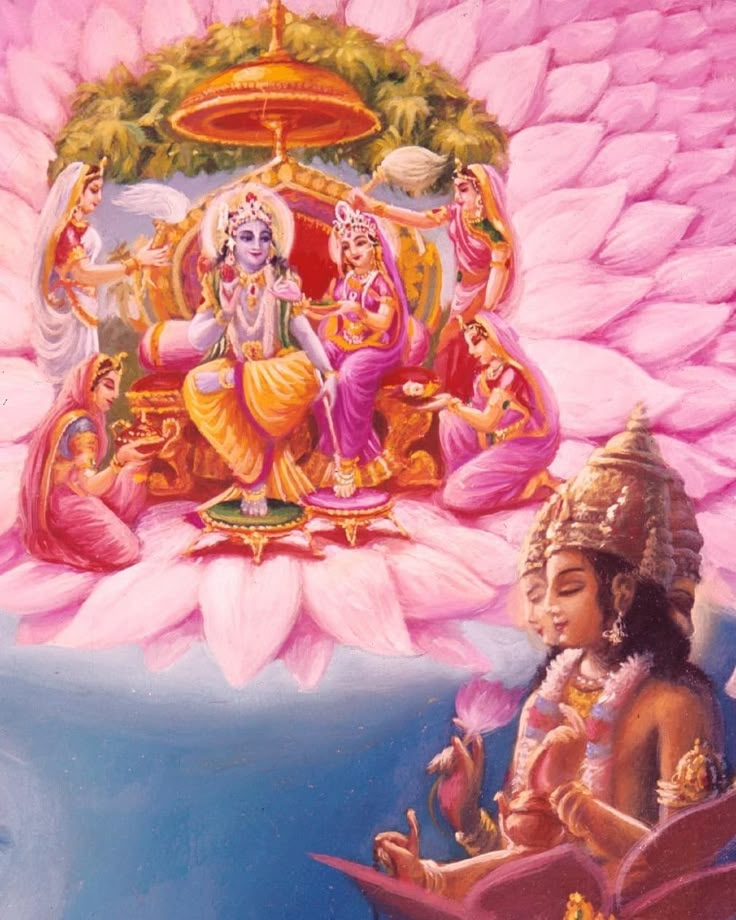
Brahma passed on what he received to his own disciple, Narada Muni. In Puranic literature, Narada is also Brahma's own mind-born son. Srila Prabhupada explained the sequence very directly in a 1969 lecture at New Vrindaban: "Our this sampradaya, the Gaudiya-sampradaya, is also in the same line: Narada, Vyasadeva. Narada is the disciple of Brahma. It is, therefore, called... this party is called Brahma-sampradaya. Brahma-madhva-gaudiya-brahma-sampradaya. Originally from Brahma. Brahma instructed Narada. You'll find in this Bhagavata, Brahma is instructing Nārada." Narada, in turn, instructed Vyasadeva, the sage who compiled the Vedic literature. On Narada's own specific instruction, Vyasadeva then composed Srimad-Bhagavatam itself as the mature summary of his life's work.
Four Sampradayas, One Named for Brahma #
Gaudiya Vaishnava tradition holds that four authorised disciplic lines were destined to appear for the age of Kali. Srila Prabhupada named all four in a 1972 Bombay lecture on the opening verses of Srimad-Bhagavatam: "There are four Vaishnava sampradayas: one is called Brahma-sampradaya, the other is called Rudra-sampradaya, the other is called Sri-sampradaya, and Nimbarka-sampradaya, or Kumara-sampradaya. So we belong to the Brahma-sampradaya." From Vyasadeva, tradition carries this specific line forward across many centuries to Madhvacharya, the thirteenth-century founder of Dvaita Vedanta. The acharya page for Madhvacharya explains in full how he is connected to this chain. It also explains the real philosophical differences between his teaching and Sri Chaitanya Mahaprabhu's, especially on Dvaita Vedanta and Achintya-Bhedabheda.
| Detail | Description |
|---|---|
| Root verse | Srimad-Bhagavatam 1.1.1: Krishna imparts knowledge to Brahma's heart |
| Brahma's title | Adi-guru, adi-kavi ("the first poet/sage") |
| Immediate disciple | Narada Muni |
| Sampradaya named for him | Brahma-sampradaya, one of four authorised Vaishnava lines |
| Full name of this tradition | Brahma-Madhva-Gaudiya sampradaya |
Down to This Tradition #
From Madhvacharya, the same 1969 lecture continues the chain without a break: "Madhva Muni, by disciplic succession, Madhavendra Puri. Now, Madhavendra Puri instructed Ishvara Puri. Ishvara Puri instructed Lord Chaitanya. Lord Chaitanya instructed the six Gosvamis. The six Gosvamis instructed Krishnadasa Kaviraja. Krishnadasa instructed Narottama dasa Thakura. Narottama dasa Thakura, Vishvanatha Chakravarti. Vishvanatha Chakravarti, Jagannatha dasa Babaji. In this way, there is a clear line of disciplic succession." Every name in that lineage is himself an acharya in this same tradition: Madhavendra Puri, Ishvara Puri, Sri Chaitanya Mahaprabhu, Krishnadasa Kaviraja Goswami, Narottama Dasa Thakura, Vishvanatha Chakravarti Thakura and Jagannatha Dasa Babaji. From Jagannatha Dasa Babaji the same living line continues through Bhaktivinoda Thakura, Bhaktisiddhanta Sarasvati Thakura and Srila Prabhupada himself, the very teacher who explained all of this in the lectures quoted above.
What Scholarship Still Questions #
Honesty requires us to report one real difficulty instead of smoothing it over. Madhvacharya's own biography already speaks about it openly. Modern historians have studied the surviving records of the Madhva sampradaya. They have raised a real question that is still not settled: do those records confirm every specific link in the chain Gaudiya Vaishnavas describe between Madhvacharya and Madhavendra Puri? Gaudiya Vaishnavas have sincerely held this understanding of their own line for centuries. It is not a modern invention. Still, scholars outside the tradition have questioned it too, and we do not hide that here. But one part of the chain is not in question at all. The Lord spoke directly into the heart of the first living being, Brahma. From him the chain runs forward through Narada and Vyasadeva into the Gaudiya Vaishnava tradition that continues to this day.
Chapter 6
Teachings and Legacy
In one lifetime Brahma was humbled by Krishna and honoured as the first guru of this disciplic line. Why does he still shape how this tradition understands spiritual authority?
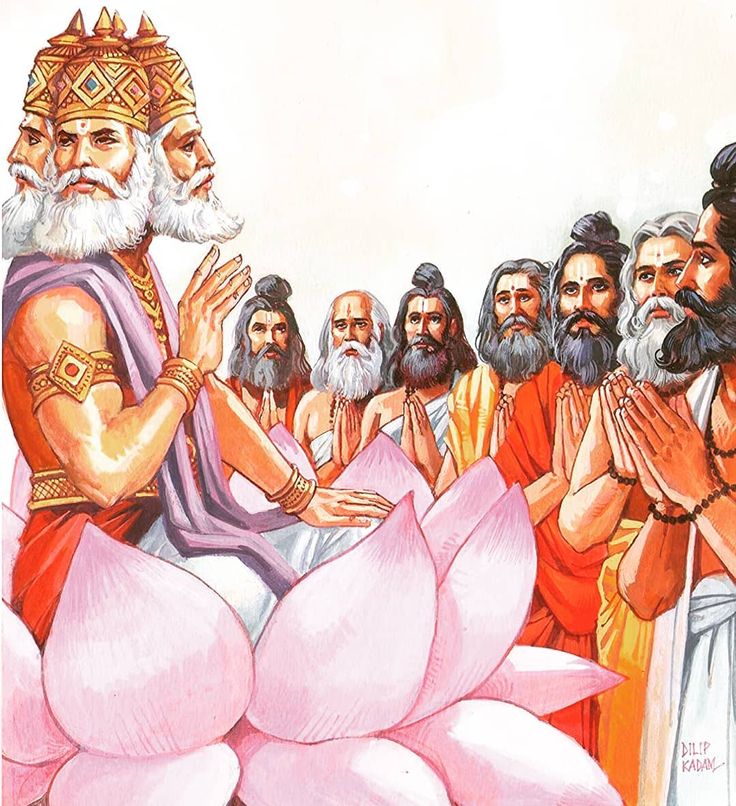
Taken together, the earlier pages show one consistent teaching in Brahma's life. It is repeated in different forms at every stage. Real spiritual authority comes from submission to the Lord. It never comes from position or power, or even from being the first to receive knowledge directly.
Position Is Not Qualification #
Brahma held the most powerful post that any living being can hold in this universe, and by Vaishnava understanding he still holds it. It is the post of secondary creator of everything in it. That position did not free him from having to search, in confusion, for basic knowledge of his own existence. Nor did it save him from a direct and humbling correction by Krishna Himself in Vrindavana. Srila Prabhupada drew exactly this lesson from the pashandi verse of Chaitanya-charitamrita, which is discussed on the page linked above. However high a post someone holds, that post can never take the place of the Supreme Lord's own, unique position. For ordinary devotees, the lesson is simple. Neither worldly achievement nor even advanced spiritual realisation removes the need for humility before Krishna.
Knowledge Must Be Transmitted, Not Just Received #
Brahma is remembered as adi-guru not only because he received the catur-shloki first. It is also because he then taught it to Narada Muni, who taught it to Vyasadeva, and so on down an unbroken chain. This tradition still claims to stand within that chain. Srila Prabhupada treated this point as central to how Krishna consciousness itself works. If knowledge stops with one person, however elevated, it has not yet done its work. The same principle lies behind every guru-disciple relationship in this parampara. It runs from Brahma and Narada at the beginning of the chain to Srila Prabhupada's own disciples at the most recent end of it that we can see.
| Detail | Description |
|---|---|
| Central teaching | Position and knowledge do not exempt anyone from submission to the Lord |
| Practical instruction | Received knowledge must be transmitted onward, disciple to disciple |
| Enduring text | Brahma-samhita, translated into English by Bhaktisiddhanta Sarasvati Thakura in 1932 |
| Best-known verse still recited | Brahma-samhita 5.1: ishvarah paramah krishnah |
| Modern reach | A 1970 recording of its "Govinda" prayer, produced by George Harrison |
A Text Still in Daily Use #
The Brahma-samhita has become an ordinary part of daily Gaudiya Vaishnava life. This is the clearest evidence that Brahma's teaching still works the way it was meant to. Verses from its recovered fifth chapter are sung as part of temple worship in ISKCON centres and other Gaudiya Vaishnava institutions worldwide, including this temple's own. These verses are discussed at length on The Brahma-Samhita and Its Rediscovery. Bhaktisiddhanta Sarasvati Thakura judged the text important enough to give it a first full English translation in 1932, together with Srila Jiva Goswami's commentary. This edition is still standard today. Four decades later, a recording of its central prayer carried Brahma's own words to an entirely new audience. It was produced outside any Vaishnava institution, by former Beatle George Harrison, and sung by a disciple of Srila Prabhupada. It likely reached people who had never heard the name Brahma-samhita before.
Why Brahma Comes First in This Chain #
The acharyas in this history are arranged roughly in the order in which their teaching reaches a Gaudiya Vaishnava disciple today. Brahma is placed at the very beginning of that order on purpose. This is not because he founded Gaudiya Vaishnavism, which he did not. It is because every acharya honoured in this history ultimately traces their own authority back through a single chain. The first link in it that faces the human world is Narada Muni. The very first link of all is Brahma himself. He received knowledge directly from Krishna at a moment when no one else existed to receive it. Everything recorded here about every later acharya's own guru depends, in the end, on one claim examined across these pages. The claim is that the chain truly began here and has never been broken since.
Still Living, By Tradition's Own Account #
One detail sets Brahma apart from every other figure in this history. Vaishnava tradition does not record a disappearance date for him, because it holds that he has not yet disappeared. A single day of Brahma's life is said to equal 4.32 billion years by human counting. He is understood to be living out his appointed hundred-year lifespan even now, still governing the same universe he was born into at its beginning. Every other acharya honoured here lived a limited life that came to an end, and left a legacy behind. Following what the tradition itself says, this account of Brahma has no closing date to give.
- Srimad-Bhagavatam 2.9.6-36 (catur-shloki and Brahma's austerity), vedabase.io
- Srimad-Bhagavatam 3.8.15-20 (Brahma's birth from the lotus), vedabase.io
- Srimad-Bhagavatam 1.1.1 (tene brahma hrida), vedabase.io
- Srimad-Bhagavatam 10.13-14 (Brahma-vimohana-lila), vedabase.io
- Brahma-samhita 5.1, vedabase.io
- Srila Prabhupada lecture, Srimad-Bhagavatam 1.5.12-13, New Vrindaban, 11 June 1969
- Srila Prabhupada lecture, Srimad-Bhagavatam 1.1.1-2, Bombay, 22 March 1972
- Srila Prabhupada lecture, Srimad-Bhagavatam 1.8.34, Los Angeles, 26 April 1973
- This website's own biography of Madhvacharya
- This website's own account of Sri Chaitanya Mahaprabhu's South India Tour
