Madhvācārya did not remain in one place as a philosopher. Devotional biographies describe him travelling across India on foot more than once. He visited Badrinātha, Vārāṇasī, Purī, and Bengal in the east; Dvārakā and Goa in the west; and Kanyakumārī in the south. At many major centres of learning, he debated scholars who followed other philosophical schools. During these travels, on the coast near his birthplace, an event took place that gave Dvaita Vedānta a permanent home: the discovery of the Kṛṣṇa Deity now worshiped at Uḍupī.
| Detail | Description |
|---|---|
| Deity installed | Krishna, discovered inside a lump of gopi-chandana clay |
| Year (traditional) | 1285 CE |
| Location | Udupi, South Kanara, Karnataka |
| Monasteries founded | Eight (Ashta Matha): Palimaru, Adamaru, Krishnapura, Puttige, Shirur, Sode, Kaniyooru, Pejavara |
| Rotation system | Paryaya: introduced later, in 1522 CE, by Vadiraja Tirtha of Sode Matha |
| Rival tradition engaged | Shankaracharya's Advaita, chiefly through the Shringeri Matha |
A Boat and a Hidden Deity #
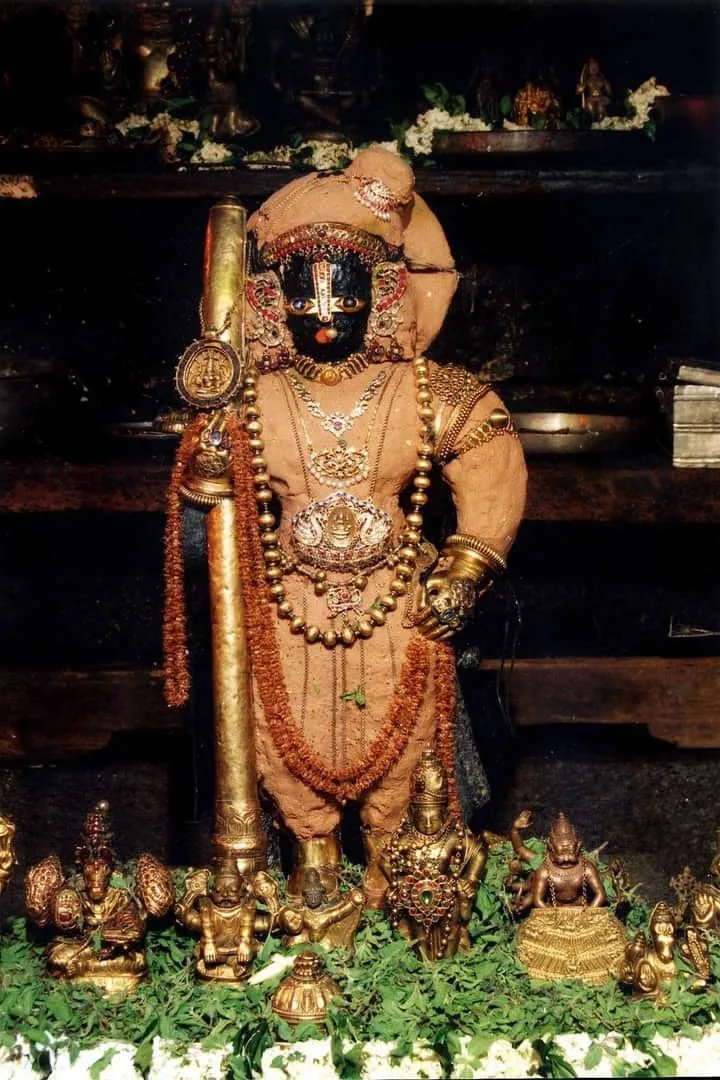
Srila Prabhupada's own purport to Chaitanya-charitamrita, Madhya 9.245, preserves the traditional account of how the Udupi Deity was found. Madhvacharya was sitting beside the sea near Udupi, absorbed in meditation on Krishna. He noticed that a large boat carrying goods toward Dvaraka was in danger of being wrecked. By signalling from the shore, he showed its crew how to bring it safely in. The grateful merchants offered him a reward, and Madhvacharya asked only for a large lump of gopi-chandana, the sacred clay Vaishnavas use to mark tilaka. As the lump was carried to him, it broke open. Inside was a large Deity of Krishna, holding a stick in one hand and a lump of food in the other. Tradition says the Deity was so heavy that no group of thirty men together could lift it. Yet Madhvacharya carried it to Udupi by himself. There he installed the Deity. Srila Prabhupada's purport notes that worship according to the pattern Madhvacharya set "is still going on at Udupi" to this day. The traditional date given for this event is 1285 CE.
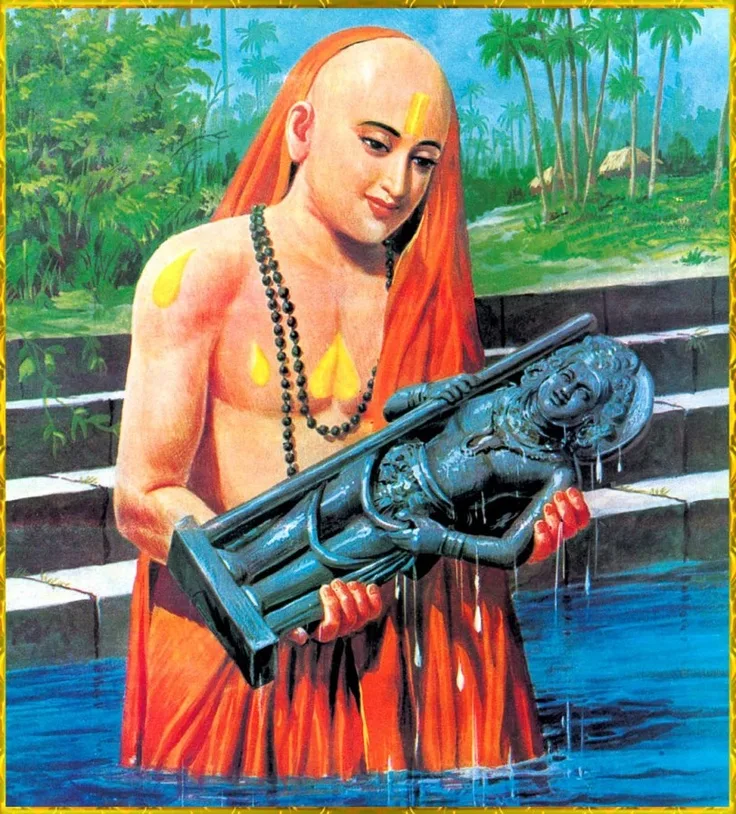
This story, like much of Madhvacharya's biography, is devotional tradition, not an event that can be checked by independent evidence. But the Deity itself and the temple built around it are real. They have been worshiped continuously and can be visited today. So this particular tradition stands on somewhat firmer ground than the childhood miracle-stories told on Life and Early Years.
Eight Disciples, Eight Mathas #
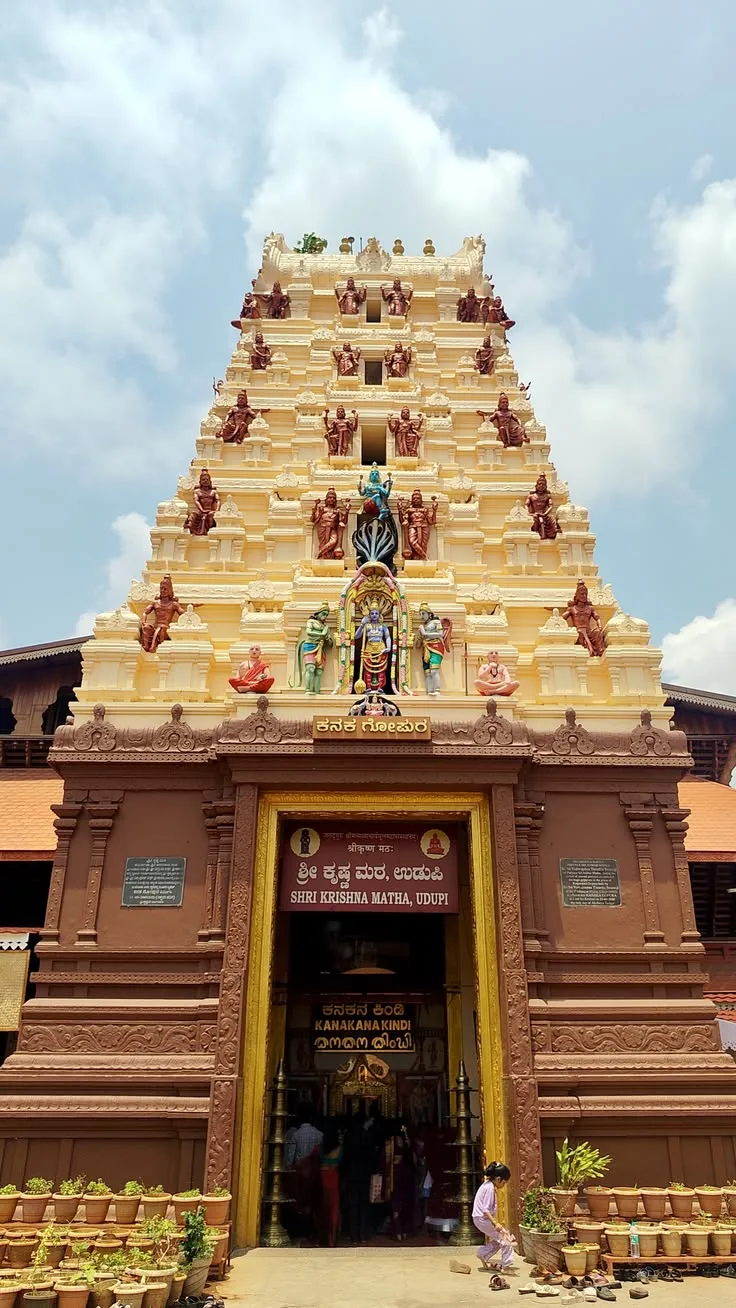
To organise the ongoing worship of the Udupi Krishna Deity, Madhvacharya appointed eight of his own sannyasa disciples as the founding heads of eight monasteries built around the temple. These are the Ashta Matha: Palimaru, Adamaru, Krishnapura, Puttige, Shirur, Sode, Kaniyooru and Pejavara. Each matha has continued as an independent institution down to the present day, headed by its own line of sannyasi successors. The eight mathas take turns conducting the Deity's worship under a formal system called Paryaya. In this system the head of each matha serves a two-year term and then hands the responsibility to the next. Paryaya was not part of Madhvacharya's own original arrangement. Vadiraja Tirtha, head of the Sode Matha, introduced it in 1522 CE, more than two centuries after Madhvacharya's disappearance. He did this so that each swamiji would have time both to serve the Deity and to travel and teach Tattvavada elsewhere in India. The Paryaya festival and the wider life of the Udupi tradition today are described further on Legacy in the Four Sampradayas.
Debates Across India #
Madhvacharya's travels were not sightseeing. Devotional biography says that on his journeys he debated some twenty-one different scholars and schools, and tradition says he defeated them. They included Jain logicians, Buddhist philosophers, and above all followers of Adi Shankaracharya's Advaita Vedanta. The most notable of these encounters, again as recorded in Srila Prabhupada's purport, was with Vidyashankara, the head of the Shringeri Matha founded by Shankaracharya himself. In discussion, tradition says, "Vidyashankara was actually diminished in the presence of Madhvacharya." As his reputation grew, the purport continues, the Shringeri establishment grew uneasy, and a Mayavadi scholar named Pundarika Puri was sent to challenge him directly. In the dispute that followed, Madhvacharya's opponents reportedly seized his manuscripts. They were recovered only later, with the help of a local king, Jayasimha of Kumla. After that, Pundarika Puri was defeated in open debate.
Two of the disciples Madhvacharya gained on his travels left their own mark on Dvaita literature. Trivikramacharya of Vishnumangala became his disciple and composed the Vayu Stuti in his honour. This is the very work that Madhvacharya's own Narasimha Nakha Stuti was written to introduce, as told on Founding Dvaita Vedanta. Trivikramacharya's son, Narayanacharya, later wrote the Sumadhva-vijaya (also called Madhva-vijaya). It is the main devotional biography of Madhvacharya. Most of what is known, or claimed, about his life comes originally from this book.
Other Travels #
Devotional accounts tell more stories about these journeys. Like the childhood stories, they should be read as devotional biography. They say that Madhvacharya once helped a local king dig a public lake in Maharashtra, simply because he happened to be passing through with his disciples. They also say that he came to a region called Ganga-pradesha, where conflict between Sanatana Dharma communities and Muslim forces had made river crossings dangerous. He crossed anyway and was brought before the ruling Muslim king. The king was so impressed that he offered Madhvacharya a kingdom and wealth, but Madhvacharya declined both. Another story says that he was once attacked by dacoits and by a tiger, and overcame both by his own bodily strength. Whether or not these stories are historical, they all give the same picture of Madhvacharya within the Madhva-sampradaya tradition. He appears as a renunciate of great physical and intellectual strength. Danger, wealth and rival scholarship could not turn him from his aim. With single-minded effort he built an institution meant to outlast him. At Udupi, it clearly has outlasted him.
