Srila Madhvacharya
Biography, Dvaita Vedanta & Teachings
The complete life, on one page: The main biography and every pastime page, in order, in one place
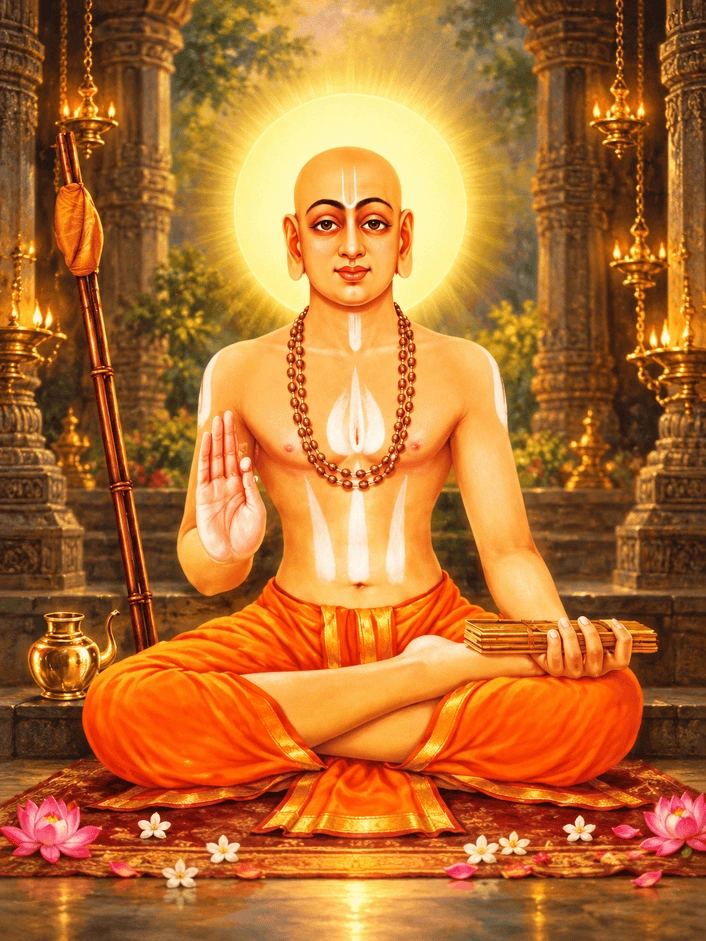
Introduction
Long before Śrī Caitanya Mahāprabhu, before Bilvamaṅgala Ṭhākura , Jayadeva Gosvāmī, and even before Mādhavendra Purī, whom the Gauḍīya tradition calls the "seed of the bhakti creeper," there was Madhvācārya. He was born in the thirteenth century on the southwestern coast of India, about three hundred years before Mahāprabhu appeared in Bengal. He established, largely through his own efforts, one of the four schools of Vedānta philosophy that Sanātana Dharma honours to this day. He called his teaching Tattvavāda, meaning "the doctrine of reality." History, however, remembers it by its central teaching, Dvaita, or dualism. According to this teaching, God, the soul, and matter are genuinely and eternally different from one another.
Two things are true about Madhvacharya, and they should not be mixed together. First, the Gaudiya Vaishnava tradition, the tradition of Sri Chaitanya Mahaprabhu, has long called itself the "Brahma-Madhva-Gaudiya sampradaya," and it traces its own guru-parampara back through a line of Madhva-sampradaya sannyasis to Madhvacharya himself. Second, Madhvacharya's own philosophy and Sri Chaitanya Mahaprabhu's Achintya-bhedabheda-tattva are not the same teaching. They are two distinct, carefully worked-out answers to the single hardest question in Vedanta: how the individual soul relates to God. Both are important, and this page tells both honestly.
| Detail | Description |
|---|---|
| Also known as | Vasudeva (childhood name), Purnaprajna Tirtha, Ananda Tirtha |
| Identity | Held in the Madhva tradition to be the third avatara of Vayu, after Hanuman and Bhima (Sumadhva-vijaya) |
| Born | Traditionally 1238 CE at Pajaka, near Udupi, Karnataka (some sources: 1199 CE; see Life and Early Years) |
| Guru | Achyutapreksha (sannyasa-guru); by tradition, personal instruction from Vyasadeva at Badarikashrama |
| Philosophy | Dvaita Vedanta (Tattvavada): eternal, five-fold difference between God, souls and matter |
| Chief works | Brahma-sutra-bhashya, Gita-bhashya, Bhagavata-tatparya-nirnaya, and roughly thirty more, together called the Sarvamula |
| Founded | The Krishna Deity worship and the eight mathas (Ashta Matha) at Udupi, and one of the four Vaishnava sampradayas |
| Disappeared | Traditionally 1317 CE, Udupi (some sources: 1278 CE) |
At a Glance
- Born Vasudeva to a Shivalli-brahmana family; took sannyasa at about age twelve under Achyutapreksha, becoming Purnaprajna Tirtha.
- Wrote commentaries on the Brahma-sutra, the Bhagavad-gita, the ten principal Upanishads and the Bhagavata Purana, rejecting Shankaracharya's Advaita as a disguised form of Buddhism.
- Found a Deity of Krishna hidden inside a lump of gopi-chandana clay and installed it at Udupi, where worship in his system continues without a break to this day.
- Toured India more than once, debating rival philosophers and, by tradition, meeting Vyasadeva himself at Badarikashrama.
- Is honoured by the Gaudiya Vaishnava tradition as the source-acharya of its own guru-parampara, even though his Dvaita and Sri Chaitanya Mahaprabhu's Achintya-bhedabheda-tattva remain genuinely different teachings.
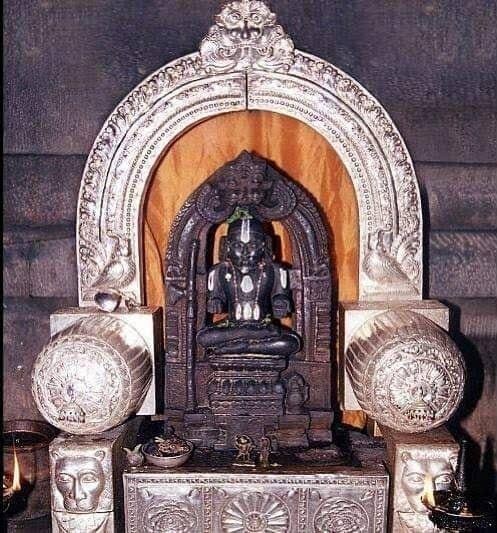
Chapter 1
Life and Early Years
A brahmana boy from a small coastal village who left home at twelve to become one of India's most influential philosophers.
Almost everything known about Madhvācārya's childhood comes from devotional biographies rather than independent historical records. The main source is the Sanskrit poem Sumadhva-vijaya, also called Madhva-vijaya. It was written one or two generations after his death by Nārāyaṇācārya, whose father, Trivikramācārya, had been a direct disciple of Madhvācārya. Śrīla Prabhupāda's purport to Śrī Caitanya-caritāmṛta, Madhya 9.245, explains who the Tattvavādīs of Uḍupī were when Śrī Caitanya Mahāprabhu met them. It also draws from this devotional tradition. For a Gauḍīya Vaiṣṇava reader, it is still a simple way to understand this tradition.
| Detail | Description |
|---|---|
| Childhood name | Vasudeva |
| Birth (traditional) | 1238 CE, Pajaka, near Udupi, South Kanara, Karnataka |
| Birth (alternate dating) | 1199 CE per some modern scholars; 1118 CE per Srila Prabhupada's purport, which also notes the 1238 CE figure |
| Father | Madhyageha Bhatta (also given as Naduillaya), a Shivalli-brahmana |
| Sannyasa-guru | Achyutapreksha, of the Ekadandi renunciate order |
| Age at sannyasa | About twelve |
| Monastic name | Purnaprajna Tirtha; later also called Anandatirtha |
A Name, and a Disputed Date #
Vāsudeva was born into a Śivallī-brāhmaṇa family in Pajaka, a small village near Uḍupī on India's southwestern coast. The exact year of his birth is uncertain. Most modern reference sources, including Wikipedia, give 1238 CE. However, some historians give 1199 CE instead. Śrīla Prabhupāda's purport to Śrī Caitanya-caritāmṛta states that Madhvācārya "took his birth... in the year 1040 Śakābda (A.D. 1118)." It then adds, "according to some, he was born in the year 1160 Śakābda (A.D. 1238)." Thus, three respected sources give three different birth years, and there is no independent historical record that can establish which date is correct.
Stories of a Remarkable Child #
The devotional tradition about Vāsudeva's early years is full of miraculous stories, like those told about the childhoods of many great Indian saints. These stories should be understood as devotional tradition, not as documented history. It is said that when his father was deeply in debt and needed money, the boy turned ordinary tamarind seeds into coins in his hand. It is also said that when Vāsudeva was five years old, he killed a demon named Maṇimat, who lived nearby in the form of a snake, simply by touching it with the toe of his left foot. His biographers also say that whenever he was away and his mother became anxious, he would appear before her again in a single jump. To devotees, this was a sign that he was no ordinary child. Alongside these miraculous stories, there is a more ordinary and probably more reliable detail: Vāsudeva was a gifted student from a young age. He learned scripture and debate faster than his teachers expected. This early ability eventually led him toward renunciation rather than the householder life his father had hoped he would accept.
Renunciation Against a Father's Wishes #
Vāsudeva received the sacred thread as a young boy, as was customary in a brāhmaṇa family. By his early teenage years, he had decided to take sannyāsa, but his father strongly opposed this decision. According to most accounts, he was about twelve years old when he finally left home and accepted initiation into the renounced order from a teacher named Acyutaprekṣa, who belonged to the Ekadaṇḍī order of sannyāsa. At initiation, he received the monastic name Pūrṇaprajña Tīrtha, meaning "one whose knowledge is complete." In later tradition, he is also known by the name Ānandatīrtha.
A Guru He Never Quite Claimed #
Acyutaprekṣa's monastic tradition traces back to the wider renunciant order associated with Ādi Śaṅkarācārya's line, the same Advaita Vedānta school that Madhvācārya would oppose throughout his life. One important point in his biography should be stated plainly. In his later writings, Madhvācārya did not name Acyutaprekṣa as his guru or claim descent from his monastic lineage. He studied the Upaniṣads under Acyutaprekṣa and accepted sannyāsa from him. However, after developing his own understanding of Vedānta, he did not present this formal connection as the basis of his authority. Instead, his later works base his teaching on a devotional account that he received personal instruction from Vyāsadeva himself. Founding Dvaita Vedānta examines this claim, and also how far it can be used as historical evidence.
Sometimes the formal guru-lineage recorded in one generation is not the same as the lineage that the person himself, or later generations, chose to stress. This pattern can be seen in the lives of several ācāryas. A similar question comes up about how the Gauḍīya Vaiṣṇava tradition later described its connection with Madhvācārya's line. This is discussed directly in Dvaita Vedānta and Acintya-Bhedābheda.
An Early, Independent Mind #
Even when Madhvācārya was a young renunciate, his teachers reportedly found it difficult to keep him within the standard Advaita interpretation. He raised questions about the reality of the world and the individual self that Śaṅkara's non-dualism did not easily answer. By the time he began travelling and teaching on his own, while still a young man, he had already moved away from the philosophical framework of his formal sannyāsa order. He then began developing what would become Dvaita Vedānta, or, as he called it, Tattvavāda. The development of this philosophy and the works in which he presented it are the subject of the next chapter of his life.
Scriptural evidence for this chapter (1)
From the purport: Purport excerpt: "Near the city of Udupi is a place called Pajaka-kshetra, where Madhvacharya took his birth in a Shivalli-brahmana dynasty as the son of Madhyageha Bhatta... According to some, he was born in the year 1160 Shakabda (A.D. 1238)."
Srila Prabhupada's own purport is the most detailed biographical summary of Madhvacharya available through Gaudiya sources, and itself notes more than one candidate birth year.
Chapter 2
Founding Dvaita Vedanta
A teaching of five eternal differences, explained in thirty-seven Sanskrit works, that gave Vedanta philosophy its strictest dualist system.
After Madhvacharya broke away from the Advaita interpretation held by his own sannyasa order, he spent the rest of his life explaining a complete and consistent reading of Vedanta that was different from Advaita. He expressed this teaching in a collection of Sanskrit works known together as the Sarvamūla. He called his own system Tattvavada, "the doctrine of reality," but the wider world and most histories of Indian philosophy know it as Dvaita, or dualism. Later commentators gave it this name.
| Detail | Description |
|---|---|
| Preferred name | Tattvavada ("doctrine of reality/realism") |
| Common name | Dvaita Vedanta ("dualism") |
| Central doctrine | Pancha-bheda: five eternal, irreducible differences |
| Chief commentary | Brahma-sutra-bhashya (also called Purna-prajna-bhashya) and its supplement, the Anuvyakhyana |
| Total works | Roughly 37, together called the Sarvamula |
| Rejected | Advaita Vedanta of Adi Shankaracharya, as a disguised form of Buddhism |
Pancha-Bheda: Five Differences That Never End #
The main idea of Madhvācārya's philosophy is pañca-bheda, the principle of five eternal differences. He taught that there are five kinds of differences in everything that exists. These differences are real and permanent. They never disappear, even when a person gains knowledge or reaches liberation. The five differences are between God and the individual soul (jīva), God and matter (prakṛti), one soul and another soul, the soul and matter, and one material thing and another material thing. Since the world is made up of these five differences, it is sometimes called prapañca, which means "five-fold." Madhvācārya taught that the many different things in the world are real and not an illusion. In his view, there is no hidden oneness behind them. This is the main meaning of pañca-bheda. It also explains why simply calling his philosophy "Dvaita" is not completely enough. "Dvaita" means "two," but Madhvācārya's teaching explains five different kinds of differences that always exist.
Two more important teachings follow from this basic idea. The first is tāratamya, or eternal gradation. Madhvācārya taught that liberated souls remain unequal to one another, and infinitely unequal to God, even after liberation. These differences never disappear. The second teaching is a three-fold classification of souls according to their ultimate destiny: mukti-yogyas, those who are fit for liberation; nitya-saṁsārins, those who remain in the cycle of birth and death without ever attaining liberation or eternal condemnation; and tamo-yogyas, those who are destined for eternal condemnation. This last category is unusual among the philosophical schools of Sanātana Dharma. Most other schools, including the Gauḍīya Vaiṣṇava tradition, teach that every soul can attain liberation through genuine devotion. For this reason, Madhvācārya's teaching about the three types of souls is one of the most distinctive and widely discussed parts of Tattvavāda among scholars of Indian philosophy.
Against Shankara: "Buddhism in Disguise" #
Madhvācārya's main philosophical arguments were directed against Ādi Śaṅkarācārya's Advaita Vedānta. Advaita teaches that Brahman alone is ultimately real and that the differences we see between the soul, the world, and God are caused by ignorance (māyā). According to Advaita, these differences completely disappear when a person attains enlightenment. Madhvācārya rejected this teaching completely. In works such as the Upādhi-khaṇḍana and Tattvadyota, he argued that Advaita's teaching of an ultimately undivided and impersonal Absolute was not the true teaching of the Vedas. He also argued that it was really Mahāyāna Buddhist philosophy expressed in Vedic language. This criticism has roots in earlier Vaiṣṇava literature, including a passage in the Padma Purāṇa that describes Māyāvāda as "concealed Buddhism." Madhvācārya also rejected Rāmānujācārya's Viśiṣṭādvaita, or qualified non-dualism. Rāmānuja taught that souls and matter are real but depend on Brahman and exist as parts of Brahman's body. Madhvācārya did not accept this idea. For him, any teaching that made the soul a part of God in any sense failed to preserve the complete and eternal difference between the soul and God.
The Gaudiya Vaishnava tradition developed three centuries after Madhvacharya. Even so, Sri Chaitanya Mahaprabhu's own line agrees with Madhvacharya completely on these points. Both hold that Mayavada philosophy is a disguised form of Buddhism. Both also hold that the Puranas and the eternal, personal form of God are as fully authoritative as the Upanishads. The real philosophical difference between the two traditions lies elsewhere. It concerns how each tradition explains the relationship between the soul and God after impersonalism has been rejected. This difference is discussed in Dvaita Vedānta and Acintya-Bhedābheda.
The Sarvamula: Thirty-Seven Works #
Madhvācārya presented his philosophy in a body of works traditionally counted as thirty-seven titles, known together as the Sarvamūla, meaning "the root of everything." At the center is the Brahma-sūtra-bhāṣya, also called the Pūrṇa-prajña-bhāṣya after his monastic name. It is his commentary on Bādarāyaṇa's Vedānta-sūtra. He explained it in greater detail in the long poetic work Anuvyākhyāna. Śrīla Prabhupāda describes this work in his purport to Śrī Caitanya-caritāmṛta as Madhvācārya's "greatest work." His other important works include the Gītā-bhāṣya, a commentary on the Bhagavad-gītā; ten commentaries on the principal Upaniṣads; a commentary on forty hymns of the Ṛg Veda; the Bhāgavata-tātparya-nirṇaya, his explanation of the Bhāgavata Purāṇa; and the Mahābhārata-tātparya-nirṇaya, his explanation of the Mahābhārata. He also wrote several shorter works on ritual, ethics, and specific points of philosophy.
Tradition holds that the Gita-bhashya in particular was written, or at least completed and confirmed, during Madhvacharya's pilgrimage to Badarikashrama. There, it is said, he read his commentary aloud before Vyasadeva himself and received his approval, while a companion named Satya Tirtha wrote the finished text down. This meeting, like the miracle-stories of his childhood, cannot be confirmed by independent evidence. It belongs to the devotional tradition about his life, not to recorded history. But the Madhva tradition itself gives this account to explain why the Sarvamula carries the authority it does. So we tell it here, clearly marked as tradition, instead of leaving it out.
One Composition That Still Survives as Song #
Among the thirty-seven works of the Sarvamula is one short hymn of two verses, the Narasimha Nakha Stuti. It still survives as a devotional song and is sung today across the wider Vaishnava world. Tradition says Madhvacharya composed it as an introduction to his disciple Trivikramacharya's own Vayu Stuti, because he did not want his disciple's praise directed only at himself. Its surviving first verse prays:
pāntv asmān puruhūta-vairi-balavan-mātaṅga-mādyad-ghaṭā-
kumbhoccādri-vipāṭanādhika-paṭu pratyeka vajrāyitāḥ
śrīmat-kaṇṭhīrava-āsya-pratata-sunakharā dārita-ārāti-dūra-
pradhvasta-dhvānta śānta pravitata manasā bhāvitā bhūri-bhāgyāḥ
"May the wide, auspicious nails of the lion-faced Lord Narasimha protect us, nails that acted, each one, like a thunderbolt more than able to split apart the peak-like foreheads of the maddened, elephant-like enemy of Indra's foe."
The hymn is preserved, with its lyrics and audio recordings, on the song archive page for him. It is a rare direct link between the strict philosopher of pancha-bheda and living devotional culture. Vaishnava traditions, including this one, still practise that culture today.
Scriptural evidence for this chapter (1)
Quoted in the text above:
- verse 1 (Madhvacharya) Narasimha Nakha Stuti
Chapter 3
Travels and Establishing Udupi
Madhvacharya found a Deity of Krishna inside a lump of sacred clay brought from the sea, and around it established a temple and eight monasteries that still stand seven centuries later.
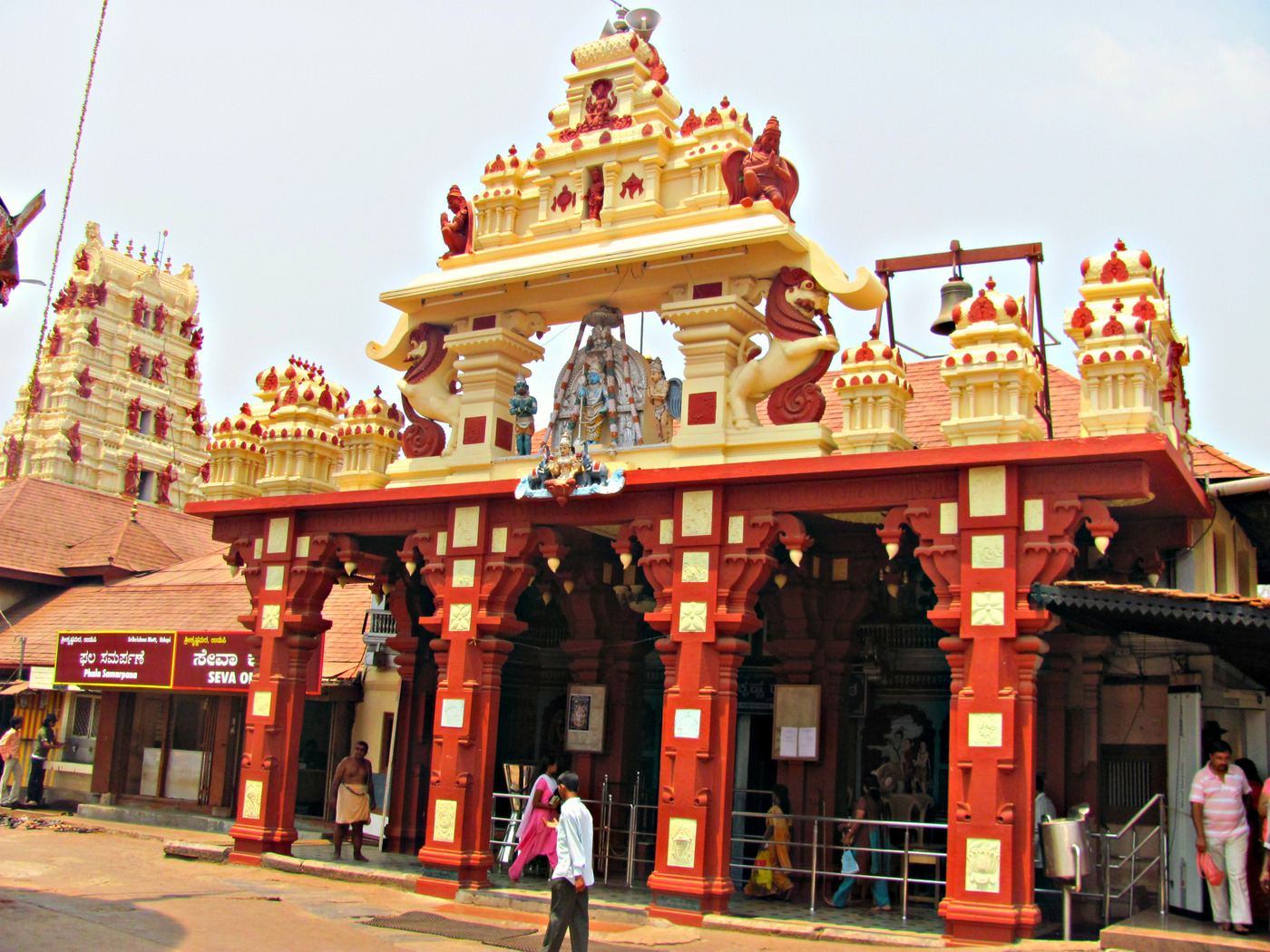
Madhvācārya did not remain in one place as a philosopher. Devotional biographies describe him travelling across India on foot more than once. He visited Badrinātha, Vārāṇasī, Purī, and Bengal in the east; Dvārakā and Goa in the west; and Kanyakumārī in the south. At many major centres of learning, he debated scholars who followed other philosophical schools. During these travels, on the coast near his birthplace, an event took place that gave Dvaita Vedānta a permanent home: the discovery of the Kṛṣṇa Deity now worshiped at Uḍupī.
| Detail | Description |
|---|---|
| Deity installed | Krishna, discovered inside a lump of gopi-chandana clay |
| Year (traditional) | 1285 CE |
| Location | Udupi, South Kanara, Karnataka |
| Monasteries founded | Eight (Ashta Matha): Palimaru, Adamaru, Krishnapura, Puttige, Shirur, Sode, Kaniyooru, Pejavara |
| Rotation system | Paryaya: introduced later, in 1522 CE, by Vadiraja Tirtha of Sode Matha |
| Rival tradition engaged | Shankaracharya's Advaita, chiefly through the Shringeri Matha |
A Boat and a Hidden Deity #
Srila Prabhupada's own purport to Chaitanya-charitamrita, Madhya 9.245, preserves the traditional account of how the Udupi Deity was found. Madhvacharya was sitting beside the sea near Udupi, absorbed in meditation on Krishna. He noticed that a large boat carrying goods toward Dvaraka was in danger of being wrecked. By signalling from the shore, he showed its crew how to bring it safely in. The grateful merchants offered him a reward, and Madhvacharya asked only for a large lump of gopi-chandana, the sacred clay Vaishnavas use to mark tilaka. As the lump was carried to him, it broke open. Inside was a large Deity of Krishna, holding a stick in one hand and a lump of food in the other. Tradition says the Deity was so heavy that no group of thirty men together could lift it. Yet Madhvacharya carried it to Udupi by himself. There he installed the Deity. Srila Prabhupada's purport notes that worship according to the pattern Madhvacharya set "is still going on at Udupi" to this day. The traditional date given for this event is 1285 CE.
This story, like much of Madhvacharya's biography, is devotional tradition, not an event that can be checked by independent evidence. But the Deity itself and the temple built around it are real. They have been worshiped continuously and can be visited today. So this particular tradition stands on somewhat firmer ground than the childhood miracle-stories told on Life and Early Years.
Eight Disciples, Eight Mathas #
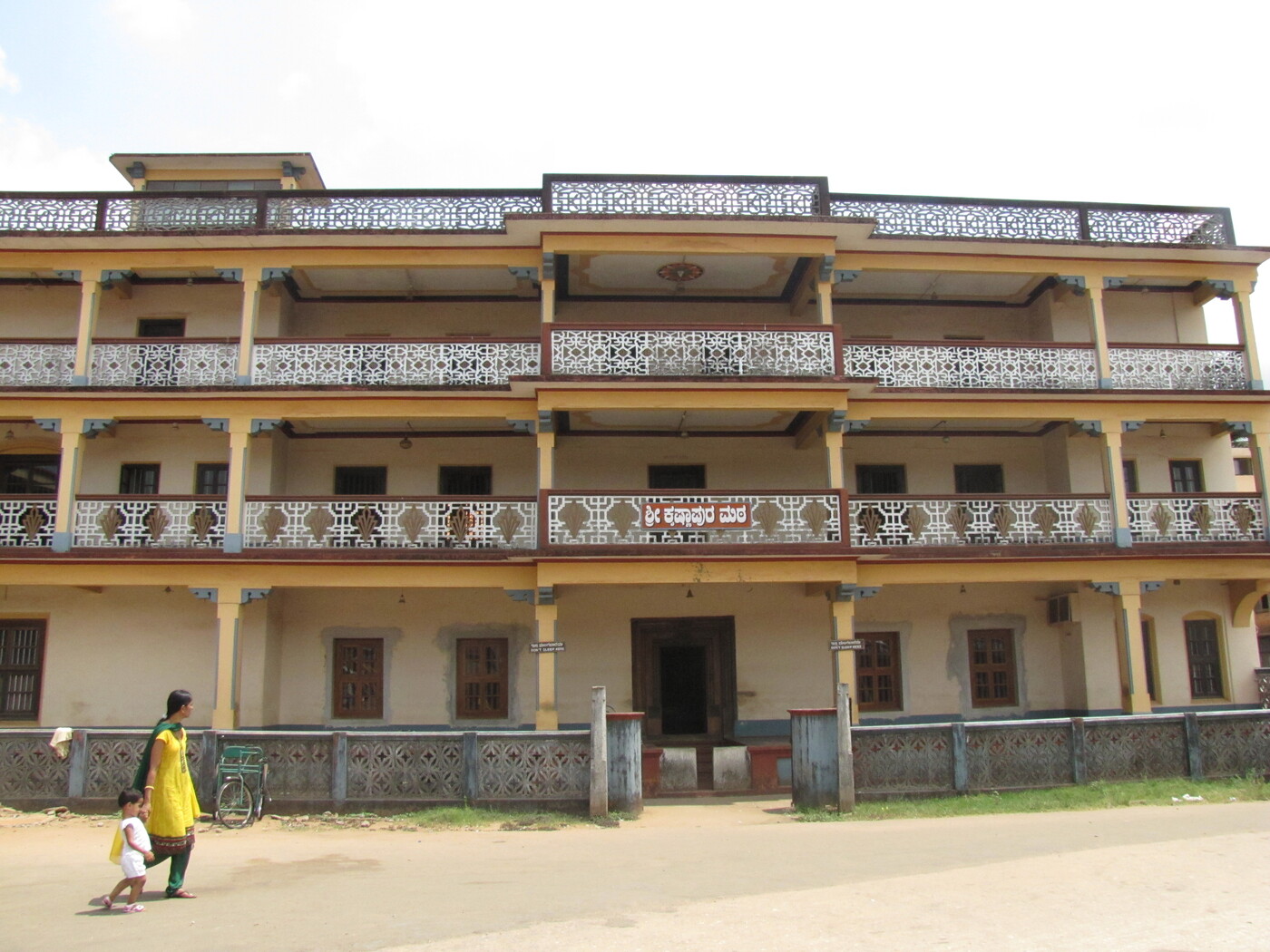
To organise the ongoing worship of the Udupi Krishna Deity, Madhvacharya appointed eight of his own sannyasa disciples as the founding heads of eight monasteries built around the temple. These are the Ashta Matha: Palimaru, Adamaru, Krishnapura, Puttige, Shirur, Sode, Kaniyooru and Pejavara. Each matha has continued as an independent institution down to the present day, headed by its own line of sannyasi successors. The eight mathas take turns conducting the Deity's worship under a formal system called Paryaya. In this system the head of each matha serves a two-year term and then hands the responsibility to the next. Paryaya was not part of Madhvacharya's own original arrangement. Vadiraja Tirtha, head of the Sode Matha, introduced it in 1522 CE, more than two centuries after Madhvacharya's disappearance. He did this so that each swamiji would have time both to serve the Deity and to travel and teach Tattvavada elsewhere in India. The Paryaya festival and the wider life of the Udupi tradition today are described further on Legacy in the Four Sampradayas.
Debates Across India #
Madhvacharya's travels were not sightseeing. Devotional biography says that on his journeys he debated some twenty-one different scholars and schools, and tradition says he defeated them. They included Jain logicians, Buddhist philosophers, and above all followers of Adi Shankaracharya's Advaita Vedanta. The most notable of these encounters, again as recorded in Srila Prabhupada's purport, was with Vidyashankara, the head of the Shringeri Matha founded by Shankaracharya himself. In discussion, tradition says, "Vidyashankara was actually diminished in the presence of Madhvacharya." As his reputation grew, the purport continues, the Shringeri establishment grew uneasy, and a Mayavadi scholar named Pundarika Puri was sent to challenge him directly. In the dispute that followed, Madhvacharya's opponents reportedly seized his manuscripts. They were recovered only later, with the help of a local king, Jayasimha of Kumla. After that, Pundarika Puri was defeated in open debate.
Two of the disciples Madhvacharya gained on his travels left their own mark on Dvaita literature. Trivikramacharya of Vishnumangala became his disciple and composed the Vayu Stuti in his honour. This is the very work that Madhvacharya's own Narasimha Nakha Stuti was written to introduce, as told on Founding Dvaita Vedanta. Trivikramacharya's son, Narayanacharya, later wrote the Sumadhva-vijaya (also called Madhva-vijaya). It is the main devotional biography of Madhvacharya. Most of what is known, or claimed, about his life comes originally from this book.
Other Travels #
Devotional accounts tell more stories about these journeys. Like the childhood stories, they should be read as devotional biography. They say that Madhvacharya once helped a local king dig a public lake in Maharashtra, simply because he happened to be passing through with his disciples. They also say that he came to a region called Ganga-pradesha, where conflict between Sanatana Dharma communities and Muslim forces had made river crossings dangerous. He crossed anyway and was brought before the ruling Muslim king. The king was so impressed that he offered Madhvacharya a kingdom and wealth, but Madhvacharya declined both. Another story says that he was once attacked by dacoits and by a tiger, and overcame both by his own bodily strength. Whether or not these stories are historical, they all give the same picture of Madhvacharya within the Madhva-sampradaya tradition. He appears as a renunciate of great physical and intellectual strength. Danger, wealth and rival scholarship could not turn him from his aim. With single-minded effort he built an institution meant to outlast him. At Udupi, it clearly has outlasted him.
Scriptural evidence for this chapter (1)
madhvācārya-sthāne āilā yāṅhā ‘tattvavādī’
uḍupīte ‘kṛṣṇa’ dekhi, tāhāṅ haila premonmādī
Word for word
madhvācārya-sthāne: at the place of Madhvācārya; āilā: arrived; yāṅhā: where; tattva-vādī: philosophers known as Tattvavādīs; uḍupīte: at the place known as Uḍupī; kṛṣṇa dekhi: seeing the Deity of Lord Kṛṣṇa; tāhāṅ: there; haila: became; prema-unmādī: mad in ecstasy
Caitanya Mahaprabhu next arrived at Udupi, the place of Madhvacharya, where the philosophers known as Tattvavadis resided. There He saw the Deity of Lord Krishna and became mad with ecstasy.
Krishnadasa Kaviraja Goswami's own record that Sri Chaitanya Mahaprabhu personally visited Udupi and honored the Deity there, even though a real philosophical distance separated Him from the Tattvavadis who worshiped it.
Chapter 4
Dvaita Vedanta and Achintya-Bhedabheda
Two different, carefully reasoned Vedanta philosophies, and how the Gaudiya tradition understands its descent from Madhvacharya's own line.
This page looks at two things, and both must be told fully, without softening one for the sake of the other. The first is how Madhvacharya's own philosophy actually compares with Sri Chaitanya Mahaprabhu's. The second is how the Gaudiya Vaishnava tradition, including its own guru-parampara, understands its connection to Madhvacharya's line in spite of that difference.
| Detail | Description |
|---|---|
| Madhvacharya's position | Dvaita: the soul and God are eternally, only different; never one in any sense |
| Sri Chaitanya Mahaprabhu's position | Achintya-bhedabheda-tattva: the soul and God are inconceivably, simultaneously both different and one |
| Traditional Gaudiya name for itself | "Brahma-Madhva-Gaudiya sampradaya," tracing guru-parampara through the Madhva line |
| Earliest sources for this lineage claim | Kavi Karnapura's Gaura-ganoddesha-dipika (1576) and Baladeva Vidyabhusana's Prameya-ratnavali (late 18th century) |
| What historians say | Disputed; this exact chain of gurus is not found in the Madhva sampradaya's own surviving records |
What Madhvacharya's Dvaita Actually Teaches #
Popular retellings sometimes blur this point, so it needs to be said plainly. Madhvacharya's Dvaita Vedanta does not teach any kind of oneness between the individual soul and God, in any sense, at any time, under any condition. Madhva identifies the Supreme Lord above all with Vishnu. He calls him Hari sarvottama, "Hari is supreme over all," and his doctrine of pancha-bheda holds that the difference between the jiva and this Supreme Lord is eternal and absolute. The difference is completely real. It is never an appearance to be dissolved by knowledge or liberation. Even a liberated soul, in Madhva's system, remains a separate, dependent, lesser reality forever. His doctrine of taratamya holds that souls remain unequal even to one another in that liberated state, let alone equal to God. Some passages of scripture appear to speak of the soul as one with Brahman. Adi Shankaracharya's Advaita takes such passages literally. Madhva's tradition reads such language at most as a figure of speech (upacara), never as literal. In short, there is no room in Dvaita Vedanta for "oneness" of any kind between soul and God. This is not just one way of describing his position. It is Madhva's own clear teaching, which he argued with care. The whole purpose of the pancha-bheda doctrine, covered on Founding Dvaita Vedanta, is to rule out oneness as a basic error in thinking.
What Sri Chaitanya Mahaprabhu's Achintya-Bhedabheda Actually Teaches #
Sri Chaitanya Mahaprabhu's Achintya-bhedabheda-tattva starts from a different question and reaches a different answer. Achintya means inconceivable, bheda means difference, and abheda means non-difference, or oneness. The teaching holds that both are equally real at the same time. They are related in a way the human mind cannot fully grasp through ordinary logic, because Krishna's own inconceivable potency (achintya-shakti) makes it so. In this view, the individual soul is one with Krishna in quality. It is a spiritual spark of the same nature, as a spark is related to fire, or sunshine to the sun. But in quantity the soul remains permanently distinct from Krishna and infinitely smaller in every spiritual quality. Both the sameness and the difference are held to be fully and equally true at once. This is not a compromise between two extremes. It is a position that neither Advaita's pure oneness nor Dvaita's pure difference can express on its own. So this is a genuinely different teaching from Madhva's, not the same idea in different words. Madhva's system is built specifically to rule out any form of abheda between soul and God. Achintya-bhedabheda insists on including it, inconceivably, alongside bheda.
What Chaitanya-Charitamrita Itself Records About the Encounter #
The clearest record in the texts of how the two systems actually met comes from Sri Chaitanya-charitamrita. It gives an account of Mahaprabhu's visit to Udupi during His South Indian travels, and it does not hide the difference. Arriving at "the place of Madhvacharya," Mahaprabhu saw the Deity of Krishna there and, the text says, "became mad with ecstasy" (Madhya 9.245). His love for the Deity did not stop Him from speaking directly about the philosophy He found there. A discussion followed with the resident Tattvavadi acharya. In it, Krishnadasa Kaviraja records Mahaprabhu quoting the Bhagavad-gita's own call to surrender: "Abandon all varieties of religion and just surrender unto Me. I shall deliver you from all sinful reactions. Do not fear" (Madhya 9.265). He continued that a genuine devotee of Narayana fears no condition at all, favorable or hellish, "because he considers it the same as elevation to the heavenly planets or liberation" (Madhya 9.270). In context, this teaching was aimed at the more ritual and rule-bound understanding of religious life that the Tattvavadi acharya had just described.
Hearing this, the text says, "the acharya of the Tattvavada sampradaya became very much ashamed," struck with wonder at Mahaprabhu's firm faith (Madhya 9.273). He admitted plainly, "What You have said is certainly factual. It is the conclusion of all the revealed scriptures of the Vaishnavas" (Madhya 9.274). Yet in the very next breath he added, "Still, whatever Madhvacharya has established as the formula for our party we practice as a party policy" (Madhya 9.275). Mahaprabhu's own verdict, as the text records it, is direct: "Both the fruitive worker and the speculative philosopher are considered nondevotees. We see both elements present in your sampradaya" (Madhya 9.276). He followed this at once with: "The only qualification that I see in your sampradaya is that you accept the form of the Lord as truth" (Madhya 9.277). Srila Prabhupada's purport to that verse explains the criticism further. It says the Tattvavada school "sticks to the principle of varnashrama-dharma, which involves fruitive activity," and that its idea of mukti, or liberation, "is simply a form of material desire" when seen from the standpoint of pure, unmotivated bhakti. But the purport also gives the Tattvavadis credit for one thing done right. They accept Vishnu's eternal, personal form against Mayavada impersonalism. Krishnadasa Kaviraja Goswami closes the episode by saying Mahaprabhu "broke the pride of the Tattvavadis to pieces" (Madhya 9.278). This is an authoritative Gaudiya text, in Mahaprabhu's own recorded words. It describes a real and large difference in teaching from the Madhva line. That difference was not invented by people outside the tradition.
How the Gaudiya Tradition Explains Its Own Connection #
And yet, in the very same purport, Srila Prabhupada also says that Sri Madhavendra Puri "accepted the Sri Madhvacharya-sampradaya" and took sannyasa within it. Madhavendra Puri came two generations before Sri Chaitanya Mahaprabhu in the Gaudiya guru-parampara. Srila Prabhupada also says that Madhavendra Puri was the first in that line to bring madhurya into what had until then been a more ritualistic Madhva tradition. Madhurya is the conjugal mood of devotion found in Krishna's own Vrindavana pastimes. The Gaudiya tradition sometimes calls itself the "Brahma-Madhva-Gaudiya sampradaya," and this is where that name comes from. Srila Prabhupada affirmed this connection directly and repeatedly, not only in his books but also in his own lectures and conversations. Speaking with a French academic in Paris in 1974, he stated simply, "Madhvacharya was direct disciple of Vyasadeva, and by parampara, Madhavendra Puri. Then from Madhavendra Puri, Ishvara Puri. And Caitanya Mahaprabhu accepted Ishvara Puri as His spiritual master. So we belong to this Madhvacharya-sampradaya." On a morning walk in Durban the following year, he compared his own line with the Vallabha-sampradaya, which descends from Vishnusvami. He put it just as plainly: "We belong to Madhvacharya, so there is no difference." This understanding is real, sincerely held and centuries old. It is not a modern invention. It rests mainly on a guru-parampara verse found in Kavi Karnapura's Gaura-ganoddesha-dipika (1576). A shorter form of the verse is repeated in Baladeva Vidyabhusana's Prameya-ratnavali (late eighteenth century). The verse gives a chain running from Krishna through Brahma, Narada and Vyasa to Madhvacharya. From Madhvacharya it runs through Padmanabha Tirtha, Narahari Tirtha, Madhava Tirtha, Akshobhya Tirtha, Jayatirtha and several more names down to Vyasa Tirtha, Lakshmipati Tirtha, Madhavendra Puri, Ishvara Puri, and finally Sri Chaitanya Mahaprabhu Himself.
What Independent Scholarship Has Found #
Here the picture becomes seriously disputed. The account of Madhavendra Puri on Life in the Madhva Sampradaya already notes part of the problem. It says that the Madhva sampradaya's own recognized guru-lists do not include either Madhavendra Puri or Ishvara Puri at all. It also says that this specific lineage claim looks like a later Gaudiya-tradition addition, not something recorded in the earliest surviving sources. Further research supports this finding and adds to it. Nearly every historian who has specifically studied this question has expressed real doubt about the connection, in varying degrees. They include S. K. De, Surendranath Dasgupta, Sundarananda Vidyavinoda, and Friedhelm Hardy, whose research is also used on Madhavendra Puri's own page.
The most striking single piece of evidence is the guru-succession list for the Madhva-sampradaya that Srila Prabhupada's own purport to Chaitanya-charitamrita, Madhya 9.245, sets out in detail. There it is credited to "the South Kanada Manual and the Bombay Gazette," and it runs from Madhvacharya through Padmanabha, Narahari, Madhava and Akshobhya Tirtha, then Jayatirtha, Vidyadhiraja, and some three dozen further names down to the nineteenth and twentieth centuries. Neither Lakshmipati Tirtha, nor Madhavendra Puri, nor Ishvara Puri appears anywhere in that list. Vyasa Tirtha does appear in it, but as a disciple of a teacher named Vidyadhiraja Tirtha. He does not appear as the guru of Lakshmipati Tirtha, as the Gaudiya lineage verses describe him. This difference is not a small technical point. The text that devotees most often cite for the Madhvacharya-sampradaya's own historical line of gurus is reproduced within Srila Prabhupada's own purport. Yet this very text does not confirm the specific chain of names that the Gaudiya lineage verses describe.
The following points are drawn from the detailed research of the Gaudiya historian Jagadananda Das. First, none of the Gaudiya line's Goswami literature written before Baladeva Vidyabhusana's eighteenth-century Prameya-ratnavali offers a pranama-mantra to Madhvacharya. This would be an odd gap if the connection had been understood as central from the beginning. Second, the earliest and most authoritative Chaitanya biographies do not connect Madhavendra Puri to the Tattvavadi line at all, even where they mention him by name. These biographies are the Chaitanya-bhagavata, the Chaitanya-charitamrita itself and the Chaitanya-chandrodaya-nataka. Third, in the very Udupi debate discussed above, Krishnadasa Kaviraja records Mahaprabhu twice referring to the Tattvavadi acharya's tradition as "your sampradaya" (Madhya 9.276, 277). He does not describe it as His own. In May 2001, the Poornaprajna Vidyapeetha in Bangalore, a recognized institution of the Madhva sampradaya itself, issued an official statement. It denied any historical connection between the two lines, based mainly on the differences in teaching given above.
Holding Both Facts Together #
None of this changes what the Gaudiya Vaishnava tradition itself sincerely holds, or what Srila Prabhupada himself repeatedly and personally affirmed. Gaudiya Vaishnavism understands itself as descending from the Madhva or Brahma-sampradaya, through Madhavendra Puri and Ishvara Puri. It reveres Madhvacharya as a great acharya standing at its historical root. Nor does any of this change the genuine, positive philosophical debt the Gaudiya line owes him. His firm defence of God's eternal personal form against Mayavada impersonalism laid essential groundwork. Sri Chaitanya Mahaprabhu's own teaching then built on it and, in its own distinct way, went beyond it.
When both facts are held together honestly, the picture is this. First, the lineage claim is a real and long-held part of how the Gaudiya tradition understands itself, and it has been affirmed at the highest level of the tradition. Second, the specific chain of names behind it is not confirmed by the Madhva sampradaya's own recognized records. Third, on the single most important question in Vedanta philosophy, Madhvacharya's Dvaita and Sri Chaitanya Mahaprabhu's Achintya-bhedabheda-tattva are two different, carefully reasoned answers. They are not two names for the same teaching. Something that happened generations later shows concretely how seriously the Gaudiya tradition had to defend its own distinct philosophical standing, apart from the connection it holds with Madhva's line. At the royal court of Jaipur, Baladeva Vidyabhusana had to compose an entirely new Vedanta-sutra commentary of his own. The full story is told on The Jaipur Challenge. He had to do this because the existing four-sampradaya framework, even though it already included Madhvacharya's own commentary, did not on its own secure the Gaudiya Vaishnavas a recognized place within it.
Scriptural evidence for this chapter (12)
Quoted in the text above:
- Madhya 9.265 Sri Chaitanya-charitamrita
- Madhya 9.275 Sri Chaitanya-charitamrita
- Madhya 9.277 Sri Chaitanya-charitamrita
Further verses:
"A person who is a devotee of Lord Narayana is not afraid of a hellish condition, because he considers it the same as elevation to the heavenly planets or liberation. The devotees of Lord Narayana are accustomed to seeing all these things on the same level."
Part of Sri Chaitanya Mahaprabhu's response to the Tattvavadi acharya, contrasting pure, unmotivated devotion with a theology weighted toward avoiding hell and seeking liberation.
After hearing Sri Chaitanya Mahaprabhu, the acharya of the Tattvavada sampradaya became very much ashamed. Upon observing Sri Chaitanya Mahaprabhu's rigid faith in Vaishnavism, he was struck with wonder.
The Tattvavadi acharya's own recorded reaction to Mahaprabhu's teaching, showing this was a real theological confrontation, not a friendly meeting of identical views.
The Tattvavadi acharya replied, "What You have said is certainly factual. It is the conclusion of all the revealed scriptures of the Vaishnavas."
The Tattvavadi acharya concedes the truth of Mahaprabhu's teaching in principle, even while remaining loyal to his own sampradaya's practice, as the next verse shows.
Sri Chaitanya Mahaprabhu said, "Both the fruitive worker and the speculative philosopher are considered nondevotees. We see both elements present in your sampradaya."
One of the most direct doctrinal critiques of the Tattvavada system recorded anywhere in Chaitanya-charitamrita, spoken by Mahaprabhu Himself and addressed to "your sampradaya," not His own.
Thus Sri Chaitanya Mahaprabhu broke the pride of the Tattvavadis to pieces. He then went to the holy place known as Phalgu-tirtha.
Krishnadasa Kaviraja Goswami's own closing summary of the Udupi encounter, describing a real doctrinal victory rather than an agreement between equivalent positions.
ayi dīna-dayārdra nātha he
mathurā-nātha kadāvalokyase
hṛdayaṁ tvad-aloka-kātaraṁ
dayita bhrāmyati kiṁ karomy aham
Word for word
ayi: O My Lord; dīna-dayā-ārdra nātha he: O master compassionate to the poor; mathurā-nātha: O master of Mathura; kadā avalokyase: when shall I see You; hṛdayam: My heart; tvat-aloka-kātaram: aggrieved by not seeing You; dayita: O most beloved; bhrāmyati: becomes overwhelmed; kim karomi aham: what shall I do
"O My Lord! O most merciful master! O master of Mathura! When shall I see You again? Because of My not seeing You, My agitated heart has become unsteady. O most beloved one, what shall I do now?"
From the purport: Purport excerpt: "Out of the four sampradayas, the Sri Madhvacarya-sampradaya was accepted by Madhavendra Puri... Sri Madhavendra Puri introduced the conception of conjugal love for the first time in the Madhvacarya-sampradaya."
This purport, already cited on Madhavendra Puri's own page, is the primary Gaudiya source for the specific claim that the Gaudiya line descends through the Madhva-sampradaya.
mādhava-īśvara-purī, śacī, jagannātha
advaita ācārya prakaṭa hailā sei sātha
Word for word
mādhava: Madhavendra Puri; īśvara-purī: Ishvara Puri; śacī: Sachimata; jagannātha: Jagannatha Mishra; advaita ācārya: Advaita Acharya; prakaṭa hailā: appeared; sei sātha: together with this
"Madhavendra Puri, Isvara Puri, Srimati Sacimata and Srila Jagannatha Misra all appeared with Sri Advaita Acharya."
Chaitanya-charitamrita groups Madhavendra Puri and Ishvara Puri among the eternal associates who appeared specifically to prepare the way for Sri Chaitanya Mahaprabhu, part of the textual basis for the traditional lineage claim.
paravyomeśvarasyāsīc chiṣyo brahmā jagat-patiḥ
tasya śiṣyo nārado'bhūt vyāsas tasyāpa śiṣyatām
...
vyāsāl labdha-kṛṣṇa-dīkṣo mādhvācāryo mahāyaśāḥ
tasya śiṣyo'bhavat padmanābhācāryo mahāśayaḥ
...
tasya śiṣyo mādhavendro yad-dharmo'yaṁ pravartitaḥ
tasya śiṣyo'bhavat śrīmān īśvarākhya-purī-yatiḥ
"Brahma, the master of this universe, was the disciple of the lord of the spiritual world. His disciple was Narada and Vyasa became the disciple of Narada... Madhvacharya took initiation in the Krishna mantra from Vyasa. Madhva's disciple was Padmanabhacharya... Lakshmipati's disciple Madhavendra founded this religion. His disciple was the sannyasi Ishvara Puri."
This is the earliest known textual source for the specific guru-parampara chain the Gaudiya tradition uses to connect itself to Madhvacharya; quoted here via the detailed historical study of Gaudiya scholar Jagadananda Das, since no independent English translation of the full text is posted online.
śrī-kṛṣṇa-brahma-devarṣi-bādarāyaṇa-saṁjñakān
śrī-madhva-śrī-padmanābha-śrīmān-narahari-mādhavān
...
tato lakṣmīpatiṁ mādhavendraṁ ca bhaktitaḥ
tac-chiṣyān śrī-advaita-nityānandau jagad-gurū
devam īśvara-śiṣyaṁ śrī-caitanyaṁ ca bhajāmahe
"The disciplic succession goes from Krishna to Brahma, to Narada, to Vyasa; then to Madhva, Padmanabha, Narahari, and Madhava... With devotion, I praise all these spiritual masters, then Lakshmipati and his disciple Madhavendra, whose disciples were the spiritual masters of the universe Advaita and Nityananda. I worship Lord Sri Chaitanya, the disciple of Ishvara Puri."
Baladeva Vidyabhusana's own summary of the same lineage claim, composed generations after Kavi Karnapura and quoted here via Jagadananda Das's research; Baladeva is the same acharya who later had to defend the Gaudiya sampradaya's distinct philosophical standing at the Jaipur court.
Chapter 5
Legacy in the Four Sampradayas
A living tradition, still centred at Udupi, that is honoured by Gaudiya Vaishnavism as its own root — and remains, in practice, a separate religious community.
Vaishnava tradition describes four bona fide disciplic lines, or sampradayas. They are authorized to carry genuine Vedic mantra and teaching through the age of Kali. Each is traced to a different divine source: the Sri-sampradaya, through the goddess Lakshmi to Ramanujacharya; the Brahma-sampradaya, through the god Brahma to Madhvacharya; the Rudra-sampradaya, through Lord Shiva to Vishnusvami; and the Kumara-sampradaya, through the four Kumaras to Nimbarka. In Madhvacharya's own story, what matter most are his place among these four lines and the very different tradition he actually founded at Udupi. That tradition is still alive today.
| Detail | Description |
|---|---|
| Sampradaya founded | Brahma-sampradaya, also called the Madhva-sampradaya |
| Other three (per tradition) | Sri (Ramanujacharya), Rudra (Vishnusvami), Kumara (Nimbarka) |
| Source of the four-sampradaya teaching | Verses said to be from the Padma Purana, quoted by later Vaishnava acharyas; not traced to any particular surviving chapter of the printed Padma Purana |
| Living centre today | Udupi Sri Krishna Matha and its eight associated mathas, Karnataka |
| Distinct from | Gaudiya Vaishnavism, which reveres Madhvacharya as a lineage source but follows Achintya-bhedabheda-tattva, not Dvaita |
The Four-Sampradaya Scheme, and a Note of Caution #
Later Vaishnava literature repeats very consistently the idea that there are exactly four authorized Vaishnava sampradayas. Kavi Karnapura, Gopala Guru Goswami, Baladeva Vidyabhusana and Harirama Vyasa all do so, and all quote a pair of verses said to come from the Padma Purana:
sampradāya-vihīnā ye mantrās te niṣphalā matāḥ
ataḥ kalau bhaviṣyanti catvāraḥ sampradāyinaḥ
śrī-brahma-rudra-sanakāḥ vaiṣṇavāḥ kṣiti-pāvanāḥ
catvāras te kalau bhavyā hy utkale puruṣottamāt
"Mantras that are without a disciplic succession do not bear fruit. Therefore the founders of four disciplic successions will appear in the age of Kali. Thus the four world-purifying Vaishnavas of the Sri, Brahma, Rudra and Sanaka (Kumara) lines will appear in the age of Kali, out of Purushottama (Jagannatha Puri) in the land of Utkala (Orissa)."
Researchers who have looked for this exact verse in the surviving text of the Padma Purana have not been able to find it there. Even so, the wider idea it expresses has real roots in older Vaishnava thought. This does not make the idea of four sampradayas false. The verse may simply come from a source, or an edition of the Purana, that is not easily searched today. But it does mean that where the verse comes from is less certain than its wide devotional use suggests. So it should not be presented as a fact settled by scholars.
Wherever the idea of four sampradayas first came from in the texts, Madhvacharya's own historical role is not in question. No one, whether a practitioner of Sanatana Dharma or an academic, a devotee or a historian, doubts that he founded a major, independent Vaishnava school of Vedanta. His place among the four founding acharyas reflects this undisputed greatness as a philosopher, whatever the exact origin of the verses used to describe the four lines.
The Living Tradition at Udupi Today #
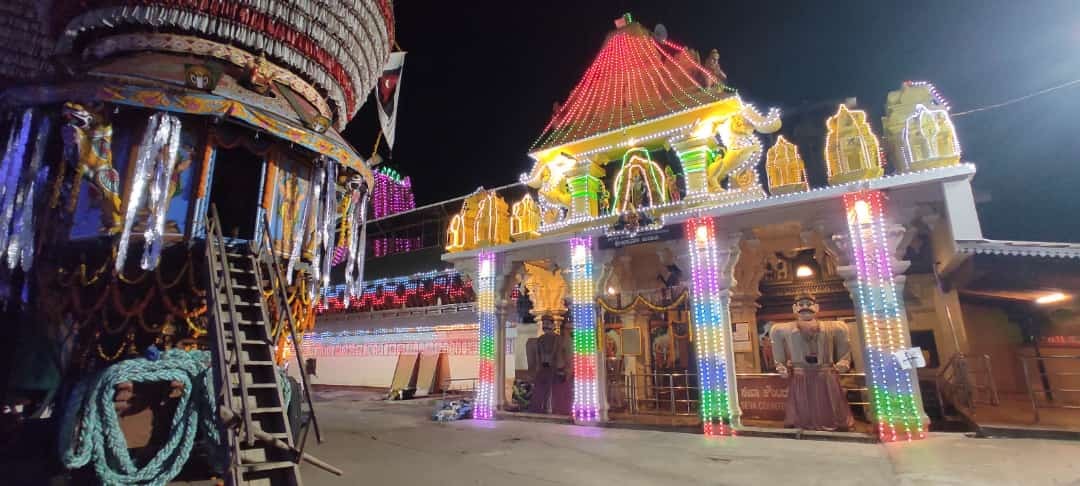
Leaving aside any claims that later traditions have made about it, Madhvacharya's own Dvaita, or Tattvavada, school is a real religious community today. It has continued to function without a break. Its centre is the Udupi Sri Krishna Matha and the eight associated mathas he founded, discussed on Travels and Establishing Udupi. Every two years, in the Paryaya festival introduced in 1522 CE, the charge of the Krishna temple's worship formally passes from one of the eight mathas to the next. The order is fixed, beginning with Palimaru and ending with Pejavara, and each change is still marked with major public celebration in Udupi. Three further institutions descend from Madhvacharya's line: the Uttaradi Matha, the Vyasaraja Matha and the Raghavendra Matha. Together they are known as the Mathatraya. They carry on the broader Tattvavada tradition outside Udupi itself, with their own lines of scholar-saints. Vyasaraja Tirtha and Raghavendra Tirtha, in particular, remain widely revered figures within that tradition, centuries after Madhvacharya's own life.
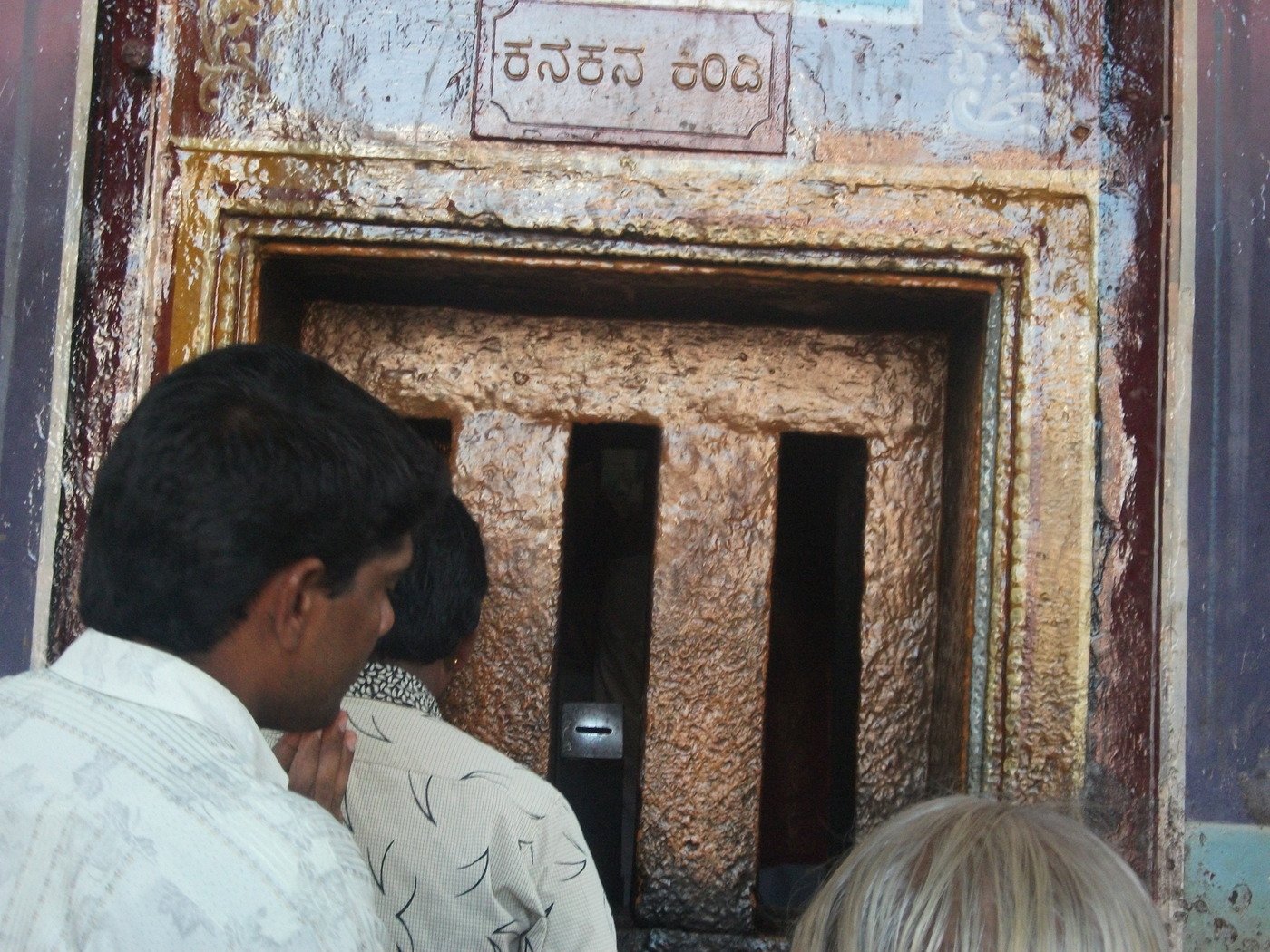
One of the best-known devotional stories associated with the Udupi temple today belongs to a much later century than Madhvacharya's own lifetime. It is the story of Kanakadasa, a sixteenth-century devotee-poet. He is said to have been turned away from the temple's main entrance because of his caste. He is remembered as having gone instead to a small opening in the temple's western wall and sung his devotion to Krishna through it. Tradition holds that at this the Deity turned to face him. Visitors are still shown that opening today. It is called the Kanakana Kindi, or "Kanaka's Window," and the story is widely told as one of devotion overcoming social barriers. But the earliest written record of it dates from roughly two centuries after Kanakadasa's own lifetime, and some more recent retellings dispute exactly how it should be read. In any case, it belongs to the Udupi tradition's own later devotional history. It is not something Madhvacharya personally witnessed.
Related, But a Distinct Tradition #
In closing, it should be said clearly that the Dvaita, or Tattvavada, tradition alive today at Udupi is not the same religious community as Gaudiya Vaishnavism. This is so even though Gaudiya Vaishnavism reveres Madhvacharya as standing at its own historical root. The Udupi tradition follows Madhvacharya's own strict, eternal-difference Dvaita philosophy without modification. It does not accept Achintya-bhedabheda-tattva. It does not centre its worship on Radha and Krishna together in the way Gaudiya Vaishnavism does. Its scholars have at times said plainly that, from their own side, they do not see the Gaudiya lineage claim as historically established. Among them, in the modern era, was the widely respected Vishvesha Tirtha Swamiji of the Pejavara Matha. This is discussed on Dvaita Vedanta and Achintya-Bhedabheda. To tell Madhvacharya's story honestly, we must recognise his greatness. We must also recognise that his living tradition today is its own separate religious community, and not an earlier chapter of Gaudiya Vaishnavism.
Scriptural evidence for this chapter (1)
Quoted in the text above:
- verses beginning sampradaya-vihina ye Padma Purana (as quoted by later Vaishnava acharyas)
Chapter 6
Final Days and Disappearance
Tradition says this acharya disappeared at Udupi while teaching his disciples, leaving behind a Deity, a philosophy and eight monasteries that have outlasted him by more than seven centuries.
In the tradition's own telling, Madhvacharya's life does not end with death in any ordinary sense. It ends with his disappearance. Vaishnava biography uses this word consistently for the final departure of a great acharya. The word is worth explaining, not simply stating.
| Detail | Description |
|---|---|
| Traditional date | 1317 CE (some sources: 1278 CE, depending on which birth-year is accepted) |
| Traditional age | About eighty years |
| Location | Anantheshwara temple, Udupi |
| Occasion | Teaching the Aitareya Upanishad |
| Tradition's own account | Body vanished amid falling flowers; believed to have gone to Badarikashrama to rejoin Vyasadeva |
| Modern observance | Madhva Navami, on Magha Shukla Navami each year |
A Teaching Left Unfinished, and a Departure #
Srila Prabhupada's own purport to Chaitanya-charitamrita, Madhya 9.245, gives the plainest available summary: "Shrila Madhvacharya passed from this material world at the age of eighty while writing a commentary on the Aitareya Upanishad." The fuller devotional account comes mainly from the Sumadhva-vijaya and is repeated in modern retellings across the Udupi and wider Vaishnava world. It places the event at the Anantheshwara temple in Udupi, on the ninth day of the bright fortnight of the month of Magha. This is the very temple around which the eight mathas discussed on Travels and Establishing Udupi still stand. Madhva-sampradaya followers still observe that date each year as Madhva Navami. According to that account, Madhvacharya was seated teaching a group of disciples on a particular verse of the Aitareya Upanishad, glorifying Krishna, when his physical body simply vanished. His cloth and garland, tradition says, were left behind on the stone platform where he had been sitting, and flowers are said to have begun falling from the sky at that moment. He is remembered as having told his followers beforehand that when he departed he would go to live with his own guru at Badarikashrama, and would not be seen by them again.
Disappearance, Not Death #
Like the accounts of the disappearance of other great Vaishnava acharyas, this should be understood as devotional tradition. It is not a claim that can be checked by ordinary historical methods. No outside record confirms it. It is the same kind of account as the meeting with Vyasadeva described on Founding Dvaita Vedanta. What we can say with more confidence is how the tradition itself understands the event, and this understanding is specific and consistent. Madhva-sampradaya followers do not describe it as an ordinary death at all. They describe it as Madhvacharya's voluntary return to an eternal, ongoing relationship with Vyasadeva beyond the material world. Vaishnava tradition understands the departures of great souls generally in the same way, including that of Sri Chaitanya Mahaprabhu Himself.
A Disputed Date, Honestly Reported #
The exact year of this event cannot be stated with certainty, and for the same reason neither can his birth year. It depends entirely on which of the competing sets of dates discussed on Life and Early Years is accepted. Most widely used modern sources follow the 1238 CE birth date and place his disappearance in 1317 CE, at the traditional age of eighty. Sources that accept the 1199 CE birth date arrive at 1278 CE instead. Neither date is based on independent records from Madhvacharya's own time that can be checked. So both are reported here side by side, instead of quietly choosing one over the other.
What Endured #
Whatever the exact year, what Madhvacharya left behind at his disappearance did not depend on any single date to last. The Krishna Deity he installed at Udupi is still worshiped today. The monks who worship the Deity belong to monasteries he personally founded. They follow a system of rotation that has continued essentially unbroken. The only addition was the Paryaya schedule, more than two centuries later. His thirty-seven Sanskrit works remain the basic textbooks of an entire living school of Vedanta philosophy. And within the Gaudiya Vaishnava tradition itself, the community has sincerely understood its guru-parampara, for centuries, as tracing back through his line. This claim is examined honestly, with its strengths and difficulties alike, on Dvaita Vedanta and Achintya-Bhedabheda. Whatever the historical uncertainties, that guru-parampara still places his name at the very root of how the Gaudiya tradition tells its own story.
Closing
A Child Prodigy Named Vasudeva #
A little unexpectedly, the fullest account of Madhvacharya's life comes from Srila Prabhupada's own purport to Chaitanya-charitamrita, Madhya 9.245. Srila Prabhupada did not write it to teach Madhva's philosophy. He wrote it simply to explain who the Tattvavadis were. Sri Chaitanya Mahaprabhu had met these Tattvavadis at Udupi. That purport says Madhvacharya was born "near Udupi, which is situated in the South Kanara district of South India," in a village called Pajaka, "in a Shivalli-brahmana dynasty as the son of Madhyageha Bhatta." Most sources today place his birth in 1238 CE. But this date is genuinely disputed. Some historians say 1199 CE. Srila Prabhupada's own purport gives yet a third year, 1118 CE, and adds only that "according to some" 1238 is correct. No single date can honestly be called settled. Most encyclopedias use the 1238 to 1317 CE span for his life, though real and serious alternatives exist too.
As a child he was named Vasudeva. As with most saints of India's past, the tradition around him is full of stories of wonders. These should be read as devotional literature, not as proven history. For example, it is said that he once turned tamarind seeds into coins to pay off his father's debts. It is also said that at the age of five he killed a snake-demon named Manimat with nothing but his toe, and that he was a great scholar almost from infancy. We can say with more confidence that he received the sacred thread as a small child and showed unusual intellectual gifts early. His father hoped that his gifted son would stay at home to look after the family. Vasudeva had other plans.
Sannyasa Under Achyutapreksha #
Against his father's wishes, Vasudeva took sannyasa at about the age of twelve. He entered the Ekadandi renunciate order under a guru named Achyutapreksha and received the name Purnaprajna Tirtha, "the one whose knowledge is complete." Achyutapreksha's own monastic line goes back to the same broad tradition from which Adi Shankaracharya's Advaita school claims descent. Here there is a small detail that tells us something. In his own later writings, Madhvacharya never once named Achyutapreksha as his guru, nor did he claim descent from his monastic line. In other words, Madhvacharya spent his whole life refuting Advaita Vedanta. Yet he had taken sannyasa from a teacher tied to the very tradition he set out to defeat. The Madhva tradition traces his teaching not to that sannyasa line but to Srila Vyasadeva, who, the tradition says, instructed him directly at Badarikashrama.
Under his new name, Purnaprajna (also called Anandatirtha), Madhvacharya began travelling and teaching. Before long he broke firmly away from the Advaita philosophy of his own formal sannyasa order.
Meeting Vyasadeva at Badarikashrama #
Devotional tradition holds that Madhvacharya travelled twice in his life to Badarikashrama in the Himalayas. On the first visit, tradition says, he met Srila Vyasadeva there in person, placing before him his still-unfinished commentary on the Bhagavad-gita and receiving his approval. His companion on this journey, a scholar named Satya Tirtha, is said to have written down the completed Gita-bhashya as Madhvacharya spoke it on the return journey. On the second visit, tradition says, Vyasadeva gave him the shalagrama-shila known as Ashtamurti. No independent historical method can prove this meeting. It is the same devotional kind of account as the meetings with heavenly personalities recorded in the lives of many Indian saints of earlier times. But it has a central place in the way the Madhva-sampradaya itself explains the authority of his commentaries. So it is told here as tradition, clearly marked as such, instead of being passed over in silence.
The Doctrine of Five Eternal Differences #
Some details of his life are uncertain, but Madhvacharya's achievement as a philosopher is beyond question. It is recorded not only in devotional literature but also in mainstream academic studies of Indian philosophy. There he stands beside Shankaracharya and Ramanujacharya as one of the three most influential Vedanta commentators in history. His system rests on the doctrine of pancha-bheda, five eternal and basic differences: between God and the individual soul, between God and matter, between one soul and another, between the soul and matter, and between one piece of matter and another. Madhvacharya taught that none of these five differences is ever cancelled, not by knowledge, not by liberation, not under any circumstance. Reality is, and always remains, made up of many distinct things. This is why his system is called Dvaita, "dualism" or "twoness," but Madhvacharya himself preferred to call it Tattvavada. This name means the teaching that things are exactly what they really are, with no illusion in the way.
He carried this further than most other schools of Vedanta were willing to go. He taught a doctrine of taratamya, eternal gradation or ranking, even among liberated souls. No soul, he held, ever becomes equal to another, let alone equal to God. He also taught a controversial three-fold division of souls: those bound for liberation (mukti-yogyas), those fated to endless rebirth (nitya-samsarins), and those destined for eternal condemnation (tamo-yogyas). This last teaching is truly unusual within Sanatana Dharma as a whole, because most schools hold out the hope that every soul will finally be liberated. Among scholars of Indian philosophy, it is still one of the most debated and distinctive features of Madhva's system.
Madhvacharya set out these teachings in roughly thirty-seven works, together called the Sarvamula, "the root of everything". They include his commentary on the Brahma-sutra, the Brahma-sutra-bhashya, which is also called the Purna-prajna-bhashya. It has a long poetic supplement, the Anuvyakhyana, which Srila Prabhupada's purport calls "his greatest work". He also wrote commentaries on the Bhagavad-gita (the Gita-bhashya), on ten of the principal Upanishads, on forty hymns of the Rig Veda, and on the Bhagavata Purana (the Bhagavata-tatparya-nirnaya) and the Mahabharata. Throughout, he argued that Adi Shankaracharya's Advaita Vedanta was not authentic Vedic teaching at all but "Buddhism in disguise," mayavada wearing the clothes of scripture. Real philosophical differences separate Madhva's teaching from the Gaudiya line. Even so, on this one point the two traditions agree completely. Sri Chaitanya Mahaprabhu and every acharya in His line also treat Mayavada philosophy as covered Buddhism. Like Madhvacharya, and against Advaita, they firmly teach that the Puranas and Itihasas are as fully Vedic as the Upanishads themselves. They also firmly teach that God's form is fully real.
- Anu-Madhva-Vijaya (Prameya-Nava-Malika) — Sanskrit-English summary of Narayana Panditacharya's hagiography, tr. M. S. Katti
- B. N. K. Sharma, History of the Dvaita School of Vedanta and Its Literature
- Sarvamoola Grantha — Madhvacharya's complete works (Taraprakashana)
- Shri Krishna Matha Paryaya, Shiroor Matha, Udupi (one of the eight Ashta Mathas founded by Madhvacharya)
- Sri Chaitanya-charitamrita, Madhya-lila 9.245, purport
- Is the Gaudiya Vaishnava sampradaya connected to the Madhva line? by Jagadananda Das
- Sri Madhvacharya - Gaudiya History (ISKCON Desire Tree)
