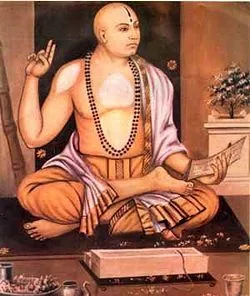
After Madhvacharya broke away from the Advaita interpretation held by his own sannyasa order, he spent the rest of his life explaining a complete and consistent reading of Vedanta that was different from Advaita. He expressed this teaching in a collection of Sanskrit works known together as the Sarvamūla. He called his own system Tattvavada, "the doctrine of reality," but the wider world and most histories of Indian philosophy know it as Dvaita, or dualism. Later commentators gave it this name.
| Detail | Description |
|---|---|
| Preferred name | Tattvavada ("doctrine of reality/realism") |
| Common name | Dvaita Vedanta ("dualism") |
| Central doctrine | Pancha-bheda: five eternal, irreducible differences |
| Chief commentary | Brahma-sutra-bhashya (also called Purna-prajna-bhashya) and its supplement, the Anuvyakhyana |
| Total works | Roughly 37, together called the Sarvamula |
| Rejected | Advaita Vedanta of Adi Shankaracharya, as a disguised form of Buddhism |
Pancha-Bheda: Five Differences That Never End #
The main idea of Madhvācārya's philosophy is pañca-bheda, the principle of five eternal differences. He taught that there are five kinds of differences in everything that exists. These differences are real and permanent. They never disappear, even when a person gains knowledge or reaches liberation. The five differences are between God and the individual soul (jīva), God and matter (prakṛti), one soul and another soul, the soul and matter, and one material thing and another material thing. Since the world is made up of these five differences, it is sometimes called prapañca, which means "five-fold." Madhvācārya taught that the many different things in the world are real and not an illusion. In his view, there is no hidden oneness behind them. This is the main meaning of pañca-bheda. It also explains why simply calling his philosophy "Dvaita" is not completely enough. "Dvaita" means "two," but Madhvācārya's teaching explains five different kinds of differences that always exist.
Two more important teachings follow from this basic idea. The first is tāratamya, or eternal gradation. Madhvācārya taught that liberated souls remain unequal to one another, and infinitely unequal to God, even after liberation. These differences never disappear. The second teaching is a three-fold classification of souls according to their ultimate destiny: mukti-yogyas, those who are fit for liberation; nitya-saṁsārins, those who remain in the cycle of birth and death without ever attaining liberation or eternal condemnation; and tamo-yogyas, those who are destined for eternal condemnation. This last category is unusual among the philosophical schools of Sanātana Dharma. Most other schools, including the Gauḍīya Vaiṣṇava tradition, teach that every soul can attain liberation through genuine devotion. For this reason, Madhvācārya's teaching about the three types of souls is one of the most distinctive and widely discussed parts of Tattvavāda among scholars of Indian philosophy.
Against Shankara: "Buddhism in Disguise" #
Madhvācārya's main philosophical arguments were directed against Ādi Śaṅkarācārya's Advaita Vedānta. Advaita teaches that Brahman alone is ultimately real and that the differences we see between the soul, the world, and God are caused by ignorance (māyā). According to Advaita, these differences completely disappear when a person attains enlightenment. Madhvācārya rejected this teaching completely. In works such as the Upādhi-khaṇḍana and Tattvadyota, he argued that Advaita's teaching of an ultimately undivided and impersonal Absolute was not the true teaching of the Vedas. He also argued that it was really Mahāyāna Buddhist philosophy expressed in Vedic language. This criticism has roots in earlier Vaiṣṇava literature, including a passage in the Padma Purāṇa that describes Māyāvāda as "concealed Buddhism." Madhvācārya also rejected Rāmānujācārya's Viśiṣṭādvaita, or qualified non-dualism. Rāmānuja taught that souls and matter are real but depend on Brahman and exist as parts of Brahman's body. Madhvācārya did not accept this idea. For him, any teaching that made the soul a part of God in any sense failed to preserve the complete and eternal difference between the soul and God.
The Gaudiya Vaishnava tradition developed three centuries after Madhvacharya. Even so, Sri Chaitanya Mahaprabhu's own line agrees with Madhvacharya completely on these points. Both hold that Mayavada philosophy is a disguised form of Buddhism. Both also hold that the Puranas and the eternal, personal form of God are as fully authoritative as the Upanishads. The real philosophical difference between the two traditions lies elsewhere. It concerns how each tradition explains the relationship between the soul and God after impersonalism has been rejected. This difference is discussed in Dvaita Vedānta and Acintya-Bhedābheda.
The Sarvamula: Thirty-Seven Works #
Madhvācārya presented his philosophy in a body of works traditionally counted as thirty-seven titles, known together as the Sarvamūla, meaning "the root of everything." At the center is the Brahma-sūtra-bhāṣya, also called the Pūrṇa-prajña-bhāṣya after his monastic name. It is his commentary on Bādarāyaṇa's Vedānta-sūtra. He explained it in greater detail in the long poetic work Anuvyākhyāna. Śrīla Prabhupāda describes this work in his purport to Śrī Caitanya-caritāmṛta as Madhvācārya's "greatest work." His other important works include the Gītā-bhāṣya, a commentary on the Bhagavad-gītā; ten commentaries on the principal Upaniṣads; a commentary on forty hymns of the Ṛg Veda; the Bhāgavata-tātparya-nirṇaya, his explanation of the Bhāgavata Purāṇa; and the Mahābhārata-tātparya-nirṇaya, his explanation of the Mahābhārata. He also wrote several shorter works on ritual, ethics, and specific points of philosophy.
Tradition holds that the Gita-bhashya in particular was written, or at least completed and confirmed, during Madhvacharya's pilgrimage to Badarikashrama. There, it is said, he read his commentary aloud before Vyasadeva himself and received his approval, while a companion named Satya Tirtha wrote the finished text down. This meeting, like the miracle-stories of his childhood, cannot be confirmed by independent evidence. It belongs to the devotional tradition about his life, not to recorded history. But the Madhva tradition itself gives this account to explain why the Sarvamula carries the authority it does. So we tell it here, clearly marked as tradition, instead of leaving it out.
One Composition That Still Survives as Song #
Among the thirty-seven works of the Sarvamula is one short hymn of two verses, the Narasimha Nakha Stuti. It still survives as a devotional song and is sung today across the wider Vaishnava world. Tradition says Madhvacharya composed it as an introduction to his disciple Trivikramacharya's own Vayu Stuti, because he did not want his disciple's praise directed only at himself. Its surviving first verse prays:
pāntv asmān puruhūta-vairi-balavan-mātaṅga-mādyad-ghaṭā-
kumbhoccādri-vipāṭanādhika-paṭu pratyeka vajrāyitāḥ
śrīmat-kaṇṭhīrava-āsya-pratata-sunakharā dārita-ārāti-dūra-
pradhvasta-dhvānta śānta pravitata manasā bhāvitā bhūri-bhāgyāḥ
"May the wide, auspicious nails of the lion-faced Lord Narasimha protect us, nails that acted, each one, like a thunderbolt more than able to split apart the peak-like foreheads of the maddened, elephant-like enemy of Indra's foe."
The hymn is preserved, with its lyrics and audio recordings, on the song archive page for him. It is a rare direct link between the strict philosopher of pancha-bheda and living devotional culture. Vaishnava traditions, including this one, still practise that culture today.
