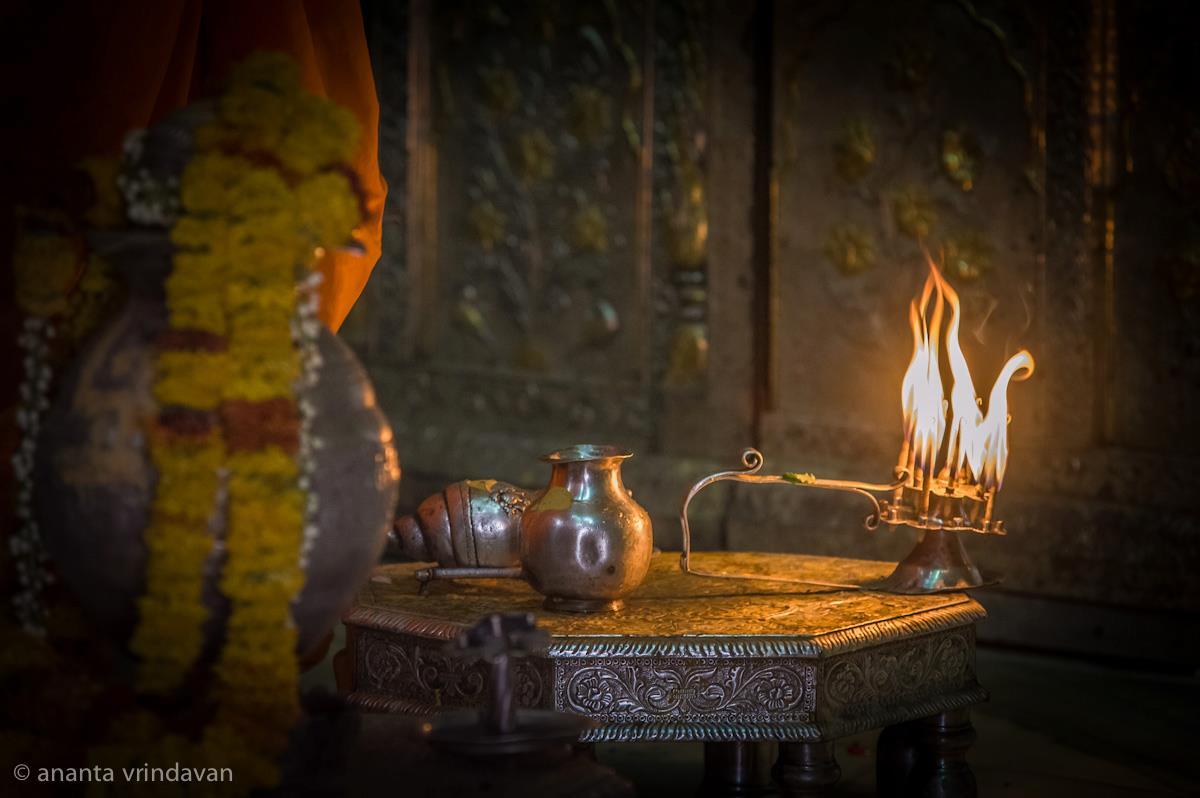
Narahari Chakravarti Thakura is remembered today for what he wrote. But the sources that describe his own daily life remember him almost entirely for what he cooked. Narahari spent the greater part of his adult life in the personal service of Radha-Govindaji in Vrindavana. As the tradition puts it, in this he fulfilled both his father's wish and the desire of the Deity Himself. He continued this work into his seventies, long after most temple servants would have passed such labor on to younger people.
The Expert Cook-Priest #
Narahari became known as *rasoi pujari*, the cook-priest who was expert in preparing food that truly pleased the Deity, not only food that was correct by the rules of ritual. Sources describe a man personally chosen for this role. He was trusted to turn Vrindavana's simple offerings (grain, ghee, milk, seasonal fruit) into preparations fit for Govindaji's table. It was skilled, repetitive work that few people saw, done daily for decades. Apart from what he wrote, it is almost all that is recorded about how Narahari actually spent his time.
Beyond the Kitchen #
The cooking was only part of it. Traditional accounts say he also did many other daily chores, the hardest and least honoured jobs in a temple. He ground sandalwood into paste for the Deity's decoration, collected firewood, swept the temple courtyard, and picked tulasi leaves and manjaris for offering. He also fanned Govindaji from outside the sanctum by pulling a rope connected to a hanging fan. None of these tasks needed the learning he clearly had. Sources agree that he was well trained in Sanskrit, in the bhakti-shastras, and in classical music and dance. Yet there is no record that he used any of this learning to gain a more visible position.
"I Have No Right" #
Apart from his books, only a little of Narahari's own direct speech survives, and it is about this very question of position. The temple's priests reportedly urged him to stop doing service so far beneath a scholar of his standing. Later retellings preserve his answer, humble as always: he considered himself unfit for any higher service at all, and called it a mercy that he was permitted to do even this much. These may be his exact words, or they may be a devotional retelling handed down through generations. Either way, the nature they describe fits everything else known about him. He was a man content to remain, in his own words elsewhere, "most fallen," while quietly doing more work than ten ordinary servants.
A Humility That Shaped How He Wrote #
He showed this same humility directly in his writing. In the opening lines of the Narottama-vilasa, Narahari does not introduce himself as a scholar-historian. He calls himself "an illiterate fool who knows nothing of right or wrong," who writes only because he was "ordered by saintly persons" to do so. He spent decades grinding sandalwood and gathering firewood, not claiming a teacher's seat. So these words do not seem to be only a writer's polite custom. They seem to be a fair description of how he really saw himself. Later Vaishnavas at Vrindavana are said to have admired this same humility in him especially, more than any dramatic episode. The Vrajavasis among whom he lived are recorded as speaking often of his good qualities, for the very reason that he never wanted to be spoken of at all.
Service Without a Chronicle #
No source available records when Narahari began this service, when he ended it, or how his final years passed. This gap fits everything else known about him. The man who wrote down the lives of an entire generation of Gaudiya Vaishnavas left no similar record of his own disappearance. Only the general outline of his life is certain. He was a trained scholar who gave himself to a servant's labor for decades. He offered this service without any apparent wish for it to be remembered.
