Srila Narahari Chakravarti Thakura
Author of the Bhakti-ratnakara and Narottama-vilasa
The complete life, on one page: The main biography and every pastime page, in order, in one place
Introduction
Srila Narahari Chakravarti Thakura signed several of his own books as Ghanashyama Dasa. He left almost no record of his own life. Yet dozens of other Gaudiya Vaishnavas are known today largely because he wrote their lives down. He is the author of the Bhakti-ratnakara and the Narottama-vilasa. For this reason he is the single most important source for the generation that followed the Six Goswamis of Vrindavana and the direct associates of Chaitanya Mahaprabhu. His books tell of the return of the Goswamis' teachings to Bengal, the mission of Narottama Dasa Thakura and Shrinivasa Acharya, and the Kheturi festival that first drew the scattered Gaudiya Vaishnava community together. He should not be confused with an earlier, better-known Vaishnava of a very similar name, as explained below.
| Detail | Description |
|---|---|
| Also known as | Ghanashyama Dasa (his own signature in several works); Narahari Dasa |
| Era | Late 1600s onward; roughly a generation after Vishvanatha Chakravarti Thakura |
| Birthplace | West Bengal; exact village not established in the sources available |
| Father | Jagannatha Vipra, a disciple of Vishvanatha Chakravarti Thakura |
| Diksha guru | Narasimha Chakravarti, in the disciplic line descending from Shrinivasa Acharya |
| Major works | Bhakti-ratnakara, Narottama-vilasa, Shrinivasa-charita, Gaura-charitra-samudra, Namamrita-samudra, Sangita-sara-sangraha, Navadvipa-dhama-parikrama |
| Service | Cook and personal servant of the Radha-Govindaji Deity in Vrindavana, into his seventies |
Chapter 1
Cook and Servant of Radha-Govindaji
Decades of humble kitchen and courtyard service in Vrindavana, and what his own words about it show.
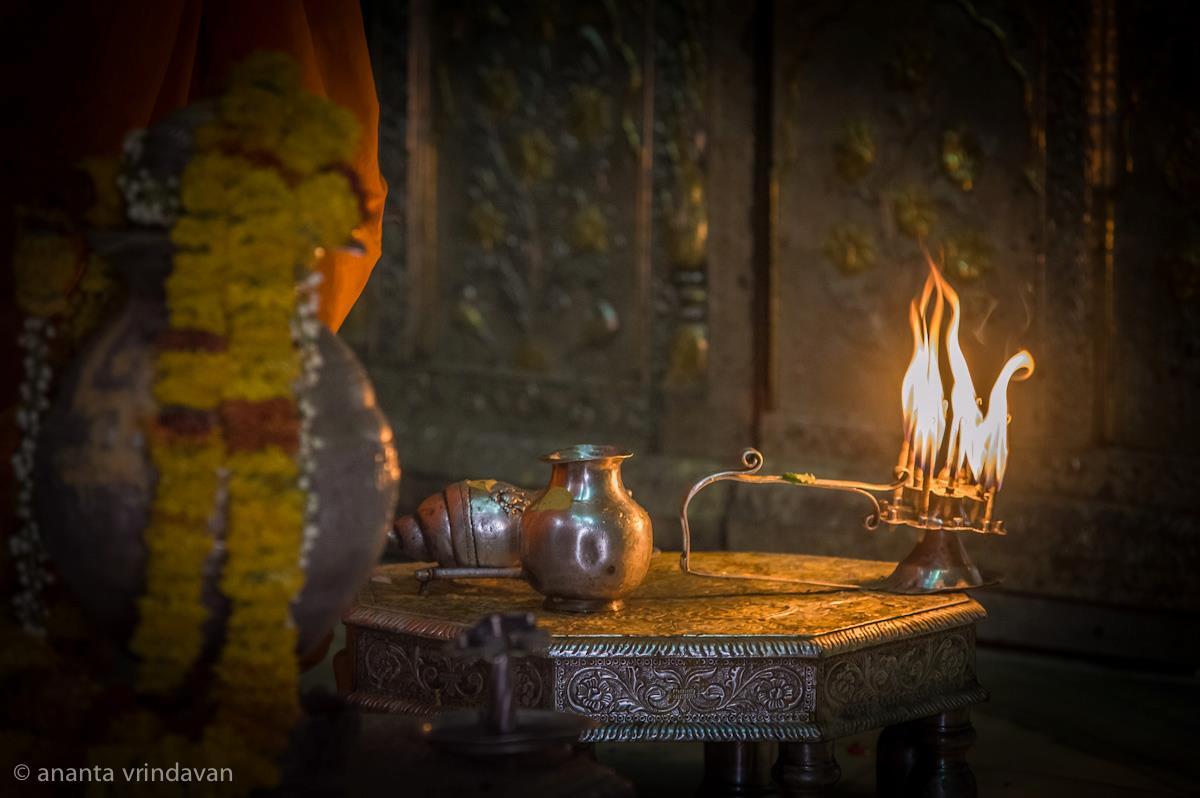
Narahari Chakravarti Thakura is remembered today for what he wrote. But the sources that describe his own daily life remember him almost entirely for what he cooked. Narahari spent the greater part of his adult life in the personal service of Radha-Govindaji in Vrindavana. As the tradition puts it, in this he fulfilled both his father's wish and the desire of the Deity Himself. He continued this work into his seventies, long after most temple servants would have passed such labor on to younger people.
The Expert Cook-Priest #
Narahari became known as *rasoi pujari*, the cook-priest who was expert in preparing food that truly pleased the Deity, not only food that was correct by the rules of ritual. Sources describe a man personally chosen for this role. He was trusted to turn Vrindavana's simple offerings (grain, ghee, milk, seasonal fruit) into preparations fit for Govindaji's table. It was skilled, repetitive work that few people saw, done daily for decades. Apart from what he wrote, it is almost all that is recorded about how Narahari actually spent his time.
Beyond the Kitchen #
The cooking was only part of it. Traditional accounts say he also did many other daily chores, the hardest and least honoured jobs in a temple. He ground sandalwood into paste for the Deity's decoration, collected firewood, swept the temple courtyard, and picked tulasi leaves and manjaris for offering. He also fanned Govindaji from outside the sanctum by pulling a rope connected to a hanging fan. None of these tasks needed the learning he clearly had. Sources agree that he was well trained in Sanskrit, in the bhakti-shastras, and in classical music and dance. Yet there is no record that he used any of this learning to gain a more visible position.
"I Have No Right" #
Apart from his books, only a little of Narahari's own direct speech survives, and it is about this very question of position. The temple's priests reportedly urged him to stop doing service so far beneath a scholar of his standing. Later retellings preserve his answer, humble as always: he considered himself unfit for any higher service at all, and called it a mercy that he was permitted to do even this much. These may be his exact words, or they may be a devotional retelling handed down through generations. Either way, the nature they describe fits everything else known about him. He was a man content to remain, in his own words elsewhere, "most fallen," while quietly doing more work than ten ordinary servants.
A Humility That Shaped How He Wrote #
He showed this same humility directly in his writing. In the opening lines of the Narottama-vilasa, Narahari does not introduce himself as a scholar-historian. He calls himself "an illiterate fool who knows nothing of right or wrong," who writes only because he was "ordered by saintly persons" to do so. He spent decades grinding sandalwood and gathering firewood, not claiming a teacher's seat. So these words do not seem to be only a writer's polite custom. They seem to be a fair description of how he really saw himself. Later Vaishnavas at Vrindavana are said to have admired this same humility in him especially, more than any dramatic episode. The Vrajavasis among whom he lived are recorded as speaking often of his good qualities, for the very reason that he never wanted to be spoken of at all.
Service Without a Chronicle #
No source available records when Narahari began this service, when he ended it, or how his final years passed. This gap fits everything else known about him. The man who wrote down the lives of an entire generation of Gaudiya Vaishnavas left no similar record of his own disappearance. Only the general outline of his life is certain. He was a trained scholar who gave himself to a servant's labor for decades. He offered this service without any apparent wish for it to be remembered.
Chapter 2
The Bhakti-ratnakara and a Library of Lives
What each of his major works covers, and how deeply Gaudiya Vaishnava history has come to depend on them.
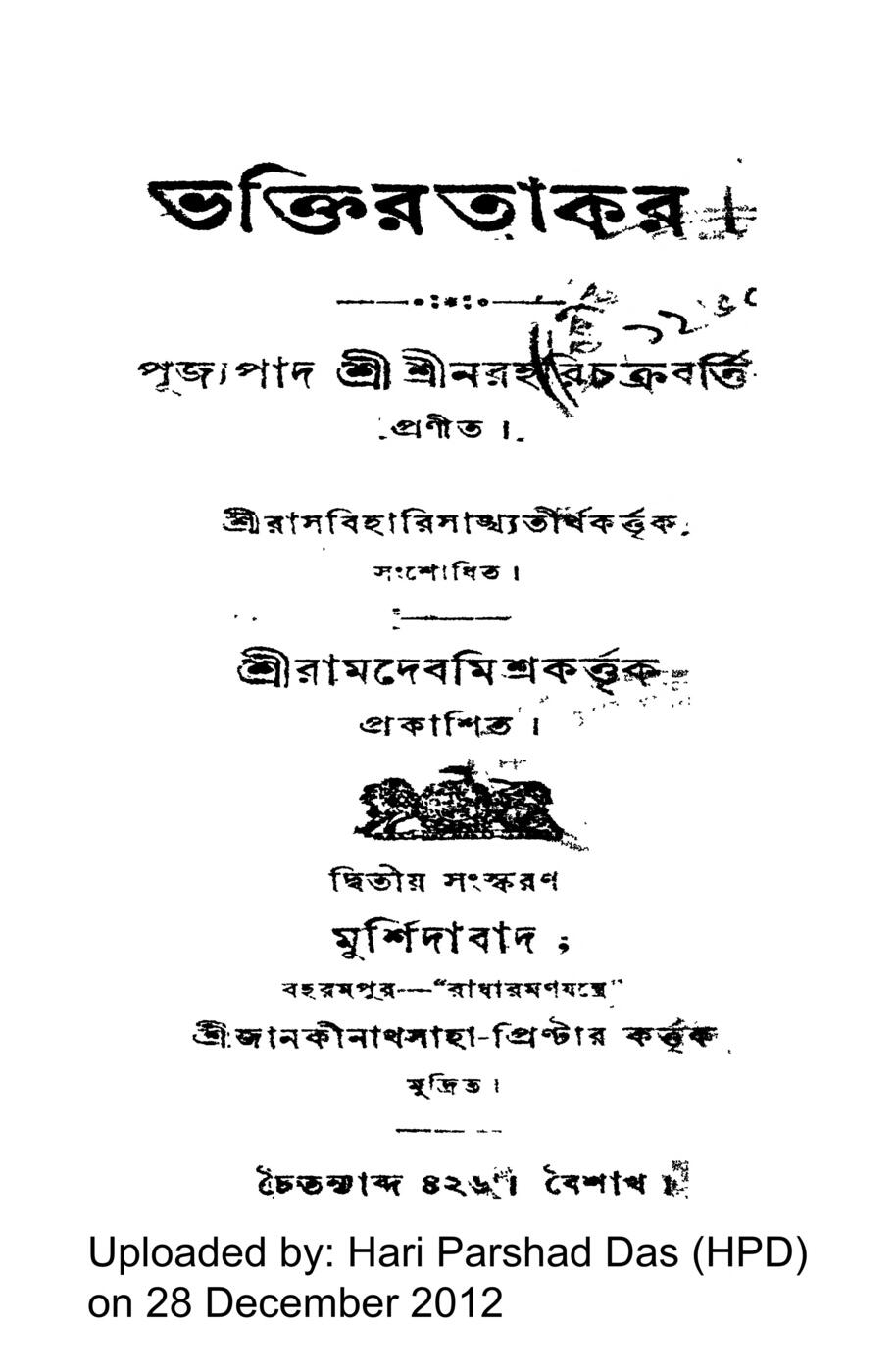
Without his books, Narahari Chakravarti Thakura would be a temple cook whose name very likely would not have survived at all. With them, he becomes the single most important source for the story of an entire generation of Gaudiya Vaishnava history. No one else took the trouble to write about that generation at such length. Through the Bhakti-ratnakara, the Narottama-vilasa, and a handful of shorter works, Narahari did for the generation after Mahaprabhu's own associates roughly what Krishnadasa Kaviraja Goswami's Sri Chaitanya-charitamrita did for Mahaprabhu's own lifetime.
The Bhakti-ratnakara Itself #
The Bhakti-ratnakara, "the jewel-mine of devotional service," is organized into a series of chapters that the text calls *tarangas*, or waves. In its full form there are well over a dozen of them. Its main subject is the period after Mahaprabhu's disappearance. Narottama Dasa Thakura and Shrinivasa Acharya returned from Vrindavana to Bengal, carrying the writings of the Six Goswamis. They met resistance there, and in the end acceptance. Then came the Kheturi festival, which for the first time drew Gaudiya Vaishnavism's scattered followers into a single community. Later sections turn to the sacred places of Vraja itself. They describe individual forests, ponds and pilgrimage sites in such close detail that only someone who had actually walked there could have given it.
Quoted Inside Chaitanya-charitamrita Itself #
The Gaudiya Vaishnava tradition has always taken this work seriously. The clearest sign of this is that Srila Prabhupada's purports draw on it directly, inside Sri Chaitanya-charitamrita's account of Mahaprabhu's tour of Vrindavana's twelve forests. Srila Prabhupada's purport to Chaitanya-charitamrita Madhya-lila 16.207 names the author openly, "Sri Narahari Cakravarti, or Ghanasyama dasa, has written in his Bhakti-ratnakara," and then quotes his description of the town of Kuliya-pahadapura. Elsewhere in these purports, the Bhakti-ratnakara is cited again and again for descriptions of Vraja's forests, including Kamyavana, Mahavana and Khadiravana. So the purports to one of Gaudiya Vaishnavism's own most authoritative texts rely on Narahari Chakravarti as a source, more than two centuries after Narahari himself was writing.
The Narottama-vilasa #
The Bhakti-ratnakara covers an entire generation. The Narottama-vilasa narrows its focus to one person, Narottama Dasa Thakura himself. It follows him from his princely birth at Kheturi, through his discipleship under Lokanatha Gosvami and his years of study in Vrindavana, to his return to Bengal. Together with the Bhakti-ratnakara, it is still one of the two main traditional sources for Narottama's life. Later writers draw on it, including the compilers of the biography of Narottama Dasa Thakura, because no other surviving account tells his story in such detail.
The Smaller Works #
Narahari is also credited with several shorter works. Shrinivasa-charita is a life of Narottama's missionary companion Shrinivasa Acharya. Gaura-charitra-samudra and Namamrita-samudra are further collections of devotional history. Sangita-sara-sangraha draws on his own training in classical music. Navadvipa-dhama-parikrama is a guide to the sacred sites of Nadia district. Srila Prabhupada's Chaitanya-charitamrita purports also cite this last work by name, along with the Bhakti-ratnakara. None of these has the same standing as his two major works. But together they show that, book after book, he kept returning to the same task: writing down what would otherwise have been lost.
A Debt Only Now Being Named #
This has a practical side too. On this website, the account of Narottama Dasa Thakura's final days draws directly on the Bhakti-ratnakara's version of events. The story of Gadadhara Pandit's grief in the months after Mahaprabhu's disappearance quotes Narahari Chakravarti's description of an old man repeating the Lord's name with his eyes closed. In both cases, the Vaishnava who actually supplied the account was never named until now. The same thing happens across pages touching Sanatana Goswami and the circle around Shrinivasa Acharya. There is a small irony here, and it fits the man himself. He stayed so far in the background of his own books that even the sites built on his research can go years without giving him credit by name.
An Honest Gap #
No source available gives a firm date for when the Bhakti-ratnakara was composed. The sources say only that it was written after the events it describes. Its author's own father had studied under Vishvanatha Chakravarti Thakura. This places its composition somewhere in the late 1600s or early 1700s. The sources used here gave no manuscript history or scholarly dating to narrow that further. So we do not try to invent a more exact date than the evidence supports.
Scriptural evidence for this chapter (2)
kuliyā pāhāḍapura dekha śrīnivāsa / pūrve 'koladvīpa'-parvatākhya — e pracāra
"O Srinivasa, just see the town of Kuliya-pahadapura, which was previously known as Koladvipa."
From the purport: Purport excerpt: "Sri Narahari Cakravarti, or Ghanasyama dasa, has written in his Bhakti-ratnakara."
Srila Prabhupada's own purport to Chaitanya-charitamrita directly names Narahari Chakravarti Thakura (as Ghanashyama Dasa) as the author of the Bhakti-ratnakara, and quotes his description of a Navadvipa-area town, the clearest primary confirmation of his authorship and identity used here.
ei kāmyavane kṛṣṇa-līlā manohara / karibe darśana sthāna kuṇḍa bahutara / kāmyavane yata tīrtha lekhā nāhi tāra
"In this Kamyavana, Krishna performed enchanting pastimes. Here you will be able to take darshan of many ponds and other transcendental spots. I cannot even describe in writing all the sacred tirthas found at Kamyavana."
Srila Prabhupada's purport to this verse of Chaitanya-charitamrita quotes the Bhakti-ratnakara's description of Kamyavana, one of Vrindavana's twelve forests, during the book's account of Mahaprabhu's Vraja-mandala parikrama, clear evidence that Narahari Chakravarti's geographical writing is still treated as authoritative.
Closing
Not the Same Narahari #
Gaudiya Vaishnava history has two important devotees named Narahari, who lived well over a century apart. Their almost identical names have confused readers ever since. Narahari Sarkar Thakura was born around 1479-80 into a physician (vaidya) family of Shrikhanda in Bengal. He became one of Mahaprabhu's own direct associates, and by tradition he personally fanned the Lord with a camara. He led the devotional circle of poets at Shrikhanda along with Raghunandana Thakura and others. He wrote his own short works of Bengali devotional poetry, but none of them are the books associated with Narahari Chakravarti Thakura. Narahari Chakravarti Thakura belongs to a different family and a completely different century. He was born after Narahari Sarkar's own disciples had already passed away. His connection to Mahaprabhu's own generation is only ever second-hand or third-hand. It comes through the very books he wrote about that generation.
A Family of Scholars, a Guru of His Own Choosing #
The little that is recorded about Narahari Chakravarti's family shows that he came from a respected Brahmana household. His father, Jagannatha Vipra, was known as a disciple of Vishvanatha Chakravarti Thakura, the Vrindavana commentator whose Sarartha-darsini shaped so much of later Gaudiya Vaishnava theology. But Narahari himself did not take initiation in his father's line. His own diksha guru was Narasimha Chakravarti, a spiritual descendant of Shrinivasa Acharya. So Narahari's branch of the parampara runs back through Shrinivasa Acharya, Narottama Dasa Thakura's own missionary companion. It does not run through Vishvanatha Chakravarti's line, which his father had followed. Sources describe him from youth as a lifelong celibate. They also describe him as unusually accomplished in classical music, dance and the playing of instruments, and thoroughly trained in the bhakti-shastras. His books would later use these talents in a special way, since Bhakti-ratnakara is itself composed as devotional poetry meant to be sung.
A Source Already Relied On Elsewhere #
The Bhakti-ratnakara has shaped later Gaudiya Vaishnava memory so deeply that it is quoted, by name, inside Sri Chaitanya-charitamrita itself. It is not quoted in Krishnadasa Kaviraja Goswami's own verses, which were written long before it. It is quoted in Srila Prabhupada's purports, which draw on it for details of Vrindavana's sacred geography. His purport to Chaitanya-charitamrita Madhya-lila 16.207 names Narahari Chakravarti directly as its author. On this website too, the account of Narottama Dasa Thakura's final days and the story of Gadadhara Pandit's grief after Mahaprabhu's disappearance both draw on the Bhakti-ratnakara as a source. But until now they never named the Vaishnava who actually wrote it. The same is true of the pages on Sanatana Goswami and several of the associates around Shrinivasa Acharya. That gap should be put right.
What Is Not Known #
The real difficulty in writing about Narahari Chakravarti Thakura comes from the kind of writer he was. He was a biographer, not the subject of a biography. The sources keep many small details about the devotees he wrote about, but they keep almost nothing like that about him. No source available gives a year of birth or disappearance, and none names the village where he was born. What survives instead is a general picture, not a timeline. He came from a Brahmana family. He chose a guru outside his father's own line. He gave decades of humble kitchen service at Govindaji's temple. And he left a shelf of books. Between them, those books are the reason so much of Gaudiya Vaishnavism's second and third generations is remembered at all.
- Narahari Chakravarti Thakura - Gaudiya History
- Narahari Cakravarti Thakura - Stephen Knapp
- Narahari Sarakara Thakura - Biography - Gaudiya History
- Sri Caitanya-caritamrita, Madhya-lila 16.207, purport
- Narottama-vilasa, by Narahari Chakravarti Thakura, tr. Dravida Dasa
- Bhakti Ratnakar (Bengali) - Internet Archive
