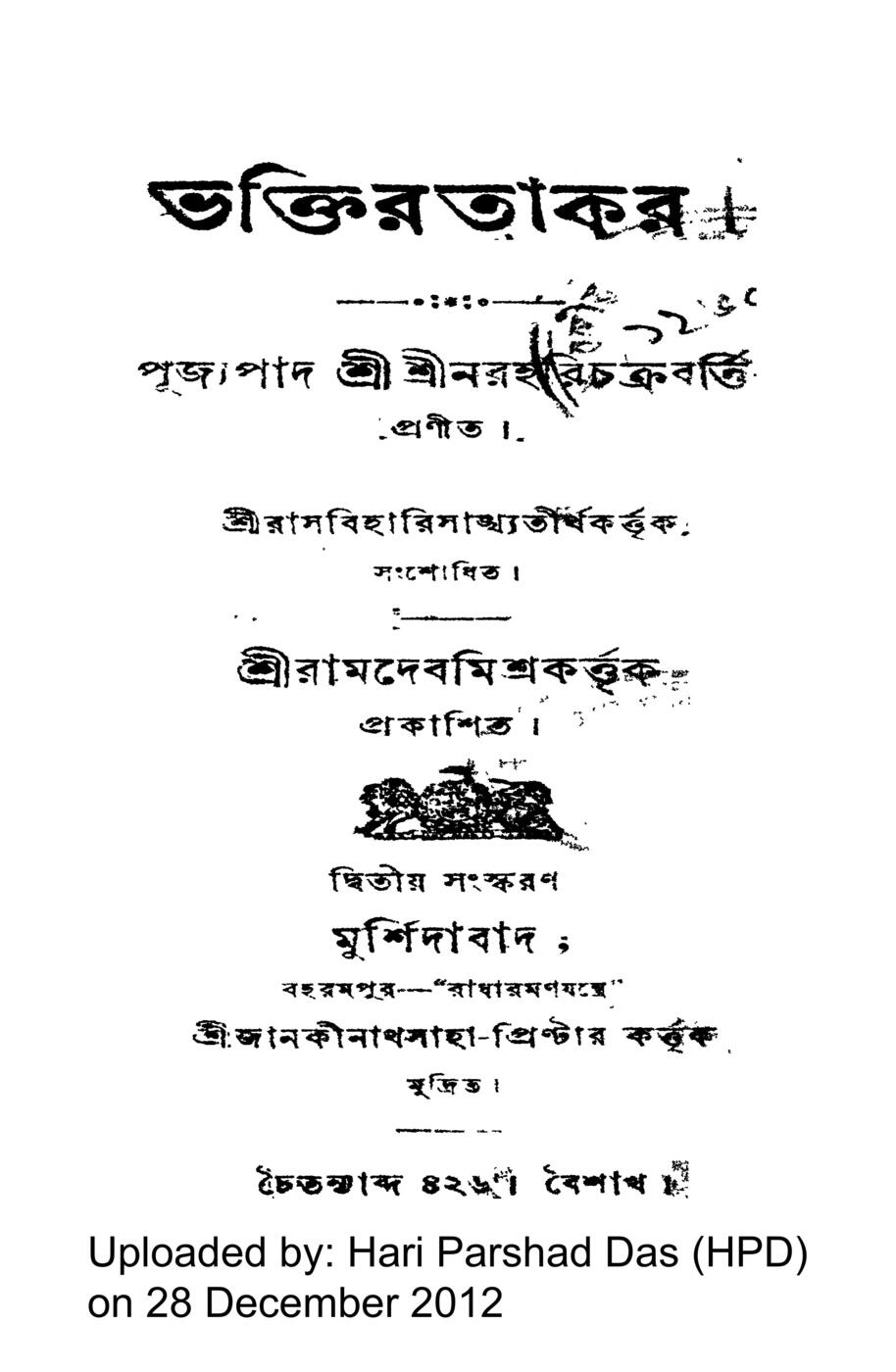
Without his books, Narahari Chakravarti Thakura would be a temple cook whose name very likely would not have survived at all. With them, he becomes the single most important source for the story of an entire generation of Gaudiya Vaishnava history. No one else took the trouble to write about that generation at such length. Through the Bhakti-ratnakara, the Narottama-vilasa, and a handful of shorter works, Narahari did for the generation after Mahaprabhu's own associates roughly what Krishnadasa Kaviraja Goswami's Sri Chaitanya-charitamrita did for Mahaprabhu's own lifetime.
The Bhakti-ratnakara Itself #
The Bhakti-ratnakara, "the jewel-mine of devotional service," is organized into a series of chapters that the text calls *tarangas*, or waves. In its full form there are well over a dozen of them. Its main subject is the period after Mahaprabhu's disappearance. Narottama Dasa Thakura and Shrinivasa Acharya returned from Vrindavana to Bengal, carrying the writings of the Six Goswamis. They met resistance there, and in the end acceptance. Then came the Kheturi festival, which for the first time drew Gaudiya Vaishnavism's scattered followers into a single community. Later sections turn to the sacred places of Vraja itself. They describe individual forests, ponds and pilgrimage sites in such close detail that only someone who had actually walked there could have given it.
Quoted Inside Chaitanya-charitamrita Itself #
The Gaudiya Vaishnava tradition has always taken this work seriously. The clearest sign of this is that Srila Prabhupada's purports draw on it directly, inside Sri Chaitanya-charitamrita's account of Mahaprabhu's tour of Vrindavana's twelve forests. Srila Prabhupada's purport to Chaitanya-charitamrita Madhya-lila 16.207 names the author openly, "Sri Narahari Cakravarti, or Ghanasyama dasa, has written in his Bhakti-ratnakara," and then quotes his description of the town of Kuliya-pahadapura. Elsewhere in these purports, the Bhakti-ratnakara is cited again and again for descriptions of Vraja's forests, including Kamyavana, Mahavana and Khadiravana. So the purports to one of Gaudiya Vaishnavism's own most authoritative texts rely on Narahari Chakravarti as a source, more than two centuries after Narahari himself was writing.
The Narottama-vilasa #
The Bhakti-ratnakara covers an entire generation. The Narottama-vilasa narrows its focus to one person, Narottama Dasa Thakura himself. It follows him from his princely birth at Kheturi, through his discipleship under Lokanatha Gosvami and his years of study in Vrindavana, to his return to Bengal. Together with the Bhakti-ratnakara, it is still one of the two main traditional sources for Narottama's life. Later writers draw on it, including the compilers of the biography of Narottama Dasa Thakura, because no other surviving account tells his story in such detail.
The Smaller Works #
Narahari is also credited with several shorter works. Shrinivasa-charita is a life of Narottama's missionary companion Shrinivasa Acharya. Gaura-charitra-samudra and Namamrita-samudra are further collections of devotional history. Sangita-sara-sangraha draws on his own training in classical music. Navadvipa-dhama-parikrama is a guide to the sacred sites of Nadia district. Srila Prabhupada's Chaitanya-charitamrita purports also cite this last work by name, along with the Bhakti-ratnakara. None of these has the same standing as his two major works. But together they show that, book after book, he kept returning to the same task: writing down what would otherwise have been lost.
A Debt Only Now Being Named #
This has a practical side too. On this website, the account of Narottama Dasa Thakura's final days draws directly on the Bhakti-ratnakara's version of events. The story of Gadadhara Pandit's grief in the months after Mahaprabhu's disappearance quotes Narahari Chakravarti's description of an old man repeating the Lord's name with his eyes closed. In both cases, the Vaishnava who actually supplied the account was never named until now. The same thing happens across pages touching Sanatana Goswami and the circle around Shrinivasa Acharya. There is a small irony here, and it fits the man himself. He stayed so far in the background of his own books that even the sites built on his research can go years without giving him credit by name.
An Honest Gap #
No source available gives a firm date for when the Bhakti-ratnakara was composed. The sources say only that it was written after the events it describes. Its author's own father had studied under Vishvanatha Chakravarti Thakura. This places its composition somewhere in the late 1600s or early 1700s. The sources used here gave no manuscript history or scholarly dating to narrow that further. So we do not try to invent a more exact date than the evidence supports.
