Pradyumna Brahmachari
The Branch Renamed Nrisimhananda for His Devotion to Lord Nrisimhadeva
The complete life, on one page: The main biography and every pastime page, in order, in one place
Introduction
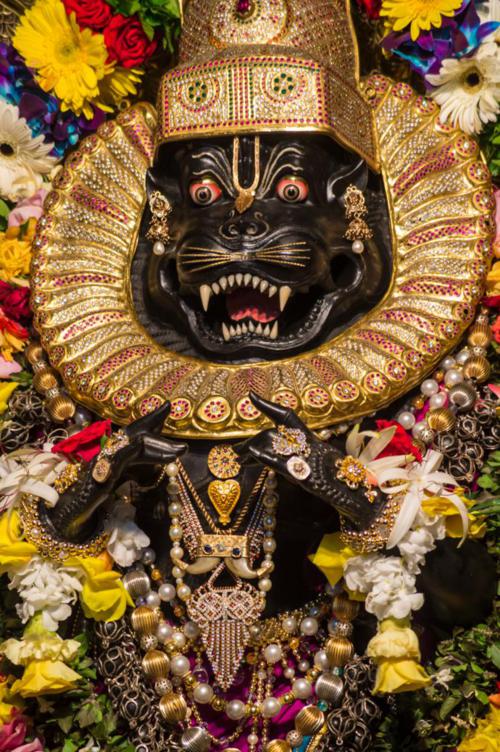
Pradyumna Brahmachari appears in Sri Chaitanya-charitamrita as one of the named "branches" of the tree that is Sri Chaitanya Mahaprabhu himself. These devotees were so close to the Lord that Krishnadasa Kaviraja Goswami pictures them as limbs growing from His body. Pradyumna was deeply absorbed in the worship of Lord Nrisimhadeva, so Mahaprabhu gave him a new name, Nrisimhananda Brahmachari. His two best-known pastimes are told under this name. In one, he built a road entirely in meditation. In the other, the Lord ate a feast without ever physically arriving.
| Detail | Description |
|---|---|
| Original name | Pradyumna Brahmachari |
| Renamed by Mahaprabhu | Nrisimhananda Brahmachari (for his worship of Lord Nrisimhadeva) |
| Identity | In his heart Lord Nrisimhadeva was manifest; Mahaprabhu appeared before him by avirbhava (Chaitanya-charitamrita Adi 10.35 purport; Antya 2.5-6) |
| Status | Named the thirteenth branch of the Chaitanya tree |
| Known for | Mentally decorating Mahaprabhu's road to Vrindavana; feeding the Lord in meditation at Kumarahatta |
| Central sources | Sri Chaitanya-charitamrita, Adi-lila 10.35; Madhya-lila 1.155-162; Antya-lila, Chapter 2 |
| Birth / disappearance | Not recorded in the available sources |
Scriptural evidence for the introduction (3)
sri-nrsimha-upasaka — pradyumna brahmacari / prabhu tanra nama kaila 'nrsimhananda' kari'
Word for word
sri-nrsimha-upasaka: the worshiper of Lord Nrsimhadeva; pradyumna brahmacari: of the name Pradyumna Brahmacari; prabhu: the Lord; tanra: his; nama: name; kaila: turned into; nrsimhananda: of the name Nrsimhananda; kari': by such a name
The thirteenth branch was Pradyumna Brahmacari. Since he was a worshiper of Lord Nrsimhadeva, Sri Caitanya Mahaprabhu changed his name to Nrsimhananda Brahmacari.
From the purport: Purport excerpt: "The Gaura-ganoddesa-dipika (74) says, avesas ca tathajneyo misre pradyumna-samjnake: Sri Caitanya Mahaprabhu changed the name of Pradyumna Misra, or Pradyumna Brahmacari, to Nrsimhananda Brahmacari, for in his heart Lord Nrsimhadeva was manifest."
The verse that names and renames this devotee, and the exact line whose interpretation (Bhaktisiddhanta Sarasvati Thakura reads it as referring to Pradyumna Brahmachari specifically, not the Puri devotee Pradyumna Mishra) is the root of the biography's disambiguation note.
saksat-darsana, ara yogya-bhakta-jive / 'avesa' karaye kahan, kahan 'avirbhave'
The Lord delivered the fallen souls in some places by meeting them directly, in other places by empowering a pure devotee, and in still other places by appearing before someone Himself.
States the three categories in which the Lord delivered souls: direct meeting, avesha (the Lord entering a worthy devotee) and avirbhava (the Lord appearing before someone). The next verses (Antya 2.5-6) apply avesha to Nakula Brahmachari and avirbhava to Pradyumna Brahmachari (Nrisimhananda).
‘সাক্ষাৎ-দর্শনে’ প্রায় সব নিস্তারিলা ।
নকুল-ব্রহ্মচারীর দেহে ‘আবিষ্ট’ হইলা ॥ ৫ ॥
প্রদ্যুম্ন-নৃসিংহানন্দ আগে কৈলা ‘আবির্ভাব’ ।
‘লোক নিস্তারিব,’ — এই ঈশ্বর-স্বভাব ॥ ৬ ॥
'sākṣāt-darśane' prāya saba nistārilā
nakula-brahmacārīra dehe 'āviṣṭa' ha-ilā
pradyumna-nṛsiṁhānanda āge kailā 'āvirbhāva'
'loka nistāriba', — ei īśvara-svabhāva
Śrī Caitanya Mahāprabhu delivered almost all the fallen souls by directly meeting them. He delivered others by entering the bodies of great devotees, such as Nakula Brahmacārī. And He delivered still others by appearing before them, as in the case of Nṛsiṁhānanda Brahmacārī. “I shall deliver the fallen souls.” This statement characterizes the Supreme Personality of Godhead.
Krishnadasa Kaviraja Goswami's own statement of the three ways the Lord delivered souls: directly, by avesha (entering Nakula Brahmachari), and by avirbhava (appearing before Pradyumna Brahmachari, called Nrisimhananda). Translation: Srila Prabhupada.
Chapter 1
The Road Built in Meditation
Nrisimhananda Brahmachari mentally paves an entire road for Mahaprabhu, and his meditation itself tells him how far the Lord will actually go.
After His long tour of South India, Sri Chaitanya Mahaprabhu returned to Jagannatha Puri. Some time later He set out again, this time north, along the Ganges through Bengal, intending to reach Vrindavana. On the way He stopped at the house of Sarvabhauma Bhattacharya's brother, Madhusudana Vachaspati, in Vidyanagara. He freed two offenders in the village of Kuliya, and He met Rupa Gosvami and Sanatana Gosvami for the first time at Ramakeli. Chaitanya-charitamrita tells this journey in detail in the opening part of Madhya-lila.
Building a Road with the Mind #
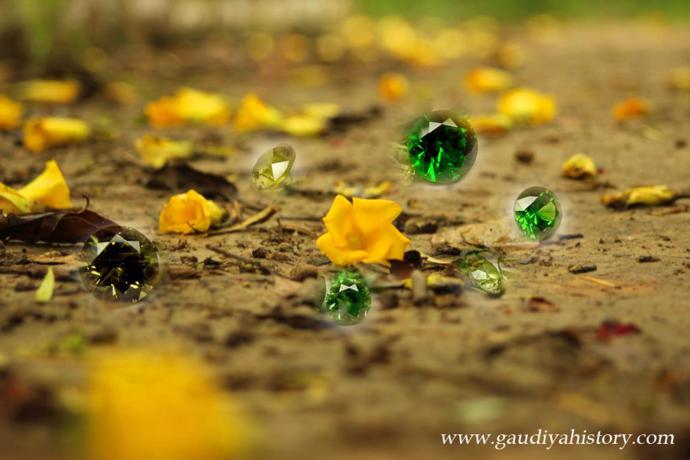
When Nrisimhananda Brahmachari heard that Mahaprabhu intended to travel all the way to Vrindavana, he could not simply wait for news. Chaitanya-charitamrita describes what he did instead. Sitting in meditation, he began to build the Lord a road in his mind. He started from the city of Kuliya. He laid down a broad path, decorated it with jewels, and over that he spread a bed of stemless flowers. Along both sides he planted rows of bakula trees. At intervals he set transcendental lakes. Their bathing places were built of jewels, the lakes were filled with blossoming lotuses, and chirping birds were all around them. The water itself was like nectar. Cool, fragrant breezes moved the length of the whole road (Chaitanya-charitamrita, Madhya-lila 1.155-159).
This was not idle daydreaming. In the devotional literature, such mental construction is a recognized form of service known as manasi-seva, service performed entirely within the mind. It is treated as no less real than service performed with actual ingredients. Rupa Gosvami himself makes this point in his Bhakti-rasamrita-sindhu (1.2.182). He gives the example of a brahmana of Pratishthanpura who reached the association of Lord Narayana in Vaikuntha purely through manasi-seva. Nrisimhananda's meditation was this same kind of service. It was an offering made of nothing but the mind's deep attention, and it was taken as seriously as any physical gift.
Where the Road Stopped #
Nrisimhananda carried his imagined road onward, mile after meditated mile, until it reached a place called Kanai Natasala, roughly two hundred miles north of Calcutta, in the Santal Paragana district of Bihar, some five miles from the town of Rajmahal. And there, without warning, his meditation simply would not go any further. He tried, and could not understand why the road refused to extend past that point (Chaitanya-charitamrita, Madhya-lila 1.160).
Nrisimhananda did not treat this as a failure of concentration. He understood its meaning correctly, and he confidently told the other devotees that Mahaprabhu would go only as far as Kanai Natasala on this journey, and then turn back. "The Lord will go to Kanai Natasala and then will return," he said. "All of you will come to know of this later, but I now say this with great assurance" (Chaitanya-charitamrita, Madhya-lila 1.161-162). And that is what happened. On this part of the journey Mahaprabhu did indeed go no further before returning, exactly as the limit of Nrisimhananda's meditation had shown him.
Avesha: The Lord Within #
Krishnadasa Kaviraja Goswami explains elsewhere in Chaitanya-charitamrita that the Lord delivers conditioned souls in three distinct ways: by meeting them directly in His own form, by entering into and empowering a worthy devotee (avesha), and by appearing before someone in a vision (avirbhava). He names two examples together in a single verse: the Lord's avirbhava took place in Nakula Brahmachari, and His avesha in Nrisimhananda Brahmachari (Chaitanya-charitamrita, Antya-lila 2.4-6). Gaudiya commentators point to this avesha, the Lord's power living within and empowering the devotee. With it they explain how Nrisimhananda's meditation could be more than imagination. It explains how a road built in the mind could correctly foretell where the Lord's feet would actually go. And by the same power, Nrisimhananda is remembered as someone who spoke with Lord Nrisimhadeva directly.
What the Episode Says #
The pastime is brief, but it makes a clear point about deep devotional absorption. In the tradition's own understanding, a mind fixed firmly enough on the Lord can know something true about Him. This is not because the devotee is guessing or predicting. It is because such meditation is itself a kind of direct contact. That same contact appears again, more dramatically, in the pastime that comes right after this one. There Nrisimhananda's meditation does not just foresee the Lord's movements. It draws Him bodily to a feast. That pastime is told on The Three Plates at Kumarahatta.
Scriptural evidence for this chapter (2)
'kananira nataçala' haite asiba phirina / janibe pascat, kahilu niscaya karina
Nrsimhananda Brahmacari said, "The Lord will go to Kanai Natasala and then will return. All of you will come to know of this later, but I now say this with great assurance."
The devotee's own confident prediction, spoken to the other devotees once his meditation on the road stopped extending past Kanai Natasala.
When Sri Nrisimhananda Brahmacari heard that Lord Caitanya Mahaprabhu would go to Vrindavana, he became very pleased and mentally began decorating the way there.
The opening verse of the road-building pastime, cited to ground the manasi-seva (mental service) point made in the prose immediately after it.
Chapter 2
The Three Plates at Kumarahatta
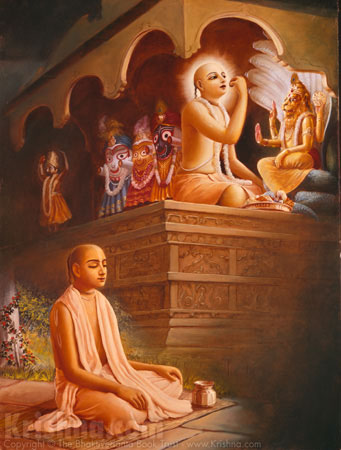
When Mahaprabhu's promised visit to Bengal was delayed, Nrisimhananda Brahmachari brought Him anyway by the power of his meditation. He cooked a real feast for Him, Jagannatha and Nrisimhadeva, and offered it in his meditation.
One year, as Shivananda Sena's nephew Shrikanta Sena left Jagannatha Puri to return to Bengal, Sri Chaitanya Mahaprabhu gave him a message for the Bengali devotees: they need not make the journey to Puri that year, because He Himself would come to Bengal in the month of Pausha. When Shrikanta arrived with this news, the devotees were overjoyed at the prospect. But as Pausha wore on with no sign of the Lord, Shivananda Sena, Jagadananda Pandita and the others who had been waiting grew disheartened.
A Confident Promise #
Just then Nrisimhananda Brahmachari came by and asked why everyone looked so unhappy. They told him they were grieving because the Lord had not come. Then he made them an extraordinary promise: he would bring Mahaprabhu there himself, within three days. Because Shivananda Sena and Jagadananda Pandita already knew something of Nrisimhananda's spiritual power, they believed him and waited.
Nrisimhananda sat down and remained absorbed in meditation for two full days. When he rose, he told Shivananda Sena that Mahaprabhu had already arrived at Panihati, and that by the following noon He would be at Kumarahatta. He asked Shivananda to give him ingredients for a feast. Early the next morning he began cooking a wide variety of preparations. He divided them onto three plates: one for Jagannatha, one for Nrisimhadeva, and one for Mahaprabhu Himself.
The Feast the Lord Actually Ate #
As soon as Nrisimhananda sat down in meditation to make the offering, Chaitanya-charitamrita records, Mahaprabhu personally appeared and ate all three plates, leaving no remnant on any of them (Chaitanya-charitamrita, Antya-lila 2.48-75, summarized). Nrisimhananda then did something on purpose, like acting in a play. Instead of showing his joy openly, he pretended to be upset. He reasoned aloud that in Gaudiya theology Mahaprabhu and Jagannatha are non-different in essence, so there was no real fault in the Lord eating Jagannatha's plate. But why had He also taken the plate meant for Nrisimhadeva? "Nrisimhadeva has fasted today," he complained, as if the Deity had been cheated of His offering.
When Mahaprabhu then left for Panihati, Nrisimhananda cried out that all three plates had been eaten and that both Jagannatha and Nrisimhadeva had gone without. Shivananda Sena, uncertain what to make of any of it, nonetheless supplied him with a second round of ingredients, and Nrisimhananda cooked again, this time offering the meal to Nrisimhadeva alone.
Confirmed a Year Later #
The following year, when Shivananda Sena and the Bengali devotees made their annual journey to Puri, Mahaprabhu Himself brought up the incident unprompted, in front of the whole assembly of devotees. "Last year in the month of Pausha," He said, "when Nrisimhananda gave Me varieties of sweetmeats and vegetables to eat, they were so good that I felt I had never before eaten such preparations" (Chaitanya-charitamrita, Antya-lila 2.77). When the assembled devotees heard the Lord confirm the story in His own words, they were struck with wonder. Shivananda Sena had supplied the ingredients without ever being quite sure what had really happened in his own house. Now he was finally convinced that the meal he had paid for had truly reached Mahaprabhu.
This pastime and The Road Built in Meditation make the same point in two different ways. For a devotee who is deeply enough absorbed, the line between what happens in meditation and what happens in the world is not where an outsider would expect it to be.
Why He Offered to Three Plates #
The detail of the three plates is important. Gaudiya theology holds Sri Chaitanya Mahaprabhu, Lord Jagannatha and Lord Nrisimhadeva to be non-different at the level of the Absolute, even as They appear in different forms to different devotees for different purposes. Nrisimhananda pretended to complain that Nrisimhadeva had been left to fast while Mahaprabhu ate His plate. He was not confused about this teaching. It was a devotee's way of acting it out, so that everyone present could feel the teaching, not just repeat it. A full year later, without being asked, the Lord Himself confirmed the meal. He spoke of it in specific terms and remembered the taste of the sweetmeats. This is what convinced Shivananda Sena's household. Nrisimhananda's meditation had not just imagined a visit from the Lord. It had actually hosted one.
Scriptural evidence for this chapter (1)
'gata-varsa pause more karaila bhojana / kabhu nahi khai aiche mistanna-vyanjana'
The Lord said, "Last year in the month of Pausa, when Nrsimhananda gave Me varieties of sweetmeats and vegetables to eat, they were so good that I felt I had never before eaten such preparations."
Mahaprabhu's own unprompted confirmation, a year later at Puri, of the meal Nrisimhananda had offered him in meditation at Kumarahatta.
Closing
At a Glance #
- Renamed Nrisimhananda by Sri Chaitanya Mahaprabhu himself, for his one-pointed worship of Lord Nrisimhadeva.
- Counted as the thirteenth branch in the list of devotees who form the Chaitanya tree in Chaitanya-charitamrita, Adi-lila.
- Mentally built a jeweled road all the way to a place called Kanai Natasala, and correctly predicted Mahaprabhu would go no further.
- Fed the Lord, Jagannatha and Nrisimhadeva a feast cooked and offered entirely within meditation, and the Lord ate it.
Two Devotees, One Name #
Two entirely different people share almost the same name in the source texts, and they are easy to confuse, so this needs to be made clear. Srila Pradyumna Mishra was the brahmana of Jagannatha Puri whom Mahaprabhu sent to Ramananda Raya to hear krishna-katha (Chaitanya-charitamrita, Antya-lila, Chapter 5). Pradyumna Brahmachari is a different devotee entirely, known for a completely different set of pastimes centered on meditation and on Lord Nrisimhadeva.
The confusion comes from the texts themselves. The Gaura-ganoddesha-dipika (verse 74) is the traditional list of who was who in Krishna-lila and in Gaura-lila. It reads avesas ca tathajneyo misre pradyumna-samjnake: literally, "the Lord's avesha, empowerment, is to be known in the one named Pradyumna Mishra." Srila Prabhupada's own purport to Chaitanya-charitamrita Adi-lila 10.35 applies this verse to Pradyumna Brahmachari. He writes that Mahaprabhu "changed the name of Pradyumna Misra, or Pradyumna Brahmacari, to Nrsimhananda Brahmacari, for in his heart Lord Nrsimhadeva was manifest." In this way, he treats the two names as belonging to one person.
But Srila Bhaktisiddhanta Sarasvati Thakura, in his own Bengali Anubhashya commentary on the same passage, says something different. He states that this verse of Gaura-ganoddesha-dipika refers to Pradyumna Brahmachari specifically, and not to the Orissan Pradyumna Mishra of Jagannatha Puri. The reference work Gaudiya Vaishnava Abhidhana takes the same position. That is the more convincing reading, for two reasons. First, it is the reading Bhaktisiddhanta Sarasvati himself stated clearly. Second, nothing in the two men's stories overlaps. Pradyumna Mishra's episode is a single conversation with Ramananda Raya, set at Jagannatha Puri and told in Antya-lila Chapter 5. Pradyumna Brahmachari's episodes are two acts of meditation, set on the road to Bengal and at Kumarahatta, and told in Madhya-lila Chapter 1 and Antya-lila Chapter 2. Pradyumna Brahmachari is also listed separately as the thirteenth branch of the Chaitanya tree in Adi-lila. Pradyumna Mishra does not appear in that list at all. He is named sixth in a separate list of devotees at Puri (Adi-lila 10.131). So the two men are told apart by where their stories differ, and by where Vaishnava commentators have read them differently, not by the first name they share.
A Branch of the Chaitanya Tree #
In Adi-lila, Chapter 10, Krishnadasa Kaviraja Goswami describes Sri Chaitanya Mahaprabhu as a great tree and names devotee after devotee as one of its branches. Pradyumna Brahmachari is named the thirteenth: "the thirteenth branch was Pradyumna Brahmacari. Since he was a worshiper of Lord Nrsimhadeva, Sri Caitanya Mahaprabhu changed his name to Nrsimhananda Brahmacari" (Chaitanya-charitamrita, Adi-lila 10.35). Elsewhere in the same work, Krishnadasa Kaviraja explains that the Lord delivered conditioned souls in three ways: by meeting them directly, by entering into a worthy devotee (avesha), and by appearing before someone in vision (avirbhava). Antya-lila 2.5-6 places Nrisimhananda Brahmachari in the third group: the Lord appeared before him (avirbhava), while He entered the body (avesha) of Nakula Brahmachari. He is said to have spoken with Lord Nrisimhadeva directly. Vrindavana Dasa Thakura records this detail in Chaitanya-bhagavata, where he describes Nrisimhananda walking in the company of devotees on their annual pilgrimage to Jagannatha Puri.
Legacy #
Apart from these two episodes and his place among the branches of the Chaitanya tree, very little is recorded about him. This should be reported honestly, not filled in with invented details. No source gives a birth or disappearance date for him, and no place of origin is recorded. Many of Mahaprabhu's other associates have a modern biography or a Wikipedia article, but Nrisimhananda Brahmachari has none. His memory rests almost entirely on the handful of verses Krishnadasa Kaviraja Goswami gave him. Srila Prabhupada carried these verses into English in his purports to Chaitanya-charitamrita. But what those verses preserve is very specific and very sweet. They show a devotee whose meditation was so powerful that the Lord Himself came to eat the food he had cooked in it.
- Chaitanya-charitamrita, Adi-lila 10.35 (verse, translation and purport)
- Chaitanya-charitamrita, Adi-lila 10.131 (verse and translation)
- Chaitanya-charitamrita, Antya-lila 2.4-6 (verse and translation)
- Pradyumna Brahmachari — Gaudiya History (ISKCON Desire Tree)
- Pradyumna Mishra — Gaudiya History (ISKCON Desire Tree)
- Pradyumna Brahmachari or Shri Nrisinghananda — Vedic Library, isvara.org (quoting Chaitanya-charitamrita Adi-lila 10.35 purport and Gaura-ganoddesha-dipika 74)
