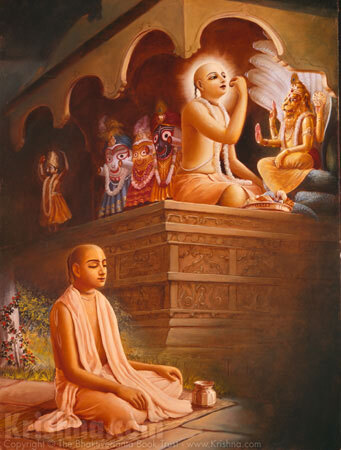
Srila Shivananda Sena
The householder who led Bengal's devotees to Jagannatha Puri every year
Also known as Sivananda Sena, Shivananda Sen, Sena Mahashaya
“Today my birth, my family and my activities have all become successful. Today I have achieved the fulfillment of religious principles, economic development, satisfaction of the senses and ultimately devotional service to Lord Krishna.”
Shivananda Sena's own words to Nityananda Prabhu, spoken with joy immediately after Nityananda Prabhu kicked him for the delay in arranging His lodging (Sri Chaitanya-charitamrita, Antya-lila 12.30)
Srila Shivananda Sena was a householder devotee of Sri Chaitanya Mahaprabhu. In a sense, his service was entirely practical. Every single year, he organized, led and personally paid for the long journey that carried Bengal's devotees from their homes near the Ganges to Jagannatha Puri, where Mahaprabhu spent His last decades. In Sri Chaitanya-charitamrita, Krishnadasa Kaviraja Goswami calls him the Lord's "extremely confidential servant," and Shivananda earned this title entirely through practical work. It came from careful organizing, from hospitality, and from a devotion that showed itself in humble, everyday tasks. Year after year, for a decade or more, he arranged tolls, lodging and food for two or three hundred people.
| Detail | Description |
|---|---|
| Native place | Kumarahatta (Halisahara), on the Ganges, a separate community from Kulina-grama, whose own residents joined his pilgrimage party |
| Caste/community | Vaidya (a Bengali community traditionally linked with medicine and scribal service) |
| Best-known service | Organizing and funding the yearly Bengali pilgrimage to see Sri Chaitanya Mahaprabhu at Jagannatha Puri |
| Family | Wife (unnamed in the sources) and three sons: Chaitanya dasa, Ramadasa and Paramananda dasa |
| Most famous son | Paramananda Sena, later known as Kavi-karnapura, author of Sri Chaitanya-chandrodaya-nataka and Gaura-ganoddesha-dipika |
| Identity | The gopis Vira and Duti of Vrindavana, combined in one person (Gaura-ganoddesha-dipika 176; Chaitanya-charitamrita Adi 10.60 purport) |
| Branch of the Chaitanya tree | Twenty-fourth branch, per Chaitanya-charitamrita, Adi-lila 10.54 |
A Confidential Servant, Not A Public One #
When Krishnadasa Kaviraja Goswami lists the branches and sub-branches of the tree of Sri Chaitanya Mahaprabhu's associates, Shivananda Sena is named directly: "Shivananda Sena, the twenty-fourth branch of the tree, was an extremely confidential servant of Lord Chaitanya Mahaprabhu. Everyone who went to Jagannatha Puri to visit Lord Chaitanya took shelter and guidance from Shri Shivananda Sena." His glory was of a very practical kind. He was not a teacher or a poet, and he did not renounce family life. He was the person whose skill and generosity made it possible for everyone else's pilgrimage to happen at all. His full background is told on a householder in Kumarahatta and Kulina-grama, along with an important correction to how his native village is usually described.
Ten Years Of Journeys To Puri #
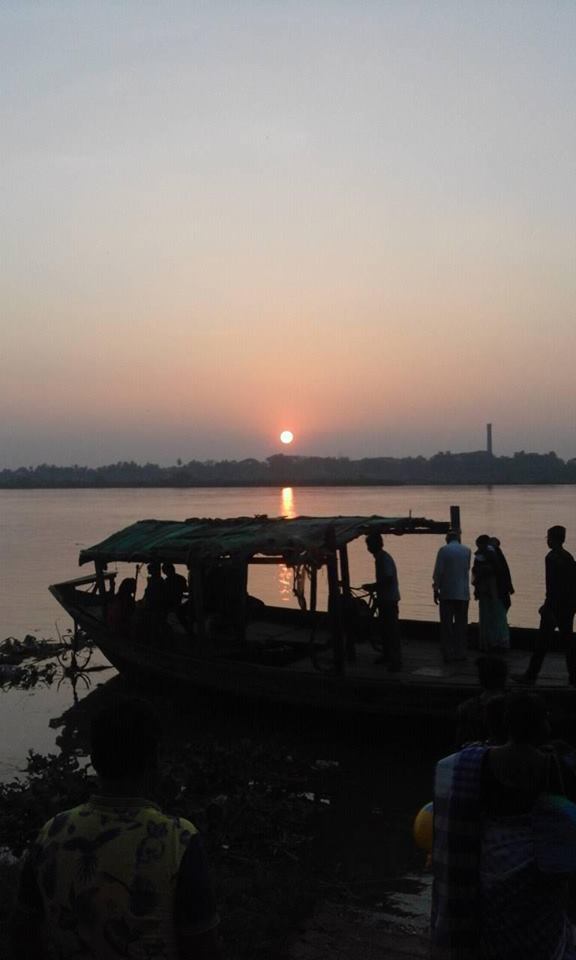
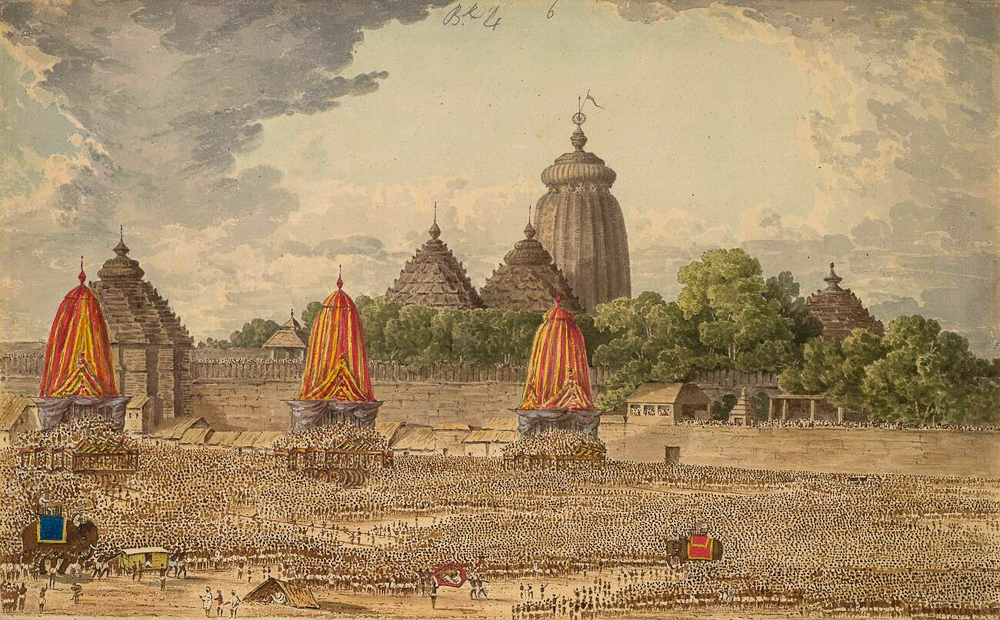
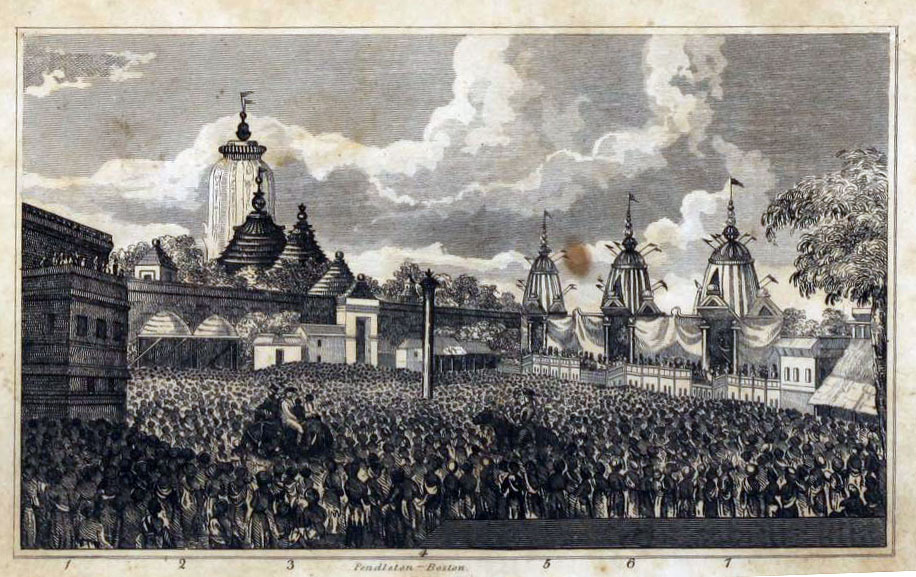
Each year, roughly a month before the rainy season, Shivananda Sena gathered the devotees of Bengal and led them on the long road south to Jagannatha Puri. Among them were Advaita Acharya, Vasudeva Datta, Murari Gupta, and Srivasa Thakura with his brothers. In some years there were two or three hundred devotees in all, including the separate communities of Kulina-grama and Khanda. He paid every toll and arranged every night's lodging, and Chaitanya-charitamrita says that he knew every path into Orissa. He was trusted with more than travel arrangements. Bhaktisiddhanta Sarasvati Thakura records that Shivananda Sena was personally put in charge of supervising the household expenses of Vasudeva Datta. Vasudeva Datta was so famous for giving lavishly and without caution that he needed someone sensible to manage his affairs. One especially difficult year on the pilgrim road led to one of the most quoted episodes in Shivananda's life. Nityananda Prabhu was left waiting for food and shelter, and in anger He cursed Shivananda's three sons. Shivananda's response to that curse is remembered as a model of a servant's humility. Years later, Shivananda showed the same care to protect a devotee. The father of Raghunatha Dasa Goswami sent men to drag his runaway son back from the pilgrim party. Shivananda Sena simply told them the young man had not arrived. The full story of the pilgrimage, the curse, and this quiet act of protection is told at leading the annual pilgrimage to Puri.
The Dog Who Learned To Chant #
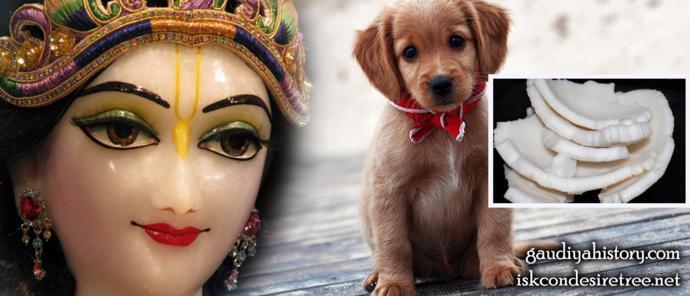
On one of these journeys, a stray dog attached itself to the party. Shivananda Sena looked after it, reluctantly at first. At real cost to himself, he fed it, paid for its river crossing, and searched for it for a night when it went missing. Once the party reached Mahaprabhu at Puri, something happened to that dog that became one of Chaitanya-charitamrita's best-loved proofs that the Lord's mercy is not limited by species. The complete account, verse by verse, is at the mercy shown to a dog.
Father Of Kavi-Karnapura #
Shivananda Sena's youngest son was born at home in Bengal, after his father had come back from a pilgrimage to Puri. Mahaprabhu named the child and joked that he should be called Puri dasa. Once He also let the infant suck His toe. Later Vaishnava writers connect this small gesture directly to the boy's extraordinary gift for Sanskrit poetry. That boy grew up to be Kavi-karnapura, the author of Sri Chaitanya-chandrodaya-nataka and the Gaura-ganoddesha-dipika. This is the same text that is cited for Ramananda Raya's identity in Krishna's pastimes. Kavi-karnapura even writes about his own father. In that same Gaura-ganoddesha-dipika, he records that Shivananda Sena himself was the combined incarnation of two gopis of Vrindavana. The fuller story of this remarkable son is told at his son, Kavi-karnapura.
Here is that verse, in which the son names the two gopis:
purā vṛndāvane vīrā dūtī sarvāś ca gopikāḥ
nināya kṛṣṇa nikaraṁ sedānīṁ janako mama
vraje bindumatī yāsīd adya sā jānakī mama
"The two gopis Vira-devi and Duti-devi, who acted as messengers arranging the gopis' meetings with Lord Krsna, combined to appear as my father (Sivananda Sena)." (Gaura-ganoddesha-dipika 176)
In his purport to Chaitanya-charitamrita Adi 10.60, Srila Prabhupada quotes Srila Bhaktisiddhanta Sarasvati Thakura on the same point: "Paramānanda Sena wrote in his Gaura-gaṇoddeśa-dīpikā (176) that two of the gopīs of Vṛndāvana, whose former names were Vīrā and Dūtī, combined to become his father."
A Life Remembered In Deeds, Not Dates #
No source records when Shivananda Sena was born or when he left this world. Instead, what survives is a set of specific deeds that are well recorded. He built a temple and raised a family in devotion. He protected a Vaishnava from an anxious father's men. And for a decade he led journeys that made it possible for hundreds of ordinary Bengali householders to see their Lord face to face. What is known of his later years, and how the tradition has remembered him since, is gathered at final days and legacy.
The tradition's major sources do not record anywhere who his diksha-guru was. Instead, he is remembered simply as a devoted householder-servant of Sri Chaitanya Mahaprabhu. His whole spiritual life took the form of taking care of other devotees.
Scriptural evidence
Quoted in the text above:
Further verses:
prati-varṣe prabhu-gaṇa saṅgete lā-iyā
nīlācale calena pathe pālana kariyā
Word for word
prati-varṣe: every year; prabhu-gaṇa: the devotees of Lord Caitanya; saṅgete: along with; lā-iyā: taking; nīlācale: to Jagannātha Purī; calena: goes; pathe: on the road; pālana: maintenance; kariyā: providing.
Every year he took a party of devotees from Bengal to Jagannatha Puri to visit Lord Chaitanya. He maintained the entire party as they journeyed on the road.
States directly the yearly pilgrimage and full material support that defines Shivananda Sena's service.
- Sri Chaitanya-charitamrita, Adi-lila 10.54-10.63 (Bhaktivedanta VedaBase)
- Sri Chaitanya-charitamrita, Madhya-lila 1.131-1.140, 16.16-16.27 (Bhaktivedanta VedaBase)
- Sri Chaitanya-charitamrita, Antya-lila 1.17-1.33 (Bhaktivedanta VedaBase)
- Sri Chaitanya-charitamrita, Antya-lila 10.12, 10.123, 10.140-10.151 (Bhaktivedanta VedaBase)
- Sri Chaitanya-charitamrita, Antya-lila 12.7-12.51 (Bhaktivedanta VedaBase)
- Sri Chaitanya-charitamrita, Antya-lila 16.65-16.76 (Bhaktivedanta VedaBase)
- Sri Chaitanya-charitamrita, Antya-lila 6.178-6.182 (Bhaktivedanta VedaBase)
- Shivananda Sena, Gaudiya History (ISKCON Desire Tree)
- Shivananda Sena, Biography (alternate account), Gaudiya History
- Kavi Karnapura Goswami, Biography, Gaudiya History
Frequently asked
When was Srila Shivananda Sena born?
Srila Shivananda Sena appeared Not recorded in Kumarahatta (present-day Halisahara), on the Ganges, Bengal.
When and where did Srila Shivananda Sena disappear?
Srila Shivananda Sena disappeared Not recorded at Traditionally associated with Jagannatha Puri (later tradition places a samadhi there); not described in Sri Chaitanya-charitamrita itself.
What are the main pastimes of Srila Shivananda Sena?
The pastimes covered here include: A Householder In Kumarahatta And Kulina-Grama, Leading The Annual Pilgrimage To Puri, The Mercy Shown To A Dog, His Son, Kavi-Karnapura, Final Days And Legacy.