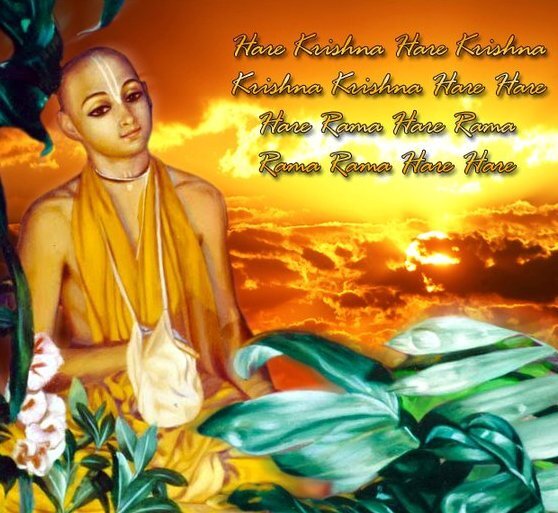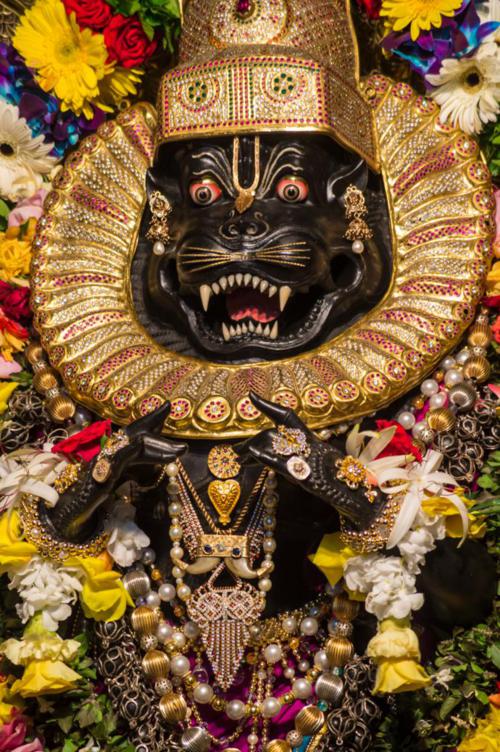
Pradyumna Brahmachari
The Branch Renamed Nrisimhananda for His Devotion to Lord Nrisimhadeva
Also known as Nrisimhananda Brahmachari, Nrsimhananda Brahmacari, Nrisinghananda
“The thirteenth branch was Pradyumna Brahmachari. Since he was a worshiper of Lord Nrisimhadeva, Sri Chaitanya Mahaprabhu changed his name to Nrisimhananda Brahmachari.”
Krishnadasa Kaviraja Goswami, Sri Chaitanya-charitamrita, Adi-lila 10.35
Pradyumna Brahmachari appears in Sri Chaitanya-charitamrita as one of the named "branches" of the tree that is Sri Chaitanya Mahaprabhu himself. These devotees were so close to the Lord that Krishnadasa Kaviraja Goswami pictures them as limbs growing from His body. Pradyumna was deeply absorbed in the worship of Lord Nrisimhadeva, so Mahaprabhu gave him a new name, Nrisimhananda Brahmachari. His two best-known pastimes are told under this name. In one, he built a road entirely in meditation. In the other, the Lord ate a feast without ever physically arriving.
| Detail | Description |
|---|---|
| Original name | Pradyumna Brahmachari |
| Renamed by Mahaprabhu | Nrisimhananda Brahmachari (for his worship of Lord Nrisimhadeva) |
| Identity | In his heart Lord Nrisimhadeva was manifest; Mahaprabhu appeared before him by avirbhava (Chaitanya-charitamrita Adi 10.35 purport; Antya 2.5-6) |
| Status | Named the thirteenth branch of the Chaitanya tree |
| Known for | Mentally decorating Mahaprabhu's road to Vrindavana; feeding the Lord in meditation at Kumarahatta |
| Central sources | Sri Chaitanya-charitamrita, Adi-lila 10.35; Madhya-lila 1.155-162; Antya-lila, Chapter 2 |
| Birth / disappearance | Not recorded in the available sources |
At a Glance #
- Renamed Nrisimhananda by Sri Chaitanya Mahaprabhu himself, for his one-pointed worship of Lord Nrisimhadeva.
- Counted as the thirteenth branch in the list of devotees who form the Chaitanya tree in Chaitanya-charitamrita, Adi-lila.
- Mentally built a jeweled road all the way to a place called Kanai Natasala, and correctly predicted Mahaprabhu would go no further.
- Fed the Lord, Jagannatha and Nrisimhadeva a feast cooked and offered entirely within meditation, and the Lord ate it.
Two Devotees, One Name #
Two entirely different people share almost the same name in the source texts, and they are easy to confuse, so this needs to be made clear. Srila Pradyumna Mishra was the brahmana of Jagannatha Puri whom Mahaprabhu sent to Ramananda Raya to hear krishna-katha (Chaitanya-charitamrita, Antya-lila, Chapter 5). Pradyumna Brahmachari is a different devotee entirely, known for a completely different set of pastimes centered on meditation and on Lord Nrisimhadeva.
The confusion comes from the texts themselves. The Gaura-ganoddesha-dipika (verse 74) is the traditional list of who was who in Krishna-lila and in Gaura-lila. It reads avesas ca tathajneyo misre pradyumna-samjnake: literally, "the Lord's avesha, empowerment, is to be known in the one named Pradyumna Mishra." Srila Prabhupada's own purport to Chaitanya-charitamrita Adi-lila 10.35 applies this verse to Pradyumna Brahmachari. He writes that Mahaprabhu "changed the name of Pradyumna Misra, or Pradyumna Brahmacari, to Nrsimhananda Brahmacari, for in his heart Lord Nrsimhadeva was manifest." In this way, he treats the two names as belonging to one person.
But Srila Bhaktisiddhanta Sarasvati Thakura, in his own Bengali Anubhashya commentary on the same passage, says something different. He states that this verse of Gaura-ganoddesha-dipika refers to Pradyumna Brahmachari specifically, and not to the Orissan Pradyumna Mishra of Jagannatha Puri. The reference work Gaudiya Vaishnava Abhidhana takes the same position. That is the more convincing reading, for two reasons. First, it is the reading Bhaktisiddhanta Sarasvati himself stated clearly. Second, nothing in the two men's stories overlaps. Pradyumna Mishra's episode is a single conversation with Ramananda Raya, set at Jagannatha Puri and told in Antya-lila Chapter 5. Pradyumna Brahmachari's episodes are two acts of meditation, set on the road to Bengal and at Kumarahatta, and told in Madhya-lila Chapter 1 and Antya-lila Chapter 2. Pradyumna Brahmachari is also listed separately as the thirteenth branch of the Chaitanya tree in Adi-lila. Pradyumna Mishra does not appear in that list at all. He is named sixth in a separate list of devotees at Puri (Adi-lila 10.131). So the two men are told apart by where their stories differ, and by where Vaishnava commentators have read them differently, not by the first name they share.
A Branch of the Chaitanya Tree #
In Adi-lila, Chapter 10, Krishnadasa Kaviraja Goswami describes Sri Chaitanya Mahaprabhu as a great tree and names devotee after devotee as one of its branches. Pradyumna Brahmachari is named the thirteenth: "the thirteenth branch was Pradyumna Brahmacari. Since he was a worshiper of Lord Nrsimhadeva, Sri Caitanya Mahaprabhu changed his name to Nrsimhananda Brahmacari" (Chaitanya-charitamrita, Adi-lila 10.35). Elsewhere in the same work, Krishnadasa Kaviraja explains that the Lord delivered conditioned souls in three ways: by meeting them directly, by entering into a worthy devotee (avesha), and by appearing before someone in vision (avirbhava). Antya-lila 2.5-6 places Nrisimhananda Brahmachari in the third group: the Lord appeared before him (avirbhava), while He entered the body (avesha) of Nakula Brahmachari. He is said to have spoken with Lord Nrisimhadeva directly. Vrindavana Dasa Thakura records this detail in Chaitanya-bhagavata, where he describes Nrisimhananda walking in the company of devotees on their annual pilgrimage to Jagannatha Puri.
Two Pastimes Remembered #
We do not have a continuous biography of Nrisimhananda Brahmachari. What survives are two specific, vividly told acts of service done in the mind, both preserved by Krishnadasa Kaviraja Goswami. On Mahaprabhu's journey back toward Bengal after touring South India, Nrisimhananda mentally built and decorated an entire road for the Lord to walk on. His meditation itself told him, correctly, how far the journey would actually go. This is told in full on The Road Built in Meditation. Later, the Bengali devotees at Shivananda Sena's house in Kumarahatta were disheartened because Mahaprabhu had not come as promised. Through his meditation, Nrisimhananda brought the Lord to appear and eat a feast he had cooked. This pastime is told on The Three Plates at Kumarahatta.
Krishnadasa Kaviraja Goswami names the three ways in which the Lord delivered souls, and he places Nrisimhananda Brahmachari in the third group, those before whom the Lord Himself appeared (avirbhava):
'sākṣāt-darśane' prāya saba nistārilā
nakula-brahmacārīra dehe 'āviṣṭa' ha-ilā
pradyumna-nṛsiṁhānanda āge kailā 'āvirbhāva'
"Śrī Caitanya Mahāprabhu delivered almost all the fallen souls by directly meeting them. He delivered others by entering the bodies of great devotees, such as Nakula Brahmacārī. And He delivered still others by appearing before them, as in the case of Nṛsiṁhānanda Brahmacārī." (Chaitanya-charitamrita Antya 2.5-6)
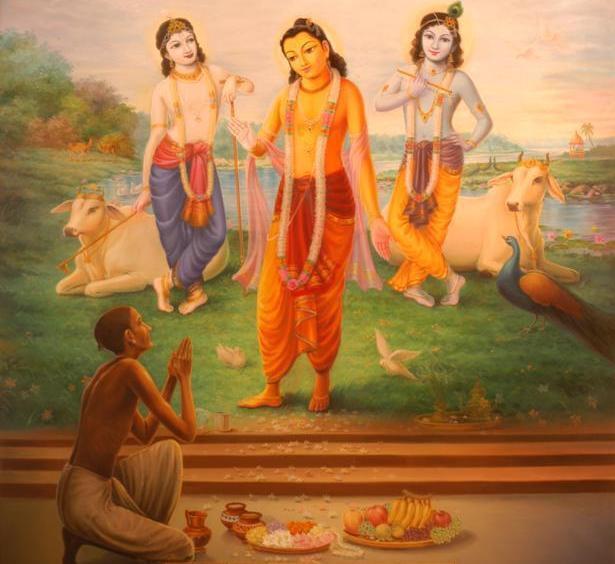
Srila Prabhupada connects this with the Kumarahatta pastime in his purport to Chaitanya-charitamrita Adi 10.35: "While coming from the house of Rāghava Paṇḍita at Pānihāṭi to the house of Śivānanda, Lord Caitanya Mahāprabhu appeared in the heart of Nṛsiṁhānanda Brahmacārī."
Legacy #
Apart from these two episodes and his place among the branches of the Chaitanya tree, very little is recorded about him. This should be reported honestly, not filled in with invented details. No source gives a birth or disappearance date for him, and no place of origin is recorded. Many of Mahaprabhu's other associates have a modern biography or a Wikipedia article, but Nrisimhananda Brahmachari has none. His memory rests almost entirely on the handful of verses Krishnadasa Kaviraja Goswami gave him. Srila Prabhupada carried these verses into English in his purports to Chaitanya-charitamrita. But what those verses preserve is very specific and very sweet. They show a devotee whose meditation was so powerful that the Lord Himself came to eat the food he had cooked in it.
Scriptural evidence
Quoted in the text above:
- Adi 10.35 Sri Chaitanya-charitamrita quoted above ↑
- Antya 2.5-6 Sri Chaitanya-charitamrita quoted above ↑
Further verses:
saksat-darsana, ara yogya-bhakta-jive / 'avesa' karaye kahan, kahan 'avirbhave'
The Lord delivered the fallen souls in some places by meeting them directly, in other places by empowering a pure devotee, and in still other places by appearing before someone Himself.
States the three categories in which the Lord delivered souls: direct meeting, avesha (the Lord entering a worthy devotee) and avirbhava (the Lord appearing before someone). The next verses (Antya 2.5-6) apply avesha to Nakula Brahmachari and avirbhava to Pradyumna Brahmachari (Nrisimhananda).
- Chaitanya-charitamrita, Adi-lila 10.35 (verse, translation and purport)
- Chaitanya-charitamrita, Adi-lila 10.131 (verse and translation)
- Chaitanya-charitamrita, Antya-lila 2.4-6 (verse and translation)
- Pradyumna Brahmachari — Gaudiya History (ISKCON Desire Tree)
- Pradyumna Mishra — Gaudiya History (ISKCON Desire Tree)
- Pradyumna Brahmachari or Shri Nrisinghananda — Vedic Library, isvara.org (quoting Chaitanya-charitamrita Adi-lila 10.35 purport and Gaura-ganoddesha-dipika 74)
Frequently asked
When was Pradyumna Brahmachari born?
Pradyumna Brahmachari appeared Not recorded in Not recorded.
When and where did Pradyumna Brahmachari disappear?
Pradyumna Brahmachari disappeared Not recorded at Not recorded.
What are the main pastimes of Pradyumna Brahmachari?
The pastimes covered here include: The Road Built in Meditation, The Three Plates at Kumarahatta.