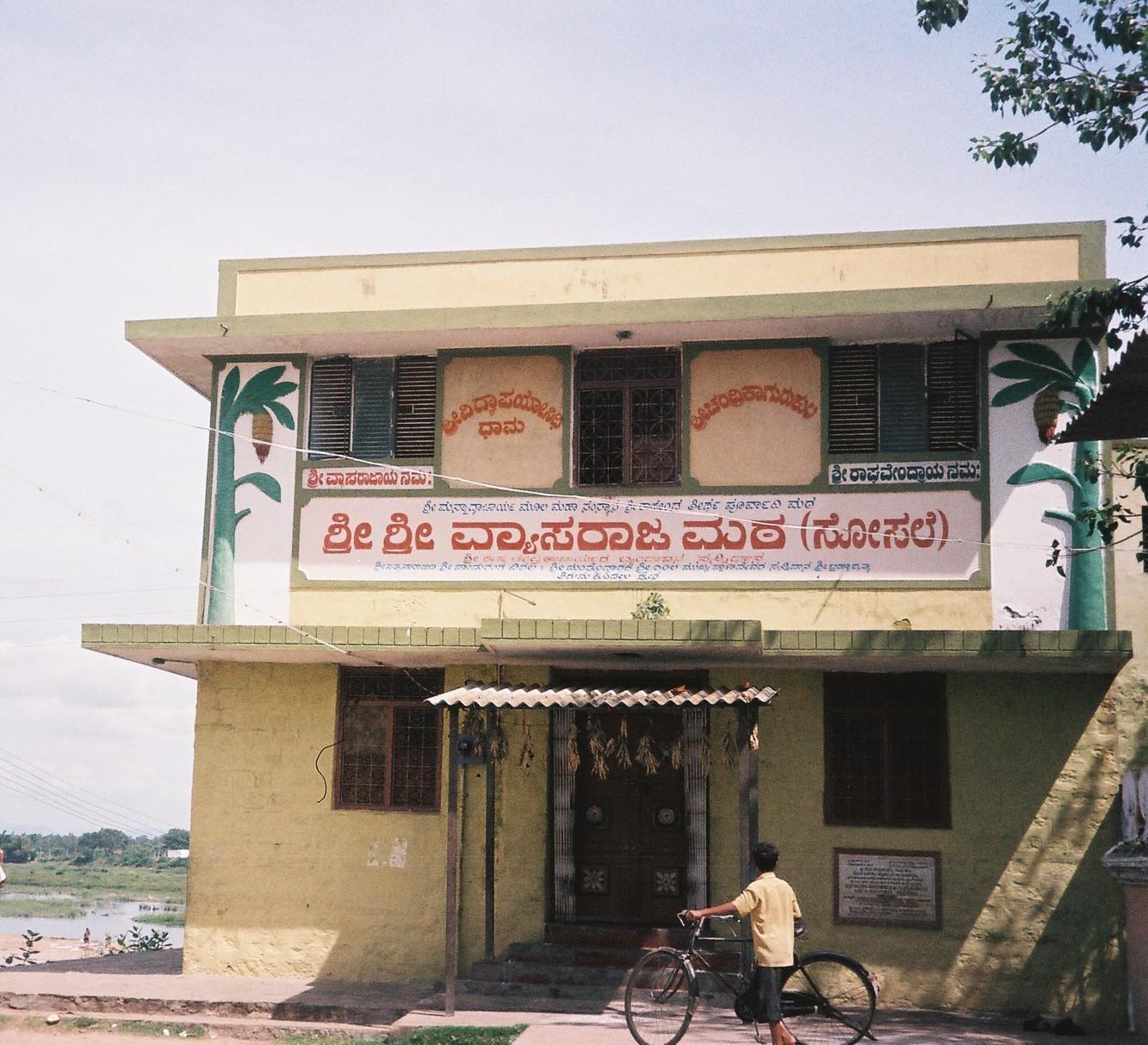
Everything known about Purushottama Tirtha's life comes from the Vyasaraja Matha's own tradition, not from any Gaudiya source. So this account stays close to what that tradition itself records, including the places where its own dates do not quite add up.
A Name Chosen At Puri #
The Vyasaraja Matha remembers that before taking sannyasa, Purushottama Tirtha was called Srinivasacharya. His guru was Jayadhvaja Tirtha, the ninth head of the succession coming down from Rajendra Tirtha. Jayadhvaja Tirtha is the same person the Gaudiya guru-parampara list calls Jayadharma. Tradition places the ordination itself at Puri, in the Jagannatha Kshetra, and it gives a specific reason for the name chosen there. In scripture, Puri is also called Purushottama Kshetra, "the field of the Supreme Person," and the new head's name was meant to link him to that place for ever. By this account, he became the tenth head of a line that had not yet taken the name it is known by today. That name, Vyasaraja Matha, was only given to the matha two heads later, after Vyasa Tirtha.
Settling By The Kanva River #
He was sent south from wherever his early travels had taken him. Purushottama Tirtha then made his base at Channapatna in Karnataka, near a place called Abburu on the banks of the Kanva river. Tradition already linked this site with the sage Kanva's own penance long before. There he is remembered for establishing worship connected to a form of Narasimha still known locally as Kambada Narasimha of Abburu Doddi. Some heads of the line before him are remembered mainly for touring the country and debating rival philosophers. But the record of Purushottama Tirtha shows him staying in one place.
Daily Tapasya In A Cave #
The Vyasaraja Matha's tradition speaks longest not about travel or debate, but about a daily discipline. It is said that Purushottama Tirtha never went out begging for alms, although this was usually expected in a sannyasi's life. Instead, it is said, he spent each day, after temple worship, walking to a nearby cave. There he sat in meditation on Madhvacharya's Brahma-sutra-bhashya, the founding commentary of the whole Dvaita school. That cave still carries his name today, Purushottama Guha. Local memory is also said to have given him three informal titles that reflect this life: Madi Swami, Huli Swami ("Tiger Swami"; the cave's surroundings were said to hold tigers), and Guhe Swami, "the cave swami." None of these appear in any Gaudiya source. They belong entirely to the matha's own local memory.
Ordaining A Successor, Then Disappearing #
Late in his time as head, Purushottama Tirtha ordained a young disciple named Narasimha. He gave him the name Brahmanya Tirtha and handed him charge of the matha. He then returned to his cave at Abburu. Tradition says that he did not die in any ordinary sense, but disappeared from view while still alive in tapasya. This is remembered as the first such disappearance in the succession since Madhvacharya's own. From Brahmanya Tirtha the line continued to Vyasa Tirtha (Vyasaraja). Modern scholars firmly date Vyasa Tirtha's life to roughly 1447 to 1539, since he served for decades as a teacher at the royal court of the Vijayanagara Empire.
A Date That Does Not Quite Fit #
There is one real problem that we must point out honestly. The Vyasaraja Matha's own published succession record says that Purushottama Tirtha was head from 1400 to 1416. Other sources place Brahmanya Tirtha's own time as head at roughly 1460 to 1467, and Vyasa Tirtha's firmly recorded life runs to 1539. That leaves a forty-year gap between Purushottama Tirtha's recorded time as head and that of his own direct disciple. No available source explains it. There may be several reasons. He may have spent a very long time in cave tapasya between formally stepping down and ordaining Brahmanya Tirtha. There may be a copying mistake somewhere along a chain of tradition passed on by word of mouth and in manuscripts. Or the records from this far back in the succession may simply be incomplete. This conflict is reported here, instead of being quietly settled by picking one date and presenting it as certain. But every available source agrees on the order itself: Jayadhvaja Tirtha ordained Purushottama Tirtha, and Purushottama Tirtha ordained Brahmanya Tirtha.
