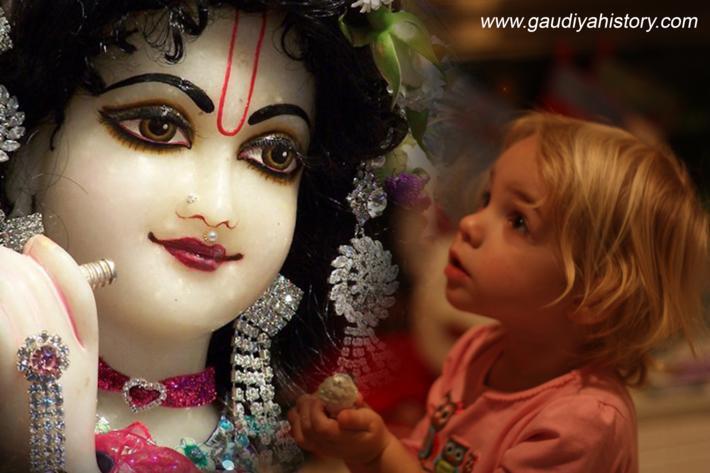
The household of Mukunda Dasa at Srikhanda worshiped a family Deity of Gopinatha. By tradition, this Deity had already been served across several generations. One day Mukunda was called away on his duties as a physician. He left the day's worship in the hands of his young son. He told him only to be sure the Deity was fed, the same way, he said, that Raghunandana's own mother fed the household every day. By most accounts Raghunandana was still very small, barely five years old. He prepared the offering with total sincerity, but he grew anxious when the food appeared untouched on the plate. In his simple way, he did the only thing he could think of. He told Gopinatha directly, through tears, to eat. According to the Bhakti-ratnakara, and to a song that the poet Uddhava Dasa composed to celebrate the pastime, Krishna could not resist such open and simple devotion, and He ate the entire offering before the boy's eyes.
| Detail | Description |
|---|---|
| Deity | Sri Gopinatha, worshiped by Mukunda Dasa's family for generations |
| Age of Raghunandana | Traditionally said to be about five years old |
| Primary source for the pastime | Bhakti-ratnakara 9.525, and Uddhava Dasa's devotional song |
| Confirmed in scripture | Sri Chaitanya-charitamrita, Madhya-lila 15.108-135 |
| Mahaprabhu's declaration | "One who awakens devotion to Krishna is certainly the spiritual master" (Madhya 15.117) |
Two Servings and a Father's Astonishment #
When Mukunda Dasa returned and asked for the Deity's prasadam, Raghunandana answered plainly that there was none left, because Gopinatha had eaten everything. Mukunda could not quite believe it. He asked his son to make the offering again on another day, and then slipped back into the house by a side door to watch unseen. This time Raghunandana offered a single laddu and again urged the Deity to eat. He watched Gopinatha take exactly half of it. Then Gopinatha caught sight of Mukunda hidden in the doorway, and He stopped there, with the other half still in His hand. Mukunda, overcome, swept his son into his arms in tears. Devotees who visit Srikhanda are still shown, to this day, the half-eaten laddu said to remain in Gopinatha's hand.
"Is He Your Father, or Are You His?" #
Sri Chaitanya-charitamrita itself directly confirms the heart of this pastime. It gives Mahaprabhu's own words to the three Srikhanda devotees at Jagannatha Puri. Mahaprabhu asked Mukunda Dasa directly: "Are you Raghunandana's father and he your son? Or is he your father and you his son? Tell me, so that My doubts may be settled" (Chaitanya-charitamrita, Madhya 15.113-114). Mukunda answered without hesitation: "Raghunandana is my father, and I am his son. All of us have attained devotion to Krishna because of him; therefore in my mind he is my father" (Madhya 15.115-116). Sri Chaitanya Mahaprabhu at once confirmed this judgment. He gave the principle that has been quoted ever since: "One who awakens devotion to Krishna is certainly the spiritual master" (Madhya 15.117). Krishnadasa Kaviraja Goswami adds that Mahaprabhu spoke of His devotees' glories so happily in that moment that, to anyone watching, He seemed to have five faces at once (Madhya 15.118).
Mahaprabhu was not finished. He went on to describe Mukunda's own hidden love of Godhead as being like the purest gold beneath the ordinary appearance of a royal physician (Madhya 15.119-120). The same passage illustrates this with an episode. Once, at court, Mukunda fainted merely from the sight of a peacock feather, because it brought Krishna's own form so fully to his mind (Madhya 15.121-127). Then, in the presence of all three, Mahaprabhu assigned each of them a distinct role. Mukunda was to earn wealth honestly while keeping religious principles, Narahari was to remain always in the company of devotees, and Raghunandana (already doing exactly this) was simply to continue serving Krishna in the temple, with no other interest at all (Madhya 15.130-131). "Furthermore, it is the duty of Raghunandana to always engage in Lord Krishna's service. He has no other intention but the service of Lord Krishna," Mahaprabhu said (Madhya 15.131). Then He added that these three services looked entirely different from outside, but with Krishna at the center, they were one and the same thing (Madhya 15.132, purport).
A Kadamba Tree That Never Stopped Flowering #
Sri Chaitanya-charitamrita closes this episode with one more detail about Raghunandana's own temple, almost as an aside: "Raghunandana is constantly engaged in serving Lord Krishna in the temple. Beside the entrance of the temple is a lake, and on its banks is a kadamba tree, which daily delivers two flowers to be used for Krishna's service" (Madhya 15.128-129). Later Gaudiya tradition remembers this pond as the Madhu Pushkarini. Narahari Sarakara Thakura is separately said to have once served honey there to Nityananda Prabhu and Mahaprabhu. The same tradition says that the kadamba tree flowered without fail, even out of season, directly because of Raghunandana's own devotional power. In a small and natural way, this recalls the same boy who once made a Deity of stone and wood answer a child's simple request to eat.
