As his own end approached, Raghunandana Thakura is remembered turning his attention to the generation of Vaishnavas who would carry the movement forward after him. According to the Bhakti-ratnakara, he spoke words of comfort and confidence to Shrinivasa Acharya, for whom he had great personal affection. He warned him plainly that a difficult time was coming. In that time, even sincere Vaishnavas would be troubled by doubt from day to day. To support this warning, he quoted directly from his own uncle Narahari Sarakara Thakura's Sri Krishna-bhajanamrita: "krishna-caitanya-candrena nityanandena samhrite, avatare kalav asmin vaishnavah sarva eva hi, bhavishyanti sadodvignah kale kale dine dine, prayah sandigdha-hridaya uttametara-madhyamah". He said that once Krishna Chaitanya and Nityananda Prabhu had ended Their own visible pastimes, Vaishnavas of every level, advanced or beginner, would find their hearts nearly always troubled by doubt (Bhakti-ratnakara 13.174-179). But Raghunandana did not leave Shrinivasa with only a warning. "Don't let this worry you," he continued. "Lord Gauranga will accomplish many great works through you. I bless you that you remain long on this earth, and that you and your followers protect our Lord's religion."
| Detail | Description |
|---|---|
| Final blessing given to | Shrinivasa Acharya |
| Disappearance date | Shukla Chaturthi (fourth day of the waxing moon), month of Shravana |
| Year of disappearance | Not given in the available sources |
| Deity service inherited by | Kanai Thakura, his son |
| Spiritual identity (Gaura-ganoddesha-dipika 70) | Pradyumna of the chatur-vyuha (sources differ on the vraja-lila identity beneath that; see below) |
A Final Departure Marked by the Holy Name #
According to the Bhakti-ratnakara, Raghunandana Thakura left this world on Shukla Chaturthi, the fourth day of the waxing moon, in the month of Shravana. To the last, he was absorbed in repeating the names of Sri Krishna Chaitanya. The text records that his own son, Kanai Thakura, offered a feast to mark the occasion. It closes the episode with a verse of its own praise: "Raghunandan slowly became hidden to mortal eyes while repeating again and again the names of Shri Krishna Chaitanya. How glorious is that day of Shravan shukla chaturthi! Who will not sing the glories of Raghunandan Thakur?" (Bhakti-ratnakara 13.183-184). None of the available sources gives a specific year for this disappearance. They give only the date within the lunar calendar. This gap is reported here as it is, not filled in with an invented figure.
The Deity That Stayed in the Family #
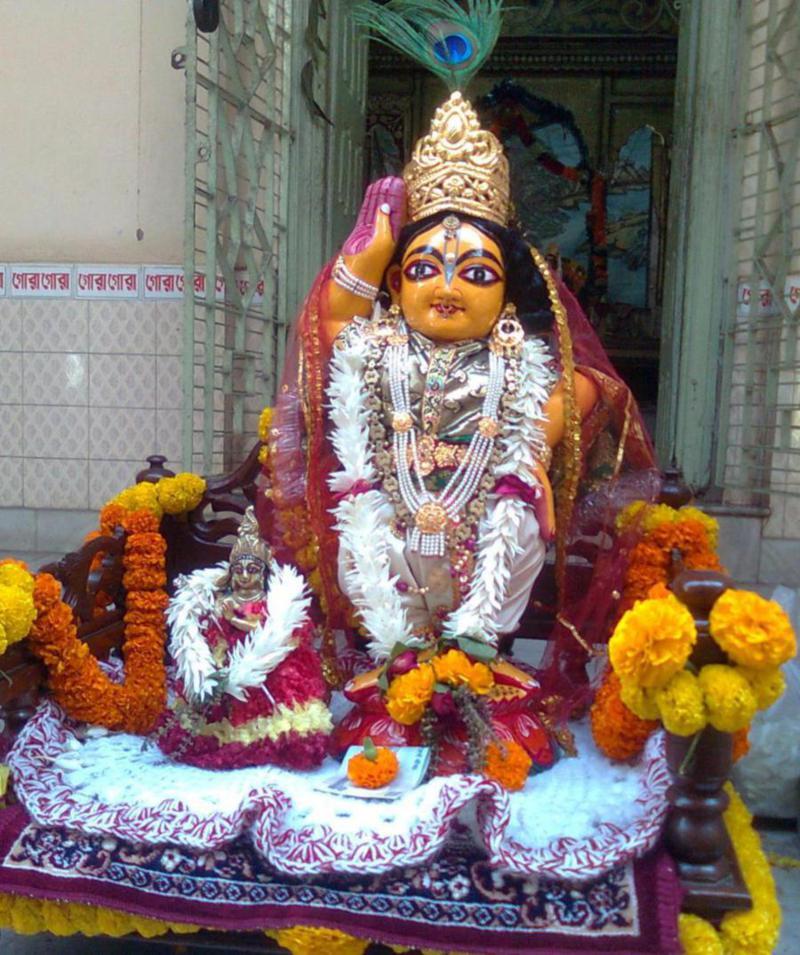
Before his disappearance, Raghunandana passed on the personal service of his Gaura-Gopala Deity to his own son, Kanai Thakura. In this way the family's household Deity worship continued. By the time of Srila Prabhupada's own purport to Sri Chaitanya-charitamrita, the family had grown to an estimated four hundred descendants, living in Srikhanda across several further generations. Their names are still recorded in the village itself. Kanai Thakura in turn had two sons, Madana Raya (a disciple of Narahari Sarakara Thakura) and Vamshivadana, who carried the same family line one generation further. By tradition, the Gopinatha and Gaura-Gopala Deities that a five-year-old Raghunandana once fed with such determination are still worshiped at Srikhanda today. This worship is a living continuation of the pastime told on The Boy Who Fed Sri Gopinatha.
Place in the Parampara's Memory #
The Gaura-ganoddesha-dipika identifies Raghunandana as Pradyumna, third among the four original expansions of Krishna in the chatur-vyuha. But the available sources do not agree on the more specific identity beneath that. One verse of the Gaura-ganoddesha-dipika, as quoted on Gaudiya History, describes this same Pradyumna appearing in Krishna's vraja-lila as Radha-Madhava's intimate friend, a priya-narma-sakha. The verse also says that his body is not different from Chaitanya Mahaprabhu's own. A separate traditional account, drawing on the Gaudiya Vaishnava Abhidhana and also recorded on Gaudiya History, instead calls him Kandarpa-manjari in Krishna's own vraja-lila. In Dvaraka-lila, this account calls him Krishna's actual son named Kandarpa. Both versions agree that Raghunandana's eternal identity is linked with Pradyumna/Kandarpa. But they differ on the exact form that identity takes in Vraja. This is a real point on which the sources simply disagree, and it is reported here, not resolved. Later Gaudiya Vaishnava writers, including the poet Uddhava Dasa, called Raghunandana "non-different from Madana," Cupid himself. They said this in praise of the same powerful, heart-winning love that once moved a stone Deity to eat before a crying child. Sri Chaitanya-charitamrita itself, though, gives a simpler and perhaps more lasting judgment. It tells us that Raghunandana Thakura's whole life had one interest in it, the service of Krishna. It also tells us that this single-minded service was itself enough for Sri Chaitanya Mahaprabhu to confirm, without any reservation, that Raghunandana was his own father's spiritual master.
