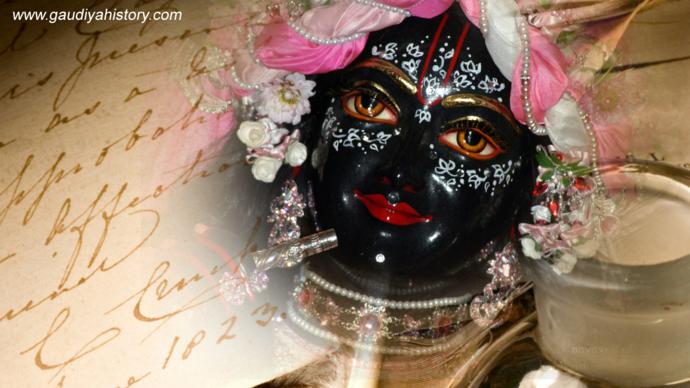
As Raghupati Upadhyaya continued reciting his verses, he watched Mahaprabhu's ecstatic symptoms: the trembling, the loss of composure, the tears. He then came to a private conclusion of his own. Krishnadasa Kaviraja Goswami records it in a single blunt line: "manusya nahe, iho krishna" - He is not a human being. He is Krishna Himself. Mahaprabhu never directly confirmed or denied this conclusion to him. The text simply notes that Raghupati Upadhyaya made up his own mind, based on what he had personally seen.
Mahaprabhu then began to question him. In quick succession, He asked Raghupati Upadhyaya four questions that any Vaishnava theologian of that time would have recognized. Which of Krishna's countless forms is supreme? Which of His abodes is best? Which age of His life is most worth meditating on? And which devotional mood (rasa) is higher than all others? Raghupati Upadhyaya answered each in a single Sanskrit phrase: shyamam eva param rupam, "the form of Shyamasundara is supreme"; puri madhu-puri vara, "Mathura is the best of cities"; vayah kaishorakam dhyeyam, "fresh youth is the age to meditate on"; and adya eva paro rasah, "the original mellow - conjugal love - is the highest rasa." In his purport on the first answer, Srila Prabhupada explains why Shyamasundara, and not any of Krishna's other forms, was named supreme. He turns back to two verses of Brahma-samhita. Among them is the well-known description of devotees who see that form "within the heart," their eyes "anointed with the pulp of love." He also turns to Srimad-Bhagavatam's own declaration that "Krishna is the original Personality of Godhead," the source from which every other form and incarnation expands. Years earlier, in Jagannatha Puri, Mahaprabhu had explored these same four questions in a long night of conversation with Ramananda Raya. Krishnadasa Kaviraja Goswami records that dialogue elsewhere in Sri Chaitanya-charitamrita, at much fuller length. Here at Adaila, a scholar he had met only that evening answered the same four questions in four lines, without hesitation.
Mahaprabhu's response is recorded directly: "You have certainly given first-class conclusions." Krishnadasa Kaviraja Goswami says that He then spoke "in a faltering voice," reciting the full four-line Sanskrit verse that combines all of Raghupati Upadhyaya's answers. Rupa Gosvami would later place this same verse in the Padyavali as its eighty-second entry. Overcome, Mahaprabhu embraced Raghupati Upadhyaya in ecstatic love. Raghupati Upadhyaya, "overwhelmed by love" in his own turn, began to dance.
Vallabha Bhattacharya, watching Mahaprabhu and Raghupati Upadhyaya dance together, was struck with wonder. He brought his sons forward and had them fall at Mahaprabhu's feet. But Srila Prabhupada's own purport points out a small problem with the dates here. The purport names the two sons as Gopinatha and Vitthalesvara, and says that Vitthalesvara was not yet born when Mahaprabhu visited Prayag, in 1512 or 1513. Prabhupada does not explain how this fits with the "two sons" of the verse. He simply notes it and points the reader elsewhere in the text. Word of Mahaprabhu's presence spread through Adaila all the same. Villagers came simply to see Him, and, Krishnadasa Kaviraja Goswami writes, became Krishna's devotees by that sight alone. Local brahmanas lined up to invite Mahaprabhu into their own homes. But Vallabha Bhattacharya himself declined the invitations, so that he could keep his unexpected guest a little longer.
Raghupati Upadhyaya does not appear again by name anywhere else in Sri Chaitanya-charitamrita. The tradition kept only these memories of him. He received a blessing. He recited two verses that broke Mahaprabhu's composure. He answered four questions without pause. And he shared a dance with the Lord whom, in his own understanding, he had just recognized.
prema dekhi': seeing His ecstatic love; upādhyāyera: of Raghupati Upādhyāya; haila camatkāra: there was wonder; manuṣya nahe: not a human being; iṅho kṛṣṇa: He is Lord Kṛṣṇa Himself; karila nirdhāra: made this assessment.
When Raghupati Upadhyaya saw Sri Caitanya Mahaprabhu's ecstatic symptoms, he decided that the Lord was not a human being but Krishna Himself.
Raghupati Upadhyaya's own private conclusion about Mahaprabhu's identity, reached simply from witnessing His ecstatic symptoms.
śyāmam eva paraṁ rūpaṁ
purī madhu-purī varā
vayaḥ kaiśorakaṁ dhyeyam
ādya eva paro rasaḥ
Word for word
śyāmam: the form of Śyāmasundara; eva param rūpam: is certainly the supreme form; purī madhu-purī varā: the city of Mathura is the best abode; vayaḥ kaiśorakam dhyeyam: the age of fresh youth is to be meditated on; ādyaḥ eva paraḥ rasaḥ: the original mellow, conjugal love, is certainly the supreme rasa.
The form of Shyamasundara is the supreme form, the city of Mathura is the supreme abode, Krishna's fresh youth should always be meditated upon, and the mellow of conjugal love is the supreme mellow.
From the purport: Purport excerpt: "This verse is found in the Padyavali (82)."
The combined verse Mahaprabhu Himself recited in a faltering voice, gathering Raghupati Upadhyaya's four one-line answers into a single Sanskrit couplet.
dekhi' vallabha-bhaṭṭa mane camatkāra haila
dui putra āni' prabhura caraṇe pāḍila
Word for word
dekhi': seeing; vallabha-bhaṭṭa: Vallabha Bhaṭṭācārya; mane camatkāra haila: was struck with wonder; dui putra āni': bringing his two sons; prabhura caraṇe pāḍila: made them fall at the Lord's feet.
Vallabha Bhattacharya was struck with wonder to see Sri Caitanya Mahaprabhu and Raghupati Upadhyaya dance. He even brought forward his two sons and made them fall down at the Lord's lotus feet.
From the purport: Purport excerpt: "When Sri Caitanya Mahaprabhu visited Prayaga in the year 1434 or 1435 Sakabda Era (A.D. 1512 or 1513), Vithhalesvara was not yet born."
Fixes the approximate date of the Adaila meeting (1512-1513 CE) and records a chronological puzzle Prabhupada himself flags about Vallabha Bhattacharya's 'two sons.'
prema: of love; añjana: with the salve; churita: tinged; bhakti: of devotion; vilocanena: with the eye; santaḥ: the pure devotees; sadā: always; eva: indeed; hṛdayeṣu: in their hearts; vilokayanti: see; yam: whom; śyāma: dark blue; sundaram: beautiful; acintya: inconceivable; guṇa: with attributes; svarūpam: whose nature is endowed; govindam: Govinda; ādi-puruṣam: the original person; tam: Him; aham: I; bhajāmi: worship.
I worship Govinda, the primeval Lord, who is Shyamasundara, Krishna Himself with inconceivable innumerable attributes, whom the pure devotees see in their heart of hearts with the eye of devotion tinged with the salve of love.
From the purport: Purport excerpt: "The Shyamasundara form of Krishna is His inconceivable simultaneous personal and impersonal self-contradictory form. True devotees see that form in their purified hearts under the influence of devotional trance."
A verified Brahma-samhita verse supporting Raghupati Upadhyaya's own answer that Shyamasundara is Krishna's supreme form, referenced in Srila Prabhupada's purport at this point in the text.
ete: all these; ca: and; aṁśa: plenary portions; kalāḥ: portions of the plenary portions; puṁsaḥ: of the Supreme; kṛṣṇaḥ: Lord Krishna; tu: but; bhagavān: the Personality of Godhead; svayam: in person; indra-ari: the enemies of Indra; vyākulam: disturbed; lokam: all the planets; mṛḍayanti: gives protection; yuge yuge: in different ages.
All of the above-mentioned incarnations are either plenary portions or portions of the plenary portions of the Lord, but Lord Sri Krishna is the original Personality of Godhead. All of them appear on planets whenever there is a disturbance created by the atheists. The Lord incarnates to protect the theists.
The Bhagavatam's own declaration that Krishna is the source of all incarnations, the scriptural ground for Srila Prabhupada's purport explaining why Raghupati Upadhyaya's answer named Krishna's own form supreme above all His expansions.
Our editorial team comprises trained devotees and researchers of the Hare Krishna Movement, Kota, who follow this same disciplic tradition in daily practice. Every biography is carefully researched, fact-checked against Vedic scriptures, and cites its sources.
Reviewed by
Temple & Scriptural Research Team
Each biography undergoes a detailed review by our senior devotees and scriptural researchers to verify factual accuracy and ensure alignment with Vaishnava philosophy and Srila Prabhupada's teachings.