Srila Raghupati Upadhyaya
Whose Verses Melted Mahaprabhu's Composure
The complete life, on one page: The main biography and every pastime page, in order, in one place
Introduction
Raghupati Upadhyaya was a Vaishnava scholar and poet from Tirhut, in the Mithila region of northern Bihar. Today he is remembered for one evening that is vividly recorded. He visited the home of Vallabha Bhattacharya near Prayag, and there his own Sanskrit verses on Krishna moved Sri Chaitanya Mahaprabhu to uncontrollable ecstatic love. Krishnadasa Kaviraja Goswami gives the meeting nearly twenty full verses in Sri Chaitanya-charitamrita. Sri Rupa Gosvami later preserved three of Raghupati Upadhyaya's own compositions in his anthology of devotional Sanskrit poetry, the Padyavali. Apart from that one episode, and a single sentence naming his guru, almost nothing else about his life survives in any available source.
| Detail | Description |
|---|---|
| Home | Tirhut (Tirabhukti), Mithila region, northern Bihar |
| Background | Brahmana scholar, poet and householder Vaishnava |
| Guru | Disciple of Madhavendra Puri, per the Gaudiya-bhasya commentary on Sri Chaitanya-bhagavata |
| Known chiefly from | Sri Chaitanya-charitamrita, Madhya-lila 19.92-110; Sri Chaitanya-bhagavata, Adi-khanda 2.31 |
| Literary legacy | Three Sanskrit verses preserved in Sri Rupa Gosvami's Padyavali (verses 82, 99 and 126) |
| Birth / disappearance | Not recorded in any source |
Scriptural evidence for the introduction (1)
कारो जन्म नवद्वीपे, कारो चाटिग्रामे
केह राढे, ओढ्र-देशे, श्रीहट्टे, पश्चिमे ॥ ३१ ॥
kāro janma navadvīpe, kāro cāṭigrāme
keha rāḍhe, oḍhra-deśe, śrīhaṭṭe, paścime
Word for word
kāro janma: someone's birth; navadvīpe: in Navadvīpa; kāro: someone's; cāṭigrāme: in Chattagrama; keha: someone; rāḍhe: in Radha-desha; oḍhra-deśe: in Orissa; śrīhaṭṭe: in Shrihatta; paścime: in the west.
Some of the Lord's devotees were born in Navadvipa, some in Chattagrama, some in Radha-desha, some in Orissa, some in Shrihatta, and some in the west — meaning Tirhut.
From the purport: Gaudiya-bhasya excerpt (Bhaktisiddhanta Sarasvati Thakura): "Shripada Paramananda Puri and Sri Raghupati Upadhyaya appeared at this place [Tirhut]. They were both disciples of Srila Madhavendra Puripada and very intimate associates of Sriman Mahaprabhu."
The only source found that names Raghupati Upadhyaya's guru (Madhavendra Puri) and identifies his home district by its Sanskrit name, Tirabhukti (Tirhut).
Chapter 1
Arrival at Adaila
A boat nearly overturned by ecstasy, a blessing for a visiting scholar, and two verses that made Mahaprabhu lose His composure.
As Mahaprabhu's boat approached Adaila's ghat on the river near Prayag, He was seized by such powerful ecstatic love that He began to dance where He stood. The boat tilted under His weight, filling with water and coming close to capsizing, until the boatmen and companions grabbed hold of Him and pulled Him back onto its deck. Sri Chaitanya-charitamrita tells openly what happened next. Mahaprabhu tried to stay composed in front of Vallabha Bhattacharya, but, in Krishnadasa Kaviraja Goswami's words, His prema was "difficult to stop" and could not be held back by will alone. He was aware of the circumstances: ordinary people were watching, and His host was still largely unknown to Him. Only this awareness allowed Mahaprabhu to settle His mind before the boat finally reached Adaila's shore.
Welcomed Into Vallabha Bhattacharya's Home #
Once Mahaprabhu had landed, Vallabha Bhattacharya stayed close by Him, because he was fearful for the Lord's welfare after what had just happened on the water. He arranged for His bath and personally brought Him home. There he offered Mahaprabhu a fine seat, washed His feet with his own hands, gave Him spices to freshen His mouth, and later massaged His feet himself while Mahaprabhu rested. A meal was prepared with what Krishnadasa Kaviraja Goswami calls "affection and great care." The remnants of Mahaprabhu's own plate went first to Rupa Gosvami. Sri Chaitanya-charitamrita specifies that they went to "the two brothers": Rupa Gosvami and his younger brother, Anupama Mallika, who in his youth was known simply as Sri Vallabha. Only then did they go to Krishnadasa, the disciple accompanying them on the journey. The household was now settled and well fed, though still recovering from the drama of the river crossing. Just then, a visitor arrived unannounced.
A Scholar Arrives From Tirhut #
Krishnadasa Kaviraja Goswami introduces him in a single line: a pandita of Tiruhita, a great vaishnava, a mahashaya - "a respectable gentleman." Raghupati Upadhyaya came forward, offered his obeisances at Mahaprabhu's feet, and received a blessing in return: four words in Bengali that Srila Prabhupada renders in English as "Always stay in Krishna consciousness." Raghupati Upadhyaya, delighted to hear it, was then asked by Mahaprabhu Himself to describe Krishna.
Two Verses That Undid Mahaprabhu's Composure #
Raghupati Upadhyaya did not recite memorized scriptural verses. He recited his own Sanskrit compositions. The first verse put aside all the usual objects of worship at once: "Those who are afraid of material existence worship the Vedic literature. Some worship smriti, the corollaries to the Vedic literature, and others worship the Mahabharata. As far as I am concerned, I worship Krishna's father, Maharaja Nanda, in whose courtyard the Supreme Personality of Godhead, the Absolute Truth, is playing." Mahaprabhu, hearing it, was overwhelmed with ecstatic love and asked for more. Raghupati Upadhyaya offered a second: "To whom can I speak who will believe me when I say that Krishna, the Supreme Personality of Godhead, is hunting the gopis in the bushes by the banks of the river Yamuna?" Both verses were later given a permanent place in Rupa Gosvami's Padyavali, the first as verse 126 and the second as verse 99. But at that moment they were only one scholar's private devotion, spoken aloud to a man he had met only that evening. By the time the second verse ended, Krishnadasa Kaviraja Goswami writes, Mahaprabhu's "body and mind" had grown limp with prema. Srila Prabhupada's own purport on this moment reads simply: "Our minds and bodies are always engaged in material activities. When they are activated on the spiritual platform, they slacken on the material platform." Raghupati Upadhyaya was astonished to see Mahaprabhu in this slackened, transformed state. His astonishment carried the evening into its second half, told on What Raghupati Taught the Lord.
Scriptural evidence for this chapter (3)
Quoted in the text above:
- Madhya 19.96 Sri Chaitanya-charitamrita
- Madhya 19.98 Sri Chaitanya-charitamrita
Further verses:
hena-kāle āilā raghupati upādhyāya
tiruhitā paṇḍita, baḍa vaiṣṇava, mahāśaya
Word for word
hena-kāle: at this time; āilā: arrived; raghupati upādhyāya: a brāhmaṇa named Raghupati Upādhyāya; tiruhitā: belonging to the Tiruhitā state; paṇḍita: a very learned scholar; baḍa: great; vaiṣṇava: devotee; mahāśaya: respectable gentleman.
At that time Raghupati Upadhyaya of the Tiruhita district arrived. He was a very learned scholar, a great devotee and a respectable gentleman.
From the purport: Purport excerpt: "Tiruhita, or Tirhutiya, is a combination of four districts in Bihar: Saran, Champaran, Muzaffarpur and Darbhanga."
The core verse introducing Raghupati Upadhyaya's arrival at Vallabha Bhattacharya's home in Adaila, and Prabhupada's own definition of the Tirhut region.
Chapter 2
What Raghupati Taught the Lord
A scholar's private conclusion, a four-question examination on the nature of Krishna, and the embrace that followed.
As Raghupati Upadhyaya continued reciting his verses, he watched Mahaprabhu's ecstatic symptoms: the trembling, the loss of composure, the tears. He then came to a private conclusion of his own. Krishnadasa Kaviraja Goswami records it in a single blunt line: "manusya nahe, iho krishna" - He is not a human being. He is Krishna Himself. Mahaprabhu never directly confirmed or denied this conclusion to him. The text simply notes that Raghupati Upadhyaya made up his own mind, based on what he had personally seen.
Four Questions and Four Answers #
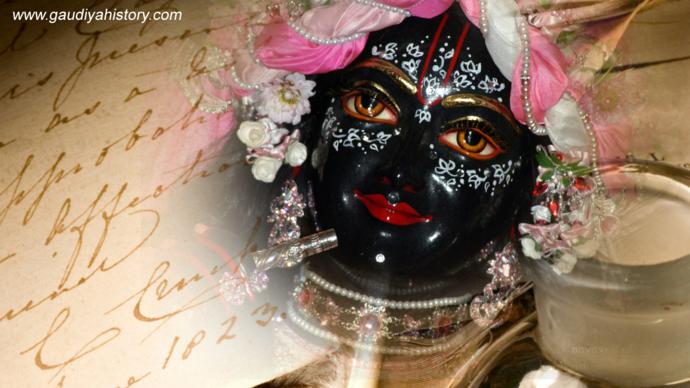
Mahaprabhu then began to question him. In quick succession, He asked Raghupati Upadhyaya four questions that any Vaishnava theologian of that time would have recognized. Which of Krishna's countless forms is supreme? Which of His abodes is best? Which age of His life is most worth meditating on? And which devotional mood (rasa) is higher than all others? Raghupati Upadhyaya answered each in a single Sanskrit phrase: shyamam eva param rupam, "the form of Shyamasundara is supreme"; puri madhu-puri vara, "Mathura is the best of cities"; vayah kaishorakam dhyeyam, "fresh youth is the age to meditate on"; and adya eva paro rasah, "the original mellow - conjugal love - is the highest rasa." In his purport on the first answer, Srila Prabhupada explains why Shyamasundara, and not any of Krishna's other forms, was named supreme. He turns back to two verses of Brahma-samhita. Among them is the well-known description of devotees who see that form "within the heart," their eyes "anointed with the pulp of love." He also turns to Srimad-Bhagavatam's own declaration that "Krishna is the original Personality of Godhead," the source from which every other form and incarnation expands. Years earlier, in Jagannatha Puri, Mahaprabhu had explored these same four questions in a long night of conversation with Ramananda Raya. Krishnadasa Kaviraja Goswami records that dialogue elsewhere in Sri Chaitanya-charitamrita, at much fuller length. Here at Adaila, a scholar he had met only that evening answered the same four questions in four lines, without hesitation.
You Have Taught Me Well #
Mahaprabhu's response is recorded directly: "You have certainly given first-class conclusions." Krishnadasa Kaviraja Goswami says that He then spoke "in a faltering voice," reciting the full four-line Sanskrit verse that combines all of Raghupati Upadhyaya's answers. Rupa Gosvami would later place this same verse in the Padyavali as its eighty-second entry. Overcome, Mahaprabhu embraced Raghupati Upadhyaya in ecstatic love. Raghupati Upadhyaya, "overwhelmed by love" in his own turn, began to dance.
A Household and a Village Transformed #
Vallabha Bhattacharya, watching Mahaprabhu and Raghupati Upadhyaya dance together, was struck with wonder. He brought his sons forward and had them fall at Mahaprabhu's feet. But Srila Prabhupada's own purport points out a small problem with the dates here. The purport names the two sons as Gopinatha and Vitthalesvara, and says that Vitthalesvara was not yet born when Mahaprabhu visited Prayag, in 1512 or 1513. Prabhupada does not explain how this fits with the "two sons" of the verse. He simply notes it and points the reader elsewhere in the text. Word of Mahaprabhu's presence spread through Adaila all the same. Villagers came simply to see Him, and, Krishnadasa Kaviraja Goswami writes, became Krishna's devotees by that sight alone. Local brahmanas lined up to invite Mahaprabhu into their own homes. But Vallabha Bhattacharya himself declined the invitations, so that he could keep his unexpected guest a little longer.
Raghupati Upadhyaya does not appear again by name anywhere else in Sri Chaitanya-charitamrita. The tradition kept only these memories of him. He received a blessing. He recited two verses that broke Mahaprabhu's composure. He answered four questions without pause. And he shared a dance with the Lord whom, in his own understanding, he had just recognized.
Scriptural evidence for this chapter (5)
prema dekhi' upādhyāyera haila camatkāra
'manuṣya nahe, iṅho — kṛṣṇa' — karila nirdhāra
Word for word
prema dekhi': seeing His ecstatic love; upādhyāyera: of Raghupati Upādhyāya; haila camatkāra: there was wonder; manuṣya nahe: not a human being; iṅho kṛṣṇa: He is Lord Kṛṣṇa Himself; karila nirdhāra: made this assessment.
When Raghupati Upadhyaya saw Sri Caitanya Mahaprabhu's ecstatic symptoms, he decided that the Lord was not a human being but Krishna Himself.
Raghupati Upadhyaya's own private conclusion about Mahaprabhu's identity, reached simply from witnessing His ecstatic symptoms.
śyāmam eva paraṁ rūpaṁ
purī madhu-purī varā
vayaḥ kaiśorakaṁ dhyeyam
ādya eva paro rasaḥ
Word for word
śyāmam: the form of Śyāmasundara; eva param rūpam: is certainly the supreme form; purī madhu-purī varā: the city of Mathura is the best abode; vayaḥ kaiśorakam dhyeyam: the age of fresh youth is to be meditated on; ādyaḥ eva paraḥ rasaḥ: the original mellow, conjugal love, is certainly the supreme rasa.
The form of Shyamasundara is the supreme form, the city of Mathura is the supreme abode, Krishna's fresh youth should always be meditated upon, and the mellow of conjugal love is the supreme mellow.
From the purport: Purport excerpt: "This verse is found in the Padyavali (82)."
The combined verse Mahaprabhu Himself recited in a faltering voice, gathering Raghupati Upadhyaya's four one-line answers into a single Sanskrit couplet.
dekhi' vallabha-bhaṭṭa mane camatkāra haila
dui putra āni' prabhura caraṇe pāḍila
Word for word
dekhi': seeing; vallabha-bhaṭṭa: Vallabha Bhaṭṭācārya; mane camatkāra haila: was struck with wonder; dui putra āni': bringing his two sons; prabhura caraṇe pāḍila: made them fall at the Lord's feet.
Vallabha Bhattacharya was struck with wonder to see Sri Caitanya Mahaprabhu and Raghupati Upadhyaya dance. He even brought forward his two sons and made them fall down at the Lord's lotus feet.
From the purport: Purport excerpt: "When Sri Caitanya Mahaprabhu visited Prayaga in the year 1434 or 1435 Sakabda Era (A.D. 1512 or 1513), Vithhalesvara was not yet born."
Fixes the approximate date of the Adaila meeting (1512-1513 CE) and records a chronological puzzle Prabhupada himself flags about Vallabha Bhattacharya's 'two sons.'
premāñjana-cchurita-bhakti-vilocanena
santaḥ sadaiva hṛdayeṣu vilokayanti
yaṁ śyāmasundaram acintya-guṇa-svarūpaṁ
govindam ādi-puruṣaṁ tam ahaṁ bhajāmi
Word for word
prema: of love; añjana: with the salve; churita: tinged; bhakti: of devotion; vilocanena: with the eye; santaḥ: the pure devotees; sadā: always; eva: indeed; hṛdayeṣu: in their hearts; vilokayanti: see; yam: whom; śyāma: dark blue; sundaram: beautiful; acintya: inconceivable; guṇa: with attributes; svarūpam: whose nature is endowed; govindam: Govinda; ādi-puruṣam: the original person; tam: Him; aham: I; bhajāmi: worship.
I worship Govinda, the primeval Lord, who is Shyamasundara, Krishna Himself with inconceivable innumerable attributes, whom the pure devotees see in their heart of hearts with the eye of devotion tinged with the salve of love.
From the purport: Purport excerpt: "The Shyamasundara form of Krishna is His inconceivable simultaneous personal and impersonal self-contradictory form. True devotees see that form in their purified hearts under the influence of devotional trance."
A verified Brahma-samhita verse supporting Raghupati Upadhyaya's own answer that Shyamasundara is Krishna's supreme form, referenced in Srila Prabhupada's purport at this point in the text.
ete cāṁśa-kalāḥ puṁsaḥ
kṛṣṇas tu bhagavān svayam
indrāri-vyākulaṁ lokaṁ
mṛḍayanti yuge yuge
Word for word
ete: all these; ca: and; aṁśa: plenary portions; kalāḥ: portions of the plenary portions; puṁsaḥ: of the Supreme; kṛṣṇaḥ: Lord Krishna; tu: but; bhagavān: the Personality of Godhead; svayam: in person; indra-ari: the enemies of Indra; vyākulam: disturbed; lokam: all the planets; mṛḍayanti: gives protection; yuge yuge: in different ages.
All of the above-mentioned incarnations are either plenary portions or portions of the plenary portions of the Lord, but Lord Sri Krishna is the original Personality of Godhead. All of them appear on planets whenever there is a disturbance created by the atheists. The Lord incarnates to protect the theists.
The Bhagavatam's own declaration that Krishna is the source of all incarnations, the scriptural ground for Srila Prabhupada's purport explaining why Raghupati Upadhyaya's answer named Krishna's own form supreme above all His expansions.
Closing
A Disciple of Madhavendra Puri From Tirhut #
Tirhut, called Tirabhukti in Sanskrit, is today spread across several districts of northern Bihar, among them Darbhanga, Muzaffarpur, Champaran and Saran. Sri Chaitanya-charitamrita itself says very little about Raghupati Upadhyaya's origin. It says only that he arrived from "the Tiruhita district," and calls him a pandita, a "great vaishnava," and a mahashaya, "a respectable gentleman." A fuller sentence survives in Sri Chaitanya-bhagavata, in the Gaudiya-bhasya commentary written by Bhaktisiddhanta Sarasvati Thakura. Vrindavana Dasa Thakura has a verse naming the home districts of Mahaprabhu's devotees. Commenting on it, the Gaudiya-bhasya names Tirhut as the birthplace of two of them, Raghupati Upadhyaya and Paramananda Puri. It states plainly: "They were both disciples of Srila Madhavendra Puripada and very intimate associates of Sriman Mahaprabhu." That single line is the only source that names a guru for Raghupati Upadhyaya. It places him, through initiation, in the same spiritual family as Ishvara Puri, Mahaprabhu's own diksha-guru. But no source describes Raghupati Upadhyaya taking sannyasa, as most of Madhavendra Puri's better-known disciples did. In every account he remains a householder scholar, not a renunciate.
Verses Kept Alive in the Padyavali #
Raghupati Upadhyaya left no independent literary work that survives under his own name. What remains of his writing are individual Sanskrit verses recited that evening at Adaila. Sri Rupa Gosvami later gathered them into the Padyavali, alongside verses by dozens of other Vaishnava poets. Krishnadasa Kaviraja Goswami quotes three of them directly inside Chaitanya-charitamrita. This is the only reason they survive at all outside the Padyavali manuscripts. The best known of the three puts aside even the authority of scripture and turns instead to a single scene from Krishna's childhood: "Those who are afraid of material existence worship the Vedic literature... As far as I am concerned, I worship Krishna's father, Maharaja Nanda, in whose courtyard the Supreme Personality of Godhead, the Absolute Truth, is playing." A second verse describes Krishna "hunting the gopis in the bushes by the banks of the river Yamuna," and a third sums up an entire teaching on worship, covering form, place, age and mood, in a single four-line Sanskrit verse. That verse is examined on the pastime pages.
What the Sources Do Not Say #
No source gives Raghupati Upadhyaya's birth year, the year or place of his disappearance, or his age at the time of the Adaila meeting. Sri Gaura-ganoddesha-dipika is Kavi Karnapura's traditional list that identifies many of Mahaprabhu's associates with a role in Krishna's own Vrindavana pastimes. It does not appear to have an entry for him. By contrast, Ramananda Raya and Murari Gupta, for instance, both receive such identifications elsewhere in the same text. No available source records whether Raghupati Upadhyaya ever met Mahaprabhu again after that evening, what he did with the rest of his life, or when he passed from this world. What survives is one evening, three verses, and a single sentence naming his guru.
- Sri Chaitanya-charitamrita, Madhya-lila 19.92-110 (verse, translation and purport)
- Sri Chaitanya-bhagavata, Adi-khanda 2.31, with Gaudiya-bhasya commentary of Bhaktisiddhanta Sarasvati Thakura (trans. Bhumipati Dasa, 2008)
- Raghupati Upadhyaya - biography, Gaudiya History (ISKCON Desire Tree)
- Sri Raghupati Upadhyaya - Shyam Das Baba (associates of Mahaprabhu)
