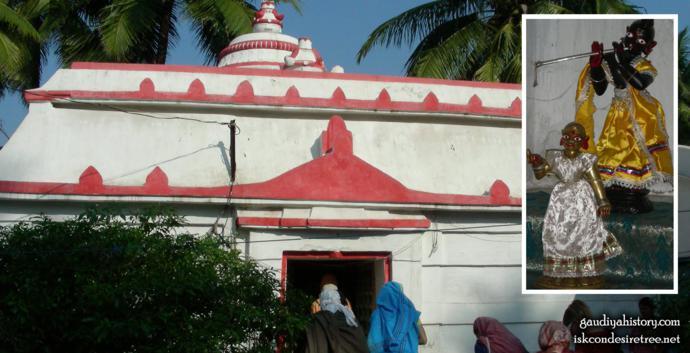
Once the worship of the Govinda Deity was firmly established at Gopiballabhpur, Rasikananda took up the preaching mission his guru had given him. He carried it across Odisha for the rest of his active life. Sources do not agree on exactly how long that mission lasted. One account describes roughly sixteen years of preaching after his initiation, while another states he preached for something closer to forty years. But they agree it filled the rest of his adult life, right up to his disappearance in 1652.
| Detail | Description |
|---|---|
| Base | Gopiballabhpur |
| Also active in | Dharenda, Nrisimhapura, Balarampur, and villages across Utkal (Odisha) |
| Royal disciples | Vaidyanatha Bhanj (raja of Mayurbhanj), Gajapati (zamindar of Patashpur), Chandrabhanu (raja of Moyna), Harinarayana (raja of Panchet) |
| Temple founded at Puri | Kunja Math (formerly Fultota Math), Deity of Radha-Rasika Raya |
A Mission Handed Down From Guru to Disciple #
Rasikananda preached over the same ground where his guru had preached before him. This included Dharenda, Nrisimhapura (where Shyamananda himself stayed on visits from Bengal), Balarampur, and the wider stretch of villages around Gopiballabhpur. He travelled there with his own growing circle of disciples. Going from village to village, he gave out what the traditional biographies call "the jewel of devotion." The Bhakti-ratnakara records that he and Shyamananda met again more than once during these years. One of these meetings was a large festival Shyamananda held at Dharenda together with Rasikananda and a disciple named Damodara, still remembered, the text says, by their descendants.
Kings and Zamindars at His Feet #
Among those who took initiation from Rasikananda were important rulers of the region: Vaidyanatha Bhanj, the raja of Mayurbhanj; Gajapati, the zamindar of Patashpur in Midnapore; Chandrabhanu, the raja of Moyna; and Harinarayana, the raja of Panchet. Alongside them were men who first came to him as enemies, not as admirers. The zamindars Bhima and Shrikara of Dharenda are both remembered as violent, sinful men who later surrendered to Rasikananda and became his disciples.
Taming the Wild #
Two episodes involving animals appear again and again in the traditional accounts of this period. In one, a hostile Muslim zamindar sent an intoxicated elephant to kill Rasikananda. But tradition says that the elephant was transformed by his presence. It was given the name Gopala Das and was engaged in the service of Krishna and the Vaishnavas. After this, the zamindar who had sent it came and surrendered at Rasikananda's feet. A second wild elephant is said to have been tamed the same way, and two jungle tigers are described as having given up their ferocity after meeting him. Whether or not these accounts are read as literal history, the biographers of the period clearly meant them to teach one point. It is the same point made more directly through his human disciples, discussed at length on Initiating Across Caste Lines. Nothing, not caste, religion, criminal history, or even species, placed a living being forever beyond the reach of the holy name. Sri Chaitanya Mahaprabhu Himself had made the same point about a century earlier, with wild animals as His audience. Passing through the Jharikhanda forest on His way to Vrindavana, He called out, "Chant Krishna! Krishna!" Krishnadasa Kaviraja Goswami records that the tigers and deer of the forest began to dance and chant the name in response (Sri Chaitanya-charitamrita Madhya 17.40).
A Temple Won From Lord Jagannath #
One year Rasikananda was busy preaching in another part of the country. He realized too late that the Ratha-yatra festival of Lord Jagannath at Puri had already begun without him, and he rushed to Nilachala to try to arrive in time. Tradition holds that Jagannath's cart would not move, no matter how many elephants the king summoned to push it, until Rasikananda arrived. At that point the Lord told the king He had simply been waiting for His devotee. When Rasikananda finally reached the cart and pulled its rope, it moved easily. Grateful, the king afterward offered him land at a site called Fultota Math, later renamed Kunja Math. There Rasikananda installed a Deity of Bat Krishna, who is worshipped today as Radha-Rasika Raya. The math still stands at Puri, alongside the temples of many other Gaudiya Vaishnava acharyas, including Haridasa Thakura.
