Srila Rasikananda Prabhu
The Preacher Who Crossed Every Caste Line in Odisha
The complete life, on one page: The main biography and every pastime page, in order, in one place
Introduction
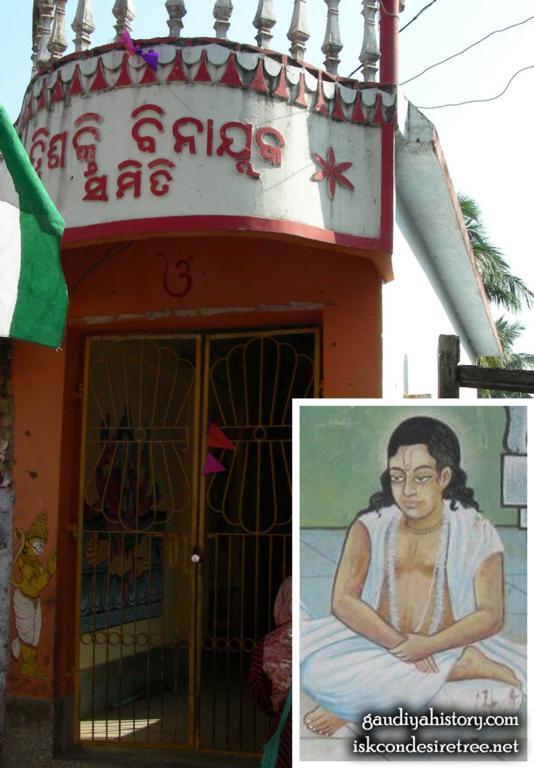
Srila Rasikananda Prabhu was the foremost disciple of Shyamananda Pandit. More than anyone else, he carried Gaudiya Vaishnavism deep into Odisha, into the Mayurbhanj and Gopiballabhpur border area where Bengal and Odisha meet along the Subarnarekha River. He founded a temple that still stands. He is said to have converted kings, zamindars, dacoits and Muslims alike. Most special of all, he initiated people across every caste line of his time, from brahmanas to outcastes, on the direct order of his own guru.
| Detail | Description |
|---|---|
| Birth | Kartika, night of Dipamalika (Diwali); Sakabda 1512, c. 1590 AD |
| Birthplace | Rohini (also called Rayni), on the Subarnarekha River, Mallabhumi region |
| Parents | Raja Achyuta Deva (Achyutananda) and Bhavani Devi |
| Guru | Shyamananda Pandit (Duhkhi Krishnadasa) |
| Deity service | Radha-Govinda at Gopiballabhpur; later Radha-Rasika Raya at Kunja Math, Puri |
| Disappearance | First day of the bright fortnight of Phalguna; Sakabda 1574, 1652 AD |
| Disappearance place | Kshira-chora Gopinatha Temple, Remuna, Odisha |
Chapter 1
A Prince Born on the Subarnarekha
Rasikananda is born into a landholding family at Rohini, where the Subarnarekha River marks the Bengal-Odisha border.
Rasikananda Prabhu was born to Raja Achyuta Deva and his wife Bhavani Devi in the village of Rohini, also called Rayni. He was born in the Bengali month of Kartika, on the lamp-lit night of the Dipamalika festival. Today that same night is widely kept as Diwali. Traditional dating places the year at Sakabda 1512, roughly 1590 AD. Rohini stood on the banks of the Subarnarekha, the "river of the golden line," in a territory then called Mallabhumi. The river still marks part of the modern border between West Bengal and Odisha. The general area around it, reaching toward Mayurbhanj and Gopiballabhpur, would later become the heart of Rasikananda's own preaching.
| Detail | Description |
|---|---|
| Born | Kartika, night of Dipamalika; Sakabda 1512 (c. 1590 AD) |
| Birthplace | Rohini (Rayni), on the Subarnarekha River |
| Father | Raja Achyuta Deva (Achyutananda) |
| Mother | Bhavani Devi |
| Wife | Shyamadasi, of the village of Ghantashila |
| Also known as | Murari, Rasika-Murari |
Rohini on the Golden Line #
Achyuta Deva governed Rohini as a landholding raja. The traditional biographies remember him as a devoted protector of his subjects who carefully observed the duties expected of a king. His son was born on Dipamalika night, when every house in the village would have been lined with lamps. So early biographers naturally described the boy as rising over the village the way the sun rises in the east. He was given two names, Rasikananda and Murari, which later writers usually join together as Rasika-Murari.
The sources do not fully agree about his caste. We say this plainly instead of picking one account and moving on. Several traditional biographies describe Achyuta Deva as belonging to the Karana caste. One of them is the account preserved in Narahari Chakravarti's Bhakti-ratnakara. The Karanas are an Odia community, roughly equal to the Kayasthas of Bengal, and these biographies clearly say that this was not a brahmana lineage. Srila Prabhupada, however, writing in his purport to Sri Chaitanya-charitamrita Madhya 8.128, describes Rasikananda as "born in a brahmana family." The two accounts clearly say different things, and we leave this difference open instead of resolving it. But both traditions agree on the larger point. Rasikananda's own life became proof that a person's spiritual position has nothing to do with the caste into which he happened to be born.
A Boy Learned Beyond His Years #
Even as a child, Rasikananda is remembered as unusually devoted to his parents, especially his mother, and as someone who mastered scripture with striking speed. Biographies say he became expert in the shastras while he was still young. This strong base of learning later helped him stand firm in the debates he had with brahmana pandits during his preaching years. Those debates are described on the page on spreading the faith in Odisha.
Marriage and a Household Still Waiting for a Guru #
Following the custom of the time, Achyuta Deva arranged his son's marriage while Rasikananda was still young. His bride came from the nearby village of Ghantashila and would later be known by her Vaishnava name, Shyamadasi. In local memory, Ghantashila was known as a place connected with the Pandavas' forest exile. It was here, not at Rohini itself, that Rasikananda would later have the experience that shaped the rest of his life. This was the meeting with Shyamananda Pandit that made him, within a short time, his guru's foremost disciple.
Chapter 2
Discipleship Under Shyamananda Pandit
A voice from the sky, a dream, and a dawn meeting bring Rasikananda to the guru who will shape the rest of his life.
Before Rasikananda could become anyone's guru, he first had to find his own. The traditional account of how that happened is one of the best-loved episodes in his story. But first we must say something about the man who became his guru, Shyamananda Pandit. Shyamananda's own path to becoming a guru helps us understand Rasikananda's later mission.
Shyamananda Pandit's Own Path to Vrindavana #
Shyamananda Pandit was born Duhkhi Krishnadasa, the son of a family of milkmen in Bengal. He took his first initiation from a renounced devotee named Hridaya Chaitanya and received the name Krishnadasa. Hridaya Chaitanya was himself a disciple of Gauridasa Pandita of Ambika Kalna. Eager for deeper training, Krishnadasa travelled on to Vrindavana and took shelter of Jiva Goswami. Jiva Goswami taught him the philosophy and devotional practice of the Gaudiya sampradaya. In time he gave him the name by which he is remembered today: Shyamananda. In Vrindavana he became close companions with two other students of Jiva Goswami, Narottama Dasa Thakura and Shrinivasa Acharya. When Jiva Goswami judged the three of them ready, he sent them back east. They were to carry the Goswamis' writings and preach the teachings of Chaitanya Mahaprabhu in Bengal and Odisha. Shyamananda took up his own field of preaching in Odisha, and it was there, in the village of Rohini, that he found his own foremost disciple.
Shyamananda himself was not born into a brahmana family. This matters for understanding what came next. Sri Chaitanya Mahaprabhu had taught that whoever knows the science of Krishna can serve as a guru, regardless of birth. In his purport to Chaitanya-charitamrita Madhya 8.128, Srila Prabhupada names Rasikananda directly as a clear example of that teaching. He notes that Rasikananda accepted initiation from Shyamananda even though Shyamananda "was not born in a caste brahmana family."
A Voice From the Sky #
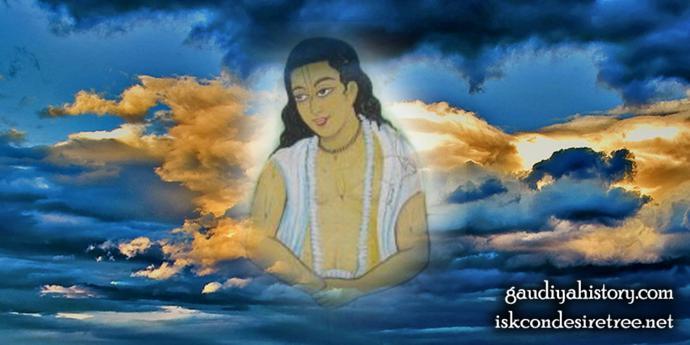
According to the traditional account, Rasikananda was meditating alone in Ghantashila, anxious to find a spiritual master, when he heard a voice from an unseen source tell him plainly: "You need be anxious no longer. Your guru is Shyamananda, and you will meet him very shortly." That night he could not sleep, repeating his future guru's name until, toward dawn, he fell into a dream in which Shyamananda himself appeared and told him, "Don't worry any longer, for you will meet me this very day."
Meeting at Dawn #
At first light, Rasikananda kept watch on the path. Before long he saw Shyamananda approaching, surrounded by disciples such as Kishora Dasa. Shyamananda was dancing, fully absorbed, and chanting the names of Chaitanya and Nityananda. Rasikananda fell at his feet. Shyamananda lifted him up, embraced him, and gave him and his wife, Shyamadasi, initiation into the Radha-Krishna mantra. Afterward Rasikananda gave himself so completely to his guru's service that biographers describe him becoming, within a short time, Shyamananda's foremost disciple. He was the one who best absorbed and carried forward what Shyamananda had to teach.
Entrusted With the Govinda Deity at Gopiballabhpur #
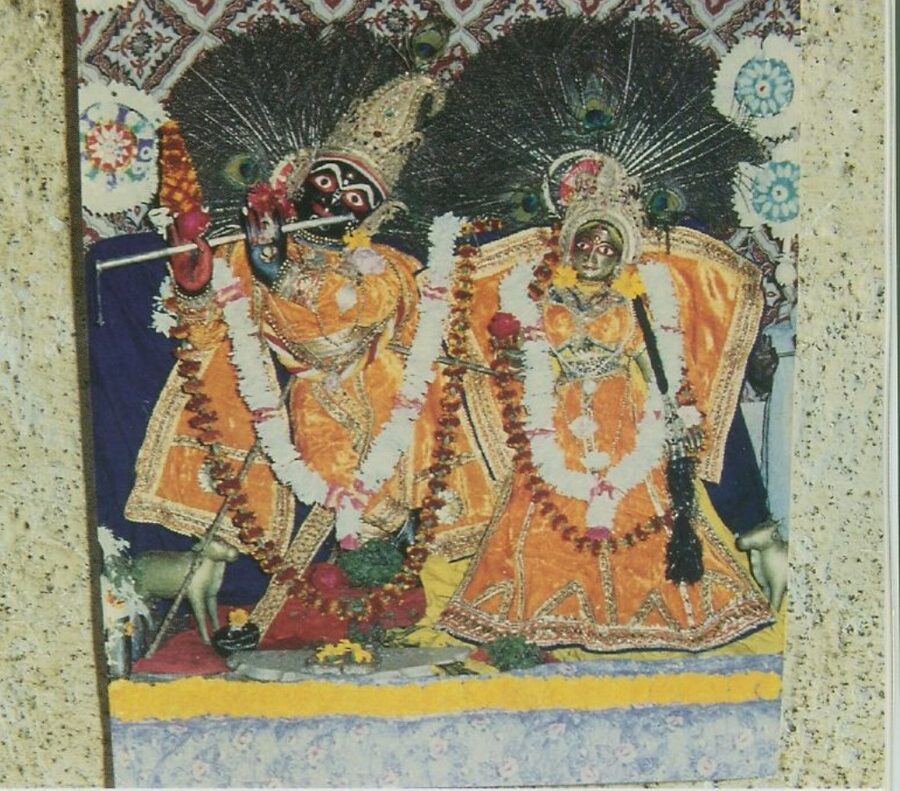
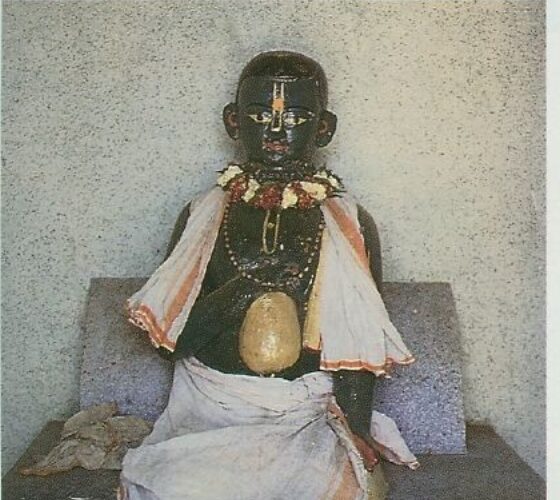
Shyamananda's own worship centered on a Deity of Govinda that had come down through Rasikananda's own family. Shyamananda gave the Deity the name Gopi-vallabha Raya, and the settlement that grew up around Its worship took the name Gopiballabhpur. Shyamananda placed the daily service of this Deity in Rasikananda's hands. Biographers describe the young disciple's care of Govindaji as so complete and so absorbed that it charmed the older devotees who watched him serve. Rasikananda was a pujari first and a preacher second. From this base he began the work covered in Spreading the Faith in Odisha.
Scriptural evidence for this chapter (1)
কিবা বিপ্র, কিবা ন্যাসী, শূদ্র কেনে নয় ।
যেই কৃষ্ণতত্ত্ববেত্তা, সেই ‘গুরু’ হয় ॥
kibā vipra, kibā nyāsī, śūdra kene naya
yei kṛṣṇa-tattva-vettā, sei ‘guru’ haya
Word for word
kibā: whether; vipra: a brāhmaṇa; kibā: whether; nyāsī: a sannyāsī; śūdra: a śūdra; kene: why; naya: not; yei: anyone who; kṛṣṇa-tattva-vettā: a knower of the science of Kṛṣṇa; sei: that person; guru: the spiritual master; haya: is.
"Whether one is a brahmana, a sannyasi or a shudra — regardless of what he is — he can become a spiritual master if he knows the science of Krishna."
From the purport: Purport excerpt: "Advaita Acarya, although a grhastha, was initiated by Madhavendra Puri, and Sri Rasikananda, although born in a brahmana family, was initiated by Sri Syamananda Prabhu, who was not born in a caste brahmana family."
Srila Prabhupada names Rasikananda directly in this purport as a historical example of the principle stated in the verse, that spiritual qualification, not birth, determines who may serve as guru, since Rasikananda accepted initiation from Shyamananda even though Shyamananda was not born into a brahmana family.
Chapter 3
Spreading the Faith in Odisha
Decades of preaching carry Rasikananda's mission from Gopiballabhpur across Odisha's kings, zamindars, and forests.
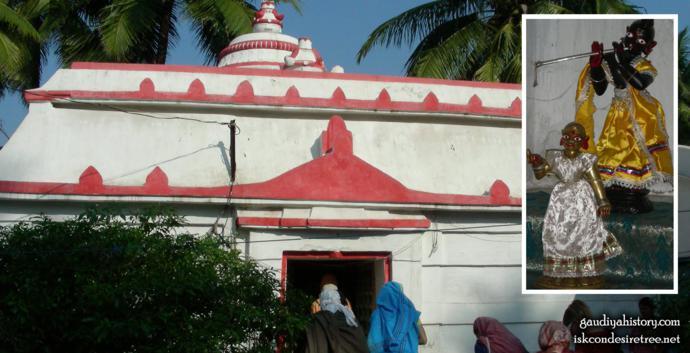
Once the worship of the Govinda Deity was firmly established at Gopiballabhpur, Rasikananda took up the preaching mission his guru had given him. He carried it across Odisha for the rest of his active life. Sources do not agree on exactly how long that mission lasted. One account describes roughly sixteen years of preaching after his initiation, while another states he preached for something closer to forty years. But they agree it filled the rest of his adult life, right up to his disappearance in 1652.
| Detail | Description |
|---|---|
| Base | Gopiballabhpur |
| Also active in | Dharenda, Nrisimhapura, Balarampur, and villages across Utkal (Odisha) |
| Royal disciples | Vaidyanatha Bhanj (raja of Mayurbhanj), Gajapati (zamindar of Patashpur), Chandrabhanu (raja of Moyna), Harinarayana (raja of Panchet) |
| Temple founded at Puri | Kunja Math (formerly Fultota Math), Deity of Radha-Rasika Raya |
A Mission Handed Down From Guru to Disciple #
Rasikananda preached over the same ground where his guru had preached before him. This included Dharenda, Nrisimhapura (where Shyamananda himself stayed on visits from Bengal), Balarampur, and the wider stretch of villages around Gopiballabhpur. He travelled there with his own growing circle of disciples. Going from village to village, he gave out what the traditional biographies call "the jewel of devotion." The Bhakti-ratnakara records that he and Shyamananda met again more than once during these years. One of these meetings was a large festival Shyamananda held at Dharenda together with Rasikananda and a disciple named Damodara, still remembered, the text says, by their descendants.
Kings and Zamindars at His Feet #
Among those who took initiation from Rasikananda were important rulers of the region: Vaidyanatha Bhanj, the raja of Mayurbhanj; Gajapati, the zamindar of Patashpur in Midnapore; Chandrabhanu, the raja of Moyna; and Harinarayana, the raja of Panchet. Alongside them were men who first came to him as enemies, not as admirers. The zamindars Bhima and Shrikara of Dharenda are both remembered as violent, sinful men who later surrendered to Rasikananda and became his disciples.
Taming the Wild #
Two episodes involving animals appear again and again in the traditional accounts of this period. In one, a hostile Muslim zamindar sent an intoxicated elephant to kill Rasikananda. But tradition says that the elephant was transformed by his presence. It was given the name Gopala Das and was engaged in the service of Krishna and the Vaishnavas. After this, the zamindar who had sent it came and surrendered at Rasikananda's feet. A second wild elephant is said to have been tamed the same way, and two jungle tigers are described as having given up their ferocity after meeting him. Whether or not these accounts are read as literal history, the biographers of the period clearly meant them to teach one point. It is the same point made more directly through his human disciples, discussed at length on Initiating Across Caste Lines. Nothing, not caste, religion, criminal history, or even species, placed a living being forever beyond the reach of the holy name. Sri Chaitanya Mahaprabhu Himself had made the same point about a century earlier, with wild animals as His audience. Passing through the Jharikhanda forest on His way to Vrindavana, He called out, "Chant Krishna! Krishna!" Krishnadasa Kaviraja Goswami records that the tigers and deer of the forest began to dance and chant the name in response (Sri Chaitanya-charitamrita Madhya 17.40).
A Temple Won From Lord Jagannath #
One year Rasikananda was busy preaching in another part of the country. He realized too late that the Ratha-yatra festival of Lord Jagannath at Puri had already begun without him, and he rushed to Nilachala to try to arrive in time. Tradition holds that Jagannath's cart would not move, no matter how many elephants the king summoned to push it, until Rasikananda arrived. At that point the Lord told the king He had simply been waiting for His devotee. When Rasikananda finally reached the cart and pulled its rope, it moved easily. Grateful, the king afterward offered him land at a site called Fultota Math, later renamed Kunja Math. There Rasikananda installed a Deity of Bat Krishna, who is worshipped today as Radha-Rasika Raya. The math still stands at Puri, alongside the temples of many other Gaudiya Vaishnava acharyas, including Haridasa Thakura.
Scriptural evidence for this chapter (1)
'kṛṣṇa kṛṣṇa kaha' kari' prabhu yabe balila
'kṛṣṇa' kahi' vyāghra-mṛga nācite lāgila
"When Sri Chaitanya Mahaprabhu said, 'Chant Krishna, Krishna!' the tigers and deer began to dance and chant, 'Krishna!'"
This verse records Sri Chaitanya Mahaprabhu Himself causing wild tigers and deer of the Jharikhanda forest to chant and dance simply by calling out the holy name, decades before Rasikananda's own preaching in Odisha. The traditional accounts of Rasikananda taming a hostile elephant and two jungle tigers are remembered by his biographers as the same principle at work in his own mission: that the holy name reaches even the animal kingdom, not only human society.
Chapter 4
Initiating Across Caste Lines
Ordered by his guru to preach without discrimination, Rasikananda initiated brahmanas and outcastes, Hindus and Muslims, alike.
Of everything remembered about Rasikananda, one thing stands out most. On the direct and clear order of his guru, he initiated people across every caste and community line of his own time. In those days caste decided who could receive mantra initiation, and from whom. So this was not a minor detail of his career. It was close to the center of his life's work.
Shyamananda's Charge #
The order itself is found, in substance, in more than one traditional source. Shyamananda instructed Rasikananda to "distribute the Sri Hari-nama maha-mantra to everyone in Utkal, from the brahmanas up to the chandalas," to men and women, kings and paupers, old persons, brahmacaris, grihasthas, vanaprasthas and sannyasis, without any discrimination. This was not a vague idea of tolerance that later writers credited to Rasikananda. It was a specific instruction. It named brahmanas and chandalas as the two ends of the caste scale that his mission was meant to cover. He is described as having carried it out for the rest of his preaching life.
From Brahmanas to Chandalas #
The traditional biographies describe Rasikananda delivering "criminals, atheists, Muslims, and other fallen souls" without regard for their origin. The Prema-vilasa, an early biography, states plainly that "he delivered many criminals and Muslims." The zamindars Bhima and Shrikara of Dharenda are both remembered as violent men before their conversion. Many dacoits and robbers are also said to have taken shelter at his feet. They stood at the lower end of the social and moral scale his mission reached. They were exactly the chandalas and outcastes that Shyamananda's order had named. We should be careful about what the available sources do and do not say. They give specific, repeated details of initiation across caste lines, from brahmana to chandala, and across the line between Hindus and Muslims. But they do not name any tribal or adivasi community among those Rasikananda initiated. Such communities include the Bhumij, Santal, and Ho peoples, who have long lived in this same Mayurbhanj-Gopiballabhpur borderland alongside caste Hindu society. This is a real difference. We state it plainly, and we do not turn it into a wider claim than the sources actually support.
Across the Hindu-Muslim Divide #
One of Rasikananda's most striking converts was Ahmed Beg, son-in-law of Ibrahim Khan, the governor of Odisha. Ahmed Beg is remembered as having first tried to have Rasikananda killed by sending an intoxicated elephant against him. When the attempt failed and the elephant itself was transformed instead, Ahmed Beg came in person and surrendered at Rasikananda's feet, becoming his disciple. Several independent sources retell this episode with only minor variation. The tradition treats it as one of Rasikananda's most important conversions. In the biographers' telling, it proves that even a determined religious enemy could be won over, not just defeated.
A Legacy That Outlived Him #
Rasikananda's own guru had not been born a brahmana. Several traditional sources say that Rasikananda's own father had not been born a brahmana either. But Srila Prabhupada's purport to Chaitanya-charitamrita Madhya 8.128 describes Rasikananda himself as brahmana-born. This difference is noted more fully on Birth and Early Life. Whichever account of his own birth is correct, what came after him is well recorded. Srila Prabhupada's purport to Chaitanya-charitamrita Adi 7.45 records that Rasikananda-deva's own family line continued for three to four hundred years afterward, down to Srila Prabhupada's own lifetime, to initiate disciples born into brahmana families. The members of this family line were not born brahmanas, yet they also performed the sacred-thread ceremony for these disciples, "as it is for the caste Gosvamis." In this way, what began as an order from Shyamananda to a single disciple became a lasting tradition. It became a family of acharyas who initiated disciples born into brahmana families although they were not born brahmanas themselves, exactly as Rasikananda himself had first done in Odisha.
Scriptural evidence for this chapter (1)
কাশীতে লেখক শূদ্র–শ্রীচন্দ্রশেখর ।
তাঁর ঘরে রহিলা প্রভু স্বতন্ত্র ঈশ্বর ॥
kāśīte lekhaka śūdra-śrīcandraśekhara
tāṅra ghare rahilā prabhu svatantra īśvara
Word for word
kāśīte: in Varanasi; lekhaka: writer; śūdra: born of a śūdra family; śrī-candraśekhara: Candrashekhara; tāṅra ghare: in his house; rahilā: remained; prabhu: the Lord; svatantra: independent; īśvara: the supreme controller.
"This time Lord Chaitanya stayed at the house of Chandrashekhara, although he was regarded as a shudra or kayastha, for the Lord, as the Supreme Personality of Godhead, is completely independent."
From the purport: Purport excerpt: "...in the families of Thakura Raghunandana Acarya, Thakura Krsnadasa, Navani Hoda and Rasikananda-deva (a disciple of Syamananda Prabhu), the sacred thread ceremony is performed, as it is for the caste Gosvamis, and this system has continued for the past three to four hundred years."
The verse itself concerns Lord Chaitanya's disregard for caste; the purport goes further, recording that Rasikananda-deva's own family line, though not born brahmana, continued for centuries afterward to initiate brahmana-born disciples, an institutional legacy of the caste-crossing principle Rasikananda lived by.
Chapter 5
Final Days and Disappearance
After decades of preaching, Rasikananda walks quietly to Remuna and enters the Deity of Kshira-chora Gopinatha.
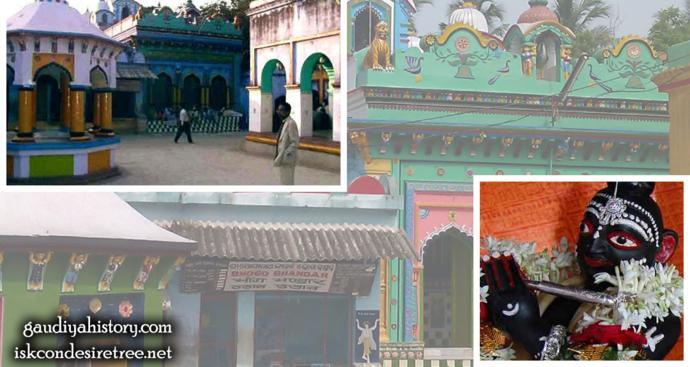
After preaching across Odisha for decades, Rasikananda left this world in a way that is remembered as deliberate and unhurried. It is remembered as a final act of devotion, not as an illness or accident that overtook him.
| Detail | Description |
|---|---|
| Date | First day of the bright fortnight of Phalguna, Sakabda 1574 (1652 AD) |
| Place | Kshira-chora Gopinatha Temple, Remuna, Odisha |
| Companions | Seven disciples, whose samadhis stand beside his own |
| Sons | Radhananda, Krishna-Govinda, Radha-Krishna |
| Works | Shyamananda-shataka, Bhakta-Bhagavatashtaka, Kunjakeli-dvadashaka |
A Quiet Departure From Santa #
Shortly before his disappearance, Rasikananda left the village of Santa without announcement and walked, together with seven of his disciples, toward Remuna, chanting kirtana the entire way, according to the Bhakti-ratnakara. Arriving at the town, he spent time discussing Krishna-katha with the local devotees and asked them to begin sankirtana before he entered the temple of Kshira-chora Gopinatha.
Merging Into Kshira-Chora Gopinatha #
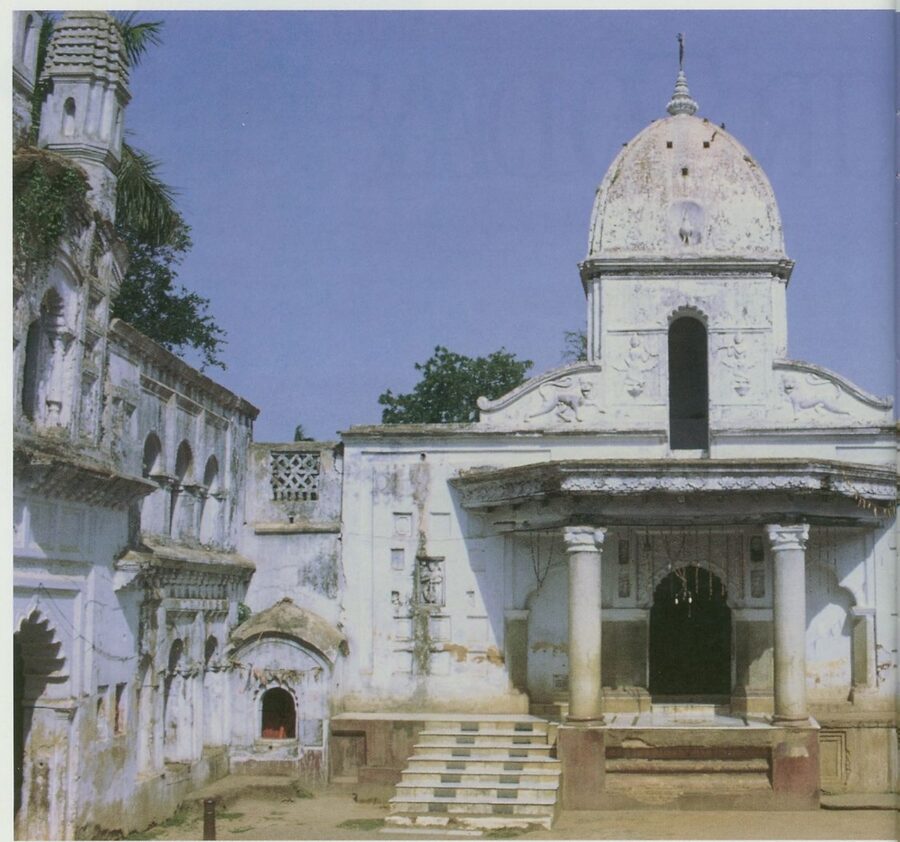
At the temple, tradition says, Rasikananda touched the Deity's lotus feet and then entered into His eternal shelter, understood by his followers as a merging into the Deity itself. His seven companions are said to have left their own bodies at the same spot. Their flower samadhis, along with Rasikananda's own, still stand in the temple courtyard at Remuna. Every year a twelve-day festival there continues to mark his disappearance. It begins the day after Shiva-chaturdashi in the month of Magha. Gaudiya Vaishnavas generally observe the day by singing the bhajana "Je anilo prema dhana." Srila Prabhupada himself confirms the location in his own writing. His purport to Chaitanya-charitamrita Madhya 4.12 notes that "within the temple the samadhi tomb of Rasikananda Prabhu, the chief disciple of Shyamananda Gosvami, can still be found," and his purport to Madhya 1.97 records that, generations later, care of the same temple had passed to Shyamsundara Adhikari, "a descendant of Rasikananda Murari." Most of what is recorded of these final days comes from the Bhakti-ratnakara of Narahari Chakravarti, the main traditional source.
Sons, Writings, and a Living Legacy #
Rasikananda left behind three sons: Radhananda, Krishna-Govinda, and Radha-Krishna. Their descendants continued to serve the Radha-Govinda Deity at Gopiballabhpur. Tradition holds that this service continues to the present day at the pilgrimage site still known as Sripat Gopiballabhpur. He also left a small body of his own writing, including the Shyamananda-shataka in praise of his guru, the Bhakta-Bhagavatashtaka, and the Kunjakeli-dvadashaka. A later descendant, Vishvambharananda Deva Goswami, is remembered as the author of the Ashtikya-darshana.
His disciplic line reached further still. Rasikananda initiated his disciple Nayanananda Goswami, and Nayanananda initiated Radha-Damodara Goswami. Generations after Rasikananda, within this same line of initiation, Radha-Damodara Goswami accepted as his own disciple the scholar who would become Baladeva Vidyabhusana. Baladeva Vidyabhusana became the Gaudiya Vaishnava acharya whose Govinda-bhashya later firmly established the sampradaya's philosophical position at the royal court of Jaipur. In this way, a line that began with a prince who gave up caste privilege to preach the holy name without distinction helped give Gaudiya Vaishnavism its formal place among the schools of Vedanta.
Scriptural evidence for this chapter (2)
পথে বড় বড় দানী বিঘ্ন নাহি করে ।
তা’ সবারে কৃপা করি’ আইলা রেমুণারে ॥
pathe baḍa baḍa dānī vighna nāhi kare
tā’ sabāre kṛpā kari’ āilā remuṇāre
Word for word
pathe: on the way; baḍa baḍa: big, big; dānī: toll or tax collector; vighna: hindrances; nāhi: not; kare: make; tā’ sabāre: to all of them; kṛpā kari’: showing mercy; āilā: reached; remuṇāre: the village known as Remuna.
"There were many rivers on the way, and at each river there was a tax collector. The tax collectors did not hinder the Lord, however, and He showed them mercy. Finally He reached the village of Remuna."
From the purport: Purport excerpt: "The temple of Ksira-cora-gopinatha still exists in this village, and within the temple the samadhi tomb of Rasikananda Prabhu, the chief disciple of Syamananda Gosvami, can still be found."
Srila Prabhupada confirms, in a purport otherwise about Lord Chaitanya's own journey through Remuna decades before Rasikananda's birth, that Rasikananda's samadhi tomb stands in the same Ksira-cora Gopinatha temple.
ক্ষীর-চুরি-কথা, সাক্ষি-গোপাল-বিবরণ ।
নিত্যানন্দ কৈল প্রভুর দণ্ড-ভঞ্জন ॥
kṣīra-curi-kathā, sākṣi-gopāla-vivaraṇa
nityānanda kaila prabhura daṇḍa-bhañjana
Word for word
kṣīra-curi-kathā: the narration of the stealing of the condensed milk; sākṣi-gopāla-vivaraṇa: the description of witness Gopala; nityānanda: Nityananda Prabhu; kaila: did; prabhura: of the Lord; daṇḍa-bhañjana: breaking the sannyasa rod.
"From Nityananda Prabhu, Lord Chaitanya Mahaprabhu heard the story of Ksira-curi Gopinatha and of the witness Gopala. Then Nityananda Prabhu broke the sannyasa rod belonging to Lord Chaitanya Mahaprabhu."
From the purport: Purport excerpt: "Syamasundara Adhikari was a descendant of Rasikananda Murari, the chief disciple of Syamananda Gosvami."
This purport confirms that care of the Ksira-curi Gopinatha temple at Remuna, where Rasikananda's own samadhi stands, had passed by Srila Prabhupada's time to a direct descendant of Rasikananda.
Closing
A Prince of Rohini on the Subarnarekha #
Rasikananda's father was Raja Achyuta Deva, a landholding ruler of Rohini village, and his mother was Bhavani Devi. He was born in the Bengali month of Kartika, on the night of Dipamalika, the lamp-lit festival of Diwali. Rohini lay where the Subarnarekha River marks the present-day Bengal-Odisha border, in a territory then known as Mallabhumi. He was also called Murari. Sources describe him as a gifted student who mastered the scriptures while still a boy. His father arranged his marriage early, to a woman later known by her Vaishnava name, Shyamadasi. The sources do not fully agree about his caste. Several traditional biographies describe Achyuta Deva as belonging to the Karana caste. This is an Odia community roughly equal to the Kayasthas of Bengal. But Srila Prabhupada's own purport to Chaitanya-charitamrita Madhya 8.128 describes Rasikananda as "born in a brahmana family." Both traditions agree on the more important point. Whatever his birth, his life showed that birth is not what makes a Vaishnava.
Was Rasika Murari a Different Person from Rasikananda Prabhu? #
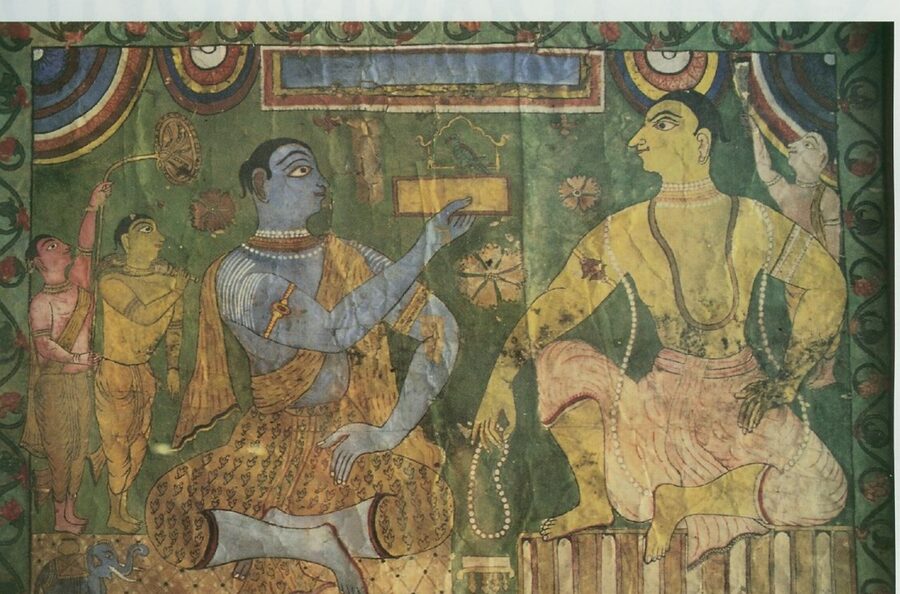
This question needs a clear answer, because one source can be misunderstood to mean that they were two different people. Ishana Nagara's Prema-vilasa, an early biography of the Gaudiya Vaishnava acharyas, names two of Shyamananda Pandit's main disciples from the village of Rayni: "one named Rasikananda, the other Murari." Read alone, that line could be taken to mean two separate men.
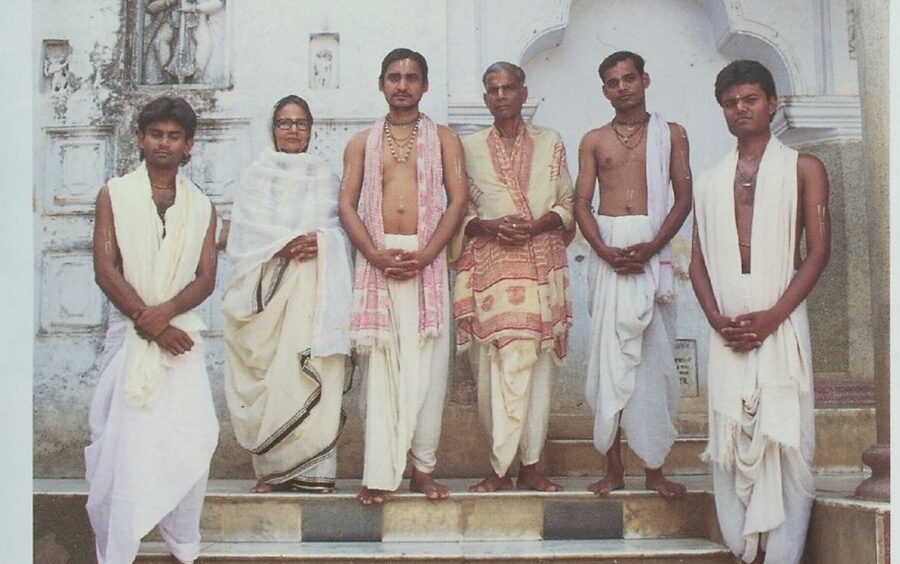
Narahari Chakravarti's Bhakti-ratnakara settles the question directly:
"In the village of Rayni lived the famous son of Achyutananda. He had two names: Rasikananda and Murari. Thus he was also known as Rasika-Murari." (Bhakti-ratnakara 15.27-8)
Rasikananda and Murari are one and the same person, not two different disciples. Rasika-Murari is simply the combined form of his two names, and it is the form his own biographers use most often.
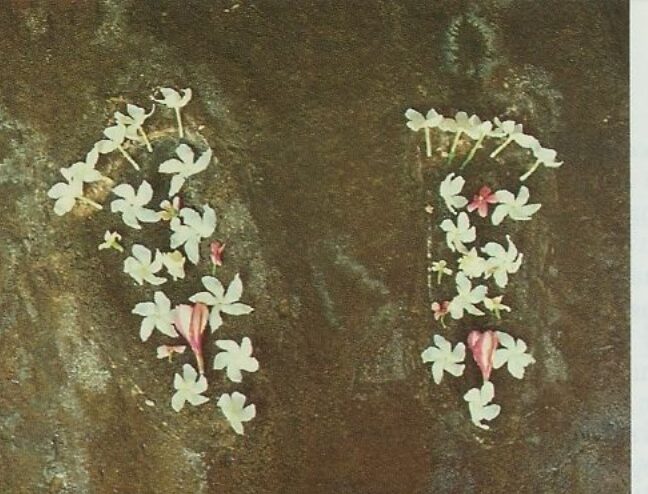
Called to Shyamananda Pandit #
As a young man meditating alone in the village of Ghantashila, Rasikananda heard a voice say that Shyamananda Pandit would become his guru. That night he dreamed of Shyamananda himself. At dawn the two met on the road, where Shyamananda was dancing in kirtana surrounded by his own disciples. Rasikananda fell at his feet. Shyamananda lifted and embraced him, then gave him and his wife initiation into the Radha-Krishna mantra. Shyamananda himself knew well what it meant to cross the limits of birth. He was born Duhkhi Krishnadasa in a family of milkmen. He had studied in Vrindavana under Jiva Goswami together with Narottama Dasa Thakura. Later Jiva Goswami sent the two of them, along with Shrinivasa Acharya, back to preach in Bengal and Odisha. Rasikananda served his new guru so completely that he was soon recognized as Shyamananda's foremost disciple.
Guardian of the Govinda Deity at Gopiballabhpur #
Shyamananda entrusted Rasikananda with the daily worship of his own beloved Govinda Deity. The Deity was installed at the place that became known as Gopiballabhpur. Tradition says this name was formed from the Deity whom Shyamananda himself named Gopi-vallabha Raya. Rasikananda is remembered for serving the Deity with great care and inspiration. Under him, Gopiballabhpur grew into the headquarters from which he preached across Odisha for the rest of his life. By most accounts this was several decades, but the sources disagree on exactly how long. Some describe sixteen years of active preaching, and others closer to forty.
A Preacher Who Crossed Every Caste Line #
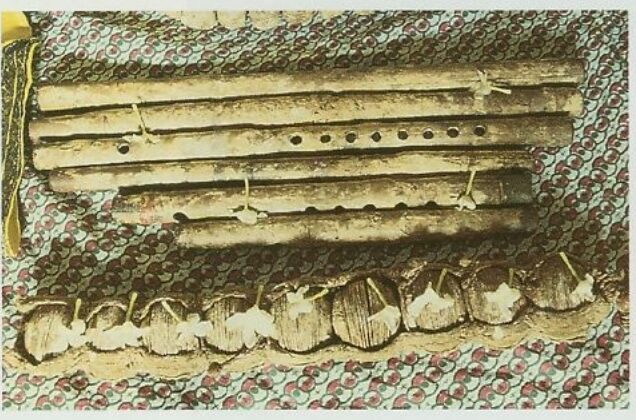
Shyamananda gave his disciple a clear order: carry the holy name to everyone in Utkal, from brahmanas to chandalas, without regard for caste, sex, wealth, or station. Rasikananda's biographers describe him doing exactly that. He initiated rulers such as Vaidyanatha Bhanj, the raja of Mayurbhanj. He also initiated dacoits, atheists, and Muslim officials. One of them was Ahmed Beg, son-in-law of the governor of Odisha, who had at first tried to have Rasikananda killed. At that time and place, it was truly unusual to initiate across every social line. This willingness is the most special feature of Rasikananda's mission, and it did not end with him. Srila Prabhupada's purport to Chaitanya-charitamrita Adi 7.45 records that Rasikananda-deva's own family line continued to initiate brahmana-born disciples for three to four hundred years afterward, though its own members were not born brahmanas. In this way the very principle Rasikananda lived by was carried on by his family line.
Entering the Deity at Remuna #
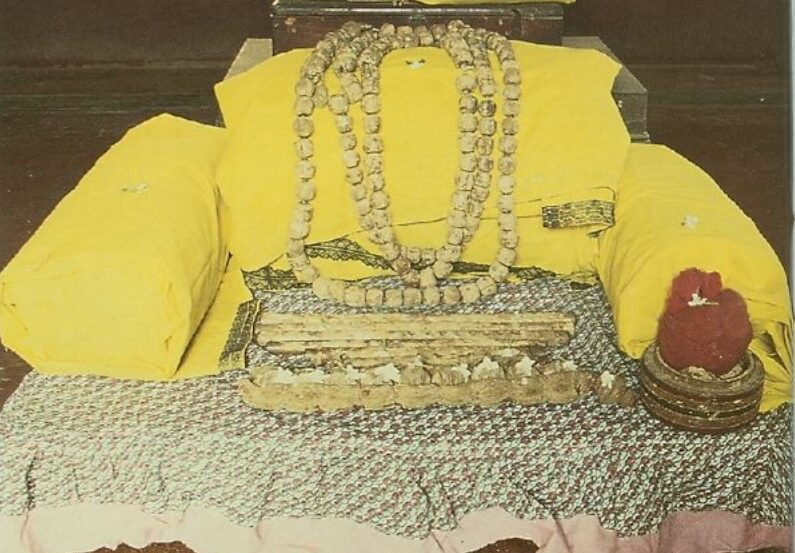
After decades of preaching, Rasikananda quietly left the village of Santa and walked to Remuna. There he entered the Kshira-chora Gopinatha temple. Tradition holds that he merged into the body of the Deity itself. Seven of his disciples are said to have left their own bodies at the same spot. His samadhi still stands in the temple courtyard. Srila Prabhupada notes in his own purports that Rasikananda's descendants still tend it. Three sons continued his line at Gopiballabhpur. Generations later, a spiritual descendant in his disciplic succession, Baladeva Vidyabhusana, would become one of Gaudiya Vaishnavism's most important philosophers.
- Rasikananda Prabhu - Gaudiya History
- Rasikananda Prabhu - Biography 2 - Gaudiya History
- Rasikananda Prabhu - Biography 3 - Gaudiya History
- Shyamananda Prabhu - Biography - Gaudiya History
- Sri Rasikananda Deva Gosvami (from Sri Chaitanya: His Life and Associates, by Srila Bhakti Ballabh Tirtha Goswami Maharaj)
- Rasikananda Dev - Stephen Knapp
- Sri Chaitanya-caritamrita, Madhya-lila 8.128, purport
- Sri Chaitanya-caritamrita, Adi-lila 7.45, purport
- "I Have Found the Future of Vaishnavism": The Story of Rasikananda Prabhu, by Satyaraja Dasa — Back to Godhead, Jan/Feb 1999 (PDF, article begins p. 44)
- Gopiballabhpur Today, by Bhaktivikasa Swami, photos by Maha Vishnu Dasa — Back to Godhead, Jan/Feb 1999 (PDF, article begins p. 47)
