Sarvabhauma Bhattacharya had lost the argument about philosophy point by point, but he was not yet a devotee. He was a defeated logician, which is a different thing. His change was not completed by another argument. It was completed by a single verse of the Srimad-Bhagavatam, and by a display of scholarship that even he could not equal.
A Verse About Self-Satisfied Sages #
After days of hard debate, Chaitanya Mahaprabhu spoke more gently and quoted a well-known Bhagavatam verse, the famous atmarama verse (Chaitanya-charitamrita, Madhya-lila 6.185-186, quoting Srimad-Bhagavatam 1.7.10). It says that even sages who are fully self-satisfied and free of material desire are drawn to the loving service of Krishna, whose qualities are transcendental and whose activities are wonderful. Sarvabhauma was still a scholar through and through, so he asked to hear it explained. The Lord, with perfect courtesy, asked him to go first.
Nine Explanations, Then Eighteen More #
Sarvabhauma did not disappoint. Using all his skill in nyaya and his knowledge of the scriptures, he explained the verse in nine different ways. Chaitanya Mahaprabhu praised the performance fully. No one in the world, He said, could explain a verse like that. Then He took each of the verse's eleven Sanskrit words in turn, without touching a single one of Sarvabhauma's nine readings. He combined each word with the word atmarama, and produced eighteen further explanations of His own (Chaitanya-charitamrita, Madhya-lila 6.195). All his life Sarvabhauma had been the person in the room whom nobody could out-argue. Now he watched someone double his own best effort without repeating a single point. This was not a defeat he could explain away.
Four Arms, Two Arms and a Flute #
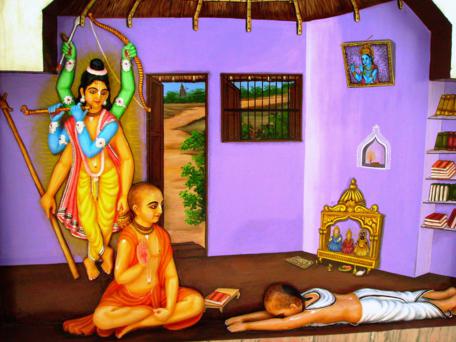
Sarvabhauma broke completely. The tradition records that in that moment he understood who stood before him. He condemned himself aloud as an offender blinded by his own learning, and fell at the Lord's feet. Chaitanya Mahaprabhu then showed him, one after the other, the four-armed form of Vishnu and then His own original form of Krishna, dark-complexioned with a flute at His lips (Chaitanya-charitamrita, Madhya-lila 6.203). A six-armed vision is also remembered in this pastime. It combines the forms of Rama and Krishna with Chaitanya's own sannyasi form. It is still a special image of worship in Gaudiya Vaishnava art to this day, including at Sarvabhauma's own house in Puri.
A Hundred Verses Faster Than Brihaspati #
Sarvabhauma fell flat on the ground, rose, and began to compose. In a very short time he produced a hundred Sanskrit verses in praise of the Lord. Krishnadasa Kaviraja remarks that not even Brihaspati, the learned priest of the demigods, could have composed them so quickly (Chaitanya-charitamrita, Madhya-lila 6.206-207). Those hundred verses would later circulate on their own as the Sarvabhauma-shataka, sometimes also called the Chaitanya-shataka. Mahaprabhu embraced him, and the man remembered as the greatest logician in Odisha wept, trembled, perspired and danced. This was the beginning of a devotional life, told further in The Two Verses on the Palm Leaf.
A six-armed Deity in memory of this darshan is still worshipped today. He is worshipped both at the Jagannatha temple in Puri and at Sarvabhauma's own former house nearby. At the house there is also a painted scene of the vision. It shows Sarvabhauma seated in prayer, with the six-armed form in the air before him, and the Lord's own sannyasi body lying flat on the floor beside him. This is one of the most often copied images of this entire episode in Gaudiya Vaishnava devotional art.
Why the Argument Had to Be Won #
Gaudiya Vaishnava tradition, following the Gaura-ganoddesha-dipika, identifies Sarvabhauma Bhattacharya as an incarnation of Brihaspati. He was sent specifically to give Chaitanya Mahaprabhu a worthy opponent for this pastime. In it the Lord defeated Mayavada philosophy with its own methods, not by miracle alone. Whether or not a reader accepts that identification, the story itself explains why this conversion has kept its place at the centre of Gaudiya Vaishnava memory. Sarvabhauma was not won over by a display of power he could not match. He was out-reasoned and out-explained in the very field where he had never once been beaten before, the explaining of Sanskrit scripture.
