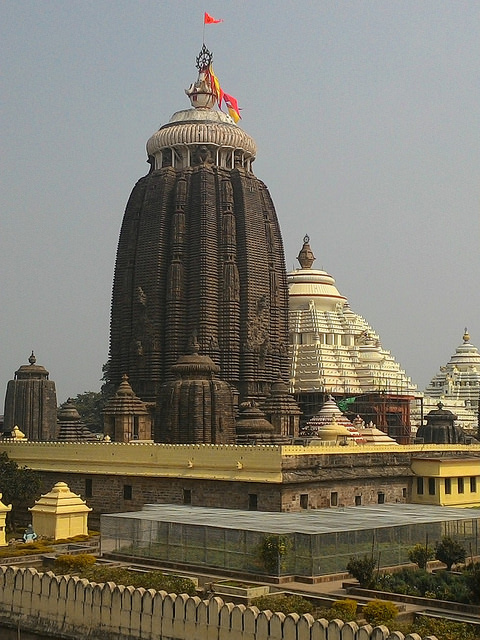
Sarvabhauma Bhattacharya did not go looking for Sri Chaitanya Mahaprabhu. Their first meeting happened because Sarvabhauma was, as usual, near the Jagannatha temple, and a stranger fell unconscious in front of him.
An Unknown Sannyasi Collapses #
Early in 1510, a young sannyasi walked into the Jagannatha temple, saw the Deity, ran toward the altar to embrace Him, and collapsed on the floor. To the temple watchmen He looked like a wandering beggar who was about to be beaten and thrown out. Sarvabhauma happened to be present. Something about the fall made him stop. He had already noticed the beauty of the young man, and the visible changes in the body that come with ecstatic love of God. He stepped in before the guards could act. Then, with the help of his own students and the temple guards, he had the unconscious sannyasi carried to his own house.
A Physician's Test #
Once home, Sarvabhauma did what any careful scholar of the scriptures would do before coming to a conclusion. He checked. He watched for movement in the abdomen and found none. He checked the breathing and found none either. Only when he held a wisp of cotton before the nostrils and saw it move faintly did he relax. Sitting beside the still body, he recognised the symptoms. The Chaitanya-charitamrita later names them suddipta-sattvika, a technical term for ecstatic transformation. The scriptures describe such symptoms as appearing only in eternally liberated souls. So Sarvabhauma could not understand how such a thing could appear in an ordinary human body (Chaitanya-charitamrita, Madhya-lila 6.9-12).
An Old Family Connection #
While Sarvabhauma looked after the unconscious sannyasi, word reached Nityananda Prabhu and the devotees travelling with the Lord that He had been carried to a house near the temple. The person who found the group at the temple gate and led them there was Sarvabhauma's own brother-in-law, Gopinatha Acharya. He was married to Sarvabhauma's sister. He was also a Nadia man, and he already knew exactly who this sannyasi was. Once the devotees began chanting the holy names, the Lord returned to external consciousness. Sarvabhauma was delighted to be host to visitors from his own home region. He fed everyone generously and sent them to bathe in the sea. Then he learned the young man's family background. He was the grandson of Nilambara Chakravarti, a scholar whom Sarvabhauma's own father Mahesvara Visarada had respected. He was the son of Jagannatha Mishra, and His own former name was Vishvambhara Mishra. Now Sarvabhauma's interest turned personal. He was old enough to be the young sannyasi's father, and he began to feel exactly that kind of protective affection.
A Well-Meant, Mistaken Plan #
That affection led to a plan that Sarvabhauma was sure was sound. Here was a very beautiful young man of about twenty-four who wept, fainted and danced at the sight of a Deity. He had newly taken sannyasa under Keshava Bharati, and in Sarvabhauma's own ranking of sannyasa lineages this was only an ordinary line. To a lifelong logician, this combination did not look like holiness. It looked more like a fine mind about to be ruined by uncontrolled emotion. Sarvabhauma even offered, quite sincerely, to arrange for Him to be initiated again into a higher sannyasa order. The remedy he chose was to recite Vedanta philosophy to the Lord all the time, until calm renunciation took the place of so much emotion.
Gopinatha Acharya's Objection #
Gopinatha Acharya understood exactly who was staying in his brother-in-law's house. He argued against the plan as strongly as politeness allowed. The Supreme Lord, he said, is known only by His own mercy, never by reasoning or scholarship. And Sarvabhauma, in spite of all his learning, was blind to what was directly in front of him. Sarvabhauma was not moved. He replied that scripture itself denies any incarnation of Vishnu in the current age of Kali. When the exchange was reported to Sri Chaitanya Mahaprabhu, He refused to hear a word said against Sarvabhauma. The Bhattacharya, He told His devotees, was acting purely out of a father's affection, and He fully accepted him as a spiritual master. That prepared the way for the seven days of one-sided Vedanta lectures told in Seven Days of Silence.
