Sri Sharanga Thakura
The Bhajananandi of Mamgachi
The complete life, on one page: The main biography and every pastime page, in order, in one place
Introduction
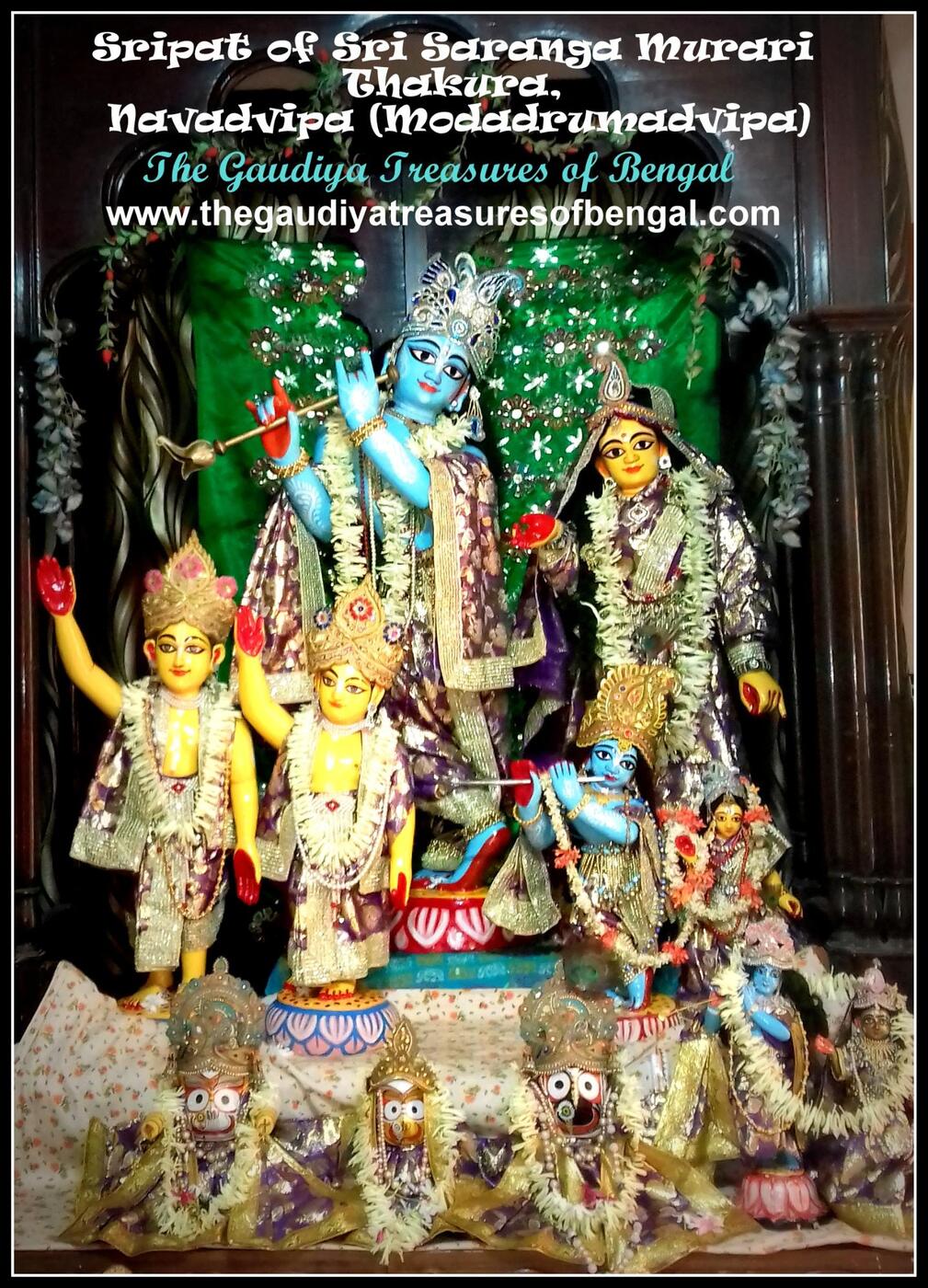
Sri Sharanga Thakura was a bhajananandi devotee of Sri Chaitanya Mahaprabhu. He lived at Mamgachi, a village on the Ganges in Modadrumadwipa, one of the nine islands of Nabadwip. This was during Mahaprabhu's own years there, in the late fifteenth and early sixteenth centuries. He left behind no writings and founded no formal following. Instead, what we have of him is a small set of specific episodes that are often retold. He spent a lifetime in solitary Deity worship under a Bakula tree, which Mahaprabhu is said to have personally revived. He also had a single disciple. Tradition says this disciple was raised from a corpse floating in the Ganges. Sharanga Thakura then joined the disciple's name to his own, and so became Sharanga Murari Thakura.
| Detail | Description |
|---|---|
| Also known as | Saranga Thakura, Sharanga Murari Thakura, Saranga Murari, Sarnga Pani, Sarnga Dhara |
| Residence | Mamgachi (Mamagachi), Modadrumadwipa, Nabadwip, on the Ganges |
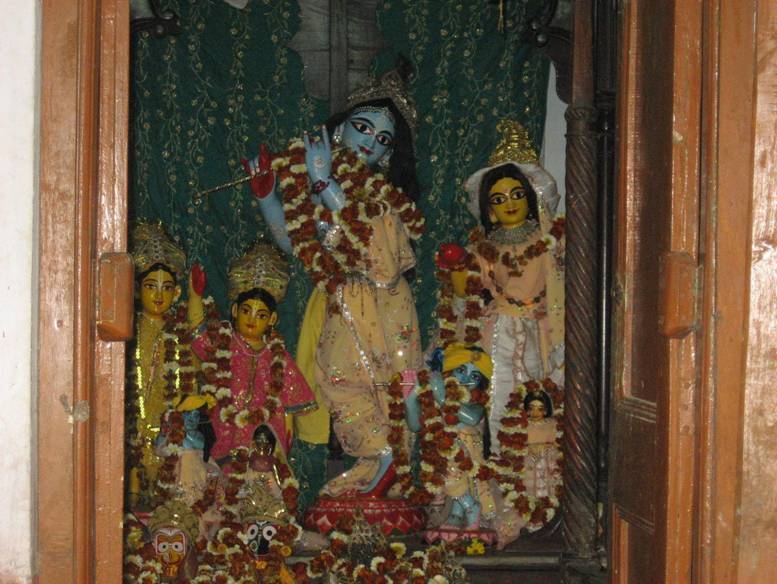
| Deity worshiped | Sri Sri Radha-Gopinatha (Madana-Gopala and Gaura-Gadadhara Deities later joined the same altar) |
| Only recorded disciple | Sharanga Murari, initiated after being revived from death |
| Identity | Nandimukhi-devi of Vraja (Gaura-ganoddesha-dipika 172; Chaitanya-charitamrita Adi 10.113 purport) |
| Appearance day observed | Fourteenth day, dark fortnight of Ashadha |
| Disappearance day observed | Thirteenth day, dark fortnight of Agrahayana (Mrigashira) |
At a Glance
- Spent his days in solitary Deity worship at Mamgachi and crossed the Ganges each evening to join Mahaprabhu's sankirtana at Mayapur.
- Vowed never to accept a disciple, gave in only after Mahaprabhu's repeated urging, and then initiated the first person he met. This was a dead boy whose body had been set afloat on the river.
- Watched Mahaprabhu personally embrace his dying Bakula tree at Mamgachi; the tree is still alive at the site today.
- Named in Kavi Karnapura's Gaura-ganoddesha-dipika as the gopi Nandimukhi. In the same passage, Kavi Karnapura records that his own father did not accept a different identification.
Scriptural evidence for the introduction (3)
व्रजे नान्दीमुखी यासीत्साद्य सारङ्गठक्कुरः ।
प्रह्लादो मन्यते कैश्चिन्मत्पित्रा न स मन्यते ॥
vraje nāndīmukhī yāsīt sādya sāraṅga-ṭhakkuraḥ
prahlādo manyate kaiścin mat-pitrā na sa manyate
The vraja-brahmani Nandimukhi-devi appeared as Saranga Thakura. Some people think that Saranga Thakura was the incarnation of Prahlada Maharaja. My father (Sivananda Sena) did not agree with them.
From the purport: In the Gaura-gaṇoddeśa-dīpikā (172) it is stated that Sāraṅga Ṭhākura was formerly a gopī named Nāndīmukhī. Some devotees say that he was formerly Prahlāda Mahārāja, but Śrī Kavi-karṇapūra says that his father, Śivānanda Sena, does not accept this proposition.
Kavi Karnapura's identification of Sharanga Thakura as Nandimukhi of Vraja, with his record that his father, Shivananda Sena, rejected the view that Sharanga Thakura was Prahlada Maharaja; repeated in Srila Prabhupada's purport to Chaitanya-charitamrita Adi 10.113. Sanskrit: diacritic edition of the Gaura-ganoddesha-dipika; English translation as published at bvmlu.org.
Whether one is a brahmana, a sannyasi or a sudra - regardless of what he is - he can become a spiritual master if he knows the science of Krishna.
From the purport: Sometimes a Vaishnava who is a bhajanandi does not take the savitra-samskara (sacred thread initiation)... There are two kinds of Vaishnavas - bhajanandi and gosthy-anandi. A bhajanandi is not interested in preaching work, but a gosthy-anandi is interested in spreading Krishna consciousness to benefit the people and increase the number of Vaishnavas.
Srila Prabhupada's purport draws the standing Gaudiya distinction between a bhajanandi devotee (absorbed only in personal devotional cultivation, uninterested in preaching) and a gosthy-anandi devotee (engaged in spreading Krishna consciousness). Sharanga Thakura's own recorded life at Mamgachi, solitary Deity worship with no preaching activity or formal following, matches the bhajanandi category this purport describes, though Sharanga Thakura is not named in this purport itself; the link is thematic, not a direct textual reference to him. Verified live via vedabase.io RSC-scrape (av-translation/purport JSON) on 2026-09-10.
rāmadāsa, kavicandra, śrī-gopāladāsa
bhāgavatācārya, ṭhākura sāraṅgadāsa
The seventy-third branch of the original tree was Rāmadāsa, the seventy-fourth was Kavicandra, the seventy-fifth was Śrī Gopāla dāsa, the seventy-sixth was Bhāgavata Ācārya, and the seventy-seventh was Ṭhākura Sāraṅga dāsa.
From the purport: Another name of Ṭhākura Sāraṅga dāsa was Śārṅga Ṭhākura. ... When he went to the bank of the Ganges to take his bath, by chance he saw a dead body floating in the water, and he touched it with his feet. This immediately brought the body to life, and Ṭhākura Sāraṅga dāsa accepted him as his disciple.
The verse naming Thakura Sharanga Dasa as the seventy-seventh branch of the Chaitanya tree; Srila Prabhupada's purport quotes Srila Bhaktisiddhanta Sarasvati Thakura's Anubhasya on his other names, his home at Modadruma-dvipa, the disciple raised from the Ganges, the Mamgachi temple and his Gaura-ganoddesha-dipika identity.
Chapter 1
The Disciple Raised From the Ganges
How a vow never to initiate ended with a dead boy brought back to life on the riverbank at Mamgachi.
Of everything remembered about Sharanga Thakura, the story told most often is the one about his only disciple - and about how strange the circumstances of that initiation were.
A Private Vow #
Sharanga Thakura had, at some point in his life at Mamgachi, made a private vow: he would never accept a disciple. Devotional accounts do not explain why - whether from humility, from a sense that he had nothing to offer another soul, or from simple preference for his own solitary bhajana under the Bakula tree. Whatever the reason, he held to it firmly enough that even direct requests from Sri Chaitanya Mahaprabhu did not immediately move him.
Mahaprabhu Will Not Let It Stand #
According to every account that survives, Mahaprabhu did not agree with the vow. He returned to the subject more than once and urged Sharanga Thakura to accept disciples as other devotees did. Sharanga Thakura's final answer was not a simple change of heart. Instead, he set himself a condition. The next morning, he would initiate the first person he happened to meet, and only that person, whoever it turned out to be. This does not read like agreement. It reads more like a way of testing whether Mahaprabhu's wish was really meant to be followed. Or it was a way of leaving the decision to the Lord's arrangement instead of making it himself.
The Body on the River #
The next morning, Sharanga Thakura went to bathe in the Ganges as he always did. What he met there was not a person walking by, but a corpse - the body of a boy, already dead, floating down the river. In the Bengal of that time, a child who died of snakebite was, by custom, not cremated but set afloat on the water, and this boy, sources agree, had died that way. His body drifted against Sharanga Thakura while he stood in the river.
Having bound himself to initiate the first person he met that morning, Sharanga Thakura kept his word to a corpse. He spoke or chanted the initiating mantra into the dead boy's ear - some tellings have him touching the body with his foot as he did, others have Mahaprabhu Himself present and instructing him to proceed. The boy's body came back to life. Regaining consciousness, he identified himself by the name Murari, and, astonished at what had happened to him, bowed down to the man who had just become his guru.
Sharanga Murari #
Murari did not go home. When his parents learned what had happened, they came to Mamgachi to take their son back. By every account, the boy refused. He chose to stay with the guru who had, quite literally, given him back his life. He would not return to the family that had already given him up for dead and set him afloat on the river. Devotional retellings present this choice as a small teaching in itself. An ideal disciple puts his guru and his worship of Radha-Gopinatha first, above the family ties he might otherwise have been expected to honor. From that point on, Murari trained under Sharanga Thakura. Because of this one disciple, and no other, Sharanga Thakura came to be known by the combined name Sharanga Murari Thakura. He is remembered by this name on temple signs and in pilgrimage guides at Mamgachi to this day, and most Gaudiya biographical sources also name him this way.
The story is preserved only in Vrindavana Dasa Thakura's Chaitanya-bhagavata and in the Gaudiya biographical literature that draws on it. It does not appear in Sri Chaitanya-charitamrita, and no Srila Prabhupada purport or lecture retelling it directly is known. Retellings also differ on small details. They differ on whether Murari was the boy's name before his death or the name given to him afterward. They also differ on whether Mahaprabhu was present in person at the riverbank or only heard of the revival afterward. But every version agrees on the main event. There was a vow, a condition set almost as a challenge, and a dead body that became a living disciple.
Chapter 2
The Bakula Tree Mahaprabhu Embraced
A devotee's dying tree, and the golden arms that are said to have brought it back to life.
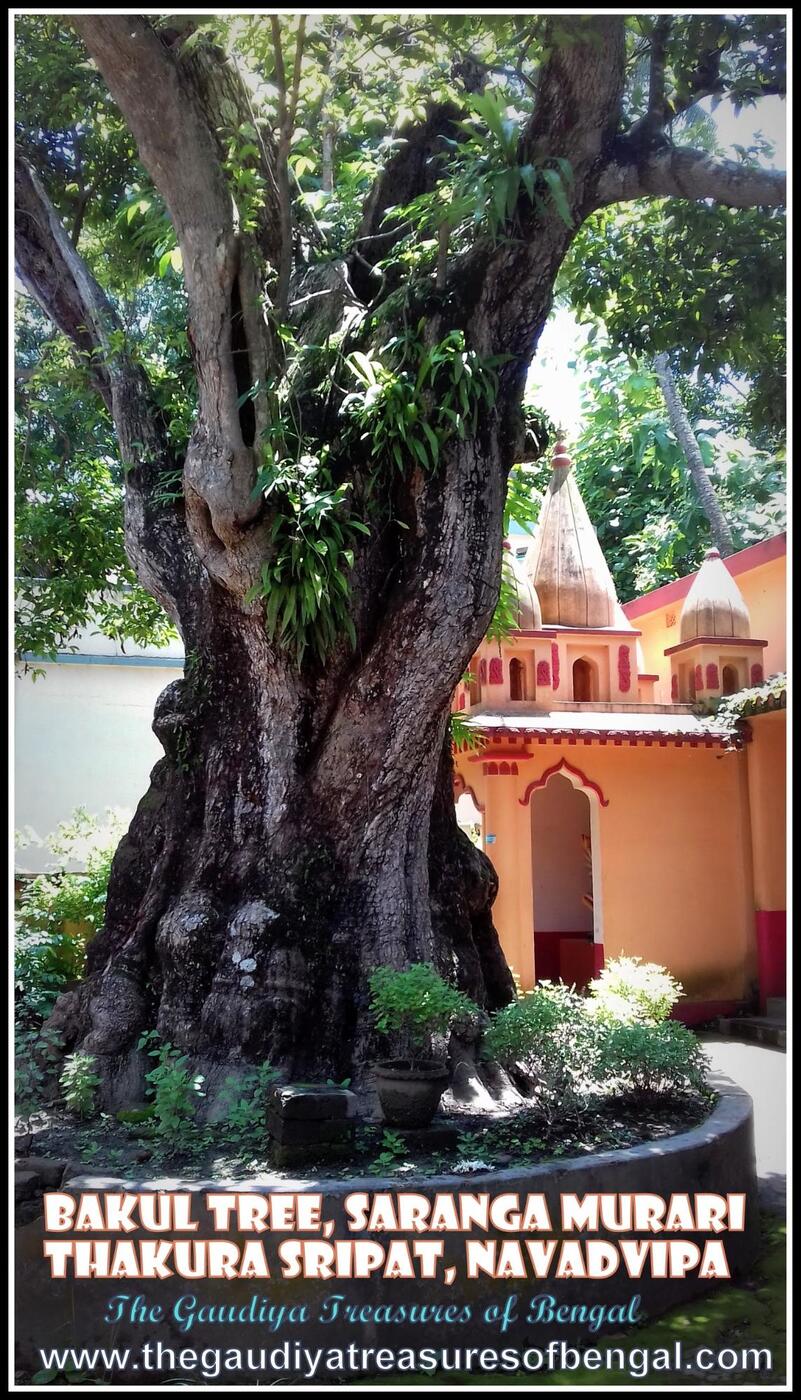
Every account of Sharanga Thakura's life returns to the story of Sharanga Murari, and also to the Bakula tree at Mamgachi. The tree is one of the few parts of his story that is still there to be visited, not only told about.
A Tree Beyond a Devotee's Own Power #
Sharanga Thakura did his daily Deity worship of Sri Sri Radha-Gopinatha under a Bakula tree in his courtyard at Mamgachi. Sources agree that during one of His visits there, Sri Chaitanya Mahaprabhu noticed this tree beginning to wither. By every account, the tree was close to dead. Its leaves were gone or going, and its trunk already showed the effects of age or disease. When he was asked about it, Sharanga Thakura is said to have answered that he saw no way to save it except through Mahaprabhu's own mercy. It was a devotee's honest admission that some things are simply beyond what his own worship or effort can fix.
An Embrace That Still Stands #
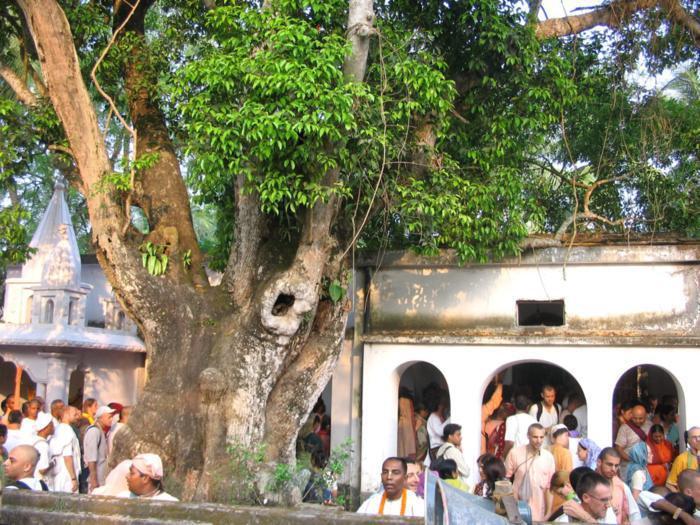
Mahaprabhu's response is the same in every telling of this story. He embraced the dying tree with His own arms. Accounts say the tree recovered where it stood. In the story, its green leaves and fragrant flowers came back at once, not slowly over time. This story is different from many Gaudiya devotional tales, because the tree did not disappear into legend afterward. A large Bakula tree still stands in the temple courtyard at Mamgachi. It is said to be well over five hundred years old, and it is now hollow at its core. It is shown to pilgrims on Nabadwip-dhama parikrama today as the very tree Mahaprabhu is said to have embraced. Some devotees who visit collect fallen wood from beneath it to make japa beads. For them, the tree itself is a living relic of the event, not only the place where it happened.
A Tree Still Tended #
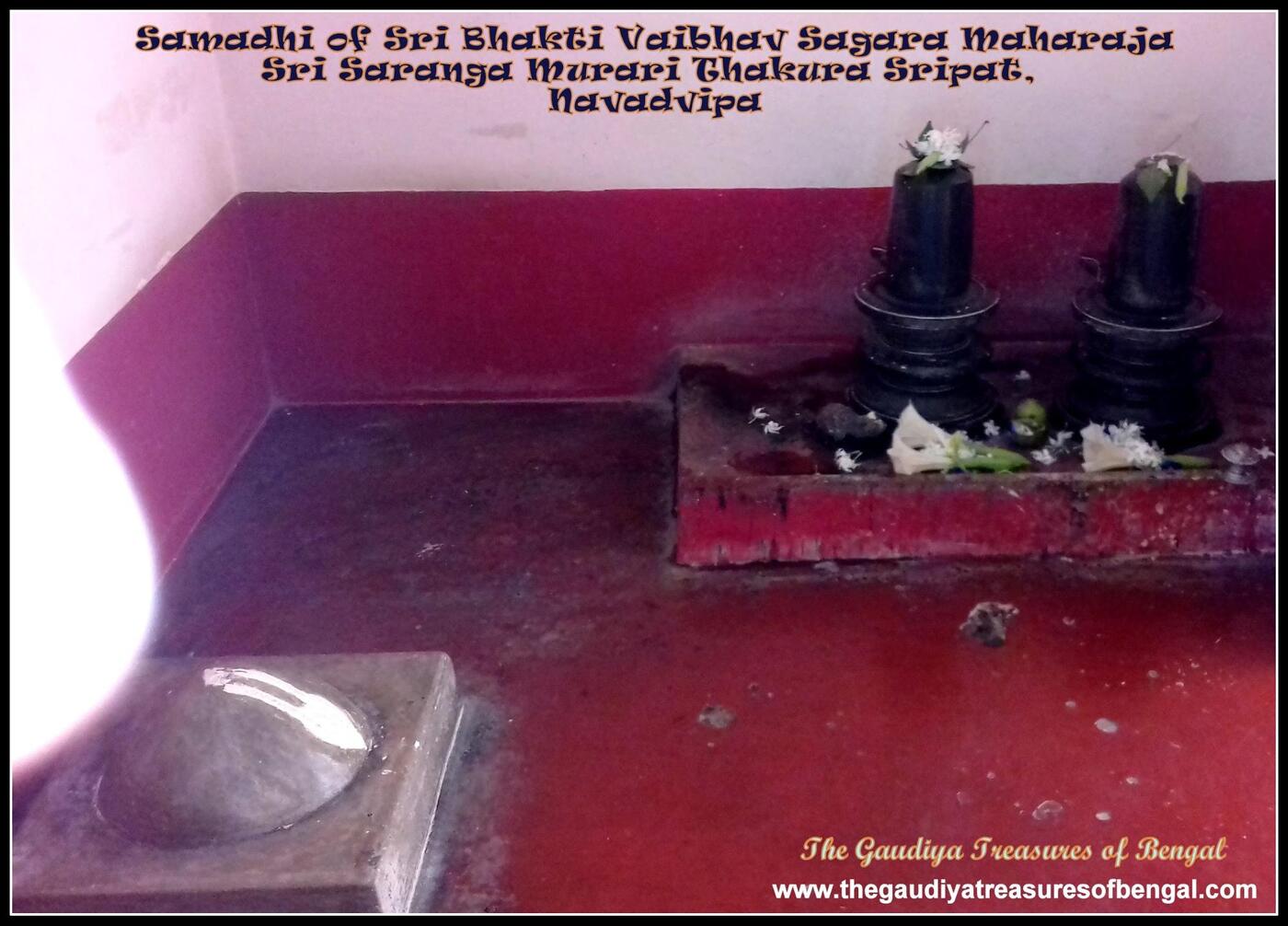
The temple beside the tree has gone through periods of neglect and repair. It is remembered that in the twentieth century a sannyasi of the Gaudiya Matha, Bhakti Vaibhava Sagara Maharaja, rescued the Deities and grounds and established them again. His samadhi now stands at the same site. By one recent account, day-to-day care of the tree and the altar beside it has rested for decades with a single long-serving pujari. He began attending the Deities as a boy of about ten and has continued for roughly sixty years since. This is a small, ordinary detail next to the story of Mahaprabhu's embrace. But this care is the reason a five-hundred-year-old tree with a hollow core still has fresh leaves each season, and is more than just a story attached to a name.
As with the story of Sharanga Murari, this episode is known only through Vrindavana Dasa Thakura's Chaitanya-bhagavata and the devotional literature built on it. It is not found in Sri Chaitanya-charitamrita, and no Srila Prabhupada purport or lecture naming Sharanga Thakura directly is known. But we can say this with more confidence. The tree that pilgrims visit at Mamgachi today is very old, and people have pointed to it as this tree for a long time. So the story and the place have supported each other for a very long time.
Closing
Bhajana Under the Bakula Tree at Mamgachi #
No year or place of birth for Sharanga Thakura survives in any known source, and no source names a guru who initiated him. When the sources first mention him, he is already settled at Mamgachi, on the Ganges in Modadrumadwipa. There he worshiped Sri Sri Radha-Gopinatha under a Bakula tree. Devotional accounts describe his routine as almost entirely self-sufficient. He gathered his own fruit, vegetables and firewood, begged rice, cooked, and bathed and dressed the Deity himself, day after day, alone. Only after a full day of this solitary service would he cross the Ganges in the evening to join Sri Chaitanya Mahaprabhu's hari-nama sankirtana in Mayapur. Then he would return to Mamgachi to begin the same round again the next morning. Later devotional biographies present this rhythm as his whole character, before either of the two episodes for which he is remembered: hard, private worship by day, and sankirtana by night.
Gaudiya Vaishnava tradition calls such a devotee a bhajananandi. A bhajananandi stays absorbed in his own devotional practice and does not take up preaching. A goshthy-anandi devotee, on the other hand, works to spread Krishna consciousness. Srila Prabhupada explains this difference in his purport. He writes that a bhajananandi Vaishnava sometimes does not even take the savitra-samskara (sacred thread initiation). Then he says, "A bhajananandi is not interested in preaching work, but a goshthy-anandi is interested in spreading Krishna consciousness to benefit the people and increase the number of Vaishnavas" (Chaitanya-charitamrita, Madhya-lila 8.128, purport). Sharanga Thakura's whole life looks like a living example of the first kind. But no early source uses this word for him directly. It became part of how he is known only in later tradition.
Nandimukhi of Vraja #
Sri Kavi Karnapura's Gaura-ganoddesha-dipika links Sri Chaitanya Mahaprabhu's associates with who they were in Krishna's Vraja-lila. In its text 172 it names Sharanga Thakura as Nandimukhi, a gopi or vraja-brahmani of Vraja. In the same passage, Kavi Karnapura also records that some devotees of his own time identified Sharanga Thakura with Prahlada Maharaja instead. He records that his father, Shivananda Sena, did not accept that other view. This small detail gives a real glimpse of how these identifications were actually debated among Mahaprabhu's own associates and their sons. They were not settled once and never questioned. Kavi Karnapura's own stated conclusion, Nandimukhi, is the accepted identification. But the other opinion did exist, and it is recorded by name.
Here is the verse, with Kavi Karnapura's note on his father's view:
vraje nāndīmukhī yāsīt sādya sāraṅga-ṭhakkuraḥ
prahlādo manyate kaiścin mat-pitrā na sa manyate
"The vraja-brahmani Nandimukhi-devi appeared as Saranga Thakura. Some people think that Saranga Thakura was the incarnation of Prahlada Maharaja. My father (Sivananda Sena) did not agree with them." (Gaura-ganoddesha-dipika 172)
Srila Prabhupada's purport to Chaitanya-charitamrita Adi 10.113, the verse that names Sharanga Thakura as the seventy-seventh branch of the Chaitanya tree, quotes Srila Bhaktisiddhanta Sarasvati Thakura's Anubhasya: "In the Gaura-gaṇoddeśa-dīpikā (172) it is stated that Sāraṅga Ṭhākura was formerly a gopī named Nāndīmukhī."
Ecstatic States and the Company of Wild Animals #
Most of what is known about Sharanga Thakura's inner life comes from Vrindavana Dasa Thakura's Chaitanya-bhagavata. It describes him as a devotee who had only the slightest awareness of the outside world, because he was otherwise always absorbed in the bhava of his bhajana. The same account says that he could stay under water for long periods without seeming discomfort, and that he moved fearlessly among tigers and pythons. The text says this ability came from the mercy of Nityananda Prabhu, not from any power of Sharanga Thakura's own. Gaudiya devotional biographies give details of this kind about many of Mahaprabhu's more absorbed, less publicly visible associates. They are best taken as Vrindavana Dasa Thakura's own description, not as history checked against other sources.
Legacy at Mamgachi #
The Radha-Gopinatha Deities Sharanga Thakura worshiped are still in daily worship at Mamgachi. Over time the same altar came to house Madana-Gopala, a Deity associated with Vasudeva Datta Thakura, together with Gaura-Gadadhara. Bhakti Vaibhava Sagara Maharaja was a sannyasi of the line of Bhaktisiddhanta Sarasvati Thakura. He is remembered for rescuing and re-establishing worship at the site in the twentieth century, after a period of neglect. His samadhi now stands there as well. The temple remains an active stop on Nabadwip-dhama parikrama.
Sharanga Thakura's name does not appear in Sri Chaitanya-charitamrita itself, or in any known purport or lecture by Srila Prabhupada. Gaudiya Vaishnavas treat these two kinds of source as the most authoritative. Everything recorded here comes instead through Vrindavana Dasa Thakura's Chaitanya-bhagavata and through later Gaudiya biographical collections. Several of these differ on small points, such as exactly when the disciple Murari identified himself after being revived. Readers should take the outline of Sharanga Thakura's life as well recorded in Gaudiya tradition. But it should not be taken as separately confirmed, as it would be for a devotee named directly in Chaitanya-charitamrita or in Srila Prabhupada's own words.
- Sharanga Thakura - Gaudiya History (ISKCON Desire Tree)
- Sharanga Thakura - Biography 2 - Gaudiya History
- Saranga Thakura - Biography 3 - Gaudiya History
- Saranga Murari Thakur - Pastimes and Sripat, Mayapur Nabadwip Dham - The Gaudiya Treasures of Bengal
- Srila Saranga Thakura - Disappearance - ISKCON Desire Tree
- Saranga Thakura - Stephen Knapp
- Sri Saranga Murari Sripata - Holy Dham
- Sri Gaura Ganoddesha Dipika - Gaudiya History
