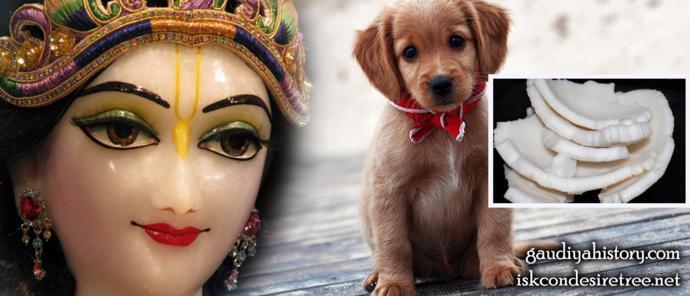
Sri Chaitanya-charitamrita tells this story with unusual care for detail. The story is best read in the same order that the text gives it, because every small step matters to what it is trying to teach.
| Detail | Description |
|---|---|
| Where told | Sri Chaitanya-charitamrita, Antya-lila, Chapter One (told a second time, briefly, in Madhya-lila 1.140) |
| Who cared for the dog | Shivananda Sena, on the road to Jagannatha Puri |
| Cost of the river crossing | Ten pana of small conchshells (kadi) |
| What Mahaprabhu fed it | Remnants of green coconut pulp |
| What the dog did in response | Chanted "Krishna, Krishna" |
| Its fate | Attained a spiritual body and departed for Vaikuntha the next day |
A Dog Joins The Party #
"While going to Jagannatha Puri, Shivananda Sena allowed a dog to go with him. He supplied it food to eat and maintained it." That is all Chaitanya-charitamrita says to introduce the animal. It does not explain where the dog came from, and it adds nothing sentimental. It simply states that the dog started following the pilgrimage and that Shivananda Sena chose to feed it instead of driving it away.
Paid Passage Across A River #
The first real test came at a river crossing. An Orissan boatman refused to let the dog board the ferry with the rest of the party. Shivananda Sena, the text says, was "unhappy that the dog had to stay behind," and he was truly troubled. So he paid the boatman ten pana of kadi simply to get the dog across to the other side. Kadi were small conchshells that served as everyday money in that period.
A Night Of Real Worry #
Some time later, while Shivananda Sena was delayed at a toll station, his servant forgot to feed the dog its usual meal. Shivananda Sena returned that evening. During his own meal, he asked whether the dog had eaten. He learned that it had not and, worse, that it had wandered off. He immediately sent ten men out to search for it. They came back empty-handed. Chaitanya-charitamrita tells plainly what followed: Shivananda Sena "became very unhappy and fasted for the night." In the morning the search continued but still found nothing. The text notes that "all the Vaishnavas were astonished," and what astonished them was not really Shivananda's grief, but how completely the dog had vanished. In great anxiety, the whole party continued on to Jagannatha Puri, where Mahaprabhu met them as He always did.
Coconut Pulp And The Holy Names #
The next morning, when the devotees came to see Sri Chaitanya Mahaprabhu at His residence, they found the missing dog already there, sitting a little apart from the Lord. Mahaprabhu was throwing it pieces of green coconut pulp, smiling, and saying to it, "Chant the holy names 'Rama,' 'Krishna' and 'Hari.'" The devotees watched the dog eat the coconut pulp while repeating "Krishna, Krishna" again and again, and Chaitanya-charitamrita says plainly that they were "very surprised." Shivananda Sena's own response is the most remarkable human detail in the whole episode. When he saw the dog chanting Krishna's name in that state, he immediately offered it his own obeisances. He did this out of natural humility. He especially wanted to make up for whatever offense he felt he had committed against it during the difficult days on the road.
"It Had Obtained Its Spiritual Body" #
The next day, no one saw the dog again. Chaitanya-charitamrita states directly what had happened to it: "the next day, no one saw that dog, for it had obtained its spiritual body and departed for Vaikuntha, the spiritual kingdom." Krishnadasa Kaviraja Goswami then states the point of the whole story very plainly: "Such are the transcendental pastimes of Sri Chaitanya Mahaprabhu, the son of mother Sachi. He even delivered a dog simply by inducing it to chant the maha-mantra, Hare Krishna." In his purport, Srila Prabhupada takes the episode as proof of the power of sadhu-sanga, association with a genuine devotee. He notes that this result of liberation "is possible even for a dog, by the mercy of the Vaishnava," and he uses the story to make a point. Everyone in the human form of life, he urges, should be encouraged to associate with devotees. His reason is that even eating prasadam, not to speak of chanting and dancing, can carry a soul all the way to Vaikuntha.
The story is told a second time, more briefly, earlier in the same work. Madhya-lila 1.140 simply notes, in passing, that "a dog accompanied Shivananda Sena and the devotees, and that dog was so fortunate that after seeing the lotus feet of Lord Chaitanya Mahaprabhu, it was liberated and went back home, back to Godhead." Krishnadasa Kaviraja Goswami mentions the same dog twice, in two different parts of his enormous biography. This says something about how seriously the tradition takes this particular pastime. It is not treated as a charming side note. It is one of the clearest and simplest examples anywhere in Chaitanya-charitamrita of a mercy that makes no difference at all between a human devotee's cherished companion and any other living being.
Throughout the story, Shivananda Sena worried about the dog, spent money on it, fasted in grief, and finally bowed in humility before the animal he had once been reluctant to keep. This part of the story is easy to overlook next to the miracle itself, but the whole episode really depends on it. Without his determined and costly care for an ordinary stray, there would have been no dog at Jagannatha Puri for Mahaprabhu to feed at all.
