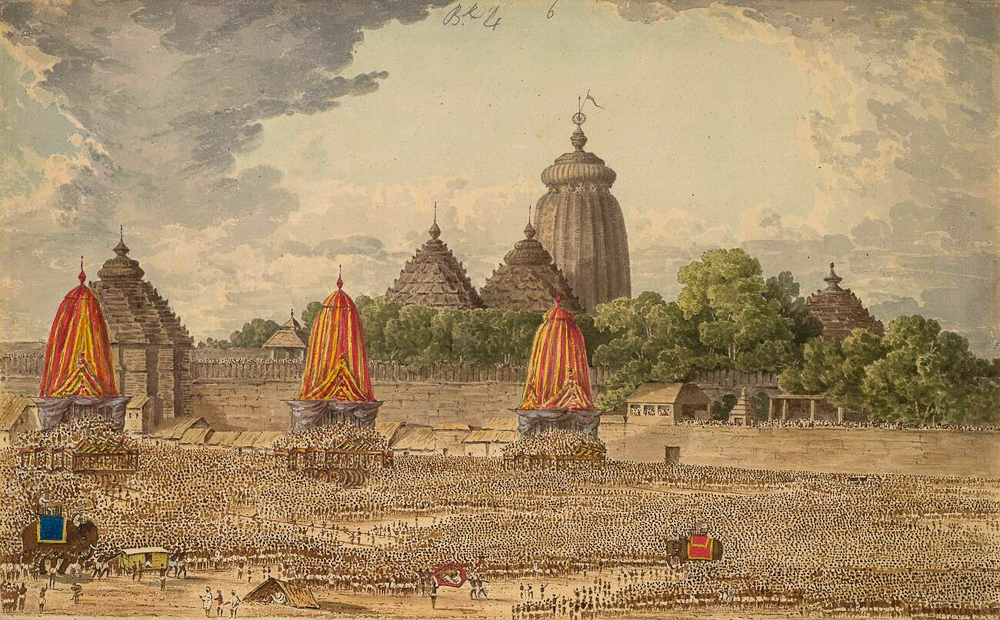
For about ten years, the same scene was repeated every summer. Hundreds of Bengali devotees left their homes near the Ganges and walked for weeks along roads and river crossings where tolls had to be paid. One householder carried the entire practical weight of the journey on his shoulders.
| Detail | Description |
|---|---|
| Timing | About one month before chaturmasya (the four-month rainy season), every year |
| Party size | Two to three hundred devotees in a typical year |
| Notable travelers | Advaita Acharya, Srivasa Thakura and his brothers and wife Malini, Vasudeva Datta, Murari Gupta, the residents of Kulina-grama and Khanda |
| Shivananda Sena's role | Paying every toll, arranging every night's lodging, maintaining the whole party |
| Best-known incident | Nityananda Prabhu's curse and kick, at a village with no shelter |
What The Job Actually Involved #
Sri Chaitanya-charitamrita describes plainly what Shivananda Sena did, without making it sound more romantic than it was: "Shivananda Sena managed the payment of tolls at different places. Maintaining everyone, he guided all the devotees in great happiness... He took care of everyone and gave each devotee places to stay. He knew all the paths leading to Orissa." This was skilled, exhausting and humble work. He had to bargain with toll collectors and find lodging for two or three hundred people in villages that had no reason to expect them. He did it again and again, year after year. Meanwhile, everyone else in the party was free simply to walk, chant, and look forward to seeing Sri Chaitanya Mahaprabhu. Before setting out, the whole group would first go to see Sacimata, the Lord's mother, and take her permission. This detail shows how fully the pilgrimage had become a recognized, expected yearly event among Bengal's Vaishnavas. It was not a sudden or occasional trip.
Left Waiting Under A Tree #
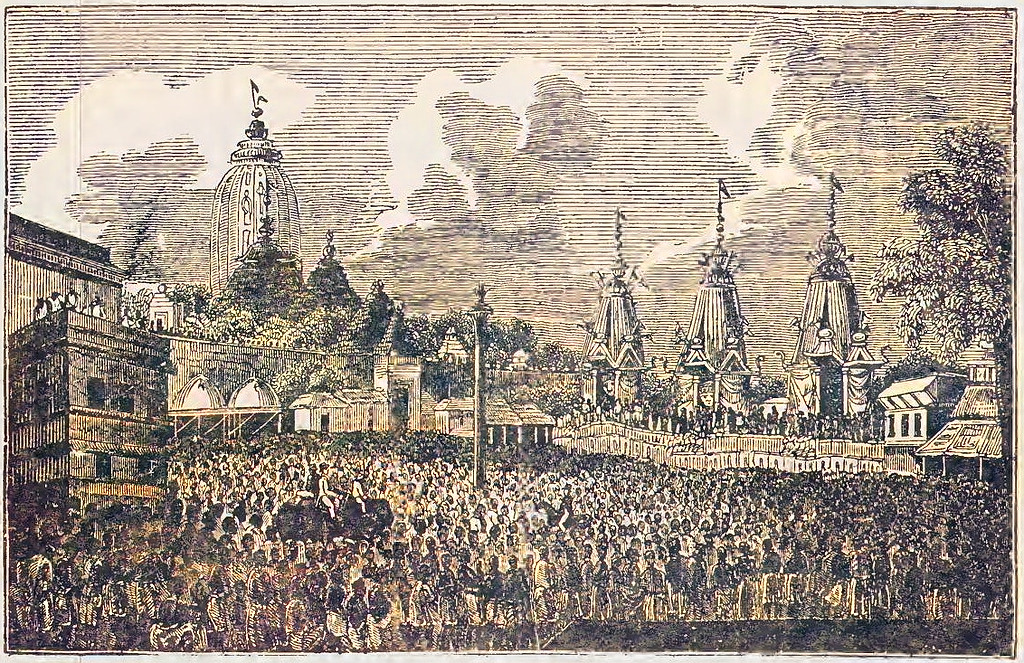
The single most quoted episode from these journeys happened in a year when things went wrong. The party reached a village and had nowhere to stay. Chaitanya-charitamrita explains plainly that "no one but Shivananda Sena could arrange for their residential quarters," and this time he had been delayed. He was held back at a toll station while everyone else went ahead. Nityananda Prabhu was left waiting under a tree, hungry and without shelter, and He grew furious. "Shivananda Sena has not arranged for My residence," He said, "and I am so hungry I could die. Because he has not come, I curse his three sons to die." When this was repeated to Shivananda's wife, she began to cry.
"Let My Three Sons Die" #
When Shivananda Sena returned from the toll station and heard what had happened, he answered his weeping wife at once, and his words were startling: "You crazy woman! Why are you needlessly crying? Let my three sons die for all the inconvenience we have caused Nityananda Prabhu." He then went straight to Nityananda Prabhu, who stood up and kicked him. Chaitanya-charitamrita clearly records what happened next. Shivananda Sena was "very pleased at being kicked," and immediately arranged a milkman's house as the Lord's residence. He touched Nityananda Prabhu's feet and led Him inside. Then he spoke words that Gaudiya Vaishnavas have quoted ever since: "Today You have accepted me as Your servant and have properly punished me for my offense... The dust of Your lotus feet is not attainable even by Lord Brahma, yet Your lotus feet have touched my wretched body. Today my birth, my family and my activities have all become successful." Hearing this, Nityananda Prabhu rose and embraced him in love. Here the text adds a short note on Nityananda Prabhu's own nature: "One of Sri Nityananda Prabhu's characteristics is His contradictory nature. When He becomes angry and kicks someone, it is actually for his benefit." Not everyone present understood the moment in this way. Shivananda's own nephew Shrikanta, who was still a boy, was offended on his uncle's behalf. He angrily went ahead alone to complain to Mahaprabhu directly. He did not realize that the Lord already knew everything that had happened.
Feeding The Lord Too Well #
Hospitality could go wrong in gentler ways too. At Puri one year, Shivananda Sena bought unusually costly remnants of Lord Jagannatha's food. Out of pure respect for the offering, he pressed Mahaprabhu to eat generously. He pressed so much that the Lord ate more than He should have and felt uncomfortably full afterward. As the Chaitanya-charitamrita says: "Because of Shivananda Sena's glories, Sri Chaitanya Mahaprabhu ate all kinds of prasadam to honor his request. However, the Lord ate more than necessary, and therefore His mind was dissatisfied" (Chaitanya-charitamrita, Antya-lila 10.147). The next day, Shivananda's eldest son, Chaitanya dasa, noticed this and quietly fixed the problem. He served a lighter meal of yogurt, lime, ginger and soft fried bread instead. Mahaprabhu was delighted: "This boy knows My mind," He said. It is a small, warm story. It shows that Shivananda Sena was not the only one in the family with a gift for knowing in advance what the Lord actually needed.
The Search for Raghunatha Dasa #
Shivananda Sena's party also comes into the story of the young Raghunatha Dasa Goswami. Raghunatha dasa fled his wealthy family's home to reach Mahaprabhu, and his father believed he had gone with the pilgrims. His anxious father then sent ten men after him with a letter for Shivananda Sena, begging for his son's return. The men caught up with the traveling Vaishnavas at a place called Jhankara and asked Shivananda Sena directly about Raghunatha dasa. His answer was short and true: "He did not come here." The men went home empty-handed. Raghunatha dasa had in fact slipped away separately and was making his own hard journey to Puri on foot. Some days later he reached the Lord safely. Later, at Puri, Shivananda Sena told him about the letter and the ten men his father had sent. This young man would go on to become one of the Six Goswamis of Vrindavana.
The most famous single episode from these pilgrim years, though, involves neither a curse nor a search party, but an ordinary dog that attached itself to the party on the road. What happened to it once the group reached Mahaprabhu is told in full at the mercy shown to a dog.
