Srila Shrinatha Pandita
Guru of Kavi-karnapura Goswami
The complete life, on one page: The main biography and every pastime page, in order, in one place
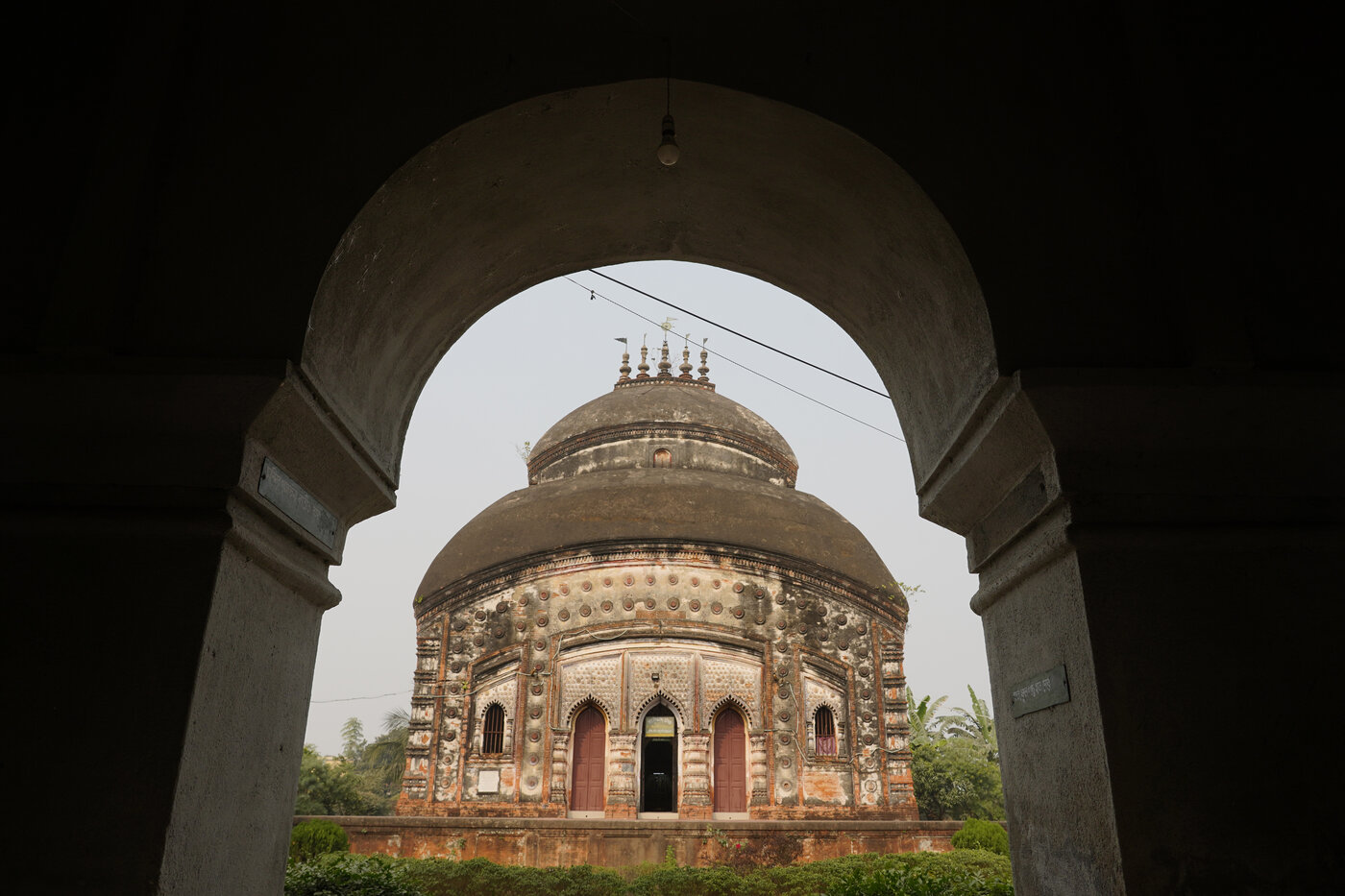
Introduction
Sri Chaitanya-charitamrita names Shrinatha Pandita as one of the branches of the "Caitanya tree," which is its orderly list of Sri Chaitanya Mahaprabhu's associates in the tenth chapter of Adi-lila. The commentary on the verse that names him adds two things besides the simple listing. He was a disciple of Sri Advaita Acharya, and he was, in turn, the guru of the famous poet Kavi-karnapura Goswami. The same commentary also credits him with founding a Deity of Radha-Krishna, named Sri Krishna Raya, at a village in Bengal. Remarkably, that temple still stands today. Apart from these three connections, very little is recorded about Shrinatha Pandita's own life. No birth year, family name, or date of disappearance survives in any available source.
| Detail | Description |
|---|---|
| Named in | Sri Chaitanya-charitamrita, Adi-lila 10.107, as the 49th branch of the Caitanya tree |
| Guru | Sri Advaita Acharya |
| Notable disciple | Kavi-karnapura Goswami (Paramananda Sena), son of Shivananda Sena |
| Family background | Not recorded by name; a guru-pranama verse by Kavi-karnapura states only that he was born into a brahmana family |
| Deity established | Sri Krishna Raya, at Kanchadapada near Kumarahatta, Bengal |
| Birth / disappearance | Not recorded in any available source |
At a Glance
- Listed by name in Chaitanya-charitamrita's catalog of Mahaprabhu's associates, with no personal pastime narrated in the verse itself.
- Identified in the accompanying commentary as a disciple of Advaita Acharya.
- Became the diksha-guru of Kavi-karnapura Goswami, later famous as the author of Gaura-ganoddesha-dipika.
- Credited with founding the Sri Krishna Raya Deity, whose temple can still be visited in Bengal.
- Easily confused with two other, unrelated "Shrinatha" figures named elsewhere in the same catalog.
Scriptural evidence for the introduction (3)
শ্রীনাথ পণ্ডিত—প্রভুর কৃপার ভাজন ।
যাঁর কৃষ্ণসেবা দেখি’ বশ ত্রিভুবন ॥১০৭॥
srinatha pandita -- prabhura krpara bhajana
yanra krsna-seva dekhi' vasa tri-bhuvana
Word for word
srinatha pandita -- Srinatha Pandita; prabhura -- of the Lord; krpara -- of mercy; bhajana -- receiver; yanra -- whose; krsna-seva -- worship of Lord Krishna; dekhi' -- seeing; vasa -- subjugated; tri-bhuvana -- all the three worlds.
Srinatha Pandita, the forty-ninth branch, was the beloved recipient of all the mercy of Sri Chaitanya Mahaprabhu. Everyone in the three worlds was astonished to see how he worshiped Lord Krishna.
From the purport: Purport excerpt: "Srinatha Pandita, one of the disciples of Advaita Prabhu, was the spiritual master of the third son of Sivananda Sena, who was known as Paramananda Kavi-karnapura."
The verse that names Shrinatha Pandita in Chaitanya-charitamrita's catalog of Mahaprabhu's associates; the commentary supplies his guru and his own most famous disciple.
শ্রীনাথ মিশ্র, শুভানন্দ, শ্রীরাম, ঈশান ।
শ্রীনিধি, শ্রীগোপীকান্ত, মিশ্র ভগবান্ ॥১১০॥
srinatha misra, subhananda, srirama, isana
srinidhi, sri-gopikanta, misra bhagavan
Word for word
srinatha misra -- Srinatha Misra; subhananda -- Subhananda; srirama -- Srirama; isana -- Isana; srinidhi -- Srinidhi; sri-gopikanta -- Sri Gopikanta; misra bhagavan -- Misra Bhagavan.
The fifty-fifth branch was Srinatha Misra, the fifty-sixth was Subhananda, the fifty-seventh was Srirama, the fifty-eighth was Isana, the fifty-ninth was Srinidhi, the sixtieth was Sri Gopikanta, and the sixty-first was Misra Bhagavan.
Cited to distinguish Srinatha Misra, a separate branch of the Caitanya tree identified elsewhere as the gopi Chitrangi, from Shrinatha Pandita of Adi 10.107.
শ্রীনাথ চক্রবর্তী, আর উদ্ধব দাস ।
জিতামিত্র, কাষ্ঠকাটা–জগন্নাথদাস ॥৮৪॥
srinatha cakravarti, ara uddhava dasa
jitamitra, kasthakata-jagannatha-dasa
Word for word
srinatha cakravarti -- Srinatha Cakravarti; ara -- and; uddhava dasa -- Uddhava dasa; jitamitra -- Jitamitra; kasthakata jagannatha-dasa -- Kasthakata Jagannatha dasa.
The fifteenth branch was Srinatha Cakravarti; the sixteenth, Uddhava; the seventeenth, Jitamitra; and the eighteenth, Jagannatha dasa.
From the purport: Purport excerpt: "The Shakha-nirnaya, verse 13, mentions Srinatha Cakravarti as a reservoir of all good qualities and an expert in the service of Lord Krishna."
Cited to distinguish Srinatha Cakravarti, a separate branch listed specifically under Advaita Acharya's own expansions, from Shrinatha Pandita of Adi 10.107 (see Which Shrinatha? in the biography).
Chapter 1
Legacy
The Sri Krishna Raya Deity that Shrinatha Pandita established has outlived him by more than four centuries.
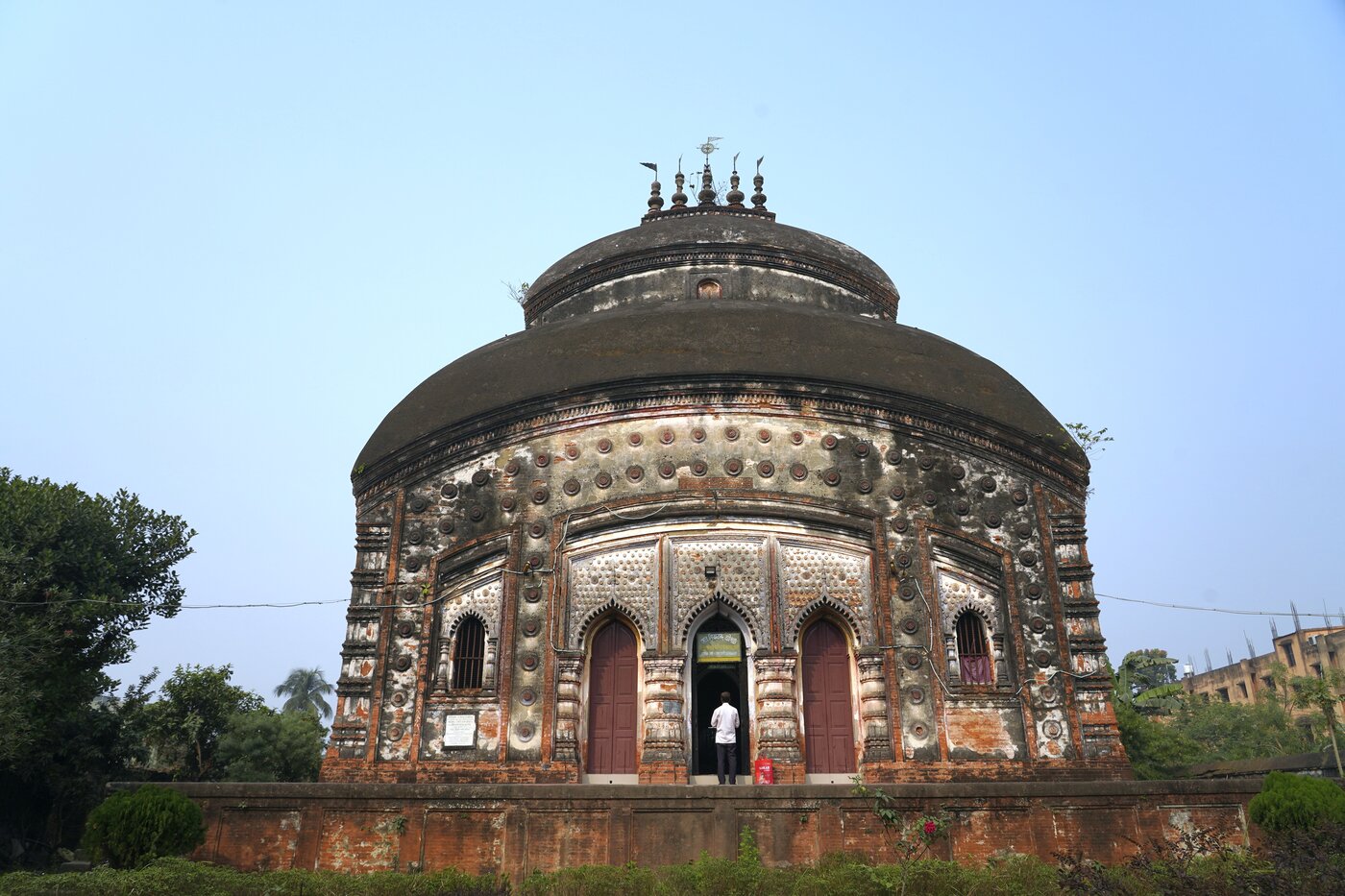
The one part of Shrinatha Pandita's life that has not been lost from history is the temple he built. The commentary tradition connected with Krishnadasa Kaviraja Goswami's Sri Chaitanya-charitamrita credits him with founding a Deity called Sri Krishna Raya. He left behind a physical site that can still be visited in Bengal today. Its walls carry a tablet inscribed with his name and the names of his father and grandfather.
| Detail | Description |
|---|---|
| Deity | Sri Krishna Raya (Radha-Krishna) |
| Original site | Kanchadapada, about one and a half miles from Kumarahatta / Kamarhatta, Bengal |
| Present-day location | Rathtala area, Kanchrapara, North 24 Parganas, West Bengal |
| Present structure built | Shakabda 1708 (1785-86 CE), by the brothers Nimai Charan and Gour Charan Mallick of Pathuriaghata, Calcutta |
| Sister Deities (tradition) | Radha-vallabha of Vallabhapura; Shyamasundara of Khadadaha |
| Stone's traditional origin | Said to have been brought from Murshidabad by Virabhadra Prabhu, son of Nityananda Prabhu |
A Temple at Kanchadapada #
According to Srila Bhaktisiddhanta Sarasvati Thakura's Anubhasya commentary on Chaitanya-charitamrita, Adi 10.107, the village of Kanchadapada lay about one and a half miles from Kumarahatta, which is itself a few miles from Calcutta. Shivananda Sena, the householder devotee who organized Sri Chaitanya Mahaprabhu's own household affairs, lived in the same area and built his own temple there to Sri Gaura-Gopala. Shrinatha Pandita's own temple stood a short distance away. It housed Radha-Krishna Deities under the name Sri Krishna Raya. So this was a separate temple, with a separate pair of Deities, in the same small corner of Bengal. This area was also where Shrinatha Pandita's future disciple, Kavi-karnapura Goswami, grew up.
Two More Deities from the Same Stone #
The Anubhasya adds a striking detail, but it reports the story only as something people said, not as settled history. Virabhadra Prabhu, the son of Nityananda Prabhu, is said to have brought a single large stone from Murshidabad. From it, three separate Deities were carved: the Radha-vallabha Deity of Vallabhapura, the Shyamasundara Deity of Khadadaha, and the Sri Krishna Raya Deity that came to Kanchadapada. If the tradition is accurate, a single block of stone ties Shrinatha Pandita's own Deity to two other well-known Bengali temples. It also ties his Deity to Nityananda Prabhu's family, through Nityananda Prabhu's son, who is said to have brought the stone. Even if not every detail of the story can be checked independently, it shows how the generations after Shrinatha Pandita remembered the temple.
Rebuilt by the Mallick Brothers #
The original structure, standing on the bank of the Ganges, in time fell into disrepair. The Anubhasya records that a prominent Calcutta zamindar named Nimai Mullik saw the ruined temple of Krishna Raya while traveling to Benares. Afterward he built the large temple that stands on the site today. It was completed in Shakabda 1708, which corresponds to 1785-86 CE. Photographs of the temple on Wikimedia Commons were taken at the Rathtala area of present-day Kanchrapara, in West Bengal's North 24 Parganas district. Their descriptions speak of an atchala, or eight-roofed, structure with a porch set on a triple archway. There the temple is credited to two brothers, Nimai Charan and Gour Charan Mallick. The Anubhasya speaks of a single builder, while the photographed temple's own record names two brothers. These two accounts are not necessarily in conflict, because large family temple projects of this kind were often credited to more than one family member. Both versions are reported here, instead of choosing one. Bhaktisiddhanta Sarasvati's commentary also describes a large courtyard in front of the temple, rooms for visitors to stay, and arrangements for cooking prasadam. High boundary walls enclose the whole compound. The commentary notes that a tablet inside names Shrinatha Pandita together with his father and grandfather, along with the date the temple was built.
Worship Continues Today #
The temple that stands today at Kanchrapara is large. Nineteenth- and twentieth-century accounts describe it as almost as large as the well-known Mahesh temple elsewhere in Bengal, and photographs confirm a big building that is still looked after. Gaudiyahistory.iskcondesiretree.com's own biography page for Shrinatha Pandita reports that "his Deity of Sri Krishna Raya is still residing there," which is a small but real sign that the worship he established has outlasted him by more than four centuries. Yet almost nothing about his own personal life has survived alongside it.
Scriptural evidence for this chapter (1)
From the purport: Purport excerpt: "Inscribed on a tablet are the names of Srinatha Pandita and his father and grandfather and the date of construction of the temple."
The same commentary that names Shrinatha Pandita as a disciple of Advaita Acharya also describes the Krishna Raya temple's tablet and construction history in detail.
Closing
Named in the Chaitanya Tree #
Sri Chaitanya-charitamrita gives an orderly list of Sri Chaitanya Mahaprabhu's associates in Adi-lila, chapter 10. It describes them as branches and twigs of a great "Caitanya tree." Shrinatha Pandita appears there by name, as the forty-ninth branch: "Shrinatha Pandita, the forty-ninth branch, was the beloved recipient of all the mercy of Sri Chaitanya Mahaprabhu. Everyone in the three worlds was astonished to see how he worshiped Lord Krishna" (Chaitanya-charitamrita, Adi 10.107). Krishnadasa Kaviraja Goswami gives him no further story inside the verse itself. Most names on this long list receive only a line or two. But the Anubhasya commentary of Srila Bhaktisiddhanta Sarasvati Thakura adds real, specific details about who he was and what he did. This commentary is printed alongside Srila Prabhupada's own English edition of the text.
A Disciple of Advaita Acharya #
That commentary states plainly that Shrinatha Pandita was one of the disciples of Sri Advaita Acharya. This places him in a known, recorded branch of the Gaudiya Vaishnava family, among the students and associates gathered around Advaita Acharya's own household. Apart from this one fact, no available source records where Shrinatha Pandita was born, what his family was called, or when he lived. There is one partial exception. It is found not in Chaitanya-charitamrita itself but in the writing of his own disciple.
Guru to a Great Poet #
Shrinatha Pandita is best remembered today for one well-documented relationship. He was the diksha-guru of Paramananda Sena, the youngest son of Shivananda Sena. Paramananda Sena grew up to become the famous Sanskrit poet Kavi-karnapura Goswami. Kavi-karnapura opens his own book, Sri Ananda-vrindavana-champu, with a guru-pranama verse in Shrinatha Pandita's honor (quoted in full above). In it he offers respect to Shrinatha Pandita as the one whose hari-katha freed everyone who heard it from attachment to worldly life. That verse is also the only available source that says anything at all about Shrinatha Pandita's family background. It states he "appeared in a brahmana family," without naming the family itself. Everything else known about the relationship comes from what Chaitanya-charitamrita's commentary says about Kavi-karnapura's guru. None of it comes from anything Shrinatha Pandita himself is recorded as having said or done.
Which Shrinatha? #
Names built on "Shrinatha" appear more than once in Chaitanya-charitamrita's catalogs, and the text itself treats them as different people. Adi-lila chapter 10 separately lists a Shrinatha Mishra as the fifty-fifth branch of the tree (Adi 10.110). Kavi-karnapura's own Gaura-ganoddesha-dipika identifies him as the gopi Chitrangi in Krishna's Vrindavana pastimes. He is a different person from Shrinatha Pandita of verse 107, and shares only the first half of a common name. Adi-lila chapter 12 separately lists Advaita Acharya's own line of expansions. There it names yet another Shrinatha, Shrinatha Chakravarti, the fifteenth branch (Adi 12.84). The Shakha-nirnaya praises him as "a reservoir of all good qualities and an expert in the service of Lord Krishna." Chaitanya-charitamrita keeps these as separate entries in separate chapters. A few later retellings, which are secondary sources, blend Shrinatha Chakravarti's name into Shrinatha Pandita's and treat them as one person under two titles. But nothing in Chaitanya-charitamrita itself, or in its own Anubhasya commentary, clearly says they are the same person. Following the original text, this page treats Shrinatha Pandita only as the person named at Adi 10.107: the guru of Kavi-karnapura and the founder of the Deity described below.
- Sri Chaitanya-charitamrita, Adi-lila 10.107 (verse and Anubhasya commentary)
- Sri Chaitanya-charitamrita, Adi-lila 10.108-111 (surrounding catalog entries)
- Sri Chaitanya-charitamrita, Adi-lila 12.84 (Shrinatha Chakravarti, a separate branch)
- Gaudiya History: Shrinatha Pandita
- Krishna Raya Jiu temple, Kanchrapara -- photographs and description, Wikimedia Commons
