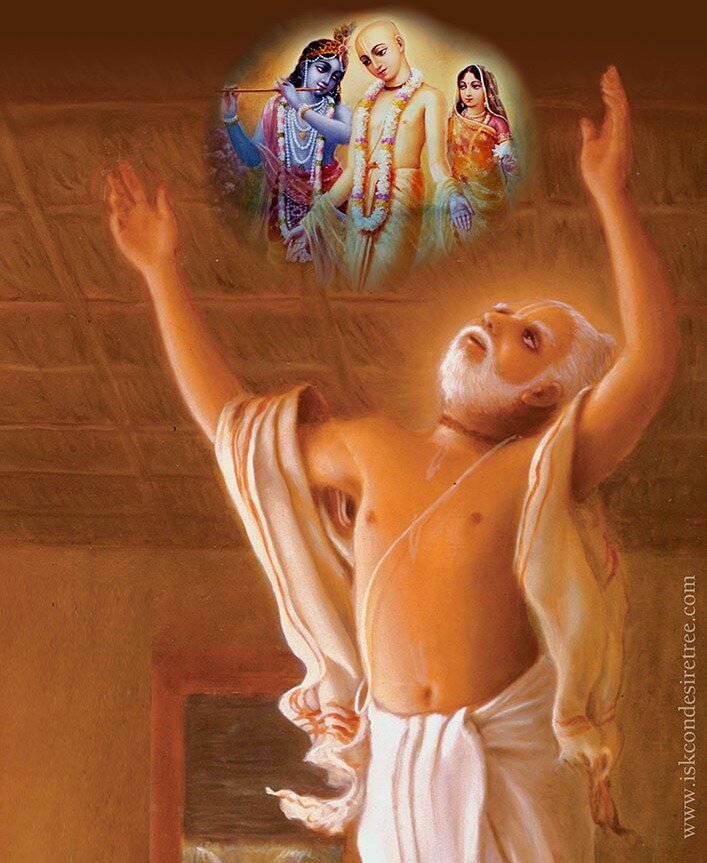
Sri Advaita Acharya
The Devotee Whose Prayers Called the Lord Down
Also known as Kamalaksha, Advaita Prabhu, Sita-natha, Nabadwip-chandra's elder
“If the sincere appeal of one devotee is meant seriously enough and sustained long enough, the Supreme Lord Himself will consent to descend.”
The principle Gaudiya Vaishnavas draw from Advaita Acharya's worship at Shantipura
Sri Advaita Acharya has a place in the Panca-tattva unlike any of the others. He is far older than Sri Chaitanya Mahaprabhu, by roughly fifty years, and the tradition holds that His prayers brought the Lord down. He is understood to be a combined incarnation of Maha-Vishnu and Sadashiva. He is also counted as bhakta-avatara, the Lord descending in the role of a devotee. For this reason He is worshipped as part of the Lord's own descent, not only as an associate who came with it.
| Detail | Description |
|---|---|
| Appearance | 1434, Nabagrama, Srihatta district, eastern Bengal |
| Birth name | Kamalaksha |
| Parents | Kuvera Pandita and Nabhadevi |
| Identity | Incarnation of Maha-Vishnu, one with Sadashiva; the bhakta-avatara (Gaura-ganoddesha-dipika 11, 76; Chaitanya-charitamrita Adi 1.12) |
| Wife | Sita Thakurani, daughter of Nrsimha Bhaduri |
| Spiritual master | Madhavendra Puri |
| Seat | Shantipura, on the bank of the Ganges in Nadia |
Advent, Pilgrimage and the Seat at Shantipura #
He appeared in 1434 in the village of Nabagrama in the Srihatta district of eastern Bengal, as the son of Kuvera Pandita and Nabhadevi, and was given the name Kamalaksha. After His parents' passing He travelled widely on pilgrimage, studied deeply, and eventually settled at Shantipura on the bank of the Ganges in Nadia, where He became the most respected Vaishnava authority in the region. He was known as a strict scholar of the Bhagavatam and the Bhagavad-gita. He received the title Advaita, "non-different," because He was understood to be non-different from the Supreme Lord. He received the title Acharya because He taught bhakti.
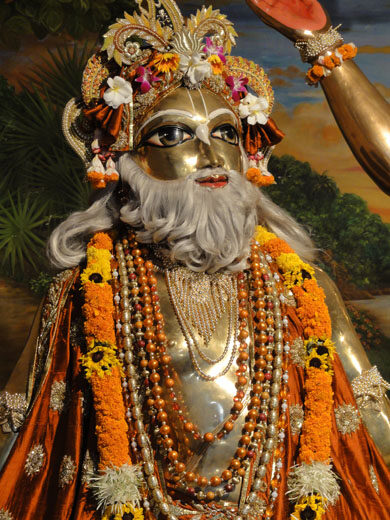
Both sides of His identity are stated in scripture. Kavi Karnapura's Gaura-ganoddesha-dipika (verse 11) names Him the bhakta-avatara and identifies Him with Sadashiva:
bhaktāvatāra ācāryo’dvaito yaḥ śrī-sadāśivaḥ
"The bhaktavatara (devotional manifestation) is Lord Advaita Acarya, who is not different from Lord Sadasiva." (Gaura-ganoddesha-dipika 11)
Chaitanya-charitamrita gives the other side, that He is the incarnation of Maha-Vishnu:
mahā-viṣṇur jagat-kartā
māyayā yaḥ sṛjaty adaḥ
tasyāvatāra evāyam
advaitācārya īśvaraḥ
"Lord Advaita Ācārya is the incarnation of Mahā-Viṣṇu, whose main function is to create the cosmic world through the actions of māyā." (Chaitanya-charitamrita Adi 1.12)
Calling the Lord to Descend #
The most important act of His life was His appeal for the Lord to descend. His position in the Panca-tattva rests on this act. Advaita Acharya looked at the Bengal of His day. It was religious on the outside and learned in ritual, but in His judgement it had no devotion at all. He concluded that only Krishna Himself, coming in person, could help. Vaishnava accounts describe Him worshipping a salagrama-sila with Ganges water and tulasi leaves. He called out so strongly and for so long that Krishna had to come. The tradition regards Sri Chaitanya Mahaprabhu's appearance at Mayapur in 1486 as the direct answer. This is why Bengali Vaishnavas hold Advaita Acharya in a special kind of affection. He is the one who asked.
His Relationship With Sri Chaitanya Mahaprabhu #
After the Lord's advent, Advaita's relationship with Mahaprabhu was also unusual. By age, the elderly Advaita was like a grandfather to the young Nimai, but in devotion He was Nimai's servant. The Chaitanya-charitamrita preserves several episodes in which Advaita Acharya deliberately provoked the Lord. The most famous is when He taught an interpretation of the Bhagavad-gita that He did not Himself hold. He did this so that Mahaprabhu would show divine anger and in this way reveal Himself. When Mahaprabhu accepted sannyasa at Katwa, He could not go to Vrindavana. Instead He was brought to Advaita Acharya's house at Shantipura. There Sachi Devi was able to see her son for a few last days.
Sita Thakurani and the Household at Shantipura #
His wife was Sita Thakurani, the daughter of Nrsimha Bhaduri. Sita Thakurani is remembered for herself, not only as His wife. She went to Mayapur when Mahaprabhu was born, bringing gifts for the child, and she is honoured throughout Bengal as one of the great women devotees of the tradition. Their household at Shantipura became one of the main centres of the movement. Several of their sons, Acyutananda in particular, were themselves well-known devotees. But the most painful division within the tradition also came from this family, when other sons turned away from their father's line of teaching.
Last Years, Samadhi and Legacy #
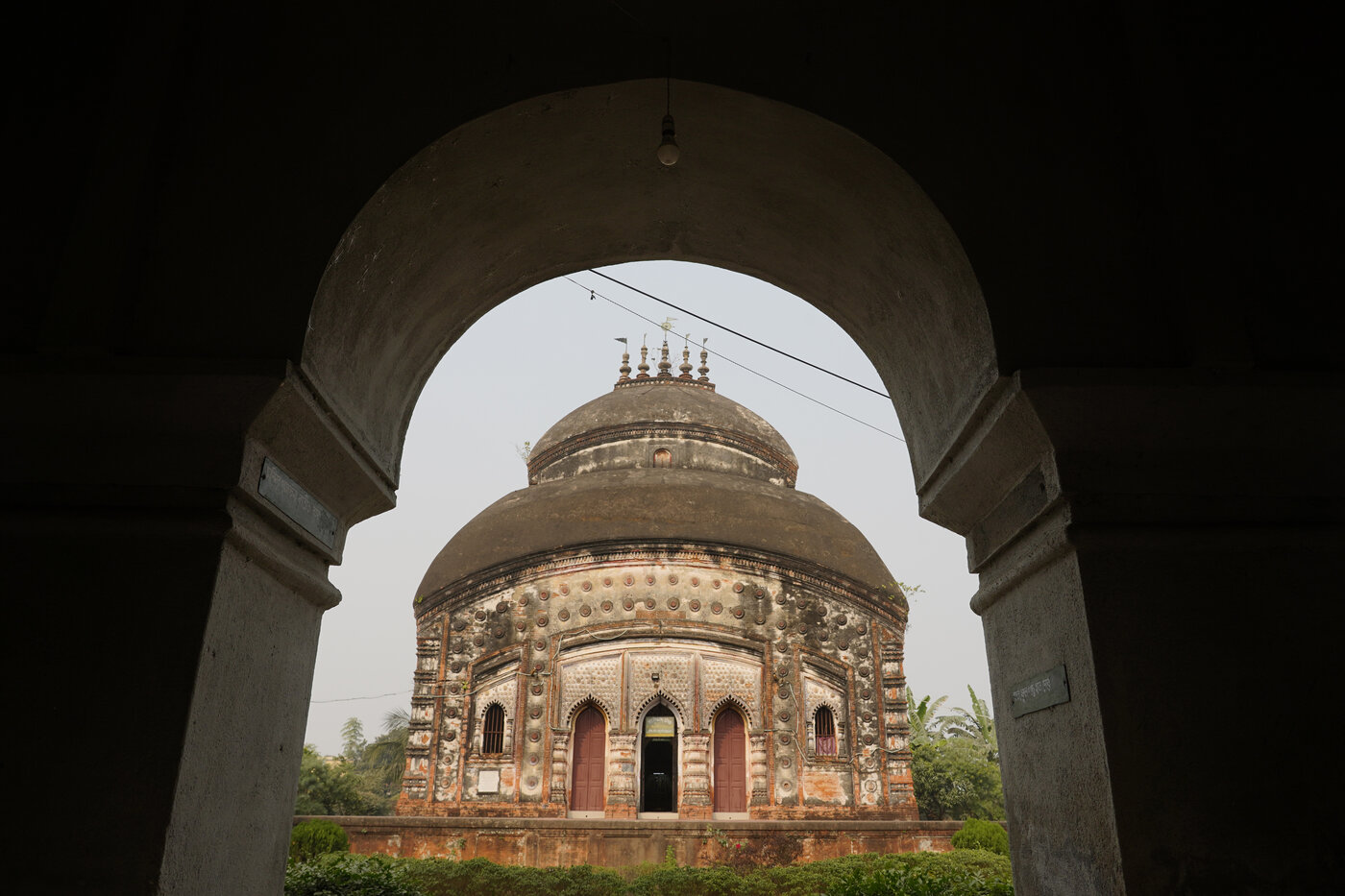
Advaita Acharya lived to a great age and outlived Mahaprabhu. His samadhi and the family Deities remain at Shantipura, which is still a place of pilgrimage. In Gaudiya theology He stands for a clear and powerful teaching. If the sincere appeal of even one devotee is kept up long enough and meant seriously enough, it is enough to move the Supreme Lord to act.
Scriptural evidence
Quoted in the text above:
- Adi 1.12 Sri Chaitanya-charitamrita quoted above ↑
Further verses:
अस्यार्थो विवृतस्तैर्यः स सङ्क्षिप्य विलिख्यते ।
भक्तरूपो गौरचन्द्रो यतोऽसौ नन्दनन्दनः ॥
भक्तस्वरूपो नित्यानन्दो व्रजे यः श्रीहलायुधः ।
भक्तावतार आचार्योऽद्वैतो यः श्रीसदाशिवः ॥
भक्ताख्याः श्रीनिवासाद्या यतस्ते भक्तरूपिनः ।
भक्तशक्तिर्द्विजाग्रण्यः श्रीगदाधरपण्डितः ॥११॥
asyārtho vivṛtas tair yaḥ sa saṅkṣipya vilikhyate |
bhakta-rūpo gauracandro yato’sau nanda-nandanaḥ ||
bhakta-svarūpo nityānando vraje yaḥ śrī-halāyudhaḥ |
bhaktāvatāra ācāryo’dvaito yaḥ śrī-sadāśivaḥ ||
bhaktākhyāḥ śrīnivāsādyā yatas te bhakta-rūpinaḥ |
bhakta-śaktir dvijāgraṇyaḥ śrī-gadādhara-paṇḍitaḥ ||11||
I shall now summarily explain the meaning of these words. In this Panca-tattva, the bhakta-rupa (form of a devotee) is Lord Caitanya Mahaprabhu, who formerly appeared as Lord Krsna, the son of Nanda Maharaja. The bhakta-svarupa (devotional incarnation) is Lord Nityananda, who formerly appeared in Vrajabhumi as Lord Balarama. The bhaktavatara (devotional manifestation) is Lord Advaita Acarya, who is not different from Lord Sadasiva. The bhaktakhya (pure devotee) is Srinivasa and the other great devotees as well. The bhakta-sakti (devotional energy) is Gadadhara Pandita, the foremost of brahmanas.
From the purport: Advaita Ācārya is the incarnation of Sadāśiva from the spiritual world.
Kavi Karnapura's summary of the Panca-tattva: Advaita Acharya is the bhakta-avatara and is Sri Sadashiva. Sanskrit: diacritic edition of the Gaura-ganoddesha-dipika; English translation as published at bvmlu.org. Purport excerpt: Srila Prabhupada, Chaitanya-charitamrita Adi 17.301.
व्रजे आवेशरूपत्वाद्व्यूहो योऽपि सदाशिवः ।
स एवाद्वैतगोस्वामी चैतन्याभिन्नविग्रहः ॥७६॥
vraje āveśa-rūpatvād vyūho yo’pi sadāśivaḥ |
sa evādvaita-gosvāmī caitanyābhinna-vigrahaḥ ||76||
Lord Sadasiva, who formerly appeared as an avesa-incarnation in Vrajabhumi, appeared in Lord Caitanya's pastimes as Lord Advaita Gosvami, who is non-different from Lord Caitanya Himself.
Identifies Sadashiva, who in Vraja appeared as an avesha form, as Advaita Gosvami, non-different from Sri Chaitanya. Sanskrit: diacritic edition of the Gaura-ganoddesha-dipika; English translation as published at bvmlu.org.
Disciples
Frequently asked
When was Sri Advaita Acharya born?
Sri Advaita Acharya appeared 1434, Magha Sukla Saptami in Nabagrama, Srihatta (Sylhet), Bengal.
Who was the guru of Sri Advaita Acharya?
The spiritual master of Sri Advaita Acharya was Srila Madhavendra Puri.
When and where did Sri Advaita Acharya disappear?
Sri Advaita Acharya disappeared after 1534 at Shantipura, Nadia, Bengal.
What are the main pastimes of Sri Advaita Acharya?
The pastimes covered here include: The Advent and Early Life of Advaita Acharya, Calling the Lord to Descend, His Relationship with Sri Chaitanya Mahaprabhu, Sita Thakurani and the Family at Shantipura, The Disappearance of Advaita Acharya.