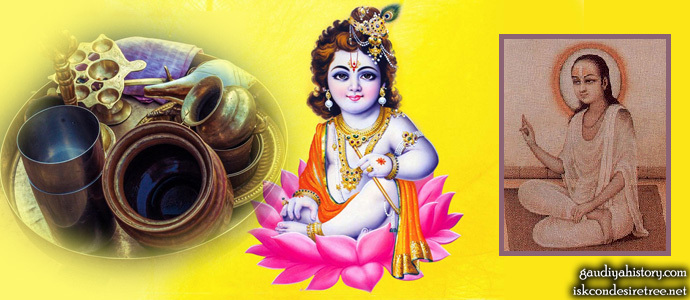
Krishnadasa Kaviraja Goswami gave chapter seven of the Antya-lila of Sri Chaitanya-charitamrita this title: "The Meeting of Sri Chaitanya Mahaprabhu and Vallabha Bhatta." The chapter tells in exact detail about the only time in the written record when Mahaprabhu, who had quietly relied on Sridhara Swami, openly and sharply defended him.
A Proud Scholar's Daily Arguments #
Vallabha Bhatta was a very powerful scholar. He would later found the Pushti-marga and become known as Vallabhacharya. There is an irony here that the sources themselves do not point out. Vallabha Bhatta belonged to the very same Vishnu Svami lineage that later acharyas identify as Sridhara Swami's own. He came to Jagannatha Puri already well known for his learning. Antya 7.100-102 describes how he came every day to Mahaprabhu's residence to argue with Advaita Acharya and Svarupa Damodara Goswami. He was "like a duck in a society of white swans." Every position he put forward was refuted, one after another, by the Vaishnavas gathered there. Their first exchange was about whether chanting Krishna's name breaks a wife's duty not to speak her husband's name aloud. It ended with Mahaprabhu Himself correcting him directly (Antya 7.103-108). The text says plainly that it left Vallabha Bhatta speechless and unhappy.
"I Have Refuted the Explanations of Sridhara Swami" #
Still not discouraged, Vallabha Bhatta returned the next day. Antya 7.112 records that he spoke "with great pride." What he said is recorded word for word: "In my commentary on Srimad-Bhagavatam, I have refuted the explanations of Sridhara Swami. I cannot accept his explanations. Whatever Sridhara Swami reads he explains according to the circumstances. Therefore he is inconsistent in his explanations and cannot be accepted as an authority" (Antya 7.113-114). This was not a small scholarly disagreement over one verse. It was a direct claim to have completely replaced the standard commentary on the whole Bhagavatam.
"One Who Does Not Accept the Svami I Consider a Prostitute" #
Sri Chaitanya-charitamrita records that Mahaprabhu answered with one sharp play on words. In Antya 7.115 He replies with a smile: "One who does not accept the svami [husband] as an authority I consider a prostitute." The wordplay depends on the two meanings of the word svami. One meaning is "husband." It has a second meaning, "the authoritative commentator," as part of Sridhara Swami's own name. Right afterward the text says that "Sri Chaitanya Mahaprabhu became very grave" and that "all the devotees present derived great satisfaction from hearing this statement" (Antya 7.116). Srila Prabhupada retold this episode in a 1973 London lecture. He explained the force of the remark plainly for an English-speaking audience: "You do not recognize Sridhara Swami, then you are a prostitute. How can I hear from a prostitute?" Mahaprabhu refused even to hear Vallabha Bhatta's commentary read aloud.
Correction, Not Cruelty #
Sri Chaitanya-charitamrita takes care to show that what follows was instruction, not simple anger. Antya 7.117-118 states that Mahaprabhu, "descended as an incarnation for the benefit of the entire world," knew Vallabha Bhatta's mind completely. He corrected his false pride "exactly as Krishna had cut down the false pride of Indra." This recalls the Puranic story in which Krishna humbled Indra's pride. Krishna did this for Indra's own highest good, not out of ill will. Vallabha Bhatta went home troubled. That same night he thought through this same reasoning for himself (Antya 7.120-124). He understood that Mahaprabhu's harsh words, like Krishna's treatment of Indra, were meant to purify him, not to punish him. The next morning he came to Mahaprabhu again, this time "in great humility, offering many prayers," and sought shelter at His feet (Antya 7.125).
Full, Specific Words of Surrender and Instruction #
What follows is one of the more detailed exchanges of confession and teaching anywhere in Sri Chaitanya-charitamrita. Here the exact words are what matter, so they are given closely here. Vallabha Bhatta admits, "I am a great fool, and indeed I have acted like a fool by trying to demonstrate my learning to You" (Antya 7.126). Mahaprabhu first answers with real respect, "You are both a greatly learned scholar and a great devotee" (Antya 7.131). Then He speaks the verses for which this whole episode is remembered. "You have dared criticize Sridhara Swami, and you have begun your own commentary on Srimad-Bhagavatam, not accepting his authority. That is your false pride" (Antya 7.132). Then, right away: "Sridhara Swami is the spiritual master of the entire world because by his mercy we can understand Srimad-Bhagavatam. I therefore accept him as a spiritual master" (Antya 7.133). Finally, Mahaprabhu gives the rule that follows from this for every future commentator, including Vallabha Bhatta: "Whatever you might write due to false pride, trying to surpass Sridhara Swami, would carry a contrary purport. Therefore no one would pay attention to it. One who comments on Srimad-Bhagavatam following in the footsteps of Sridhara Swami will be honored and accepted by everyone... Giving up your false pride, worship the Supreme Personality of Godhead, Krishna" (Antya 7.134-136).
Why the Episode Mattered #
Srila Prabhupada discussed this same story on a morning walk in Los Angeles in 1973, and he explained the theological point directly. Vallabha Bhatta was, in Prabhupada's own words, "Vaishnava, acharya," a genuine devotee, not a rival tradition to be dismissed, "but that very deviation, that 'I have done something better than Sridhara,' that is not our parampara system... We should always remain servant of the servant. Never we shall think that 'I am better than my Guru Maharaja.' That is falldown." In other words, Mahaprabhu did not react so sharply because of a disagreement over a point of Sanskrit grammar. He reacted to the proud idea that one's own personal brilliance gives one the right to set aside the long-standing authority of the disciplic succession. When this pride was aimed at Sridhara Swami, Sri Chaitanya Mahaprabhu thought it worth stopping right there, in front of the whole assembly at Jagannatha Puri. Vallabha Bhatta accepted the correction. Sri Chaitanya-charitamrita's own account ends with him surrendered, not resentful. Later Vaishnava tradition remembers that he went on to found his own respected line of devotion to Krishna, the Pushti-marga, and that he had learned this lesson at its very foundation.
