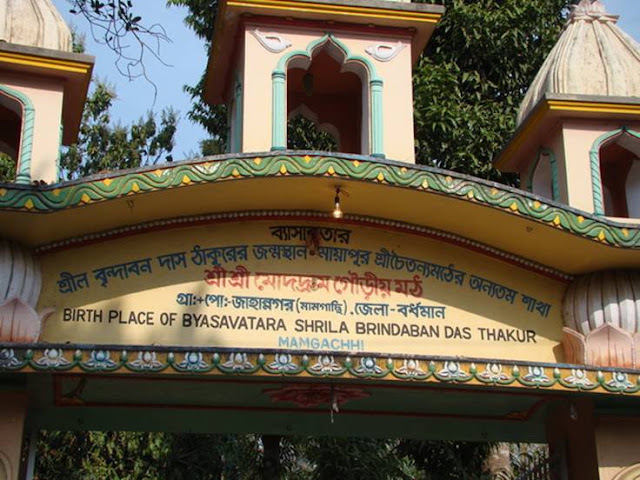
According to the reckoning most Gaudiya Vaishnava sources use, Vrindavana Dasa Thakura was born around 1507 CE, on Krishna Dvadashi of the month of Vaishakh, in the year 1429 of the Shaka era. Most accounts place his birth at Mamgachi, a village in the Navadvipa area of Bengal. Mamgachi was the ancestral home of Malini Devi, the wife of Srivasa Thakura. At least one early account gives Kumarahatta as his birthplace instead. This disagreement is old, and the two villages are close to each other among the same holy places. So both are named here honestly, instead of choosing one.
| Detail | Description |
|---|---|
| Father | Vaikunthanatha Vipra, a brahmana from Sylhet, East Bengal |
| Mother | Narayani Devi, niece of Srivasa Thakura |
| Birthplace | Mamgachi (some accounts: Kumarahatta) |
| Shripata | Denuria, Matreshvara precinct, Burdwan district |
| Later residence | Mamgachi, where he installed his own Deities |
A Father Who Died Young #
Little is known about Vrindavana Dasa's father beyond his name, Vaikunthanatha Vipra, and the fact that he was a brahmana who had come from Sylhet in East Bengal. He died while Vrindavana Dasa was still a small child. Some traditional accounts say he died even before his son was born. So Narayani Devi had to raise her son largely on her own. This almost complete silence about his father's life is not unusual for Gaudiya Vaishnava authors of this period. Like several other writers of his time, Vrindavana Dasa said almost nothing in his writing about his own worldly family. He preferred to be known only in relation to his mother and his guru.
Narayani Devi and Her Own Place in Chaitanya's Mercy #
Popular retellings sometimes mix up who received whose mercy in this family, so it is important to be clear. Narayani Devi, not Vrindavana Dasa himself, had the direct and well-recorded connection to Sri Chaitanya Mahaprabhu. Narayani was the daughter of an elder brother of Srivasa Thakura, and she grew up in Srivasa's own household in Navadvipa. She was only about four years old when Mahaprabhu revealed His divine identity to the assembled devotees inside Srivasa's house. Later Vaishnavas call this pastime the Mahaprakasha. According to her son's own account in Chaitanya-Bhagavata, young Narayani was swept into ecstatic love of God on that occasion. She cried out and fell into a trance of divine emotion. Chaitanya-Bhagavata records that in the years that followed, Narayani regularly received whatever food remnants Mahaprabhu Himself left behind. This was a mark of special favor. Krishnadasa Kaviraja Goswami later singled it out for praise in Sri Chaitanya-charitamrita. He noted that Vrindavana Dasa was born "in the womb of Narayani, who eternally enjoys Sri Chaitanya's remnants." Kavi Karnapura's Gaura-ganoddesha-dipika goes even further. It identifies Narayani, in her eternal spiritual identity, as Kilimbika. Kilimbika is the younger sister of Krishna's own nursemaid Ambika. In Mahaprabhu's pastimes, Ambika reappeared as Malini Devi, Srivasa's wife.
Childhood Between Two Villages #
After her husband's death, Narayani appears to have lived for a time in real hardship. One account says that she took shelter as a maidservant in a poor brahmana household, and that she later settled at Mamgachi, the ancestral village of Malini Devi. So Vrindavana Dasa's own childhood was divided between two places. He is remembered as having spent part of it in Mamgachi with his mother's side of the family, and part of it in the household of Srivasa Thakura himself. Narayani had grown up in that household. There, from an early age, Vrindavana Dasa would have been surrounded by Vaishnava association and kirtana. Srila Bhaktisiddhanta Sarasvati Thakura, commenting on Chaitanya-Bhagavata centuries later, wrote that at Malini Devi's ancestral home "Vrindavana Dasa played as a small boy growing up. There he was nourished and cared for just like a valuable gem." Later in life, Vrindavana Dasa settled permanently at Mamgachi. He installed Deities of Nitai-Gauranga there, and Gaudiya Vaishnavas still worship these Deities today. A separate tradition also names Denuria, in the Matreshvara precinct of Burdwan district, as his shripata, or seat of worship. Deities associated with him are also still maintained there.
