Srila Vrindavana Dasa Thakura
Author of Sri Chaitanya-Bhagavata
The complete life, on one page: The main biography and every pastime page, in order, in one place
Introduction
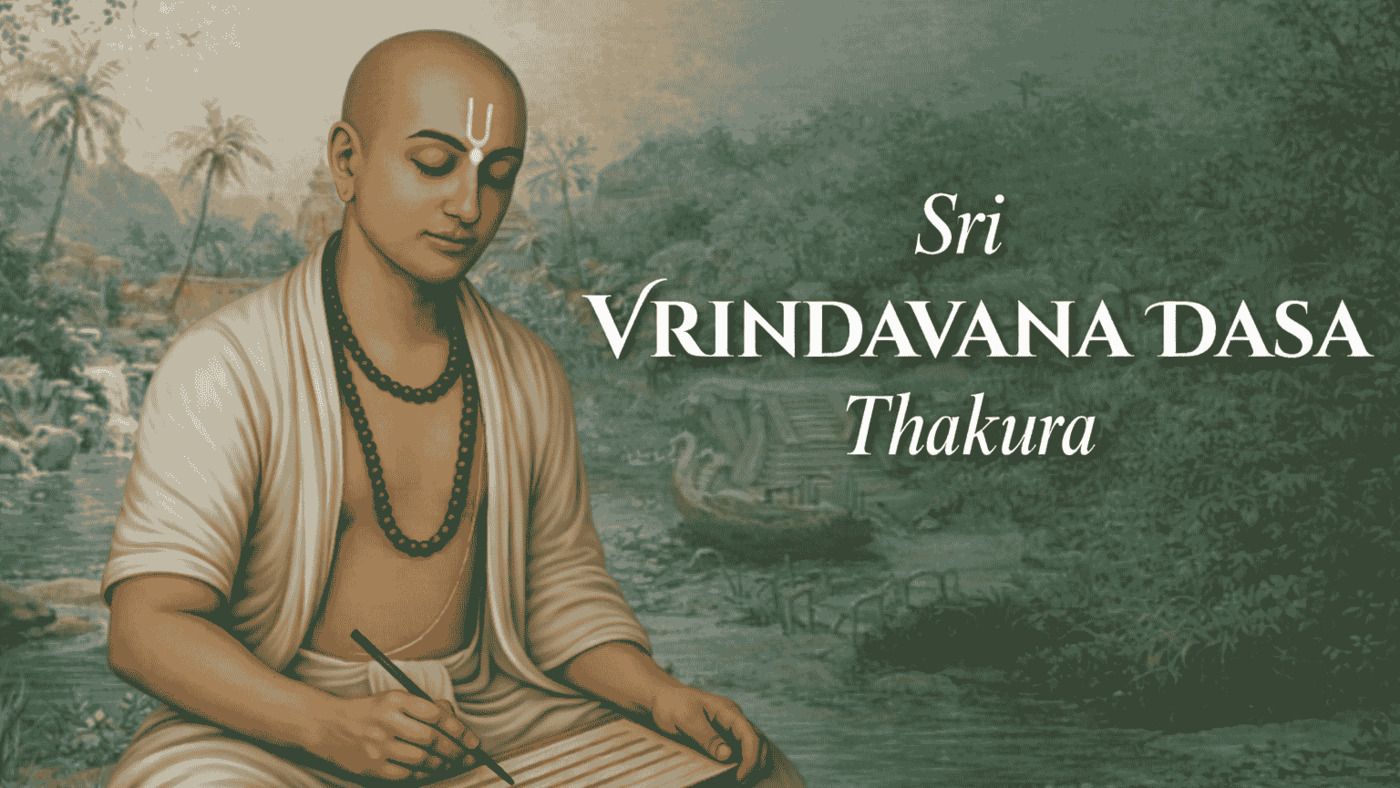
Srila Vrindavana Dasa Thakura wrote Sri Chaitanya-Bhagavata, the first full-length biography of Sri Chaitanya Mahaprabhu's life. He composed it in Bengali verse a few years after the Lord's own disappearance. Vrindavana Dasa wrote very soon after the events themselves. Also, his own mother had grown up in the household most closely connected with Mahaprabhu's early pastimes. For these reasons, his book gives unusually rich detail about Mahaprabhu's childhood and youth in Navadvipa. These are the very years that Krishnadasa Kaviraja Goswami's later Sri Chaitanya-charitamrita covers only briefly. Krishnadasa wrote decades afterward, and he deliberately left that part of the story to Vrindavana Dasa. Gaudiya Vaishnavas honor Vrindavana Dasa as the Vyasa of Chaitanya-lila. This means he is the Vedavyasa of Sri Chaitanya's pastimes, just as the sage Vyasadeva compiled Krishna's pastimes in Srimad-Bhagavatam.
| Detail | Description |
|---|---|
| Born | c. 1507 CE, Krishna Dvadashi of Vaishakh (1429 Shaka era) |
| Birthplace | Mamgachi, Navadvipa area, Bengal (some accounts say Kumarahatta) |
| Mother | Narayani Devi, niece of Srivasa Thakura |
| Identity | Incarnation of Vedavyasa; Krishna's cowherd friend Kusumapida also entered him (Gaura-ganoddesha-dipika 109; Chaitanya-charitamrita Adi 11.55 purport) |
| Spiritual master | Nityananda Prabhu |
| Chief work | Sri Chaitanya-Bhagavata (originally titled Chaitanya-mangala), composed by tradition in 1535 CE |
| Disappeared | c. 1589 CE (exact year disputed) |
| Samadhi | 64 Samadhis area, Vrindavana |
Scriptural evidence for the introduction (3)
nityananda-kṛpā-pātra — vṛndāvana-dāsa
caitanya-līlāya teṅho hayena 'ādi-vyāsa'
Word for word
nityananda: of Lord Nityananda Prabhu; kṛpā-pātra: the favorite devotee; vṛndāvana-dāsa: Vṛndāvana dāsa Ṭhākura; caitanya-līlāya: in the pastimes of Śrī Caitanya Mahāprabhu; teṅho: he; hayena: is; ādi-vyāsa: the original Vyāsadeva.
“Vrindavana dasa Thakura is Lord Nityananda's favorite devotee, and therefore he is the original Vyasadeva in describing the pastimes of Sri Chaitanya Mahaprabhu.”
The verse that most directly states Vrindavana Dasa Thakura's identity and his standing as the first great biographer of Sri Chaitanya Mahaprabhu's pastimes.
वेदव्यासो य एवासीद्दासो वृन्दावनोऽधुना ।
सखा यः कुसुमापीडः कार्यतस्तं समाविशत् ॥१०९॥
veda-vyāso ya evāsīd dāso vṛndāvano’dhunā
sakhā yaḥ kusumāpīḍaḥ kāryatas taṁ samāviśat
Vedavyasa appeared in Lord Caitanya's pastimes as Vrndavana das Thakura. Lord Krsna's cowherd friend Kusumapida also entered the body of Vrndavana das Thakura.
Kavi Karnapura records Vrindavana Dasa Thakura as Vedavyasa, with Kusumapida, a cowherd friend of Krishna, also entering him; Srila Prabhupada gives the same in his purport to Chaitanya-charitamrita Adi 11.55. Sanskrit: diacritic edition of the Gaura-ganoddesha-dipika; English translation as published at bvmlu.org.
ভাগবতে কৃষ্ণলীলা বর্ণিলা বেদব্যাস ।
চৈতন্য–লীলাতে ব্যাস—বৃন্দাবন দাস ॥
bhāgavate kṛṣṇa-līlā varṇilā vedavyāsa
caitanya-līlāte vyāsa — vṛndāvana dāsa
Śrīla Vyāsadeva described the pastimes of Kṛṣṇa in Śrīmad-Bhāgavatam. The Vyāsa of the pastimes of Lord Caitanya Mahāprabhu was Vṛndāvana dāsa.
From the purport: Śrīla Vṛndāvana dāsa Ṭhākura was an incarnation of Vedavyāsa and also a friendly cowherd boy named Kusumāpīḍa in kṛṣṇa-līlā. (Srila Prabhupada, purport purport)
Krishnadasa Kaviraja Goswami calls Vrindavana Dasa the Vyasa of Sri Chaitanya's pastimes; the purport gives his identity as Vedavyasa and Kusumapida. Verse text, translation and purport: Srila Prabhupada, Sri Chaitanya-charitamrita (vedabase.io).
Chapter 1
Birth and Family in Bengal
A father who died young, a mother touched by Chaitanya Mahaprabhu's own mercy, and a childhood spent between two Bengal villages.
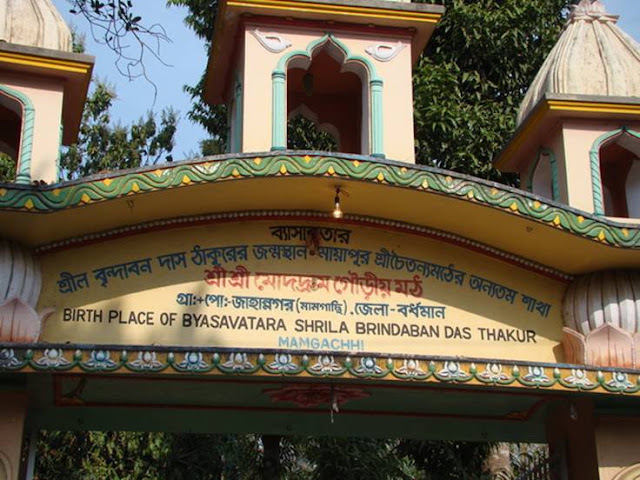
According to the reckoning most Gaudiya Vaishnava sources use, Vrindavana Dasa Thakura was born around 1507 CE, on Krishna Dvadashi of the month of Vaishakh, in the year 1429 of the Shaka era. Most accounts place his birth at Mamgachi, a village in the Navadvipa area of Bengal. Mamgachi was the ancestral home of Malini Devi, the wife of Srivasa Thakura. At least one early account gives Kumarahatta as his birthplace instead. This disagreement is old, and the two villages are close to each other among the same holy places. So both are named here honestly, instead of choosing one.
| Detail | Description |
|---|---|
| Father | Vaikunthanatha Vipra, a brahmana from Sylhet, East Bengal |
| Mother | Narayani Devi, niece of Srivasa Thakura |
| Birthplace | Mamgachi (some accounts: Kumarahatta) |
| Shripata | Denuria, Matreshvara precinct, Burdwan district |
| Later residence | Mamgachi, where he installed his own Deities |
A Father Who Died Young #
Little is known about Vrindavana Dasa's father beyond his name, Vaikunthanatha Vipra, and the fact that he was a brahmana who had come from Sylhet in East Bengal. He died while Vrindavana Dasa was still a small child. Some traditional accounts say he died even before his son was born. So Narayani Devi had to raise her son largely on her own. This almost complete silence about his father's life is not unusual for Gaudiya Vaishnava authors of this period. Like several other writers of his time, Vrindavana Dasa said almost nothing in his writing about his own worldly family. He preferred to be known only in relation to his mother and his guru.
Narayani Devi and Her Own Place in Chaitanya's Mercy #
Popular retellings sometimes mix up who received whose mercy in this family, so it is important to be clear. Narayani Devi, not Vrindavana Dasa himself, had the direct and well-recorded connection to Sri Chaitanya Mahaprabhu. Narayani was the daughter of an elder brother of Srivasa Thakura, and she grew up in Srivasa's own household in Navadvipa. She was only about four years old when Mahaprabhu revealed His divine identity to the assembled devotees inside Srivasa's house. Later Vaishnavas call this pastime the Mahaprakasha. According to her son's own account in Chaitanya-Bhagavata, young Narayani was swept into ecstatic love of God on that occasion. She cried out and fell into a trance of divine emotion. Chaitanya-Bhagavata records that in the years that followed, Narayani regularly received whatever food remnants Mahaprabhu Himself left behind. This was a mark of special favor. Krishnadasa Kaviraja Goswami later singled it out for praise in Sri Chaitanya-charitamrita. He noted that Vrindavana Dasa was born "in the womb of Narayani, who eternally enjoys Sri Chaitanya's remnants." Kavi Karnapura's Gaura-ganoddesha-dipika goes even further. It identifies Narayani, in her eternal spiritual identity, as Kilimbika. Kilimbika is the younger sister of Krishna's own nursemaid Ambika. In Mahaprabhu's pastimes, Ambika reappeared as Malini Devi, Srivasa's wife.
Childhood Between Two Villages #
After her husband's death, Narayani appears to have lived for a time in real hardship. One account says that she took shelter as a maidservant in a poor brahmana household, and that she later settled at Mamgachi, the ancestral village of Malini Devi. So Vrindavana Dasa's own childhood was divided between two places. He is remembered as having spent part of it in Mamgachi with his mother's side of the family, and part of it in the household of Srivasa Thakura himself. Narayani had grown up in that household. There, from an early age, Vrindavana Dasa would have been surrounded by Vaishnava association and kirtana. Srila Bhaktisiddhanta Sarasvati Thakura, commenting on Chaitanya-Bhagavata centuries later, wrote that at Malini Devi's ancestral home "Vrindavana Dasa played as a small boy growing up. There he was nourished and cared for just like a valuable gem." Later in life, Vrindavana Dasa settled permanently at Mamgachi. He installed Deities of Nitai-Gauranga there, and Gaudiya Vaishnavas still worship these Deities today. A separate tradition also names Denuria, in the Matreshvara precinct of Burdwan district, as his shripata, or seat of worship. Deities associated with him are also still maintained there.
Scriptural evidence for this chapter (1)
vṛndāvana-dāsa — nārāyaṇīra nandana
'caitanya-maṅgala' yeṅho karila racana
Word for word
vṛndāvana-dāsa: Śrīla Vṛndāvana dāsa Ṭhākura; nārāyaṇīra nandana: son of Nārāyaṇī; caitanya-maṅgala: the book of the name Caitanya-maṅgala; yeṅho: who; karila racana: composed.
“Vrindavana dasa Thakura, the son of Srimati Narayani, composed Sri Chaitanya-mangala [later known as Sri Chaitanya-Bhagavata].”
Krishnadasa Kaviraja Goswami identifies Vrindavana Dasa Thakura by his mother's name, reflecting how closely his identity was tied to Narayani Devi's own place in Chaitanya Mahaprabhu's mercy.
Chapter 2
Nityananda's Blessing and the Order to Write
How Nityananda Prabhu directed his young disciple toward the work that would define his life.
Vrindavana Dasa Thakura took initiation from Nityananda Prabhu in his youth. Most accounts say this was at around age sixteen, though at least one early source gives twenty instead. No one disputes that this relationship became central to everything Vrindavana Dasa is remembered for. Sri Chaitanya-charitamrita's own verse on the subject states the connection very plainly: nityananda-krpa-patra, vrndavana-dasa, "Vrindavana Dasa Thakura is Nityananda's favorite devotee". The verse then links that closeness directly to his standing as the Vyasa of Chaitanya-lila.
The Last Disciple #
Several traditional accounts describe Vrindavana Dasa as the last disciple Nityananda Prabhu personally accepted. Whether or not that claim can be tied to an exact time, it shows something Gaudiya Vaishnavas have always stressed about the relationship. This was not a distant or formal initiation. It was a close and personal one, remembered afterward as one of Nityananda Prabhu's closest attachments among all his many followers. One tradition holds that Nityananda Prabhu was traveling and preaching with his young disciple, and that at Denuria in Burdwan district he told Vrindavana Dasa to stay there and preach instead of going on. This would mean that Vrindavana Dasa may never have had the chance to see Sri Chaitanya Mahaprabhu in person. If that tradition is accurate, it makes Vrindavana Dasa's later work more remarkable, not less. By this account, the most detailed early record of Mahaprabhu's own childhood and youth was written by someone who had never personally met Him. Vrindavana Dasa depended instead on his mother's own memories and on Nityananda Prabhu's guidance.
An Order Vrindavana Dasa Attributed to His Guru #
Several Gaudiya Vaishnava sources describe the writing of Chaitanya-Bhagavata as something Vrindavana Dasa did specifically on Nityananda Prabhu's order, not just with his general blessing. This point matters for how the tradition has always read the book. It is not read as one devotee's personal literary project. It is read as a task carried out under a guru's direct instruction. In the same way, Krishnadasa Kaviraja Goswami would later describe his own Chaitanya-charitamrita as written under an order he received at the Madana-mohana temple in Vrindavana. The purports to Sri Chaitanya-charitamrita make the same point about all such writing. Transcendental literature about the Lord's pastimes can only be written by a genuine devotee. This is because the Lord Himself, working through such a devotee, actually supplies the words. Krishnadasa Kaviraja Goswami states this directly about Vrindavana Dasa's own book. He says that what Vrindavana Dasa wrote was, in effect, spoken by Sri Chaitanya Mahaprabhu Himself, and simply set down by Vrindavana Dasa's pen.
An Empowerment, Not Just a Permission #
The tradition claims something more here than a simple grant of permission. Later authors like Krishnadasa Kaviraja Goswami describe seeking and receiving a specific sign of approval before writing. But the accounts of Vrindavana Dasa's connection to Nityananda Prabhu describe something closer to an active empowerment. In them, a guru personally directs a beloved young disciple toward the very task that would fill the rest of his life. That task would also make Gaudiya Vaishnavas remember him as the tradition's first great biographer. No surviving source explains in detail exactly how Nityananda Prabhu gave this direction. But its result was Sri Chaitanya-Bhagavata itself, the subject of Writing Sri Chaitanya-Bhagavata.
Scriptural evidence for this chapter (1)
kṛṣṇa-līlā bhāgavate kahe veda-vyāsa
caitanya-līlāra vyāsa — vṛndāvana-dāsa
Word for word
kṛṣṇa-līlā: the pastimes of Lord Kṛṣṇa; bhāgavate: in the book Śrīmad-Bhāgavatam; kahe: tells; veda-vyāsa: Vyāsadeva, the editor of the Vedic literatures; caitanya-līlāra: of the pastimes of Lord Caitanya; vyāsa: compiler; vṛndāvana-dāsa: is Vṛndāvana dāsa.
“As Vyasadeva has compiled all the pastimes of Lord Krishna in Srimad-Bhagavatam, Thakura Vrindavana dasa has depicted the pastimes of Lord Chaitanya.”
The founding comparison, made by Krishnadasa Kaviraja Goswami himself, between Vyasadeva's compilation of Krishna-lila and Vrindavana Dasa Thakura's compilation of Chaitanya-lila.
Chapter 3
Writing Sri Chaitanya-Bhagavata
A book renamed by the Vaishnavas of Vrindavana, and the remarkable things later said about who really spoke through it.
Tradition dates the writing of Sri Chaitanya-Bhagavata to 1535 CE. Later literary historians, working from evidence inside the text and in the manuscripts, have argued for a somewhat later date, sometime in the mid-1540s. This is a real disagreement between devotional tradition and academic dating. We state it plainly here instead of settling it by simply choosing one side. Both sides agree that Vrindavana Dasa wrote in Bengali. They also agree that he wrote soon enough after Sri Chaitanya Mahaprabhu's own life that people who had known the Lord personally were still living. Vrindavana Dasa could draw on them directly as sources, and one of them was his own mother.
A Book Renamed #
Vrindavana Dasa first called his book Chaitanya-mangala. It kept that title until the poet Lochana Dasa Thakura wrote his own, separate biography of Mahaprabhu under the same name. The Premavilasa of Nityananda Dasa tells the lives of Narottama Dasa Thakura and his companions. According to this book, the leading Vaishnavas gathered at Vrindavana and settled the matter by agreement. Lochana Dasa's book would keep the name Chaitanya-mangala. Vrindavana Dasa's earlier work would from then on be known as Sri Chaitanya-Bhagavata. Whether they intended it or not, the new name tied the book even more closely to the Bhagavata tradition. Vrindavana Dasa had written his book to carry that tradition forward into Mahaprabhu's own age.
What Sri Chaitanya-charitamrita Says About It #
No source praises Chaitanya-Bhagavata more highly, or more sincerely, than Krishnadasa Kaviraja Goswami's own Sri Chaitanya-charitamrita. Krishnadasa writes that hearing Chaitanya-mangala "annihilates all misfortune," and that even a confirmed atheist or non-believer who hears it "immediately becomes a great devotee." He goes even further. He writes that the book's subject matter is so exalted that it seems Sri Chaitanya Mahaprabhu Himself spoke through Vrindavana Dasa's own mouth. This is not an ordinary literary compliment, even if it may sound like one today. In the Gaudiya Vaishnava understanding of how genuine devotional literature comes to be written, it is a specific claim about where the book's real authority comes from. Krishnadasa ends this praise by bowing down completely before Vrindavana Dasa's achievement: "I offer millions of obeisances unto the lotus feet of Vrindavana Dasa Thakura. No one else could write such a wonderful book for the deliverance of all fallen souls."
The Book's Own Warnings #
Chaitanya-Bhagavata is not written only in a gentle devotional tone. In several places, repeated across all three sections of the book, Vrindavana Dasa gives sharp warnings against Vaishnava aparadha, that is, offenses against devotees. He warns in particular against anyone who would speak badly of Nityananda Prabhu. Some later readers have found these passages harsh when read out of context. Srila Bhaktisiddhanta Sarasvati Thakura answered this criticism. He defended Vrindavana Dasa's tone as itself an act of compassion. A Vaishnava's apparent severity toward blasphemers, he wrote, conceals a limitless underlying concern for the well-being of the very people being warned, since nothing does more lasting harm to a soul than persisting in offenses against the Lord's own devotees.
A Reception That Outlasted the Author #
Chaitanya-Bhagavata has remained continuously read and quoted within Gaudiya Vaishnavism ever since. Centuries later, Srila Prabhupada translated the opening chapters of Srimad-Bhagavatam. In a 1974 conversation he quoted a line from Vrindavana Dasa's book directly, and he named Vrindavana Dasa as its author. The line says that whatever passes for religion throughout the world, the Bhagavata calls entirely cheating. This gives a small glimpse of how naturally Prabhupada, and the tradition before him, used Vrindavana Dasa's own words in everyday teaching. They did not treat his words as an interesting piece of old history. Even four and a half centuries after the book was written, they used it as a living source of teaching.
Scriptural evidence for this chapter (3)
Quoted in the text above:
- Adi 8.40 Sri Chaitanya-charitamrita
Further verses:
vṛndāvana-dāsa kaila 'caitanya-maṅgala'
yāṅhāra śravaṇe nāśe sarva amaṅgala
Word for word
vṛndāvana-dāsa: Vṛndāvana dāsa; kaila: compiled; caitanya-maṅgala: the book named Caitanya-maṅgala; yāṅhāra: of which; śravaṇe: by hearing; nāśe: annihilated; sarva amaṅgala: all inauspiciousness.
“Thakura Vrindavana dasa has composed Sri Chaitanya-mangala. Hearing this book annihilates all misfortune.”
Cited on the page discussing Chaitanya-Bhagavata's composition and reception, as one of several verses in which Krishnadasa Kaviraja Goswami praises the book's spiritual effect on its hearers.
'caitanya-maṅgala' śune yadi pāṣaṇḍī, yavana
seha mahā-vaiṣṇava haya tatakṣaṇa
Word for word
caitanya-maṅgala: the book named Caitanya-maṅgala; śune: anyone hears; yadi: if; pāṣaṇḍī: great atheist; yavana: a non-believer in the Vedic culture; seha: he also; mahā-vaiṣṇava: great devotee; haya: becomes; tatakṣaṇa: immediately.
“If even a great atheist hears Sri Chaitanya-mangala, he immediately becomes a great devotee.”
One of Chaitanya-charitamrita's strongest statements about Chaitanya-Bhagavata's spiritual potency, quoted on the page about the book's writing and early reception.
Chapter 4
The Scope and Structure of Chaitanya-Bhagavata
Three khandas, an unusually detailed record of Navadvipa, and a Puri section that stops well short of the whole story.
Sri Chaitanya-Bhagavata is divided into three sections, called khandas, of very unequal length. This difference in length says a great deal about what Vrindavana Dasa considered most important to preserve.
The Adi-khanda #
The Adi-khanda runs to sixteen chapters. It covers the religious and social condition of Bengal before Sri Chaitanya Mahaprabhu's birth, His own birth and childhood, His early education, and His first marriage to Lakshmipriya. It then describes His debates with rival scholars, a journey to East Bengal, the passing of Lakshmipriya, His second marriage to Vishnupriya, and finally His pilgrimage to Gaya. There He received initiation from Ishvara Puri. This was the turning point, and after it Mahaprabhu's outward life as a devotee properly begins. Vrindavana Dasa's closeness to eyewitnesses of Mahaprabhu's Navadvipa years shows most clearly in this section. Here he was drawing on memories that his own mother and the devotees around her had kept from what they saw themselves.
The Madhya-khanda #
At twenty-seven chapters, the Madhya-khanda is by far the longest of the three sections. It covers the years that many Gaudiya Vaishnavas consider the emotional heart of Mahaprabhu's preaching in Bengal. It describes His growing outward displays of ecstatic devotion, the disciples who gathered around Him, and the conversion of the notorious sinners Jagai and Madhai. It also describes His confrontation with the Muslim magistrate Chand Kazi over the public chanting of Krishna's names. In this episode the devotees openly disobeyed the ruler's order, and Gaudiya Vaishnavas still tell it as one of the first brave acts of the sankirtana movement.
The Antya-khanda, and Where It Stops #
The Antya-khanda, by contrast, is short. Most manuscripts have only ten chapters. Two later manuscripts add three more chapters, but most modern scholars do not accept these as part of Vrindavana Dasa's original text. The Antya-khanda covers Mahaprabhu's acceptance of sannyasa, His mother Sacimata's grief at His renunciation, His journey to Puri, and His meeting there with the great logician Sarvabhauma Bhattacharya. Then the book practically stops. It ends well before Mahaprabhu's final eighteen years at Puri are told. This is not so much a flaw as a result of when and how Chaitanya-Bhagavata was written. Those final Puri years belonged to a small circle around Svarupa Damodara Gosvami. Vrindavana Dasa was writing from Bengal, and he simply did not have close access to that circle. Krishnadasa Kaviraja Goswami later set out to fill exactly this gap in Sri Chaitanya-charitamrita. The two books are compared further in His Place Among the Biographers.
A Book Praised for Its Simplicity #
Modern readers of both books have long noticed a real difference in style between them. Chaitanya-Bhagavata does not attempt the long theological argument that later marks Chaitanya-charitamrita. For example, it does not explain at length the doctrine that Mahaprabhu combines Radha and Krishna in a single form. Krishnadasa Kaviraja Goswami states this teaching clearly and many times. By comparison, Vrindavana Dasa's book is simpler and tells the story more directly. It is closer in feeling to a direct devotional record than to a book of philosophy. The tradition has never seen this simplicity as a weakness. Rather, it is part of the reason why Chaitanya-Bhagavata remains the fuller and richer record of Mahaprabhu's Navadvipa childhood and youth. Later biographers had less firsthand material about exactly those years.
Beyond Chaitanya-Bhagavata #
It appears that Chaitanya-Bhagavata was Vrindavana Dasa's only major surviving work. Other writings have occasionally been said to be his, but this has never been reliably proved. So those claims are not repeated here as fact. One thing is certain. A young Bengali Vaishnava wrote this single book, working from his mother's memories and his guru's direction. It became the main source for how Gaudiya Vaishnavas understand Sri Chaitanya Mahaprabhu's early life, and it still is.
Scriptural evidence for this chapter (2)
manuṣye racite nāre aiche grantha dhanya
vṛndāvana-dāsa-mukhe vaktā śrī-caitanya
Word for word
manuṣye: a human being; racite nāre: cannot compile; aiche: such; grantha dhanya: so glorious a book; vṛndāvana-dāsa-mukhe: from the mouth of Śrīla Vṛndāvana dāsa Ṭhākura; vaktā: the speaker; śrī-caitanya: is Śrī Caitanya Mahāprabhu Himself.
“The subject matter of this book is so sublime that it appears that Sri Chaitanya Mahaprabhu has personally spoken through the writings of Sri Vrindavana dasa Thakura.”
From the purport: Purport excerpt: “Krsnadasa Kaviraja Gosvami confirms that what Vrndavana dasa Thakura wrote was actually spoken by Lord Caitanya Mahaprabhu, and he simply repeated it.”
Explains, in the tradition's own terms, why Chaitanya-Bhagavata is treated as authoritative scripture rather than an ordinary historical account of Mahaprabhu's life.
pṛthivīte yāha kichu dharma nāme cale
bhāgavata kāhe taha paripūrṇa chale
“Whatever is going on throughout the whole world in the name of religion, according to Bhagavata, they're all cheating.”
No standalone Chaitanya-Bhagavata corpus exists on VedaBase, so this verse is cited here as Srila Prabhupada quoted and translated it, crediting it directly to Vrindavana Dasa Thakura, illustrating the book's own teaching on cheating types of religion.
Chapter 5
His Place Among the Biographers
Why Gaudiya Vaishnavas read Chaitanya-Bhagavata and Chaitanya-charitamrita together rather than as rivals.
Sri Chaitanya-Bhagavata was the earliest of the major biographies of Sri Chaitanya Mahaprabhu, written well before the others. The tradition it started shaped everything written about Mahaprabhu afterward. Above all, it shaped Krishnadasa Kaviraja Goswami's Sri Chaitanya-charitamrita, which was composed decades later at Vrindavana.
Equal to Vyasadeva #
Krishnadasa's own words about Vrindavana Dasa show clearly how he saw the relationship between the two books. In Chaitanya-charitamrita's opening chapters, he calls Vrindavana Dasa "the authorized writer of the pastimes of Sri Chaitanya Mahaprabhu," adding, "he is as good as Srila Vyasadeva. He has described the pastimes in such a way as to make them sweeter and sweeter." He does not present his own work as an improvement or a replacement. Instead, he clearly describes it as completing Vrindavana Dasa's book: "Being afraid of his book's becoming too voluminous, he left some places without vivid descriptions. I shall try to fill those places as far as possible." That is a disciple's language, not a rival's.
Two Different Strengths #
When the two books are read side by side, each one turns out to be rich almost exactly where the other is thin. Chaitanya-Bhagavata has no equal on Mahaprabhu's Navadvipa childhood and youth. Vrindavana Dasa knew this material closely through his own mother's memories. But his book says less about Mahaprabhu's final eighteen years at Puri. Vrindavana Dasa was writing from Bengal, and he had no similar firsthand source for that period. Chaitanya-charitamrita is almost exactly the opposite. Krishnadasa's own guru, Raghunatha Dasa Goswami, had lived at Puri under the personal care of Svarupa Damodara Gosvami during exactly those final years. This gave Krishnadasa access to material on Mahaprabhu's last years that Vrindavana Dasa simply never had. In other words, the two books were never really competing to cover the same part of the story. Both authors, in their own ways, seem to have understood this clearly.
A Difference in Voice as Well as Content #
The two works also differ in how they argue, not only in what they cover. By comparison, Chaitanya-Bhagavata is plain and tells a story. It is closer to a direct devotional record. Chaitanya-charitamrita builds a long theological argument. Its most famous teaching is that Mahaprabhu embodies Radha and Krishna combined in a single form, and it returns to this teaching and explains it again and again. Gaudiya Vaishnava readers have generally not treated this difference as a sign that one book is more advanced than the other. They have seen the two books as two different and equally necessary voices. One sets out the facts and devotional feeling of Mahaprabhu's life in careful detail. The other builds the philosophy around it.
Vyasa and Adi-Vyasa #
Sri Chaitanya-charitamrita gives Vrindavana Dasa a special title, adi-vyasa, the original Vyasa of Chaitanya-lila. Later commentary treats this title as more than a compliment. Srila Bhaktisiddhanta Sarasvati Thakura commented on this verse. He explained that every sincere devotee who has since written about Mahaprabhu's pastimes should rightly be understood as following in Vrindavana Dasa's footsteps. This includes Krishnadasa Kaviraja Goswami. Such devotees are honored with the same title of Vyasa for doing so. According to this explanation, Vrindavana Dasa is not simply the first of several biographers of equal standing. He is the one who opened the line of Chaitanya-lila biographers. Every later biographer, including the author of Chaitanya-charitamrita itself, consciously continued that line.
Scriptural evidence for this chapter (2)
Quoted in the text above:
- Adi 13.49 Sri Chaitanya-charitamrita
Further verses:
caitanya-līlāra vyāsa, — dāsa vṛndāvana
madhura kariyā līlā karilā racana
Word for word
caitanya-līlāra: of the pastimes of Lord Caitanya; vyāsa: the authorized writer Vyāsadeva; dāsa vṛndāvana: Vṛndāvana dāsa Ṭhākura; madhura kariyā: making it sweet; līlā: pastimes; karilā racana: did compilation.
“Srila Vrindavana dasa Thakura, the authorized writer of the pastimes of Sri Chaitanya Mahaprabhu, is as good as Srila Vyasadeva. He has described the pastimes in such a way as to make them sweeter and sweeter.”
Krishnadasa Kaviraja Goswami's own statement of how he saw his predecessor, cited on the page comparing the two great biographers of Sri Chaitanya Mahaprabhu.
Chapter 6
Final Days and Disappearance
A quiet life of Deity worship at Mamgachi, one recorded pilgrimage, and a disappearance date the tradition itself does not fully agree on.
Little is known about how Vrindavana Dasa Thakura spent his years after finishing Sri Chaitanya-Bhagavata, and we do not pretend otherwise. What we can say comes mostly from a few details that agree with each other, not from a connected story.
A Settled Life at Mamgachi #
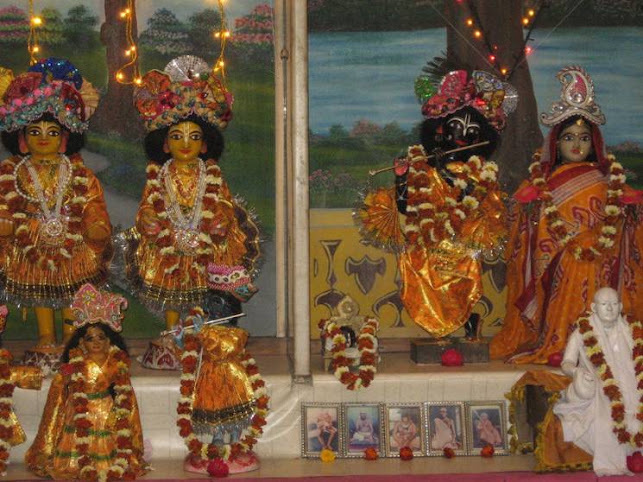
Vrindavana Dasa appears to have settled permanently at Mamgachi. There he installed Deities of Nitai-Gauranga and lived, by most accounts, as a celibate devotee absorbed in their daily worship. Those Deities are still maintained and worshiped at Mamgachi today, together with Deities of Sri Sri Radha-Krishna that Srila Bhaktisiddhanta Sarasvati Thakura installed later. Bhaktisiddhanta Sarasvati Thakura also had a Deity form of Vrindavana Dasa himself installed at the same place. This shows how important Mamgachi remained for Gaudiya Vaishnavas in remembering Vrindavana Dasa, long after his own lifetime. A separate tradition also says that Vrindavana Dasa had disciples. Among them was Gopinatha Brahmacari, a descendant of Kesava Bharati. But little else is recorded about this branch of his legacy.
The Journey to Kheturi #
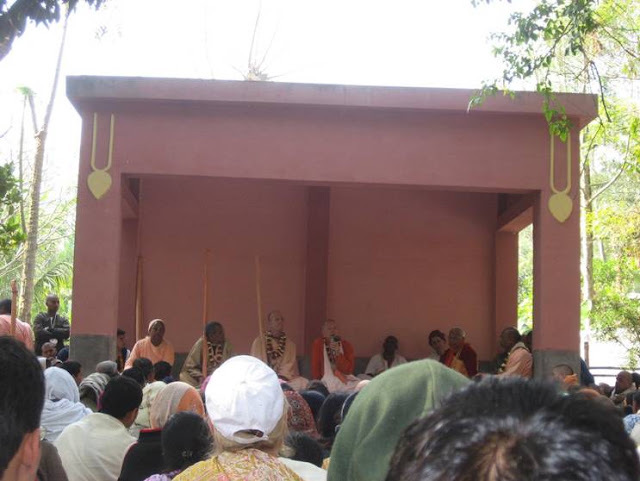
One specific episode is reported fairly consistently across the sources. Vrindavana Dasa traveled to the historic Gaura-Purnima festival at Kheturi-grama in the company of Jahnava Devi, Nityananda Prabhu's consort. This gathering is remembered as the first great Gaura-Purnima Mahotsava. It was a landmark event for the whole Gaudiya Vaishnava community. It helped to bring together devotees from across Bengal, a generation after Mahaprabhu's own disappearance. Narottama Dasa Thakura is remembered as one of its chief organizers. Vrindavana Dasa attended it at Jahnava Devi's side, and this fits naturally with everything else known about his life. From his own initiation onward, his closest ties were with Nityananda Prabhu's own family and followers.
A Disputed Date #
Vrindavana Dasa's disappearance day is observed on Krishna Dashami of the month of Vaishakh. But Gaudiya Vaishnava sources themselves admit that the exact year is not settled. The date most commonly given is 1511 in the Shaka era, which corresponds to about 1589 CE. This figure fits a birth around 1507 and a long life of some eight decades. But later writers have continued to treat it as an approximate date, not a fixed and certain one. That common view is followed here. But, as the sources themselves say, it remains a best estimate, not a recorded fact.
Samadhi and Remembrance #
Vrindavana Dasa's samadhi, or memorial tomb, stands today in the 64 Samadhis area of Vrindavana. It is among the resting places of many of the Gaudiya Vaishnava tradition's great devotees, and visitors to the dhama still come to it as a place of pilgrimage. Still, his lasting legacy lies more in the book he left behind than in that memorial. Nearly five centuries later, Sri Chaitanya-Bhagavata remains the single fullest record of Sri Chaitanya Mahaprabhu's Navadvipa childhood and youth. The tradition sees this as proof that Vrindavana Dasa's guru chose the right disciple to carry that part of the story forward.
- Vrindavana Dasa Thakura - Biography (Gaudiya History)
- Srila Vrindavana Dasa Thakura - Biography, Caitanya Bhagavata & Nityananda's Mercy (Hare Krishna Mandir)
- Srila Vrindavana Dasa Thakura (Vrindavan Chandrodaya Mandir)
- Vrndavan dasa Thakura (Stephen Knapp)
- Sri Chaitanya-charitamrita, Antya-lila 20.82 (Bhaktivedanta VedaBase)
- Sri Chaitanya-charitamrita, Adi-lila 8.33-40 (Bhaktivedanta VedaBase)
