Little is known about how Vrindavana Dasa Thakura spent his years after finishing Sri Chaitanya-Bhagavata, and we do not pretend otherwise. What we can say comes mostly from a few details that agree with each other, not from a connected story.
A Settled Life at Mamgachi #
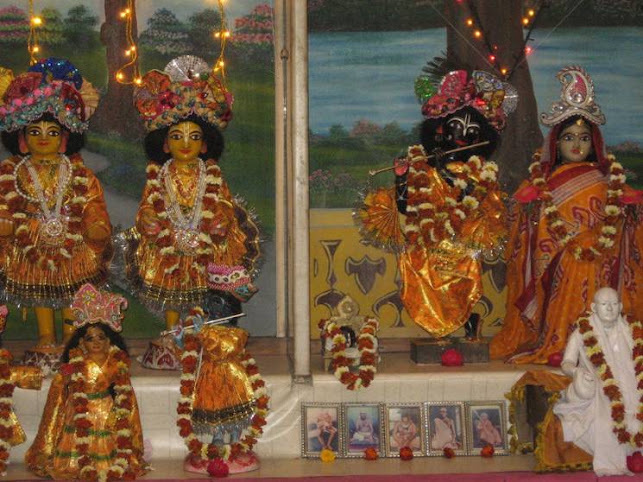
Vrindavana Dasa appears to have settled permanently at Mamgachi. There he installed Deities of Nitai-Gauranga and lived, by most accounts, as a celibate devotee absorbed in their daily worship. Those Deities are still maintained and worshiped at Mamgachi today, together with Deities of Sri Sri Radha-Krishna that Srila Bhaktisiddhanta Sarasvati Thakura installed later. Bhaktisiddhanta Sarasvati Thakura also had a Deity form of Vrindavana Dasa himself installed at the same place. This shows how important Mamgachi remained for Gaudiya Vaishnavas in remembering Vrindavana Dasa, long after his own lifetime. A separate tradition also says that Vrindavana Dasa had disciples. Among them was Gopinatha Brahmacari, a descendant of Kesava Bharati. But little else is recorded about this branch of his legacy.
The Journey to Kheturi #
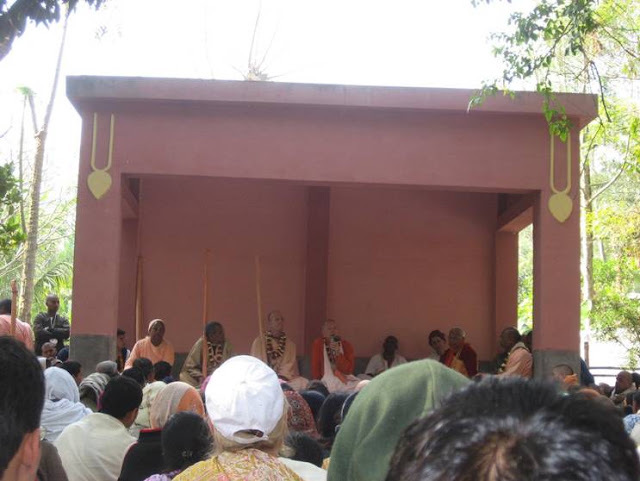
One specific episode is reported fairly consistently across the sources. Vrindavana Dasa traveled to the historic Gaura-Purnima festival at Kheturi-grama in the company of Jahnava Devi, Nityananda Prabhu's consort. This gathering is remembered as the first great Gaura-Purnima Mahotsava. It was a landmark event for the whole Gaudiya Vaishnava community. It helped to bring together devotees from across Bengal, a generation after Mahaprabhu's own disappearance. Narottama Dasa Thakura is remembered as one of its chief organizers. Vrindavana Dasa attended it at Jahnava Devi's side, and this fits naturally with everything else known about his life. From his own initiation onward, his closest ties were with Nityananda Prabhu's own family and followers.
A Disputed Date #
Vrindavana Dasa's disappearance day is observed on Krishna Dashami of the month of Vaishakh. But Gaudiya Vaishnava sources themselves admit that the exact year is not settled. The date most commonly given is 1511 in the Shaka era, which corresponds to about 1589 CE. This figure fits a birth around 1507 and a long life of some eight decades. But later writers have continued to treat it as an approximate date, not a fixed and certain one. That common view is followed here. But, as the sources themselves say, it remains a best estimate, not a recorded fact.
Samadhi and Remembrance #
Vrindavana Dasa's samadhi, or memorial tomb, stands today in the 64 Samadhis area of Vrindavana. It is among the resting places of many of the Gaudiya Vaishnava tradition's great devotees, and visitors to the dhama still come to it as a place of pilgrimage. Still, his lasting legacy lies more in the book he left behind than in that memorial. Nearly five centuries later, Sri Chaitanya-Bhagavata remains the single fullest record of Sri Chaitanya Mahaprabhu's Navadvipa childhood and youth. The tradition sees this as proof that Vrindavana Dasa's guru chose the right disciple to carry that part of the story forward.
