Sri Vyasa Tirtha
Royal Preceptor of the Vijayanagara Empire
The complete life, on one page: The main biography and every pastime page, in order, in one place
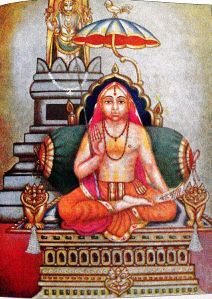
Introduction
Sri Vyasa Tirtha was one of the most important religious and intellectual figures of sixteenth-century South India. He served as rajaguru, the royal guru, to the Vijayanagara Empire at the height of its power under Krishnadevaraya. He headed the matha that came to bear his own name, the Vyasaraja Matha. He wrote major Dvaita Vedanta philosophical works still studied today. And he is the teacher most directly credited with bringing the great Kannada devotional-song saints of the Haridasa movement into the main religious life of the Madhva-sampradaya.
| Detail | Description |
|---|---|
| Birth name | Yatiraja |
| Born | Traditionally 1447 CE (Wikipedia); some sources place it nearer 1460 |
| Birthplace | Bannur (Bannuru), Mysore district, Karnataka |
| Identity | Regarded in the Madhva tradition as an amsha (partial manifestation) of Prahlada Maharaja |
| Guru (ordination) | Brahmanya Tirtha, pontiff of the matha at Abbur |
| Deeper Dvaita training under | Sripadaraja, at Mulbagal, for about twelve years |
| Chief disciples | Purandara Dasa, Kanaka Dasa, Vijayendra Tirtha, Vadiraja Tirtha, Srinivasa Tirtha (successor) |
| Died | 8 March 1539, at Vijayanagara, roughly ninety years old |
| Samadhi | Nava Brindavana, an island in the Tungabhadra river near Anegundi, close to Hampi |
His life is well recorded in independent sources, both from the Dvaita tradition and from scholars, so it can be told here in real detail, without guesswork. His place in the Gaudiya guru-parampara list is a separate claim, and the evidence for it is much thinner. This is explained honestly in the final section below.
Chapter 1
Life and Rise to Royal Preceptor
From a village boy promised to a guru before his own birth to the most trusted spiritual adviser at the height of the Vijayanagara Empire.
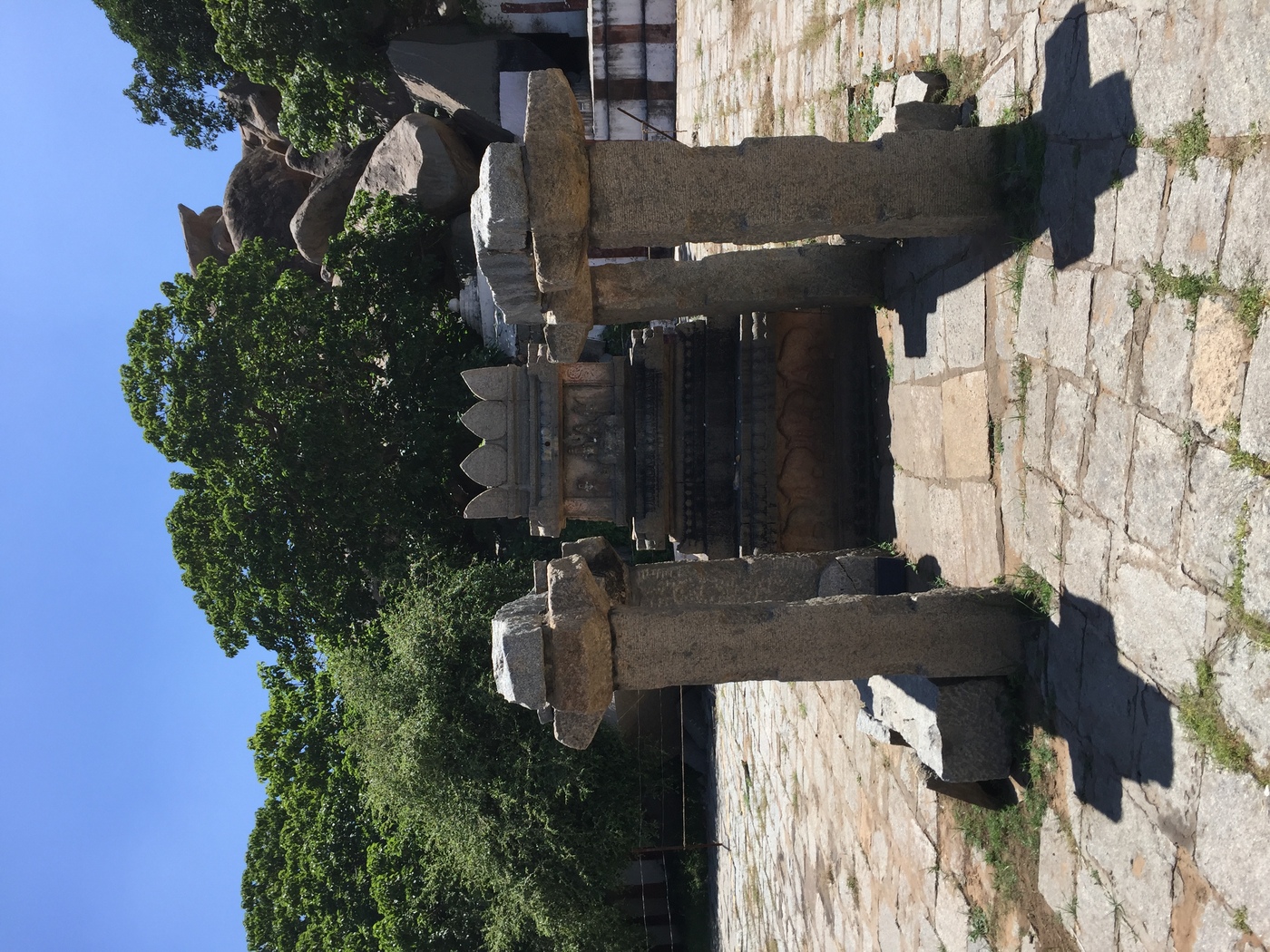
Sri Vyasa Tirtha began life in a small Karnataka village as an infant already promised away to a guru. He rose to become the most trusted spiritual adviser of the greatest Vijayanagara emperor. Both Dvaita-tradition sources and modern academic sources record his rise in enough independent detail that it can be told without inventing anything.
A Promised Son Becomes a Sannyasi #
According to Dvaita-tradition biographical sources, the boy who would become Vyasa Tirtha was born at Bannur, near Mysore, and given the name Yatiraja. His father is remembered by name in some sources as Ballanna. Tradition holds that, even before the child's birth, the family had promised their second son to Brahmanya Tirtha, the pontiff of a Madhva matha at Abbur. Brahmanya Tirtha took the boy in after his upanayana, the sacred-thread ceremony that marks the start of formal Vedic education. In time Brahmanya Tirtha gave him sannyasa, the vow of renunciation, and the name by which he has been remembered ever since: Vyasa Tirtha. Some accounts add a moment of real doubt to this early relationship. They describe the young initiate running into the forest, unsure of what his guru intended for him, until a vision persuaded him to return and accept formal initiation. Whatever the exact truth of that detail, independent sources agree without any dispute that Brahmanya Tirtha gave him diksha. Reports from within the Dvaita tradition itself, gathered on gaudiyahistory.iskcondesiretree.com, separately confirm that Vyasa Tirtha took diksha, initiation, directly from Brahmanya Tirtha. In this whole six-person guru chain, this is the only point where the Gaudiya parampara list's claim about the guru and the independent Dvaita-tradition record actually agree.
Twelve Years Under Sripadaraja at Mulbagal #
Brahmanya Tirtha died during a regional famine, around 1475-1476. Vyasa Tirtha succeeded him as pontiff of the Abbur matha around 1478, while still in his late teens. Several sources openly say that at that point the young pontiff was not yet deeply trained in Madhvacharya's own Dvaita philosophy. Being made pontiff did not make him a scholar, and Vyasa Tirtha's education still had further to go. He spent time at Kanchipuram studying the six orthodox schools (shad-darshana) of Vedic philosophy in general. Then he studied for roughly twelve years under a separate teacher, Sripadaraja, at Mulbagal. There he received the thorough training in Madhva Vedanta that made his later works possible. Sripadaraja headed a different but related matha in the same broad Madhva world, which traced its own line back to Padmanabha Tirtha. Some sources describe Sripadaraja as a cousin of Brahmanya Tirtha. If this is true, it would mean that the two teachers who shaped Vyasa Tirtha were themselves relatives. Sripadaraja is also remembered as one of the earliest organizers of the Haridasa devotional movement, a connection taken up again on The Haridasa Connection.
Thirty Days That Won Him the Court #
Vyasa Tirtha entered public religious life through debate, not politics. Tradition records that he defeated a scholar named Basava Bhatta of Kalinga, along with other learned brahmanas, in a long public debate held at the Vijayanagara royal court. Some accounts say it lasted thirty days. Whatever the exact circumstances, the result was real and lasting. Vyasa Tirtha became known as a debater of the highest rank, and he was drawn steadily closer to the religious and political life of the Vijayanagara court. Before he settled at Vijayanagara for good, he headed the administration of the great Venkateshwara temple at Tirupati for roughly a decade, from about 1486 to 1498. Then, at the invitation of the king and his ministers, he moved to Vijayanagara itself. He spent the rest of his long life there.
Rajaguru to Six Kings #
Vyasa Tirtha went on to serve as spiritual adviser to a whole line of Vijayanagara rulers. The first was Saluva Narasimha, who first drew him toward the capital. After Saluva Narasimha's death, Vyasa Tirtha stayed on at the court of his son, Narasimha Raya II. Next came Narasa Nayaka and his son Vira Narasimha. Then came Krishnadevaraya, the most important of them all. Under his long reign Vijayanagara reached the height of its territory, its wealth, and its support for culture. Last came Achyutaraya, who succeeded Krishnadevaraya. Sources describe Krishnadevaraya's regard for his guru as going deeper than the ordinary support a king gives. Some accounts hold that, in his personal devotion if not in formal theology, the emperor considered Vyasa Tirtha his kuladevata, his family's own chosen deity. Krishnadevaraya granted Vyasa Tirtha villages, including one called Bettakonda. There Vyasa Tirtha built irrigation works and a lake still remembered by the name Vyasa-samudra. He is also said to have received a ratnabhisheka, a ceremonial bathing in a shower of jewels. This was a mark of royal honor given to very few.
The Guru Who Took the Throne #
The most famous story connecting Vyasa Tirtha to Krishnadevaraya is also the hardest to be sure about. So it is told here with its uncertainties, not smoothed into false certainty. According to the legend, court astrologers warned Krishnadevaraya of a coming astrological danger, sometimes described as a kuhu-yoga, that threatened the king's life or reign. To protect the king from it, Vyasa Tirtha is said to have sat on the Vijayanagara throne himself for a period. In this way he took the danger on himself in the king's place, and he gave the crown back once the threat had passed. Sources disagree sharply on how long this actually lasted. Wikipedia's summary states simply that he "is considered to have taken over the throne of Vijayanagara for two years on behalf of the king," but a more detailed devotional account tells it differently. It gives one exact date, 3 January 1521, and says the whole episode lasted only a day. In that account, Vyasa Tirtha removed the danger by throwing his own cloth onto a mysterious spark that appeared on the throne. It is not possible to say which version, if either, is closer to the original tradition. Both sources present their version as historical fact, not as an admitted legend. What no one disputes is the relationship the story is meant to show. The king trusted Vyasa Tirtha's spiritual protection so deeply that some version of this story has survived for five centuries. During these same years at court, Vyasa Tirtha also wrote the works for which later Dvaita scholars remember him most. They are covered in full on Philosophical Works and Teachings.
Scriptural evidence for this chapter (1)
"...Brahmana Purushottama, according to some, is another name for Brahmanya Tirtha, the disciple of Jayadharma, who Vyasa Tirtha took 'diksha' from."
A direct statement, from a source written inside the Gaudiya tradition, that Vyasa Tirtha received diksha (initiation) from Brahmanya Tirtha - independently matching the guru-disciple link already recorded here and the mainstream Dvaita-tradition record (Wikipedia, New World Encyclopedia, the official Vyasaraja Matha website) that Brahmanya Tirtha ordained Vyasa Tirtha and was his immediate matha predecessor.
Chapter 2
Philosophical Works and Teachings
Three strong Sanskrit works of debate, a technical argument about reasoning on things that do not exist, and a devotional teaching he did not invent but carried into song.
Vyasa Tirtha's standing in the history of Indian philosophy does not rest on his royal connections at all. It rests on a small set of dense, forceful Sanskrit works that later Dvaita scholars still study today, and that drew serious responses from rival schools of Vedanta for generations after his death.
The Vyasa-Traya: Three Pillars of Argument #
Three works, taken together, are traditionally called the Vyasa-traya, "Vyasa's three": the Nyayamrita ("Nectar of Logic"), the Tarka-tandava ("The Dance of Logic"), and the Tatparya-chandrika ("Moonlight of the True Purport"). Each takes on a different philosophical target. The Nyayamrita is Vyasa Tirtha's long, detailed argument against Advaita Vedanta. In four sections it works through these topics: Advaita's teaching that the world is ultimately illusory or false (mithyatva); the nature and reliability of the means of valid knowledge (pramana); what real knowledge (jnana) of Brahman actually is; and the Advaita idea of liberation while still in the body (jivanmukti). The Tarka-tandava turns instead to the separate Nyaya-Vaisheshika school of logic. It deals directly and critically with that school's major thinkers, including Gangesha Upadhyaya's influential Tattva-chintamani. The Tatparya-chandrika is different again. It is a long commentary on Jayatirtha's own Tattva-prakashika, which is itself a commentary on Madhvacharya's Brahma-sutra-bhashya. Step by step, it compares Shankara's, Ramanuja's, and Madhva's readings of the Brahma-sutras. It argues that Madhva's reading is the one that truly agrees with the earlier scriptures. Vyasa Tirtha did not live to finish the Tatparya-chandrika. His own text covers only the first two chapters of the Brahma-sutras. The rest was completed centuries later by a later Dvaita scholar, Raghunatha Tirtha.
Nyayamrita and the Long Advaita Debate It Started #
Of the three, the Nyayamrita had by far the greatest influence outside the Madhva sampradaya itself. It was weighty and sharp enough to draw a direct, book-length reply from one of Advaita Vedanta's own most respected later scholars, Madhusudana Saraswati. Madhusudana Saraswati's Advaitasiddhi is still read today as the classical Advaita answer to Vyasa Tirtha's arguments. The exchange did not stop there. Later Dvaita writers wrote their own responses, defending the Nyayamrita's positions against Madhusudana Saraswati's counter-arguments. One of them, Vyasa Ramacharya, did this in a work called Nyayamrita-tarangini. The debate went on drawing scholarly attention on both sides for well over a century. Modern historians of Indian philosophy count this exchange among the true high points of debate between different schools of philosophy in the early modern period. They compare it in seriousness to famous debates within the Nyaya or Mimamsa traditions.
Reasoning About What Does Not Exist #
The Tarka-tandava contains what modern scholars more and more treat as Vyasa Tirtha's single most original technical contribution. In it, Vyasa Tirtha engaged with Navya-Nyaya, the "new logic" school built on Gangesha's work, and took up a truly difficult problem. How can a system of formal reasoning talk meaningfully about things that do not exist at all, such as "the son of a barren woman" or "a mountain of gold," and other empty terms like these? Centuries later, in an entirely separate tradition, twentieth-century Western logicians such as Bertrand Russell and Alexius Meinong were also occupied with this kind of empty term. Standard Navya-Nyaya logic had generally kept such non-existent things out of valid inference altogether. Vyasa Tirtha argued instead that non-existent things can still meaningfully have certain qualities, especially negative properties such as their own non-existence. He proposed a technical solution built around what he called substrate-free qualities, anashrita-vishesana in Sanskrit. These are qualities that do not need any actually existing thing as their base. A detailed academic study of this argument was published in the Journal of Indian Philosophy in 2020. It concludes that Vyasa Tirtha was the first Madhva scholar to work so seriously and so technically with Navya-Nyaya's own logical tools. He did real philosophical work with them, not simply borrowing their words.
Two More Works, and a Word Sometimes Misapplied to Him #
Beyond the Vyasa-traya, Vyasa Tirtha is credited with a work called Mandara-manjari. It is a set of explanatory notes on several of Madhvacharya's own short works refuting other views (the Dasha-prakaranas), and on one of Jayatirtha's works. Its aim is to explain passages that later readers found hard to understand. Vyasa Tirtha's final work, Bhedojjivana ("Reviving Difference"), is a focused restatement and defense of Dvaita's basic teaching that the difference between God, soul, and matter is real and eternal. One teaching is sometimes credited to Vyasa Tirtha personally without enough care, so it needs a careful word here. This is the idea of Hari as bimba, the original, and the individual soul as pratibimba, its dependent reflection. It is sometimes called bimbopasana or bimba-pratibimba-vada, "worship of the original through its reflection." Vyasa Tirtha did not originate this teaching. It goes back to Madhvacharya's own basic instruction. For exactly this reason, Dvaita Vedanta is even sometimes called Bimba-pratibimba-vada, as one of its traditional alternate names. What can fairly be said about Vyasa Tirtha's own role is narrower, but in its own way it is still important. This devotional theme teaches that God is the true bimba, and that a soul should worship Him through its own dependent reflection of Him. Vyasa Tirtha was the teacher most responsible for carrying this theme out of Sanskrit philosophical literature and into the Kannada devotional songs of the Haridasa movement. There it became one of that movement's central, recurring themes. How this teaching was passed on, above all through Purandara Dasa and Kanaka Dasa, is the subject of The Haridasa Connection.
Chapter 3
The Haridasa Connection
Guru, patron, and organizer to the Kannada devotional-song saints who carried Dvaita Vedanta out of Sanskrit and into ordinary life.
Vyasa Tirtha's name cannot be separated from the Haridasa movement. This was the wave of Kannada-language devotional singer-saints who did more than any Sanskrit commentary to carry Dvaita Vedanta's teachings to ordinary people. But we need to state carefully how exactly he was connected to the movement's two most famous figures, Purandara Dasa and Kanaka Dasa. It should not simply be assumed.
What the Haridasa Movement Actually Is #
The Haridasas, literally "servants of Hari," were wandering devotee-singers. They composed and performed devotional songs, called kirtanas and suladis, in Kannada, not in Sanskrit. Their songs were built around Vishnu-Krishna devotion and rooted in Madhva Dvaita theology. Their main, recurring theme, worked out across a huge body of surviving songs, was the relationship between Hari and the soul. Hari is the bimba, the original reality, and the individual soul is the pratibimba, a dependent reflection of Him. In this way the songs gave a devotional expression of Madhvacharya's own philosophical teaching. The philosophical side of this teaching is discussed on Philosophical Works and Teachings. The movement began before Vyasa Tirtha's own lifetime and continued after it. But many historians see the period of his influence at the Vijayanagara court as close to its golden age.
Founding the Dasakuta #
Vyasa Tirtha is credited with organizing the Dasakuta, literally the "community of servants" or "community of dasas," a forum for the wandering Haridasa singers. It gathered them together and drew them into closer, more organized contact with the Madhva sampradaya's own religious institutions. In this way they were not left as scattered, informal folk performers on the edges of the movement. By most accounts, Vyasa Tirtha did this very deliberately, as a way of building an institution. He used his high standing at the Vijayanagara court to give the Haridasa movement support, structure, and closer ties to Dvaita's own scholars.
Purandara Dasa, the Merchant Who Became a Bard #
Purandara Dasa is by far the best-documented of Vyasa Tirtha's disciples in the Haridasa movement. Today he is remembered, alongside Kanaka Dasa, as one of the founding figures of what later developed into Carnatic classical music. Before his renunciation, Purandara Dasa was a wealthy merchant. Tradition says that a personal crisis, and his turn toward Krishna devotion after it, changed him into a wandering singer-devotee. Sources describe him becoming Vyasa Tirtha's disciple in that new life. Vyasa Tirtha is recorded as glorifying Purandara Dasa directly in one of his own compositions. Later Haridasa tradition links the two men's names so closely that some sources count Purandara Dasa among Vyasa Tirtha's direct students in a quite literal, personal sense. In their view, Vyasa Tirtha taught him, encouraged him, and drew him into the same Dasakuta institution he had organized.
Kanaka Dasa and a Deliberate Break With Caste #
Kanaka Dasa's connection to Vyasa Tirtha is recorded just as consistently across the sources, and it carries an added, special meaning. Kanaka Dasa came from the Kuruba community. Normally, this non-brahmana background would have put real social distance between him and a brahmana sannyasi pontiff of Vyasa Tirtha's standing. Multiple independent sources describe Vyasa Tirtha accepting Kanaka Dasa as a disciple all the same. This is generally understood as a deliberate decision to bring a Haridasa devotee into the mainstream of Dvaita religious life because of his devotion, not his birth. Several independent sources describe this readiness to look past caste when accepting disciples as a real and lasting mark of Vyasa Tirtha's own leadership of the movement. It was not simply a devotional touch added later.
Three Saints, and a Different Trinity #
Later tradition uses two groupings for this same circle of figures. They overlap, but they are truly different, and it is easy to mix them up, so they should be told apart clearly. Sripadaraja, Vyasa Tirtha, and Vadiraja Tirtha came from three successive generations of teachers in the same broad world of Dvaita institutions. Together they are called the yati-trayaru, the "three saints," within Haridasa-movement tradition specifically. A separate title, the "great trinity of Vaishnava composers" from Karnataka, is given instead to Sripadaraja, Purandara Dasa, and Kanaka Dasa. This grouping is based on devotional composition itself, not on succession as heads of mathas. Vyasa Tirtha appears in the first group but not the second. This is exactly because his most lasting contribution to the Haridasa movement was as its organizer and patron, not as one of its most prolific composers. Still, he did compose kirtanas of his own, under the pen name (ankita) "Krishna," and some of them are still performed today, such as Krishna Nee Begane and Krishna Krishna Endu. Purandara Dasa and Kanaka Dasa, by contrast, are remembered above all for the huge number and lasting popularity of their own songs. So Vyasa Tirtha's role sits at the meeting point of both groupings, without fully belonging to either. He was teacher and patron to some of the movement's greatest composers, and he was also a real composer himself.
Chapter 4
Legacy in Dvaita Vedanta
A matha named after him that is still active, a temple he consecrated at Hampi that still stands, and a separate claim, with much less evidence behind it, that places him in the Gaudiya guru-parampara.
Vyasa Tirtha's death in 1539 did not end his influence. His influence went on in two quite different ways. One is a Dvaita matha named after him, which still functions today. The other is a claim, much weaker and harder to check, that places him inside the Gaudiya Vaishnava guru-parampara list.
Seven Hundred Thirty-Two Hanumans #
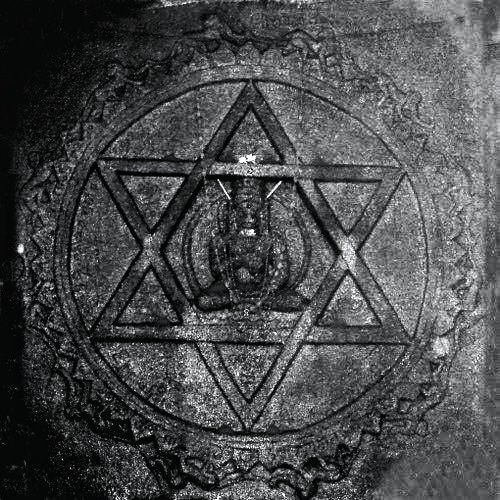
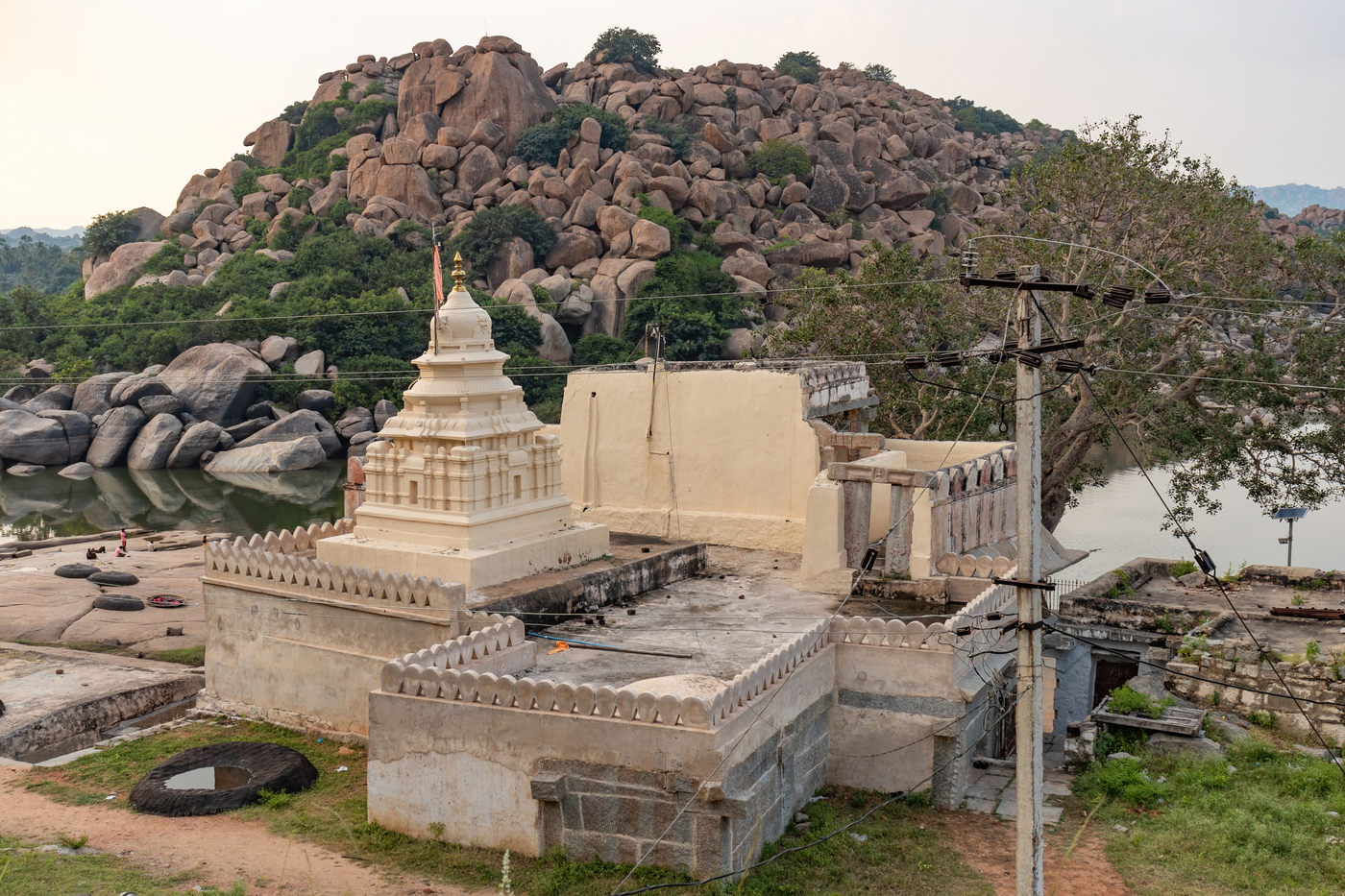
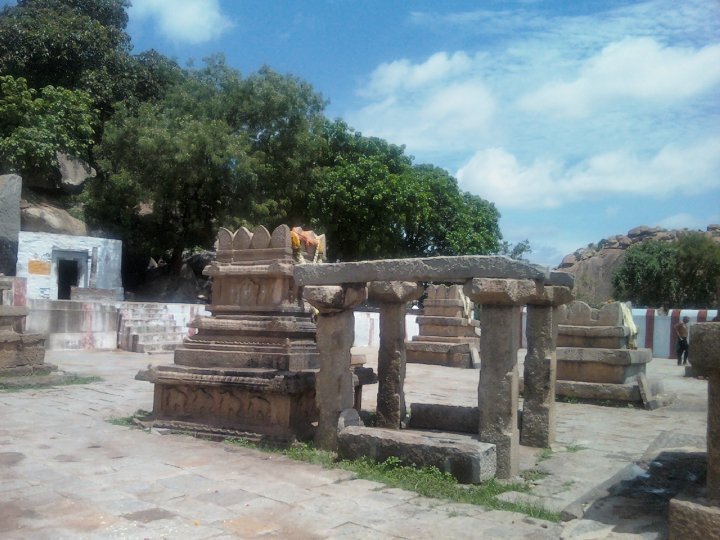
One of Vyasa Tirtha's most visible and lasting legacies is temple building on a truly large scale. Tradition credits him with installing 732 images of Hanuman across the lands of the Vijayanagara Empire. (Hanuman is also called Vayu, since in Madhva theology Hanuman is understood as an incarnation of Vayu, the wind-god.) The best-known of these that survives still stands today at Hampi itself. It is the Yantrodharaka Hanuman temple, on the bank of the Tungabhadra river near the Hampi bazaar. There Hanuman is shown seated within a hexagonal yantra, a geometric ritual diagram. The image is said to have been personally consecrated by Vyasa Tirtha. The temple and the image both survive and remain active pilgrimage sites in present-day Hampi.
Srinivasa Tirtha and the Matha That Took His Name #
Vyasa Tirtha's own line of pontiffs goes back, through his guru Brahmanya Tirtha and several earlier pontiffs, to a matha founded generations earlier by Rajendra Tirtha. At that time the matha was known as Poorvadi Matha. After Vyasa Tirtha's long and famous time as its head, the matha was renamed in his honor. It has been known ever since as Vyasaraja Matha, and it is still active today, with branches including one at Sosale. Before his death, Vyasa Tirtha gave sannyasa to a disciple named Srinivasa Tirtha and made him his successor as head of the matha. The matha's own records trace this unbroken line of pontiffs down to the present day.
Vijayendra Tirtha and Vadiraja Tirtha #
Two further disciples carried Vyasa Tirtha's specific philosophical arguments forward for another century or more. Vijayendra Tirtha wrote a commentary on the Nyayamrita called Laghu-amoda. He also wrote a separate work called Upasamhara-vijaya. In it he defended one of the Tarka-tandava's more controversial claims against criticism from the Advaita scholar Appayya Dikshita. This claim was that the concluding statements of the Brahma-sutras take priority over their opening ones. Vadiraja Tirtha is credited with actively spreading Dvaita teaching into the Chola country and the Malnad hill region of Karnataka. In this way he carried Vyasa Tirtha's own work of building institutions well beyond the immediate circle of the Vijayanagara court.
Final Days at Hampi #
Vyasa Tirtha died at Vijayanagara on 8 March 1539. By most accounts he was then in his eighties. He had spent his final decades as the empire's most trusted spiritual adviser, through the reigns of both Krishnadevaraya and Achyutaraya. His samadhi is kept at Nava Brindavana, an island in the Tungabhadra river close to Anegundi, near Hampi. Tradition understands this place as his continuing presence, not simply as a grave. The samadhis of eight other Madhva-tradition saints are there beside it. The site remains an active place of pilgrimage and annual observance (aradhana) to this day. In 2019 the shrine was damaged by vandals, and according to local reports devotees repaired it within a day.
A Claimed Place in the Gaudiya Parampara #
The traditional Gaudiya Vaishnava guru-parampara list places Vyasa Tirtha as the guru of Lakshmipati Tirtha. Lakshmipati Tirtha is in turn remembered as the guru of Srila Madhavendra Puri. Madhavendra Puri's own page describes him as the acharya who is the seed from which the whole Gaudiya bhakti tradition grew. Life in the Madhva Sampradaya already explains that serious historians doubt that the Madhva sampradaya's own surviving records actually preserve this exact chain of names. In Vyasa Tirtha's own case, there are real, specific details that add to that caution, and they point in both directions.
On one side, one point is truly confirmed. Independent Dvaita-tradition sources, which do not depend on the Gaudiya tradition at all, agree that Vyasa Tirtha's own guru was Brahmanya Tirtha. Srila Prabhupada's own purport to Sri Chaitanya-charitamrita, Madhya 9.245, quotes a succession list taken from the South Kanada Manual and the Bombay Gazette. That list independently names this same sequence:
"After the sixteenth acharya (Vidyadhiraja Tirtha), there was another disciplic succession, including Rajendra Tirtha... Vijayadhvaja; Purushottama; Subrahmanya; and Vyasa Raya."
This chain matches the six-person guru chain covered here, name for name and in the same order. "Subrahmanya" is generally understood as another form of Brahmanya Tirtha's own name.
On the other side, the claim that Vyasa Tirtha's own disciple was Lakshmipati Tirtha has much less evidence behind it. It traces back specifically to Kavi Karnapura's Gaura-ganoddesha-dipika, a Gaudiya-tradition text. A modern Gaudiya history website sums up the claim this way:
"According to Kavikarnapur in his Gauraganoddesha Dipika, Shripad Vyasa Tirtha wrote the famous book, 'Shri Vishnu Samhita,' and had a disciple by the name Laxmipati Tirtha who was originally from North India."
No independent Dvaita-tradition source includes either a work called Vishnu Samhita or a disciple named Lakshmipati Tirtha. Neither appears in the well-recorded list of his chief disciples (Purandara Dasa, Kanaka Dasa, Vijayendra Tirtha, Vadiraja Tirtha, and his actual matha successor Srinivasa Tirtha). Neither appears in the list of his own philosophical works. There is also a real, specific problem with the dates. Whatever birth year is estimated for him, Vyasa Tirtha died in 1539, five years after Sri Chaitanya Mahaprabhu's own disappearance in 1534. Consider what the Gaudiya parampara list's chain needs in order to hold together as described. Lakshmipati Tirtha would need to have become Vyasa Tirtha's disciple, and then to have trained Madhavendra Puri himself. After that, Madhavendra Puri would in turn need to have trained Isvara Puri, Sri Chaitanya Mahaprabhu's own diksha-guru. That is a full three generations of teachers. All of it would need to be substantially complete before Vyasa Tirtha, the person supposedly standing at the top of that chain, had even died. Independent researchers into Gaudiya history who have examined this question closely have noted the same difficulty. They have also pointed out that no Bengali or Orissan Vaishnava biography, and no known record from Vijayanagara itself, mentions any connection at all between Vyasa Tirtha and the Chaitanya movement. Yet Vyasa Tirtha was a figure of real and lasting fame in his own lifetime, and the Chaitanya movement was developing in the neighboring Orissan kingdom during those same decades.
None of this affects Vyasa Tirtha's own place in history as rajaguru, philosopher, and patron of the Haridasa movement. That place is secure on independent evidence, and it does not depend in any way on the Gaudiya parampara claim being accurate. What it does mean is this. Like several of the other links in this same six-person chain, this specific link in the traditional list is best understood as a devotional claim about the line of gurus, sincerely held within the Gaudiya tradition. It is not a historically documented fact confirmed independently from the Dvaita side.
Scriptural evidence for this chapter (3)
Quoted in the text above:
- Cited passage on Vyasa Tirtha and Lakshmipati Tirtha Gaura-ganoddesha-dipika (Kavikarnapura), via Gaudiya History
Further verses:
From the purport: Purport excerpt: "After the sixteenth acharya (Vidyadhiraja Tirtha), there was another disciplic succession, including Rajendra Tirtha... Vijayadhvaja; Purushottama; Subrahmanya; and Vyasa Raya."
This branch of the succession list Srila Prabhupada quotes from the South Kanada Manual and the Bombay Gazette independently names, in order, five of the six names covered in this research pass (Rajendra Tirtha, Vijayadhvaja/Jayadharma, Purushottama, Subrahmanya/Brahmanya, Vyasa Raya), matching the guru-chain already recorded for those links. The same purport does not, in this branch, extend the list to name Lakshmipati Tirtha as Vyasa Tirtha's own disciple; that specific claim traces instead to Kavikarnapura's Gaura-ganoddesha-dipika, examined in the note above.
एवं परम्पराप्राप्तमिमं राजर्षयो विदुः ।
स कालेनेह महता योगे नष्टः परन्तप ॥ २ ॥
evaṁ paramparā-prāptam
imaṁ rājarṣayo viduḥ
sa kāleneha mahatā
yogo naṣṭaḥ paran-tapa
Word for word
evam: thus; paramparā: by disciplic succession; prāptam: received; imam: this science; rāja-ṛṣayaḥ: the saintly kings; viduḥ: understood; saḥ: that knowledge; kālena iha: in course of time in this world; mahatā: great; yogaḥ: the science; naṣṭaḥ: scattered; parantapa: O subduer of enemies.
This supreme science was thus received through the chain of disciplic succession, and the saintly kings understood it in that way. But in course of time the succession was broken, and therefore the science as it is appears to be lost.
Cited for the general principle that a guru-parampara's value lies in an unbroken chain of genuine transmission, exactly the standard applied here in weighing whether the specific Vyasa Tirtha-to-Lakshmipati Tirtha link in the traditional Gaudiya list is adequately evidenced.
- Vyasatirtha - New World Encyclopedia
- Sri Vyasa Tirtha - Sri Vyasaraja Matha (official)
- Vyasa Tirtha - Gaudiya History (ISKCON Desire Tree)
- Michael Thomas Williams, "The Impact of Navya-Nyaya on Madhva Vedanta: Vyasatirtha and the Problem of Empty Terms," Journal of Indian Philosophy 49.2 (2020)
- Vyasaraya, the visionary Madhva scholar, logician, and musician - The South First
- Is the Gaudiya Vaishnava sampradaya connected to the Madhva line? - Jagadananda Das
- Sri Chaitanya-charitamrita, Madhya-lila 9.245, purport
