Vyasa Tirtha's death in 1539 did not end his influence. His influence went on in two quite different ways. One is a Dvaita matha named after him, which still functions today. The other is a claim, much weaker and harder to check, that places him inside the Gaudiya Vaishnava guru-parampara list.
Seven Hundred Thirty-Two Hanumans #
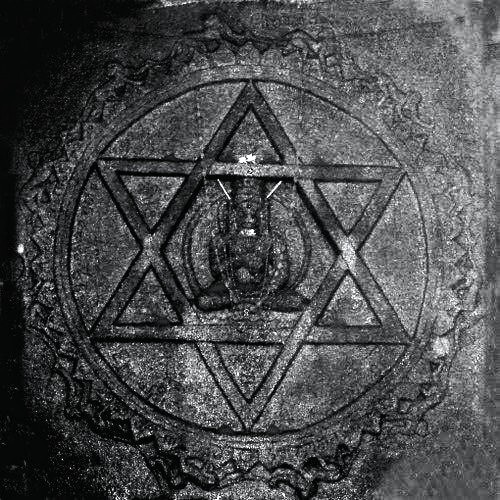
One of Vyasa Tirtha's most visible and lasting legacies is temple building on a truly large scale. Tradition credits him with installing 732 images of Hanuman across the lands of the Vijayanagara Empire. (Hanuman is also called Vayu, since in Madhva theology Hanuman is understood as an incarnation of Vayu, the wind-god.) The best-known of these that survives still stands today at Hampi itself. It is the Yantrodharaka Hanuman temple, on the bank of the Tungabhadra river near the Hampi bazaar. There Hanuman is shown seated within a hexagonal yantra, a geometric ritual diagram. The image is said to have been personally consecrated by Vyasa Tirtha. The temple and the image both survive and remain active pilgrimage sites in present-day Hampi.
Srinivasa Tirtha and the Matha That Took His Name #
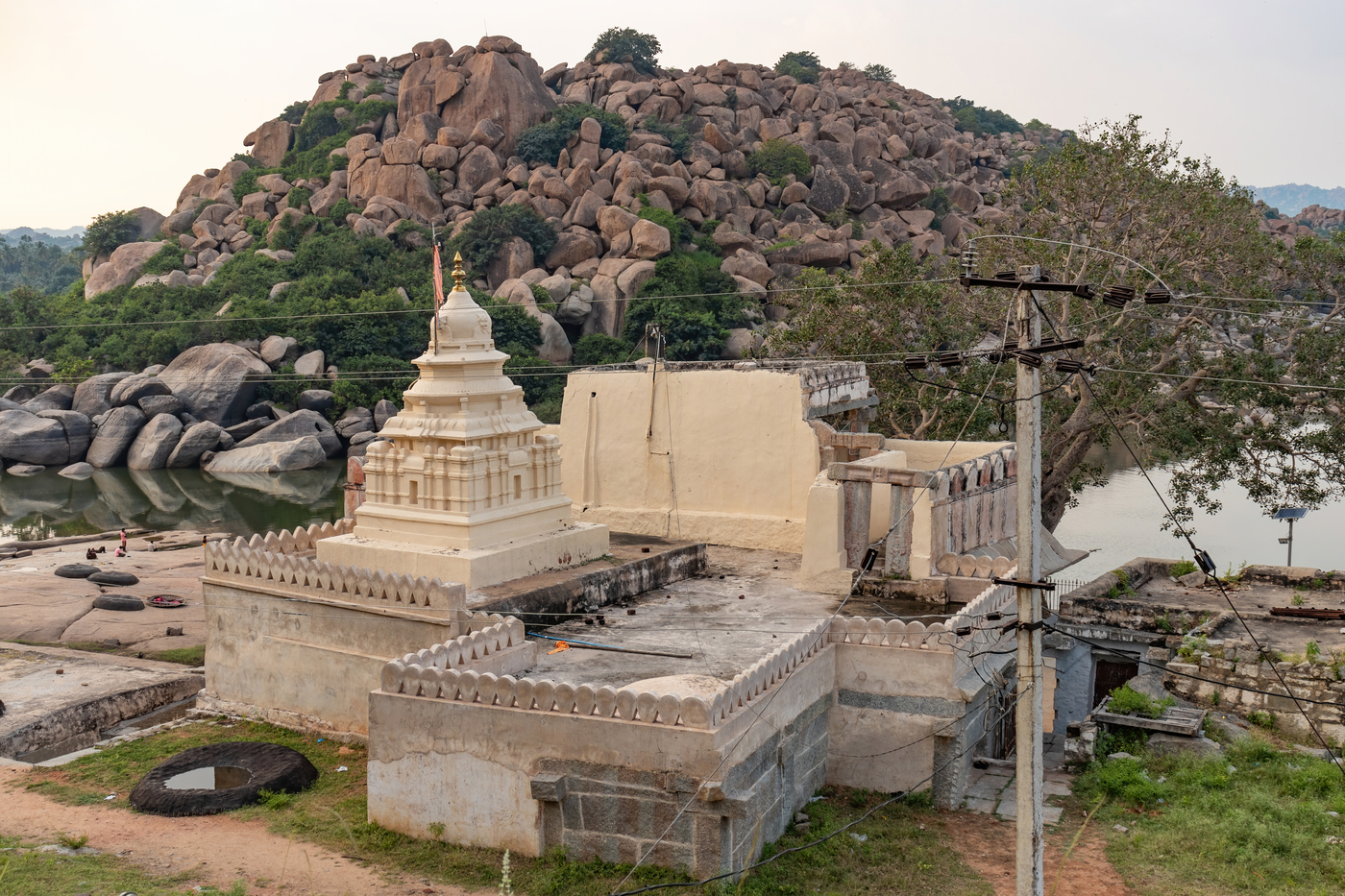
Vyasa Tirtha's own line of pontiffs goes back, through his guru Brahmanya Tirtha and several earlier pontiffs, to a matha founded generations earlier by Rajendra Tirtha. At that time the matha was known as Poorvadi Matha. After Vyasa Tirtha's long and famous time as its head, the matha was renamed in his honor. It has been known ever since as Vyasaraja Matha, and it is still active today, with branches including one at Sosale. Before his death, Vyasa Tirtha gave sannyasa to a disciple named Srinivasa Tirtha and made him his successor as head of the matha. The matha's own records trace this unbroken line of pontiffs down to the present day.
Vijayendra Tirtha and Vadiraja Tirtha #
Two further disciples carried Vyasa Tirtha's specific philosophical arguments forward for another century or more. Vijayendra Tirtha wrote a commentary on the Nyayamrita called Laghu-amoda. He also wrote a separate work called Upasamhara-vijaya. In it he defended one of the Tarka-tandava's more controversial claims against criticism from the Advaita scholar Appayya Dikshita. This claim was that the concluding statements of the Brahma-sutras take priority over their opening ones. Vadiraja Tirtha is credited with actively spreading Dvaita teaching into the Chola country and the Malnad hill region of Karnataka. In this way he carried Vyasa Tirtha's own work of building institutions well beyond the immediate circle of the Vijayanagara court.
Final Days at Hampi #
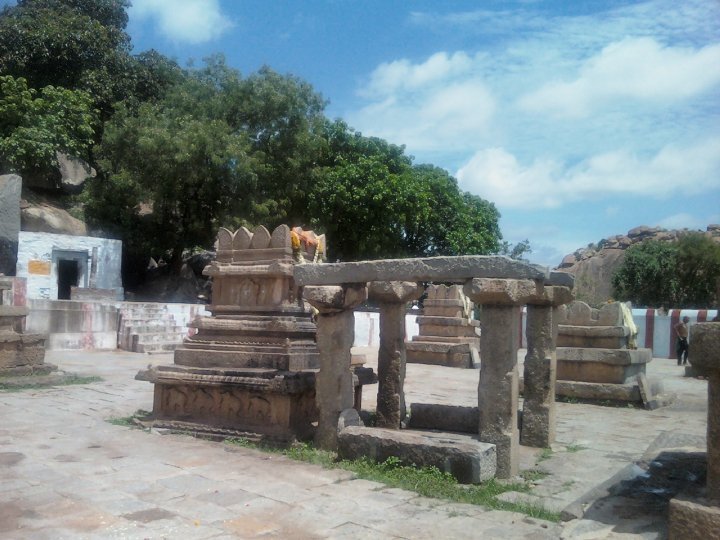
Vyasa Tirtha died at Vijayanagara on 8 March 1539. By most accounts he was then in his eighties. He had spent his final decades as the empire's most trusted spiritual adviser, through the reigns of both Krishnadevaraya and Achyutaraya. His samadhi is kept at Nava Brindavana, an island in the Tungabhadra river close to Anegundi, near Hampi. Tradition understands this place as his continuing presence, not simply as a grave. The samadhis of eight other Madhva-tradition saints are there beside it. The site remains an active place of pilgrimage and annual observance (aradhana) to this day. In 2019 the shrine was damaged by vandals, and according to local reports devotees repaired it within a day.
A Claimed Place in the Gaudiya Parampara #
The traditional Gaudiya Vaishnava guru-parampara list places Vyasa Tirtha as the guru of Lakshmipati Tirtha. Lakshmipati Tirtha is in turn remembered as the guru of Srila Madhavendra Puri. Madhavendra Puri's own page describes him as the acharya who is the seed from which the whole Gaudiya bhakti tradition grew. Life in the Madhva Sampradaya already explains that serious historians doubt that the Madhva sampradaya's own surviving records actually preserve this exact chain of names. In Vyasa Tirtha's own case, there are real, specific details that add to that caution, and they point in both directions.
On one side, one point is truly confirmed. Independent Dvaita-tradition sources, which do not depend on the Gaudiya tradition at all, agree that Vyasa Tirtha's own guru was Brahmanya Tirtha. Srila Prabhupada's own purport to Sri Chaitanya-charitamrita, Madhya 9.245, quotes a succession list taken from the South Kanada Manual and the Bombay Gazette. That list independently names this same sequence:
"After the sixteenth acharya (Vidyadhiraja Tirtha), there was another disciplic succession, including Rajendra Tirtha... Vijayadhvaja; Purushottama; Subrahmanya; and Vyasa Raya."
This chain matches the six-person guru chain covered here, name for name and in the same order. "Subrahmanya" is generally understood as another form of Brahmanya Tirtha's own name.
On the other side, the claim that Vyasa Tirtha's own disciple was Lakshmipati Tirtha has much less evidence behind it. It traces back specifically to Kavi Karnapura's Gaura-ganoddesha-dipika, a Gaudiya-tradition text. A modern Gaudiya history website sums up the claim this way:
"According to Kavikarnapur in his Gauraganoddesha Dipika, Shripad Vyasa Tirtha wrote the famous book, 'Shri Vishnu Samhita,' and had a disciple by the name Laxmipati Tirtha who was originally from North India."
No independent Dvaita-tradition source includes either a work called Vishnu Samhita or a disciple named Lakshmipati Tirtha. Neither appears in the well-recorded list of his chief disciples (Purandara Dasa, Kanaka Dasa, Vijayendra Tirtha, Vadiraja Tirtha, and his actual matha successor Srinivasa Tirtha). Neither appears in the list of his own philosophical works. There is also a real, specific problem with the dates. Whatever birth year is estimated for him, Vyasa Tirtha died in 1539, five years after Sri Chaitanya Mahaprabhu's own disappearance in 1534. Consider what the Gaudiya parampara list's chain needs in order to hold together as described. Lakshmipati Tirtha would need to have become Vyasa Tirtha's disciple, and then to have trained Madhavendra Puri himself. After that, Madhavendra Puri would in turn need to have trained Isvara Puri, Sri Chaitanya Mahaprabhu's own diksha-guru. That is a full three generations of teachers. All of it would need to be substantially complete before Vyasa Tirtha, the person supposedly standing at the top of that chain, had even died. Independent researchers into Gaudiya history who have examined this question closely have noted the same difficulty. They have also pointed out that no Bengali or Orissan Vaishnava biography, and no known record from Vijayanagara itself, mentions any connection at all between Vyasa Tirtha and the Chaitanya movement. Yet Vyasa Tirtha was a figure of real and lasting fame in his own lifetime, and the Chaitanya movement was developing in the neighboring Orissan kingdom during those same decades.
None of this affects Vyasa Tirtha's own place in history as rajaguru, philosopher, and patron of the Haridasa movement. That place is secure on independent evidence, and it does not depend in any way on the Gaudiya parampara claim being accurate. What it does mean is this. Like several of the other links in this same six-person chain, this specific link in the traditional list is best understood as a devotional claim about the line of gurus, sincerely held within the Gaudiya tradition. It is not a historically documented fact confirmed independently from the Dvaita side.
