Table of Contents
- 1. A tiny boar appears from Brahma's nostril (SB 3.13)
- 2. Hiranyaksha, the demon looking for a fight (SB 3.17)
- 3. The battle in the waters (SB 3.18)
- 4. The end of Hiranyaksha (SB 3.19)
- 5. What Srila Prabhupada draws from this pastime
- 6. Varaha Dvadashi: the day of Lord Varaha's appearance
- 7. Questions devotees ask
- When is Varaha Dvadashi in 2027?
- Is Varaha Jayanti the same as Varaha Dvadashi?
- Where is the story of Lord Varaha told?
Lord Varaha, the Supreme Lord in the form of a boar, lifted the earth out of the waters of the universe and killed the demon Hiranyaksha. The sage Maitreya tells the story to Vidura in the Third Canto of Srimad-Bhagavatam. Chapter 13 describes the Lord's appearance and the rescue of the earth; chapters 17 to 19 describe the birth of Hiranyaksha and his battle with the Lord. This article follows those chapters, quotes Srila Prabhupada's translations, and gathers the lessons he draws in his purports. The last section gives the dates of Varaha Dvadashi, the day ISKCON celebrates Lord Varaha's appearance.
A tiny boar appears from Brahma's nostril (SB 3.13)
After Lord Brahma created Svayambhuva Manu and his wife, he asked Manu to raise a family and rule the world in devotion to the Lord. Manu agreed, but asked where he and his children were to live, because the earth had sunk deep into the great water (SB 3.13.14-15). Brahma thought about it for a long time and concluded, "It is best to let the Almighty Lord direct us" (SB 3.13.17).
The answer came in a way no one expected: "while Brahmā was engaged in thinking, a small form of a boar came out of his nostril. The measurement of the creature was not more than the upper portion of a thumb." (SB 3.13.18) As Brahma watched, the boar stood in the sky as big as an elephant, and Brahma, his sons and Manu began to wonder who He could be (SB 3.13.19-22). The boar replied with a roar that echoed in every direction. The sages of the higher worlds, Janaloka, Tapoloka and Satyaloka, recognised their Lord in that sound and answered with hymns from the Vedas (SB 3.13.23-25).
The Lord then dived into the water. Since He now had a boar's body, He tracked the earth by its scent (SB 3.13.28). He found it at the bottom of the ocean and brought it up on His tusks (SB 3.13.30-31). The sages saw the whole of Vedic sacrifice in His form and offered prayers (SB 3.13.34-45). Finally He "touched the earth with His hooves and placed it on the water" (SB 3.13.46).
Verse 31 of this chapter already says, in a single line, that the Lord killed Hiranyaksha. In the purport Srila Prabhupada explains that, according to Srila Jiva Gosvami, the scriptures describe the Varaha incarnation in two different devastations, the Svayambhuva and the Cakshusha, and that Srila Visvanatha Cakravarti Thakura suggests Maitreya joined the two accounts in his telling (SB 3.13.31, purport). The full story of the fight comes four chapters later.
Hiranyaksha, the demon looking for a fight (SB 3.17)
Diti, the wife of Kashyapa Muni, carried her twin sons for a hundred years. Their birth was marked by fearful omens all over the universe (SB 3.17.2-14). Kashyapa named them Hiranyakashipu and Hiranyaksha (SB 3.17.18). Hiranyakashipu was later killed by Lord Narasimha, whose story is told on our page on Lord Narasimha's prayers. The twins were no ordinary demons. They were Jaya and Vijaya, the doorkeepers of Vaikuntha, who had been cursed by the four Kumaras to take birth in demoniac families (SB 3.15-16). As Brahma later says, "After a few such births, they will return to their own positions." (SB 3.19.29)
Proud of his strength and of a boon from Brahma, Hiranyaksha walked the universe with a mace on his shoulder, looking for someone to fight. The demigods hid from him (SB 3.17.20-23). He dived into the ocean, struck its waves with his mace for years, and reached Vibhavari, the capital of Varuna, lord of the waters. There he bowed to Varuna in mockery and asked him for a battle (SB 3.17.24-28). Varuna kept his anger in check, said he had grown too old for war, and sent the demon to Lord Vishnu, the only one who could satisfy such a fighter (SB 3.17.29-30). He also warned him: "On reaching Him you will be rid of your pride at once and will lie down on the field of battle, surrounded by dogs, for eternal sleep." The same verse gives the reason for the Lord's appearance: "It is in order to exterminate wicked fellows like you and to show His grace to the virtuous that He assumes His various incarnations like Varāha." (SB 3.17.31)
The battle in the waters (SB 3.18)
Narada Muni told Hiranyaksha where to find the Lord (SB 3.18.1). Deep in the ocean the demon found Lord Varaha holding up the earth on the tips of His tusks, and he laughed: "Oh, an amphibious beast!" (SB 3.18.2) He claimed the earth for the demons of the lower regions and heaped insults on the Lord (SB 3.18.3-5).
The Lord felt the insults but bore them. Seeing that the earth on His tusks was afraid, He first rose out of the water, set the earth on its surface and gave her His own power to float (SB 3.18.6-8). Only then did He answer the demon: "One who is freed from the entanglement of death has no fear from the loose talk in which you are indulging, for you are bound up by the laws of death." (SB 3.18.10)
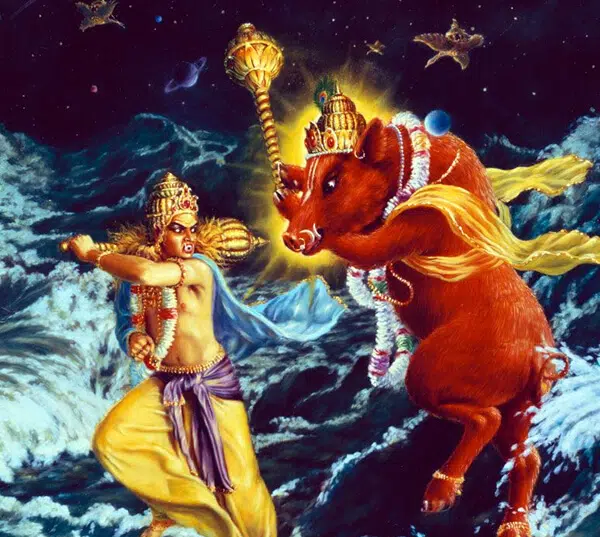
The fight with maces was fierce. When Hiranyaksha struck at the Lord's chest, the Lord moved slightly aside, "just as an accomplished yogī would elude death" (SB 3.18.15). Both were wounded, and Maitreya compares them to two bulls fighting (SB 3.18.19). Lord Brahma arrived with the sages to watch. Anxious, he begged the Lord not to play with the demon any longer but to kill him before "the darkest evening" came, when the demon would grow stronger. The auspicious midday period called abhijit had all but passed (SB 3.18.20-28).
The end of Hiranyaksha (SB 3.19)
The Lord laughed and accepted Brahma's request with a loving glance (SB 3.19.1). Soon afterwards His own mace was knocked from His hand. Hiranyaksha could have struck Him while He was unarmed, but he kept the rule of single combat and held back. The Lord "acknowledged the demon's love of righteousness" and called for His Sudarshana disc (SB 3.19.3-5). He knocked the demon's mace down with His left foot, told him to pick it up and try again, and then caught it as easily as Garuda seizes a snake (SB 3.19.9-11). The demon's trident was cut to pieces by the disc (SB 3.19.14). Hiranyaksha then filled the sky with storms, darkness and conjuring tricks, until one release of the Sudarshana scattered them all (SB 3.19.17-22).
At last the demon tried to crush the Lord in his arms, but found the Lord standing outside them. As he struck out with his fists, Lord Varaha slapped him at the root of the ear. Hiranyaksha's eyes bulged, his limbs broke, and he fell dead "like a gigantic tree uprooted by the wind" (SB 3.19.24-26).
Brahma and the demigods came to see the body. The demon's face still glowed, and Brahma said in wonder, "Oh, who could meet such blessed death?" (SB 3.19.27) Hiranyaksha had left his body struck by the Lord's forefoot and gazing at His face (SB 3.19.28). The demigods offered their prayers, and the Lord returned to His own abode (SB 3.19.30-31).
What Srila Prabhupada draws from this pastime
The Lord has feelings, and He protects His devotees first. The insults hurt the Lord, yet His first act was to make the frightened earth safe. Srila Prabhupada writes: "God is as sentient as we are. He is satisfied by our prayers and dissatisfied by our harsh words against Him." For the sake of His devotees, he adds, the Lord is ready to put up with the words of atheists (SB 3.18.6, purport).
Behind the laws of nature stands the Lord. The earth floated because the Lord gave it His energy (SB 3.18.8). Srila Prabhupada applies this to every planet in space: "the law of gravitation works under the control or direction of the Supreme Lord" (SB 3.18.8, purport).
Pride in power is still bound by death. Varuna foresaw that Hiranyaksha's pride would end on the battlefield, and the Lord reminded him that he was bound by the laws of death. In the purport to SB 3.18.10 Srila Prabhupada observes that people who decry the Lord forget that they are still subject to birth and death, while understanding the Lord's transcendental nature frees one from that cycle (SB 3.18.10, purport).
Real yoga is fixing the mind on the Lord. Brahma marvelled that the demon left his body looking at the face of the Lord, the same Lord whom yogis meditate on in seclusion. Srila Prabhupada comments: "Even if one concentrates his mind on the boar form of the Lord, that is also yoga." He concludes that "the perfection of yoga practice can be attained by a demon also if he is simply kicked by the Lord" (SB 3.19.28, purport).
Gratitude leads to devotion. At the end of the story, Suta Gosvami asks what grateful soul would not serve such a master (SB 3.19.36). Srila Prabhupada points out that we receive sunshine, moonshine and water by the Lord's arrangement, and that "anyone with a simple heart of gratefulness must be Kṛṣṇa conscious and offer devotional service to the Lord" (SB 3.19.36, purport).
Hearing the pastime is itself a blessing. The Lord is very pleased when this narration is heard and described in a devotional mood (SB 3.13.48), and hearing it frees one from the results of sin (SB 3.19.37). Srila Prabhupada's advice is simple: "Intelligent persons should therefore hear personally and cause others to hear the descriptive narrations of the Lord's activities, for that will destroy the pangs of material existence." (SB 3.13.48, purport)
Varaha Dvadashi: the day of Lord Varaha's appearance
ISKCON celebrates Lord Varaha's appearance on Varaha Dvadashi, the twelfth day (dvadashi) of the bright fortnight of the month of Magha (January or February). It falls on the day after Bhaimi Ekadashi, also called Jaya Ekadashi (see our Ekadashi 2026 calendar).
| Observance | Date | Tithi (local time, Kota, Rajasthan) |
|---|---|---|
| Varaha Dvadashi 2026 (ISKCON calendar) | Friday, 30 January 2026 | Dvadashi from 1:55 PM on 29 January to 11:09 AM on 30 January |
| Varaha Dvadashi 2027 (ISKCON calendar) | Thursday, 18 February 2027 | Dvadashi from 5:31 PM on 17 February to 2:27 PM on 18 February |
| Varaha Jayanti 2026 (general Hindu calendar) | Sunday, 13 September 2026 | Bhadrapada Shukla Tritiya from 7:08 AM on 13 September to 7:06 AM on 14 September |
Source: drikpanchang.com, ISKCON Varaha Dvadashi and Varaha Jayanti, both set to Kota, Rajasthan. Varaha Dvadashi 2026 has already passed; the next one is on 18 February 2027.
The two dates differ because two calendars are in use. Many Hindu calendars in North India mark Varaha Jayanti on the third day of the bright half of Bhadrapada (August or September), while ISKCON keeps Varaha Dvadashi in Magha. Both honour the same Lord; this page follows the ISKCON date.
A natural way to keep the day is to hear or read these chapters of the Bhagavatam, which praises the hearing of this narration (SB 3.19.37-38), and to sing the Varaha verse of Jayadeva Gosvami's hymn to the ten incarnations:
vasati daśana-śikhare dharaṇī tava lagnā
śaśini kalaṅka-kaleva nimagnā
keśava dhṛta-śūkara-rūpa jaya jagadīśa hare
Our gloss: the earth, clinging to the point of Your tusk, looks like the dark mark sunk in the moon. O Keshava, who took the form of a boar, all glories to You, Hari, Lord of the universe. The whole hymn with a translation is on our song page Pralaya Payodhi Jale.
Questions devotees ask
When is Varaha Dvadashi in 2027?
On Thursday, 18 February 2027, by the ISKCON calendar for Kota, Rajasthan (drikpanchang.com). In 2026 it fell on Friday, 30 January.
Is Varaha Jayanti the same as Varaha Dvadashi?
Both celebrate the appearance of Lord Varaha, but on different days. Many North Indian calendars keep Varaha Jayanti on Bhadrapada Shukla Tritiya (13 September in 2026 at Kota). ISKCON keeps Varaha Dvadashi on Magha Shukla Dvadashi.
Where is the story of Lord Varaha told?
In Srimad-Bhagavatam, Canto 3: chapter 13 tells of His appearance and the lifting of the earth, and chapters 17 to 19 tell of Hiranyaksha's birth and the battle. All of them can be read with Srila Prabhupada's purports on vedabase.io.
Sources and credits. Srila Prabhupada's translations and purports of Srimad-Bhagavatam are quoted word for word from vedabase.io, © The Bhaktivedanta Book Trust International. The gloss of Jayadeva Gosvami's verse is our own.