Table of Contents
- 1. Lord Balarama at a Glance
- 2. Who Is Lord Balarama?
- 3. What Are the Names of Lord Balarama?
- 4. What Is the Story of Lord Balarama's Birth?
- 5. Why Did Balarama Appear Before Krishna?
- 6. What Are Lord Balarama's Major Pastimes?
- 7. What Was Lord Balarama's Role in the Mahabharata?
- 8. What Do Balarama's Plough and Mace Represent?
- The Plough
- The Mace
- 9. Why Is Balarama Known as the Adi Guru?
- 10. What Is the Connection Between Lord Balarama and Nityananda Prabhu?
- The Story of Jagai and Madhai
- 11. What Did Śrīla Prabhupāda Teach About Balarama?
- 12. Where Is Lord Balarama Worshipped? Prominent Temples and Places
- 13. Conclusion: The Strength of Lord Balarama
- 14. Frequently Asked Questions
Summary
Lord Balarama is Krishna's elder brother, first personal expansion and constant companion. In Gaudiya Vaishnava theology, He is also the source of spiritual strength and the Adi Guru, or original spiritual master. His story includes His transfer from Devakī's womb to Rohiṇī's, His childhood pastimes in Vraja, His defeat of powerful demons and His role as a master of mace combat. The article also explains the meaning of His plough and mace, His appearance as Nityananda Prabhu, His connection with compassion and spiritual guidance, and the major temples where He is worshipped.
Lord Balarama at a Glance
Lord Balarama is widely known as the elder brother and constant companion of Lord Krishna. Yet, in Gaudiya Vaishnava theology, His story reaches far beyond that familiar relationship. He is understood as Krishna's first personal expansion, the source of spiritual strength and the original spiritual master, or Adi Guru.
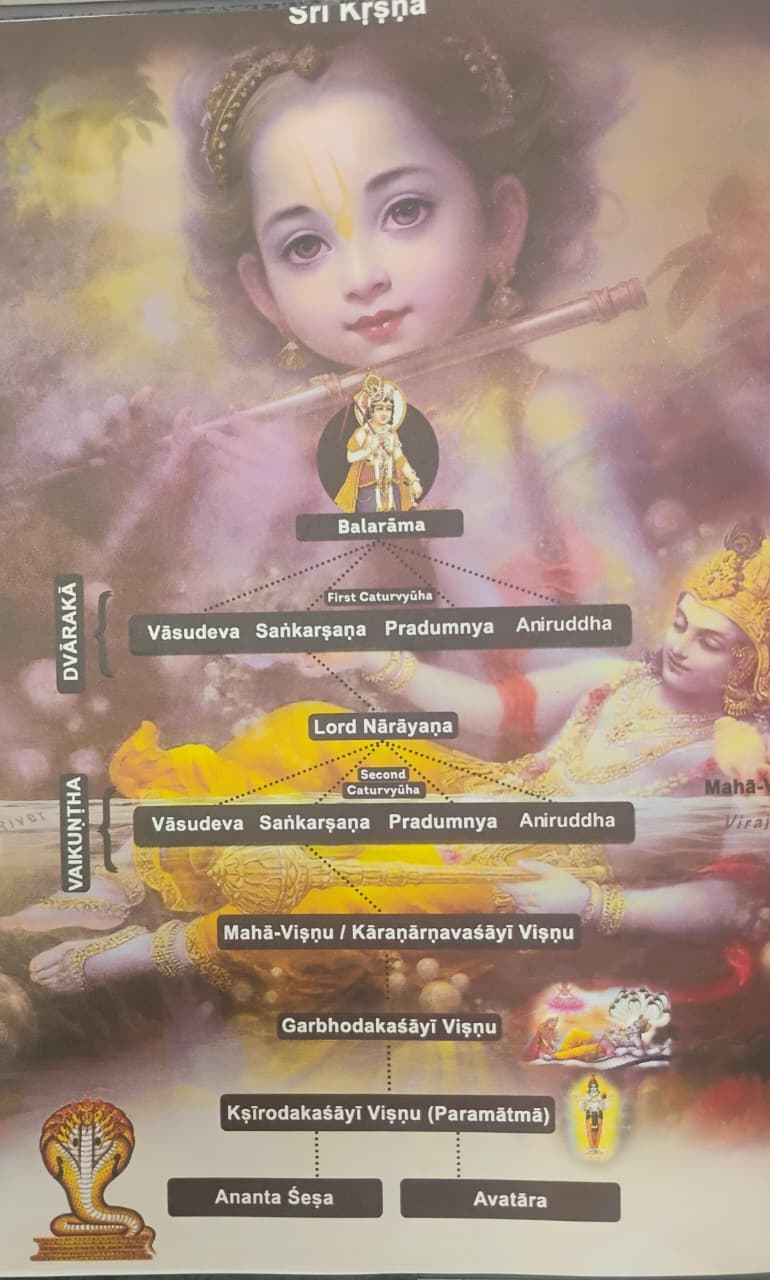
The Śrī Caitanya-caritāmṛta describes Krishna and Balarama as one identity appearing in two different forms. Balarama is Krishna's first bodily expansion, and He assists Krishna throughout His transcendental pastimes. [Source: Cc Ādi-līlā 5.4–5.5]
His story begins with an extraordinary transfer from Devakī's womb to Rohiṇī's. It then unfolds through His childhood in Vraja, His destruction of powerful demons, His role as a teacher of mace combat and, in the Gaudiya Vaishnava tradition, His later appearance as Nityananda Prabhu.
Who Is Lord Balarama?
Lord Balarama, also called Baladeva, is the elder brother of Krishna in Krishna's earthly pastimes. According to the Śrī Caitanya-caritāmṛta, Krishna is the original form of the Supreme Lord, while Balarama is His first expansion or "second body." Although They appear in separate forms, They possess the same spiritual identity and potency.
This understanding is more precise than saying that Krishna and Balarama are merely expressions of the same "divine consciousness." In Gaudiya theology, they are eternal personal forms of the Supreme, not impersonal manifestations of a shared consciousness.
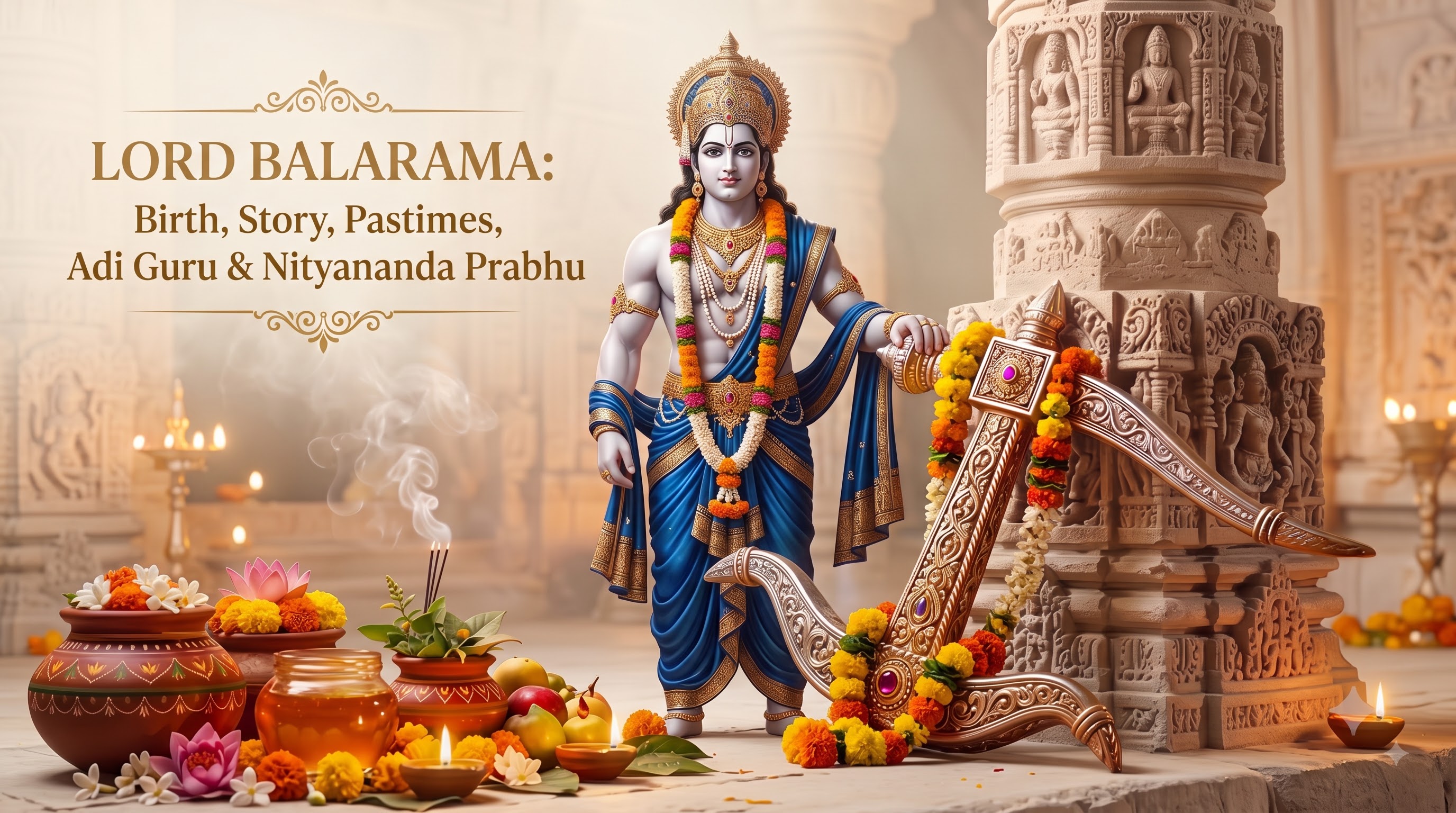
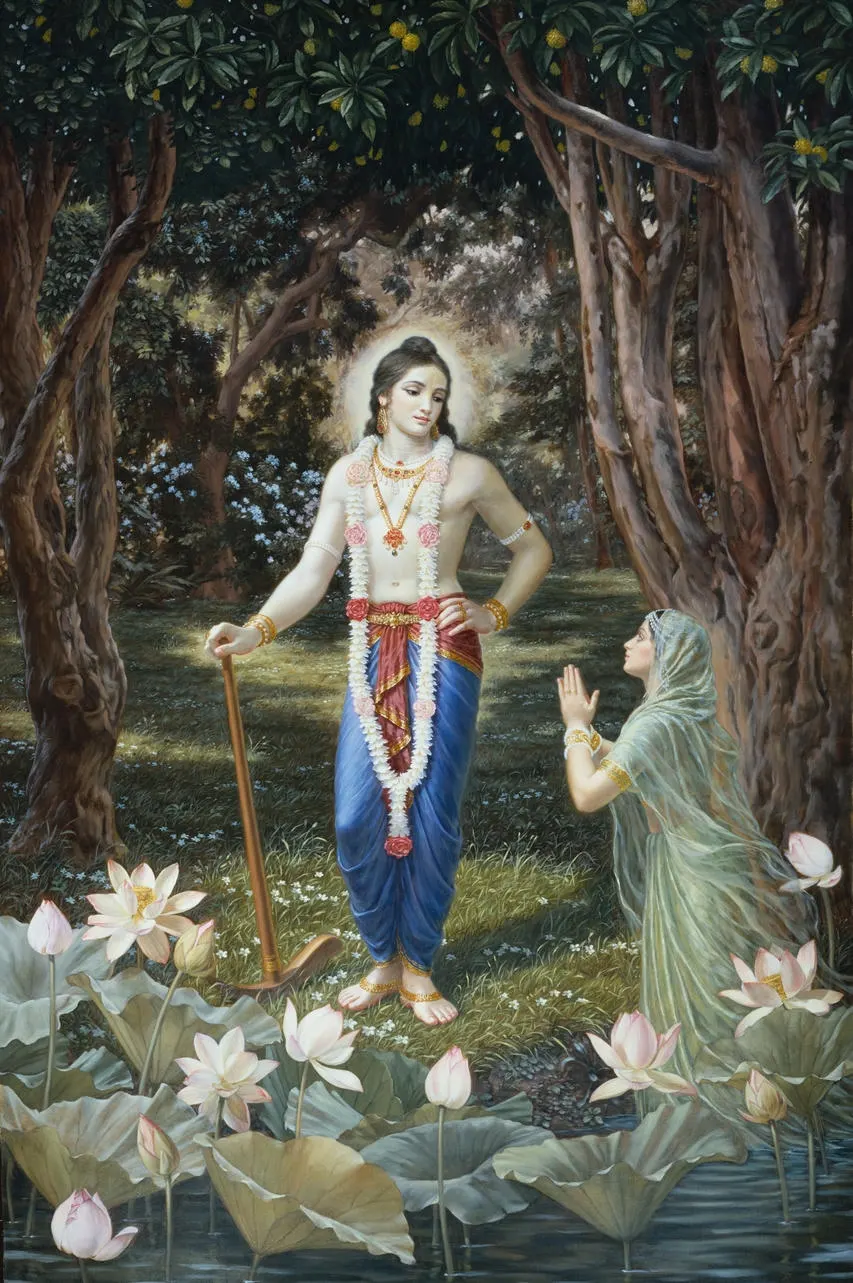
Balarama is traditionally depicted with a fair complexion, blue garments, and ornaments. He often carries a plough and a mace. His plough gives Him names such as Haladhara, meaning "the bearer of the plough," and Halayudha, meaning "He whose weapon is the plough."
What Are the Names of Lord Balarama?
Lord Balarama is known by several names, each reflecting His identity, strength, family relationship, or divine attributes:
| Name | Meaning |
|---|---|
| Balarama | One who possesses or gives great strength |
| Baladeva | The divine Lord of strength |
| Sankarshana | One who was drawn away (from Devaki's womb) |
| Haladhara | Bearer of the plough |
| Halayudha | He whose weapon is the plough |
| Rohineya | Son of Rohini |
| Taladhwaja | He whose banner bears the emblem of a palm tree |
| Dauji | Reverential North Indian name meaning elder brother |
Among these names, Sankarshana is especially connected with Balarama's transfer from Devakī's womb to Rohiṇī's womb.
What Is the Story of Lord Balarama's Birth?
The story begins in Mathura, where Kamsa had imprisoned his sister Devakī and her husband, Vasudeva. He had heard a prophecy that Devakī's eighth son would cause his death, and in fear, he killed six of their children.
During Devakī's seventh pregnancy, the Supreme Lord instructed Yogamāyā to transfer the child from Devakī's womb to the womb of Rohiṇī, another wife of Vasudeva. At that time, Rohiṇī was living under the protection of Nanda Maharaja. The Śrīmad-Bhāgavatam identifies this child as the Lord's plenary expansion, known as Sankarshana or Shesha. [Source: SB 10.2.8] [SB 10.2.15]
After the transfer, those in Kamsa's palace believed that Devakī had suffered a miscarriage. Balarama was then born from Rohiṇī and raised in the cowherd community.
It is therefore accurate to say that Balarama was first present in Devakī's womb and was transferred to Rohiṇī's womb. However, it is preferable not to describe Devakī unconditionally as His "original mother," because the tradition also recognizes Rohiṇī as His eternal mother and the mother who gave birth to Him.
Why Did Balarama Appear Before Krishna?
Within Gaudiya Vaishnava theology, Balarama appears before Krishna because He assists Krishna in all His activities and manifestations. The Śrī Caitanya-caritāmṛta calls Him Krishna's first expansion and foremost assistant.
Balarama is also understood as the source of spiritual strength. The Muṇḍaka Upaniṣad 3.2.4 contains the statement:
Nāyam ātmā bala-hīnena labhyaḥ
— Muṇḍaka Upaniṣad 3.2.4 [Source]
which means, the Self is not attained by one who is without strength.
In its original Upanishadic context, this verse emphasizes the strength, discipline, or spiritual capacity required for realization. However, it does not explicitly name Lord Balarama.
Śrīla Prabhupāda gives the passage a specifically Gaudiya Vaishnava interpretation: true spiritual strength comes through the grace of Balarama, who manifests as the guru principle and, in the age of Kali, as Nityananda Prabhu. [Source: Prabhupāda lecture, SB 3.26.25, Bombay, Jan 2, 1975]
This distinction is important. The Upaniṣadic statement and Prabhupāda's theological application are related, but they should not be presented as though they were identical claims made directly by the Upaniṣad.
What Are Lord Balarama's Major Pastimes?
Balarama's pastimes reveal strength guided by service. He protects the residents of Vraja, defeats dangerous forces, and acts for the welfare of others.
The Talavana forest was filled with fragrant palm fruits, but the demon Dhenukasura and his companions prevented people and animals from entering it. Dhenukasura had assumed the form of a powerful donkey.
When Balarama, Krishna and the cowherd boys entered Talavana, Balarama shook the palm trees so that their fruits fell. Dhenukasura attacked Him, but Balarama seized the demon by the hind legs, whirled him around and threw him into a tree. Krishna and Balarama then defeated the demon's companions, making the forest safe again.
[Source: Śrīmad-Bhāgavatam, Canto 10, Chapter 15]Pralambasura entered the company of the cowherd boys while disguised as one of them. During a game, the losing boys had to carry the winners on their shoulders. Pralamba carried Balarama away and then revealed his gigantic demonic form.
Balarama understood the danger and struck Pralamba on the head with His fist, killing him. The pastime shows that deception cannot remain hidden from divine awareness and that Balarama's strength protects those in Krishna's care.
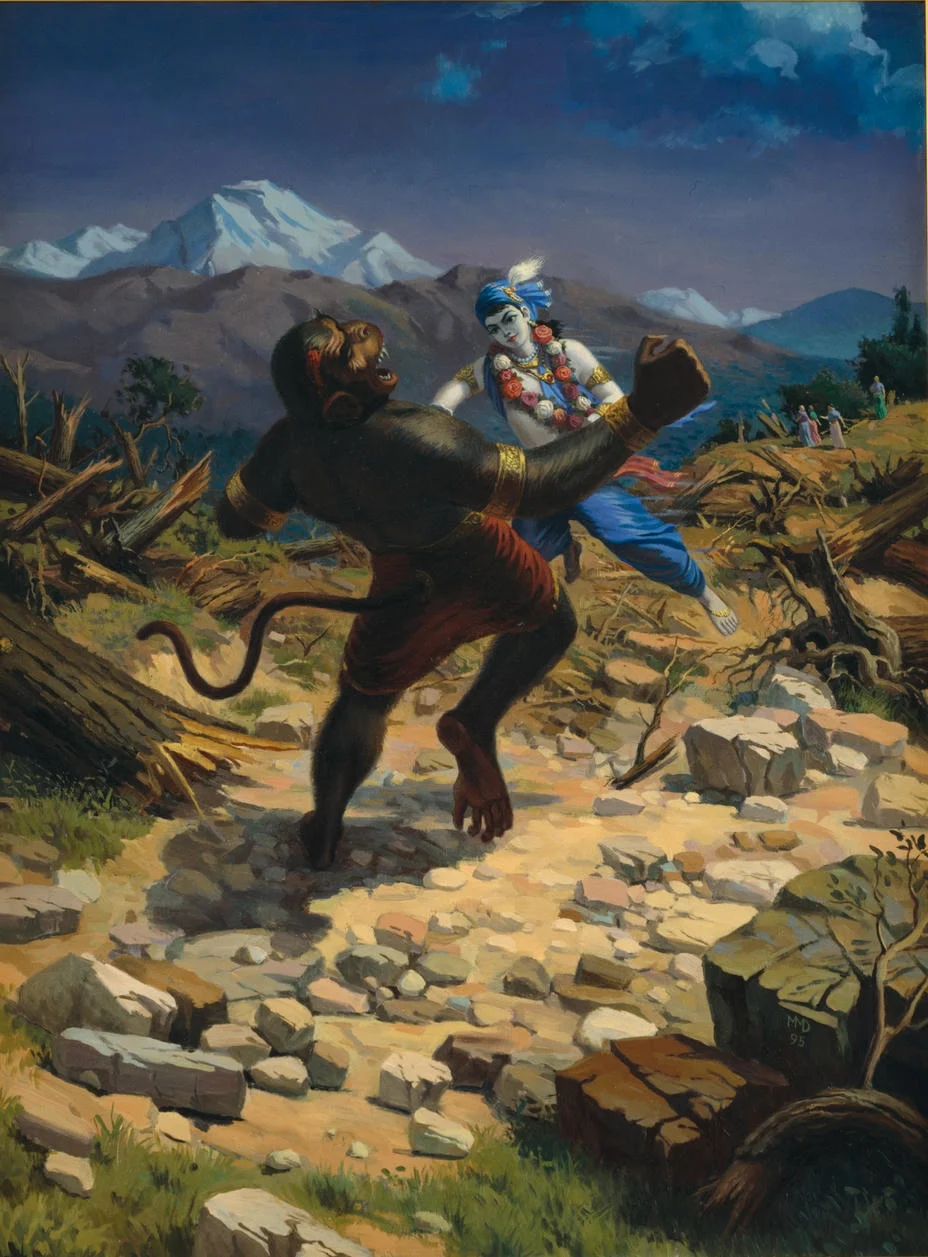
[Source: Śrīmad-Bhāgavatam, Canto 10, Chapter 18]Balarama also defeated Dvivida, a powerful gorilla who caused destruction across the region and troubled people and sages. When Dvivida challenged Him, Balarama fought the gorilla and ultimately killed him with His extraordinary strength. This pastime further highlights Balarama's role as a powerful protector who removes threats and restores peace.
During a visit to Vraja, Balarama desired to enjoy in the waters of the Yamuna. When the river did not immediately come near, He used His plough to draw her toward Him, dividing her flow into many channels.
The personified Yamuna then appeared before Balarama, asked His forgiveness and submitted to His command. The account also states that Balarama had drunk Varuni and became intoxicated.
[Source: Śrīmad-Bhāgavatam, Canto 10, Chapter 65]When the Kauravas imprisoned Samba, Balarama first tried to resolve the conflict peacefully. The Kauravas responded arrogantly and insulted Him. Balarama then used His plough to drag Hastinapura toward the Ganges.
Terrified by His power, the Kauravas released Samba and begged forgiveness. Balarama immediately became calm. This pastime shows both the immensity of His strength and His willingness to forgive when people sincerely correct their behaviour.
[Source: Śrīmad-Bhāgavatam, Canto 10, Chapter 68]What Was Lord Balarama's Role in the Mahabharata?
Balarama was a celebrated master of mace combat. Both Bhima and Duryodhana were associated with His instruction, and Duryodhana was especially accomplished in the discipline.
When the Kurukshetra War began, Balarama did not join either army. Because He had relationships with warriors on both sides, He undertook a pilgrimage instead. He returned near the end of the conflict and witnessed the final mace duel between Bhima and Duryodhana.
During the duel, Bhima struck Duryodhana below the waist. Balarama became angry because such a blow violated the accepted rules of mace combat. Krishna then explained the circumstances and pacified Him. Balarama's response can be understood as that of a teacher committed to the rules of the discipline. [Source: Śrīmad-Bhāgavatam, Canto 10, Chapters 78–79]
What Do Balarama's Plough and Mace Represent?
Balarama's two most recognizable implements are His plough and mace. Both appear prominently in His story, and both have also received devotional interpretations.
The Plough
The plough represents Balarama's connection with agriculture, strength, and the cultivation of the earth. In devotional teachings, it is also seen as a symbol of spiritual cultivation. Just as a plough prepares hard ground for planting seeds, divine guidance prepares the heart for devotion.
This symbolism is meaningful in devotional explanations. However, it is a theological interpretation and not an explanation directly given in the scriptural accounts of Balarama's appearance.
The plough also serves as a weapon in several stories. Balarama uses it to draw the Yamuna toward Him. In another episode, He threatens to use it to drag the city of Hastinapura into the Ganges.
The Mace
The mace represents focused strength, authority in warfare, and protection. Balarama's skill in mace combat is shown through His association with Bhima and Duryodhana.
Devotional teachers may also interpret the mace as a symbol of spiritual determination or the power to overcome obstacles. However, this is a contemplative interpretation and not a universally accepted meaning directly stated in scripture.
Why Is Balarama Known as the Adi Guru?
Adi Guru means the original spiritual master. In Gaudiya Vaishnavism, Balarama is called the original guru because He is the first expansion of Krishna and the source of the principle through which divine service, knowledge, and spiritual strength are transmitted.
The Śrī Caitanya-caritāmṛta explains that Nityananda, who is Balarama Himself, is the original spiritual master. [Source: Cc Ādi-līlā 1.44, purport] It also teaches that the genuine spiritual master is a manifestation and servant of the Lord, not an independent competitor to God.
Śrīla Prabhupāda repeatedly associated Balarama with guru-tattva, the theological principle embodied by the spiritual master. In a lecture for Nityananda Prabhu's appearance day, he taught that one must take shelter of Balarama, or guru-tattva, to approach Krishna and Chaitanya Mahaprabhu. [Source: Prabhupāda, Nityananda Prabhu Appearance Day lecture, Feb 2, 1977]
Thus, calling Balarama the Adi Guru does not mean that every individual teacher is literally Balarama in all respects. It means that authentic spiritual guidance derives its authority and spiritual potency from the divine guru principle represented by Balarama.
What Is the Connection Between Lord Balarama and Nityananda Prabhu?
The story of Balarama continues in the Gaudiya Vaishnava understanding of the age of Kali. Gaudiya Vaishnavas understand Sri Chaitanya Mahaprabhu as Krishna appearing in the age of Kali and Sri Nityananda Prabhu as Balarama appearing alongside Him.
The Śrī Caitanya-caritāmṛta repeatedly identifies Nityananda with Balarama and describes the cosmic manifestations of Vishnu as expanding through Him. [Source: Cc Ādi-līlā, Chapter 5]
Narottama Dasa Thakura summarizes this theology in the celebrated line:
The Story of Jagai and Madhai
The story of Jagai and Madhai shows Nityananda Prabhu's extraordinary compassion. The two brothers were known for their violent and sinful behaviour. When Nityananda approached them with the message of devotion, Madhai attacked Him.
Chaitanya Mahaprabhu was ready to punish them, but Nityananda asked Him to show mercy. The brothers then repented and were accepted into a life of devotion.
For Gaudiya Vaishnavas, this story shows that Balarama's protective and guiding nature also appears through Nityananda, who offers exceptional mercy to spiritually fallen people.
What Did Śrīla Prabhupāda Teach About Balarama?
Śrīla A.C. Bhaktivedanta Swami Prabhupāda consistently presented several central teachings about Balarama:
Where Is Lord Balarama Worshipped? Prominent Temples and Places
Lord Balarama is worshipped in several important temples and sacred places across India. Among the most prominent are the following:
Conclusion: The Strength of Lord Balarama
Lord Balarama holds a foundational place in Gaudiya Vaishnava theology. As Krishna's first expansion, elder brother and constant assistant, He is understood as the source of spiritual strength and the original spiritual master.
His story begins with divine protection through His transfer from Devakī's womb to Rohiṇī's. His pastimes in Vraja reveal His extraordinary power, while His conduct in the Mahabharata reflects His respect for martial discipline and principle.
As Nityananda Prabhu, that same strength takes the form of spiritual compassion. Instead of only defeating external enemies, He helps people overcome ignorance and move closer to Krishna through devotion.
Ultimately, Balarama's life teaches that true strength is not simply physical power. It is strength used in service, the strength to support, protect, guide, nurture devotion, and extend mercy to others.
Hare Krishna!Frequently Asked Questions
Is Balarama an avatar of Vishnu or Ananta Shesha?
Different traditions describe Balarama in different ways. In Gaudiya Vaishnavism, He is Krishna's first personal expansion, and Ananta Shesha and the various forms of Vishnu expand through Balarama and Sankarshana. Other Hindu traditions may describe Balarama as an avatar of Vishnu.
What is the relationship between Krishna and Balarama?
Balarama is Krishna's eternal elder brother in the earthly pastimes and His first expansion in Gaudiya theology. The two are described as one identity appearing in distinct forms, with Balarama serving and assisting Krishna.
Why did Balarama not fight in the Kurukshetra War?
Balarama was connected with warriors on both sides, including Bhima and Duryodhana. Rather than joining the conflict, He undertook a pilgrimage. He returned near the final mace duel and objected strongly when Bhima struck Duryodhana below the waist.
Why is Balarama considered the Adi Guru?
He is regarded as the Adi Guru because He represents the original source of spiritual service, strength, and guidance. Nityananda Prabhu, identified with Balarama, is consequently described as the original spiritual master in Gaudiya literature.
Is Balarama the same as Nityananda Prabhu?
According to Gaudiya Vaishnava theology, yes. Nityananda Prabhu is Balarama appearing with Chaitanya Mahaprabhu in the age of Kali.
Why did Balarama draw the Yamuna with His plough?
The Śrīmad-Bhāgavatam narrates that Balarama called the Yamuna so that He could enjoy in her waters. When she ignored His command, He began drawing her with His plough. The personified river then appeared, apologized, and submitted to Him.
- Śrī Caitanya-caritāmṛta, Ādi-līlā 5.4–5.5 — Krishna and Balarama as one identity in two forms; Balarama as Krishna's first expansion.
- Śrī Caitanya-caritāmṛta, Ādi-līlā 1.44, purport — Nityananda-Balarama as the original spiritual master.
- Śrī Caitanya-caritāmṛta, Ādi-līlā, Chapter 5 — The glories and expansions of Nityananda-Balarama.
- Śrīmad-Bhāgavatam 10.2.8 and 10.2.15 — Transfer of Balarama from Devakī's womb to Rohiṇī's.
- Śrīmad-Bhāgavatam, Canto 10, Chapters 15 and 18; 12.12.30 — Dhenukasura and Pralambasura.
- Śrīmad-Bhāgavatam, Canto 10, Chapter 65 — Balarama, Varuni and the Yamuna.
- Śrīmad-Bhāgavatam, Canto 10, Chapters 78–79 — Balarama's pilgrimage.
- Muṇḍaka Upaniṣad 3.2.4 — Nāyam ātmā bala-hīnena labhyaḥ.
- A.C. Bhaktivedanta Swami Prabhupāda, lecture on Śrīmad-Bhāgavatam 3.26.25, Bombay, January 2, 1975 — Balarama, spiritual strength and guru-tattva.
- A.C. Bhaktivedanta Swami Prabhupāda, Nityananda Prabhu Appearance Day Lecture, February 2, 1977 — Balarama as guru-tattva.
- Krishna: The Supreme Personality of Godhead, Chapter 2 — Balarama as the source of spiritual power and the original spiritual master.