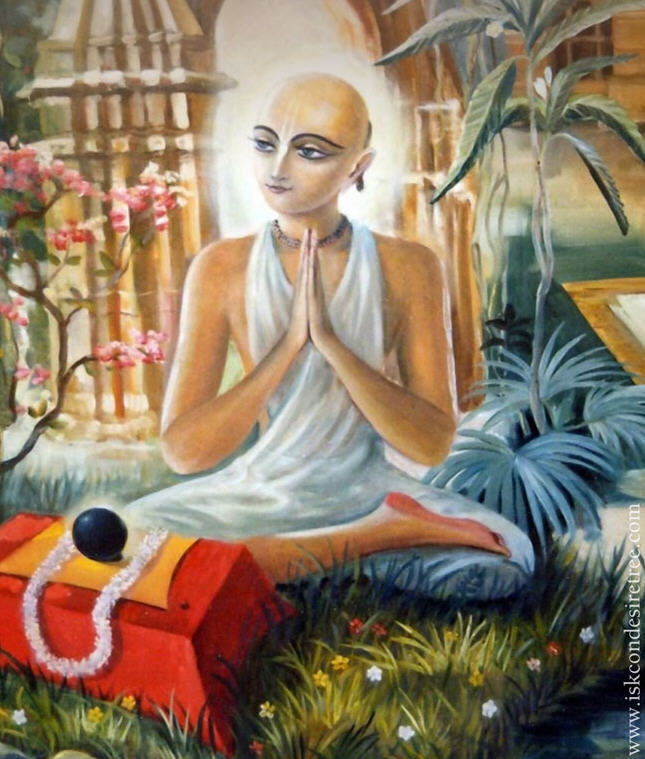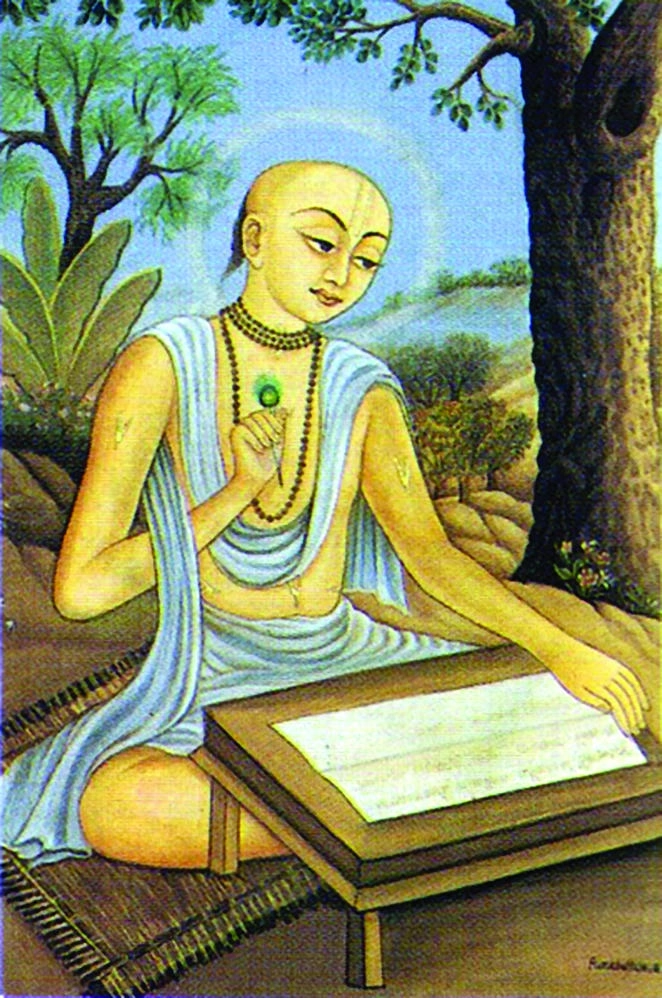
Srila Jiva Goswami
Systematic Philosopher of the Six Goswamis of Vrindavana
Also known as Jiva Gosvami, Shri Jiva Gosvami Prabhu, Jiva Gosvamipada
“From Govardhana Hill a towering form manifested itself, and as Krishna and all the Vrajavasis stood by with folded hands, that great form declared, 'I shall eat everything you have brought,' and began emptying the kundas around the hill and calling out for more.”
Sri Gopala-champu, Jiva Goswami's poetic retelling of Krishna's Vrindavana pastimes.
śrī-rūpa-caraṇa-dvandva-rāgiṇaṁ vrajavāsinaṁ śrī-jīvaṁ satataṁ vande manda-svānanda-dāyinam
"I offer my repeated obeisances unto Srila Jiva Gosvami, whose heart is constantly attracted to the lotus feet of Srila Rupa Gosvami. He is the crest jewel of all the residents of Vraja, and by his causeless mercy he bestows unimaginable joy even upon the dull and unphilosophical."
Bhakti-ratnakara 4.289
(Another devotional account of Srila Jiva Gosvami's life that we have used does not open with a pranama-mantra. It begins instead with Srila Prabhupada's own praise of him, quoted just below.)
According to Sri Gaura-ganoddesha-dipika (verse 195), Srila Jiva Gosvami is identified as Vilasa Manjari in Krishna's eternal pastimes in Vraja. Few Vaishnava philosophers have been praised by Srila Prabhupada as highly: he wrote that "the Vaishnavas are by far the greatest philosophers in the world, and the greatest among them was Jiva Gosvami Prabhu." In a letter written from Bombay on 3 November 1970, Srila Prabhupada recalled a meeting in Calcutta. At that meeting the learned Sanskrit scholar Pramathanath Tarkabhusan had said of Jiva Gosvami that "there was no comparison with Jiva Gosvami and any other philosophers of the world," and the scholar also said that "Gaudiya Vaishnavism is very much proud of having such a great acharya as Jiva Gosvami."
Srila Jiva Goswami was the youngest of the Six Goswamis of Vrindavana. In the estimate of Srila Prabhupada and generations of Gaudiya Vaishnava scholars since, he was the most systematic philosopher among them. His father was Anupama, the youngest of three brothers who served together in the court of Bengal. Jiva never knew the settled family life that his uncles Srila Rupa Gosvami and Srila Sanatana Gosvami had renounced before him. His father died on the road while Jiva was still a child, and Jiva grew up among scholars and pilgrims, not courtiers. Later he reached Vrindavana as a young man, already trained in Sanskrit philosophy at Navadwipa and Varanasi. By then his uncles had spent years rediscovering the lost holy places of Vraja and writing the tradition's first scriptures. Jiva's task was to take everything Rupa and Sanatana had lived and written, and join it into one single philosophical system that could be defended in debate.
| Detail | Description |
|---|---|
| Birth | c. 1513 (disputed; see below) |
| Family | Son of Anupama (Vallabha), youngest brother of Rupa and Sanatana Goswami |
| Identity | In Krishna-lila: Vilasa-manjari, a maidservant of Sri Radha (Gaura-ganoddesha-dipika 195, 204; Chaitanya-charitamrita Adi 10.85 purport) |
| Education | Navadwipa, then Varanasi under Madhusudana Vachaspati |
| Diksha-guru | Rupa Goswami |
| Chief work | Sat-sandarbha (six-part systematic theology of Gaudiya Vaishnavism) |
| Temple established | Radha-Damodara, Vrindavana (deity given by Rupa Goswami, ordinarily dated 1542) |
| Disappearance | Traditionally 1608, Radha-Damodara temple (another devotional account instead gives 1598, matching its own stated birth year of 1513 and an 85-year lifespan; see Final Days and Disappearance) |
A Childhood Shaped by Absence #
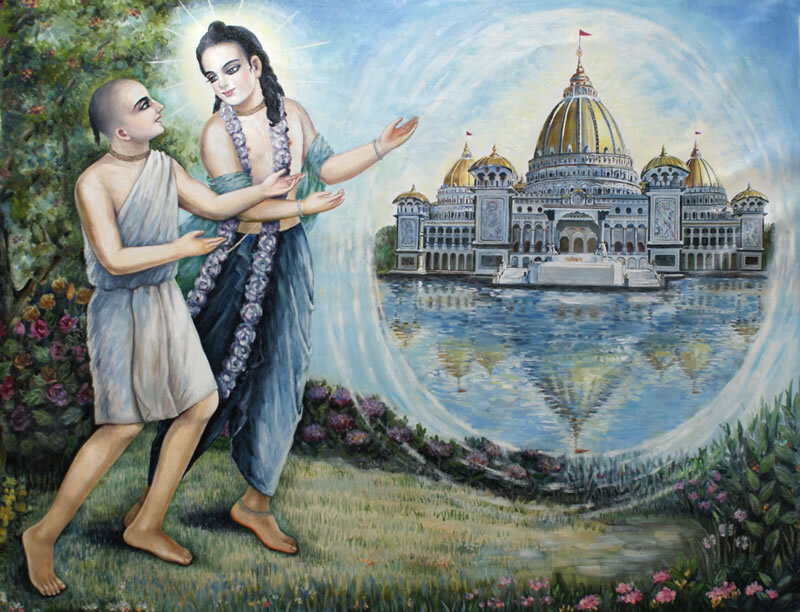
Jiva's father, Anupama, died on the bank of the Ganges while still journeying through Bengal, years before either brother's family reached Vrindavana. The loss fell on a boy who, all accounts agree, was unusually gifted and unusually serious. Local teachers had already seen that he was a natural scholar. From very early childhood he had also kept a small worship of Krishna-Balarama, and villagers noticed how intense it was. When he was still barely into his teens, his grief and his longing for Sri Chaitanya Mahaprabhu's associates at last became stronger than his mother's reluctance to lose another family member to renunciation. Jiva set out for Navadwipa, and he got there by using a small trick to slip past his mother's wishes. Nityananda Prabhu himself received him there, and Saci Mata blessed him. Jiva was then taken around the nine islands of the dhama and sent on to Varanasi for advanced study. This education is described more fully in Birth and Early Education.
Srila Prabhupada gives Jiva's eternal identity in his purport to Chaitanya-charitamrita Adi 10.85: "In the Gaura-gaṇoddeśa-dīpikā (195) it is said that Śrīla Jīva Gosvāmī was formerly Vilāsa-mañjarī gopī." In Kavi Karnapura's book, verse 195 names Vilasa-manjari in a list of Srimati Radharani's maidservants. Verse 198 says that these maidservants appeared, in the same order (kramasah), among Sri Chaitanya's associates. Verse 204 names the matching associate: Jiva, the son of Sri Vallabha. Vallabha was the former name of Jiva's father, Anupama:
vilāsa-mañjarī kāmalekhā ca mauna-mañjarī
...
gaureṇa tat-priyaiḥ sārdhaṁ dhṛta-puruṣa-vigrahaḥ
khelanti sma svabhāvānusārāt tāḥ kramaśo yathā
...
suśīlaḥ paṇḍitaḥ śrīmān jīvaḥ śrī-vallabhātmajaḥ
"Karpura-manjari, Syama-manjari, Sveta-manjari, Vilasa-manjari, ... were among the maidservants of Srimati Radharani. Assuming male forms they appeared among Lord Caitanya's associates, and each displayed his particular kind of ecstatic love for the Lord. These gopis became ... Sriman Jiva Pandita (who was the saintly son of Sri Vallabha) ..." (Gaura-ganoddesha-dipika 194-207)
Joining His Uncles in Vrindavana #
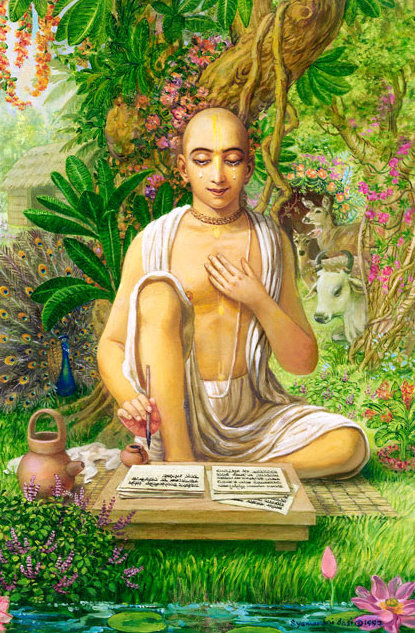
Jiva reached Vrindavana as a trained scholar, not a beginner who still had to be taught the basics. Even so, he chose to begin at the bottom. He washed Rupa Goswami's feet, copied his manuscripts, and proofread his books, even before he received formal initiation. Rupa accepted him as a disciple, and Jiva worked under his direct daily guidance. He reviewed drafts of the Bhakti-rasamrita-sindhu and took in Sanatana's Bhagavatam commentary. In this way Jiva's own scholarship grew mature. The story of this training, including the deity of Radha-Damodara that Rupa at last placed in his care, is told in Arrival in Vrindavana.
The Sat-sandarbha #
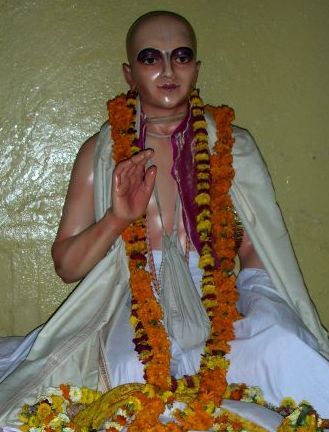
Jiva's most important achievement was the Sat-sandarbha, six connected works. In them he took the devotional conclusions that Rupa and Sanatana had lived and compiled, and set them out as formal philosophy. He wrote for Sanskrit pandits in their own language of argument. Each Sandarbha builds on the one before it, moving from scriptural method to the nature of Godhead to Krishna's own supremacy and finally to bhakti and prema as the goal of it all. The full account is in Writing the Sat-sandarbha.
Defending His Gurus, and the Accusations That Followed #
Jiva's scholarship went beyond theory. A proud Sanskrit debater, the digvijayi Rupanarayana Saraswati, tricked Rupa and Sanatana into signing a paper that gave up a public debate. They signed because they did not want to waste time on it. Then he tried the same trick on their young nephew. Jiva refused to sign and defeated the man outright. Srila Prabhupada himself later had to defend this episode against critics who called it a lapse in humility. Two more accusations were also made against Jiva after his disappearance, and these were even less fair. Srila Prabhupada answers both of them directly in his purports. The whole matter is examined in Defending His Gurus' Honor.
Leading the Goswamis of Vrindavana #
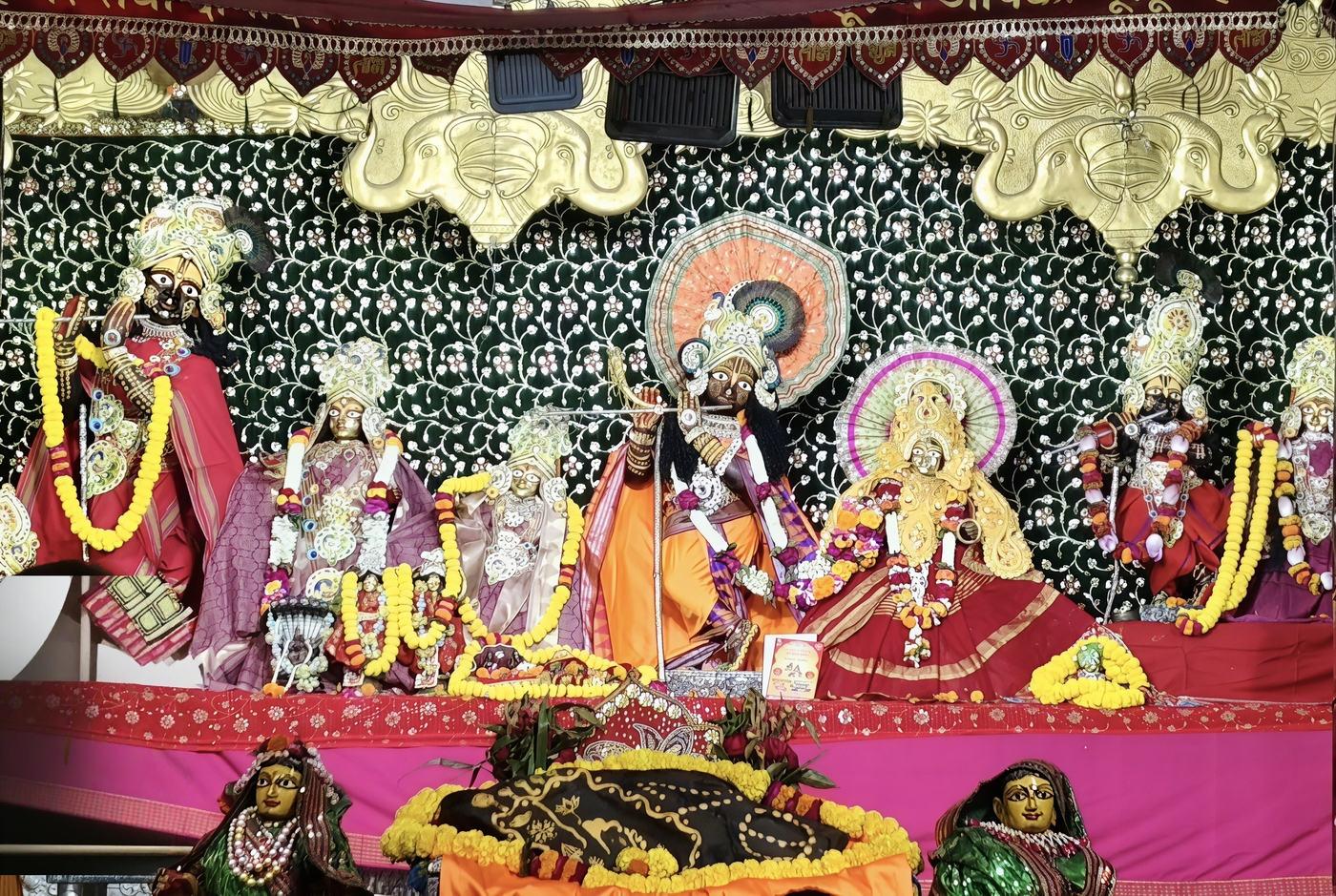
After Sanatana's disappearance and then Rupa's, Jiva Goswami became, in Srila Prabhupada's own words, the acharya of all the Vaishnavas in Bengal, Orissa and beyond. He purchased the land around Seva Kunja and hosted every Bengali pilgrim who reached Vrindavana. He trained or blessed a circle of scholars and preachers that included Krishnadasa Kaviraja Goswami, Srinivasa Acharya, Narottama Dasa Thakura and Shyamananda Pandit. He gave the last three the titles Acharya, Thakura and Shyamananda respectively, and entrusted them with carrying the Goswamis' manuscripts back to Bengal. Emperor Akbar himself came to Vrindavana in 1570 to meet him. Akbar was so impressed that he funded a library for the Goswamis' manuscripts. He also granted fine red sandstone for the building of Vrindavana's first great temples. Until then this stone had been reserved for Mughal forts and palaces. This period is covered in Leading the Vrindavana Goswamis.
A Prolific Final Body of Work #
Beyond the Sat-sandarbha, Jiva Goswami left behind roughly two dozen further works:
- A Sanskrit grammar built entirely from Krishna's names
- Commentaries on Rupa's and Sanatana's own books
- Gopala-champu: a devotional retelling of Krishna's pastimes
- Sarva-samvadini: his own auto-commentary explaining the Sandarbhas' arguments
These are surveyed in Other Literary Works.
Disappearance and Legacy #
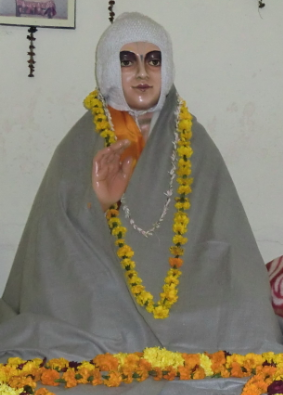
Jiva Goswami is traditionally said to have left this world in 1608 at the Radha-Damodara temple he had established. But not every source agrees even on this date. Another devotional account states plainly that he lived eighty-five years and disappeared in 1598. We report this figure here alongside 1608, instead of quietly choosing between them. What is not in dispute is the scale of his influence. Srila Prabhupada described him as one of the greatest philosophers Gaudiya Vaishnavism has produced. Centuries later, Srila Prabhupada himself lived at Jiva's own Radha-Damodara temple while translating Srimad-Bhagavatam, before he left for the West. The final chapter of Jiva's life, and this closing connection, are told in Final Days and Disappearance.
Scriptural evidence
Quoted in the text above:
- Verses 195, 198, 204 Gaura-ganoddesha-dipika
Further verses:
তাঁর মধ্যে রূপ–সনাতন—বড় শাখা ।
অনুপম, জীব, রাজেন্দ্রাদি উপশাখা ॥
tāṅra madhye rūpa-sanātana — baḍa śākhā
anupama, jīva, rājendrādi upaśākhā
Word for word
tāṅra: within that; madhye: in the midst of; rūpa-sanātana: the branch known as Rupa-Sanatana; baḍa śākhā: the big branch; anupama: Anupama; jīva: Jiva; rājendra-ādi: and Rajendra and others; upaśākhā: their subbranches.
Among these branches, Rupa and Sanatana were principal. Anupama, Jiva Gosvami and others, headed by Rajendra, were their subbranches.
From the purport: "After the disappearance of Srila Rupa Gosvami and Sanatana Gosvami in Vrndavana, Srila Jiva Gosvami became the acarya of all the Vaisnavas in Bengal, Orissa and the rest of the world, and it is he who used to guide them in their devotional service."
The genealogical verse in Krishnadasa Kaviraja Goswami's list of Sri Chaitanya Mahaprabhu's followers that names Jiva Goswami as a subbranch under Rupa and Sanatana; Srila Prabhupada's purport gives the fullest single biographical summary of Jiva Goswami's life and works.
- Sri Chaitanya-charitamrita, Adi-lila 10.85 (Bhaktivedanta VedaBase)
- Sri Chaitanya-charitamrita, Adi-lila 1.36-37 (Bhaktivedanta VedaBase)
- Jiva Goswami - Gaudiya History
- Jiva Goswami - Biography - Gaudiya History
- Srila Jiva Goswami: The Greatest Scholar and Philosopher, by Mayapur-shashi Dasa - Back to Godhead
- Srila Jiva Goswami Samadhi - Vrindaban Forest
Frequently asked
When was Srila Jiva Goswami born?
Srila Jiva Goswami appeared Traditionally c. 1513 (sources disagree; some place it as early as 1511 and others as late as the 1530s) in Bengal, in the family of the courtier Kumaradeva (sources do not agree on the exact village).
Who was the guru of Srila Jiva Goswami?
The spiritual master of Srila Jiva Goswami was Srila Rupa Gosvami.
When and where did Srila Jiva Goswami disappear?
Srila Jiva Goswami disappeared Traditionally 1608 (some sources say 1598; the exact year is disputed) at Vrindavana, at the Radha-Damodara temple.
What are the main pastimes of Srila Jiva Goswami?
The pastimes covered here include: Birth and Early Education, Arrival in Vrindavana, Writing the Sat-sandarbha, Defending His Gurus' Honor, Leading the Vrindavana Goswamis, Other Literary Works, Final Days and Disappearance.