Apsarā Vana
अप्सरा वन Hindi name proposed
- What it is
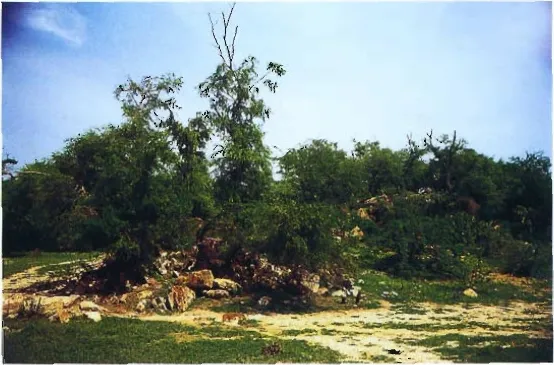
- Apsarā Vana is a forest that, according to the guidebook Govardhana Hill (2001), surrounds the tail end of Govardhana Hill on its eastern side; within it lies Apsarā-kuṇḍa.
- Visiting
- In 2001 the guidebook Govardhana Hill described the forest as still clearly visible, with a good view of it from the roof of the Narasiṁha temple at Apsarā-kuṇḍa; the undated parikramā notes …
- Places here
- Apsarā-kuṇḍa
In short
Apsarā Vana is a forest that, according to the guidebook Govardhana Hill (2001), surrounds the tail end of Govardhana Hill on its eastern side; within it lies Apsarā-kuṇḍa.[1 +3] Śrīla Nārāyaṇa Bhaṭṭa Gosvāmī's Vraja-bhakti-vilāsa counts an Apsarāvana among the twelve upavanas, the secondary forests of Vraja, and prescribes a walk around it followed by a bath in Apsarā-kuṇḍa; its prayer calls the forest delightful with Indra and the Apsarās, the dancers of heaven.[5 +1] Śrīmad-Bhāgavatam tells that the wives of the demigods danced at Kṛṣṇa's bath after the lifting of the hill, but it names no place.[7 +2]
Key facts
| Kind | forest |
|---|---|
| Region · area | Govardhana |
| Ācāryas | Śrīla Nārāyaṇa Bhaṭṭa Gosvāmī |
Divine pastimes
After Kṛṣṇa had lifted the hill, Surabhi and Indra bathed Him and Indra named Him Govinda. Śrīmad-Bhāgavatam tells that the Gandharvas and other singers then came there and sang His glories, and the wives of the demigods danced with joy. It names no place and does not call the dancers Apsarās:[7 +2]
tatrāgatās tumburu-nāradādayo gandharva-vidyādhara-siddha-cāraṇāḥ / jagur yaśo loka-malāpahaṃ hareḥ surāṅganāḥ sannanṛtur mudānvitāḥ
Tumburu, Nārada and other Gandharvas, along with the Vidyādharas, Siddhas and Cāraṇas, came there to sing the glories of Lord Hari, which purify the entire world. And the wives of the demigods, filled with joy, danced together in the Lord’s honor.
Translation: Śrīla Prabhupāda's disciples (BBT)Śrīla Jīva Gosvāmī explains "there" as the part of Govardhana known as Śakra-kuṇḍa or Govinda-kuṇḍa; Śrīla Sanātana Gosvāmī and the commentator Vaṁśīdhara say much the same. None of them mentions Apsarā-kuṇḍa, Apsarāvana or the Apsarās. The sources differ on whether the Apsarās' dance belongs to this forest:[8 +1]
Accounts differ Where Kṛṣṇa's bathing ceremony took place and whether Apsarāvana and its kuṇḍa are connected with it
- Śrīmad-Bhāgavatam 10.27.22–24Surabhi and Indra bathed Kṛṣṇa; the Gandharvas sang and the wives of the demigods danced 'there'; no place is named and the dancers are not called Apsarās
- Śrīla Jīva Gosvāmī, Vaṁśīdhara and Śrīla Sanātana Gosvāmī on ŚB 10.27.24at the place of Govardhana known as Śakra-kuṇḍa (Varāha) or Govinda-kuṇḍa (Skanda); Sanātana: śatru-kuṇḍa (Skanda)
- Śrīla Prabhupāda, Kṛṣṇa book ch. 27the bath by the surabhi cow and Indra, with the wives and damsels of the higher planets dancing; no place
- the undated parikramā notes Govardhanawithin Apsaravana is Apsara kund; at the time of Kṛṣṇa's abhiṣeka the apsaras danced here and had their abhiṣeka here
The wording of these accounts is our summary of the sources, not a published translation.
Traditional accounts
According to the Vraja-bhakti-vilāsa, Apsarāvana is the second of the twelve upavanas of Vraja.
According to the Vraja-bhakti-vilāsa, Apsarāvana is the second of the twelve upavanas of Vraja. For this list the book cites the Varāha Purāṇa, but the verse is not in the available text of that Purāṇa. The book does not say where its Apsarāvana is; since it visits the forest together with Apsarā-kuṇḍa, it probably means this forest.[5 +1] On the forest pilgrimage the book prescribes walking around Apsarāvana on the fourteenth day of the dark half of the month of Bhādra, with a prayer to the forest, and then a bath in Apsarā-kuṇḍa.[5 +1]
The Varāha Purāṇa names a kuṇḍa called Āpsarasa, a pool of clear water, on the circuit of the hill, and says that bathing there and offering tarpaṇa (libations of water) brings the merit of the Rājasūya and Aśvamedha sacrifices; it does not say where on the circuit the kuṇḍa lies, and no source identifies it with the Apsarā-kuṇḍa in this forest.[11] According to the Bhakti-ratnākara, Apsarā-kuṇḍa lies at the end of Govardhana, and the most fortunate bathe there.[12]
Visiting today
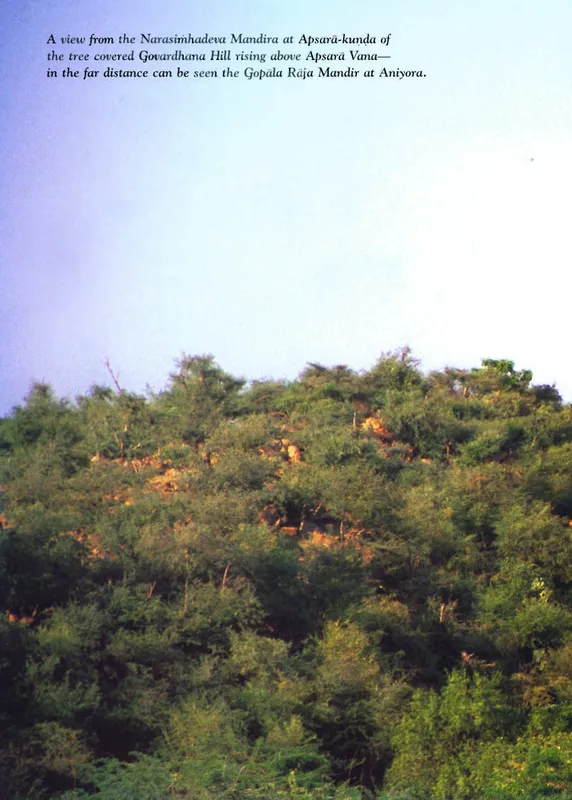
In 2001 the guidebook Govardhana Hill described the forest as still clearly visible, with a good view of it from the roof of the Narasiṁha temple at Apsarā-kuṇḍa; the undated parikramā notes Govardhana say that Apsarā-kuṇḍa lies within the forest.[1 +3]
Location
| Where it is | 'surrounds the tip of Govardhana Hill on the eastern side'[13] 'Apsara Vana surrounds the tail-end of Govardhana Hill'[13] |
|---|
Places at Apsarā Vana
1 places
Nearby places
Govardhana · Narasiṁha Mandira (Govardhana)
Pictures
1 pictures
Where the sources differ
Why Apsarā-kuṇḍa, inside the forest, has its name.
Accounts differ Why Apsarā-kuṇḍa (inside Apsarā Vana, next to the rāsa place) is so called
- Śrī Vraja-maṇḍala Parikramā (2007)named after Śrīmatī Rādhikā, who is likened to the most beautiful apsarā; Apsarā-kuṇḍa and Navala-kuṇḍa are the melted forms of Rādhā and Kṛṣṇa in the rāsa
- Govardhana Hill: India's Most Sacred Mountain (2001)created when the seven main Apsarās came to perform Kṛṣṇa's abhiṣeka (one of 108 kuṇḍas made by the bathing water); also, Rādhā and the gopīs melted into it in the rāsa
- the undated parikramā notes Govardhanathe apsaras danced and had their abhiṣeka here at the time of Kṛṣṇa's abhiṣeka after Indra-pūjā/Govardhana-pūjā; Rādhā's and the gopīs' bodies melted into it
- Vraja-bhakti-vilāsa, p. 218 (bathing prayer)born from the sport (helā) of the Apsarās and from Kṛṣṇa's bathing by Indra
References
13 references
- Govardhana Hill: India's Most Sacred Mountain (2001), Rajasekhara dasa Brahmacari, PDF p. 119
- Govardhana Hill: India's Most Sacred Mountain (2001), Rajasekhara dasa Brahmacari, PDF p. 123
- Govardhana Hill: India's Most Sacred Mountain (2001), Rajasekhara dasa Brahmacari, PDF p. 22
- the undated parikramā notes Govardhana, ¶121
- Śrīla Nārāyaṇa Bhaṭṭa, Vraja-bhakti-vilāsa, printed p. 2, verse 18, 1st ed., publ. Bābā Kṛṣṇadāsa, Kusuma-sarovara, Saṁvat 2008
- Śrīla Nārāyaṇa Bhaṭṭa, Vraja-bhakti-vilāsa, printed p. 218, sections 34-35, 1st ed., publ. Bābā Kṛṣṇadāsa, Kusuma-sarovara, Saṁvat 2008
- Śrīmad-Bhāgavatam 10.27.22–23, GRETIL
- Śrīmad-Bhāgavatam 10.27.24, GRETIL
- Śrīla Prabhupāda, Kṛṣṇa, the Supreme Personality of Godhead (Kṛṣṇa book), Chapter 27, 'Prayers by Indra, the King of Heaven' · vedabase.io
- Śrīla Jīva Gosvāmī: commentary on ŚB 10.27.24, Bhagavata Vidya Pith edition, ed. Bhagavata Rishi and Krishna Shankar Shastri, 1996
- Varāha Purāṇa, adhyāya 164, verses 20b-21, Sanskrit Wikisource
- Śrīla Narahari Cakravartī, Bhakti-ratnākara, Fifth Wave, 1912 ed. p. 203, 2nd ed., 1912
- Govardhana Hill: India's Most Sacred Mountain (2001), Rajasekhara dasa Brahmacari, p. 105