Balabhadra-kuṇḍa (Mathurā)
बलभद्र-कुण्ड (मथुरा) Hindi name proposed
On this page
In short
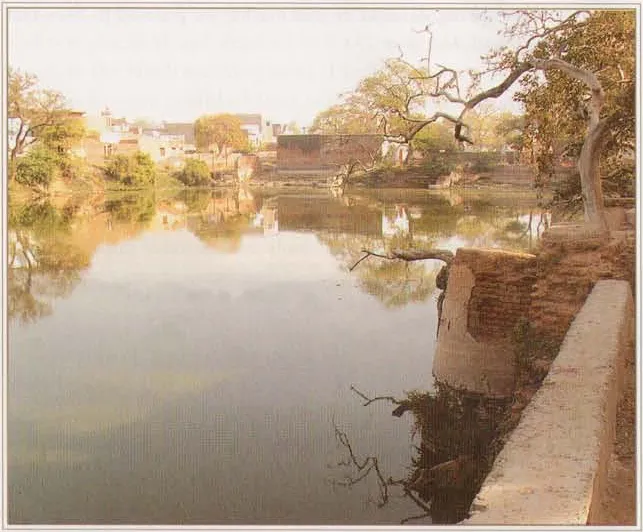
Balabhadra-kuṇḍa is a pond on Mathurā's ten-mile parikramā, the walk around the city, just before the temple of Bhūteśvara Mahādeva. The guidebook Śrī Vraja-maṇḍala Parikramā (2007) says that temples of Dāūjī (Balarāma) and Lord Jagannātha stand on its banks.[1 +1] No scripture, Gosvāmī text or statement of Śrīla Prabhupāda found so far names the pond, and no source says how it got its name.[3]
Key facts
| Kind | kuṇḍa |
|---|---|
| Region · area | Mathurā |
Traditional accounts
Two older texts name ponds in this part of Mathurā, but neither says that it is this one. According to the Bhakti-ratnākara, Śrīla Rāghava Paṇḍita Gosvāmī of Govardhana showed Śrīla Śrīnivāsa Ācārya and Śrīla Narottama dāsa Ṭhākura a Baladeva-kuṇḍa and a Kṛṣṇa-kūpa (well) in Mathurā city, near Kaṁsa-khāli and Kubjā's well, and told them that Rāma and Kṛṣṇa had played there with Their friends; whether that Baladeva-kuṇḍa is this pond is not certain.[4 +1] The Varāha Purāṇa, in its order of the Mathurā parikramā, names right after Bhūteśvara an auspicious pond called Bali-hrada, made for water sports, whose mere sight frees one from all sins (summarised here, not translated).[3]
History
In 1883 the historian F. S. Growse wrote that the temple of Bhūteśvara overlooked the old and ruinous Balabhadra-kuṇḍa. A fair was held by the pond on the full moon of Śrāvaṇa, and the pond was partly cleaned out and repaired as relief work in the famine of 1877–78. Its outer wall had cross-bars of an old Buddhist railing built into it, and among the small shrines around it were shrines of Balarāma as Dāūjī, of Gaṇeśa and of Narasiṁha.[6]
Visiting today
Śrī Vraja-maṇḍala Parikramā (2007) brings the pilgrim to Balabhadra-kuṇḍa after the temple of Kaṅkālī-devī, and from here on to Bhūteśvara Mahādeva. It prints a photograph of the pond; its present state has not been checked.[1]
The temples on the banks
- Dāūjī Mandira: a temple of Dāūjī, a name of Balarāma, Kṛṣṇa's elder brother, as Śrīla Prabhupāda explained on the way to Gokula in 1971. Śrī Vraja-maṇḍala Parikramā (2007) names the temple but says nothing more about it. Growse (1883) already records a small Dāūjī shrine among the shrines around the pond.[1 +2]
- Jagannātha Mandira: a temple of Lord Jagannātha, known only from the same guidebook, which gives no date, founder or description. Growse (1883) names no Jagannātha shrine at the pond.[1 +1]
Location
| Where it is | after Kaṅkālī-devī, before Bhūteśvara[8] |
|---|
Places at Balabhadra-kuṇḍa (Mathurā)
Nearby places
References
- Śrī Vraja-maṇḍala Parikramā (2007), PDF p. 48
- Śrīla Prabhupāda, Parikramā on the Way to Gokula, Vṛndāvana, 29 November 1971 · vedabase.io
- Varāha Purāṇa, 160.34, in the order of the Mathurā parikramā after 160.31-33, Sanskrit Wikisource
- Śrīla Narahari Cakravartī, Bhakti-ratnākara, Fifth Wave, 1912 ed. p. 183, 2nd ed., 1912
- Śrīla Narahari Cakravartī, Bhakti-ratnākara, Fifth Wave, 1912 ed. p. 165, 2nd ed., 1912
- Mathurá (1883), F. S. Growse, B.C.S., M.A. Oxon., C.I.E. (as the title page gives him
- Mathurá (1883), F. S. Growse, B.C.S., M.A. Oxon., C.I.E. (as the title page gives him, p. 132
- Śrī Vraja-maṇḍala Parikramā (2007), p. 70-71