Bhūteśvara Mahādeva
भूतेश्वर महादेव
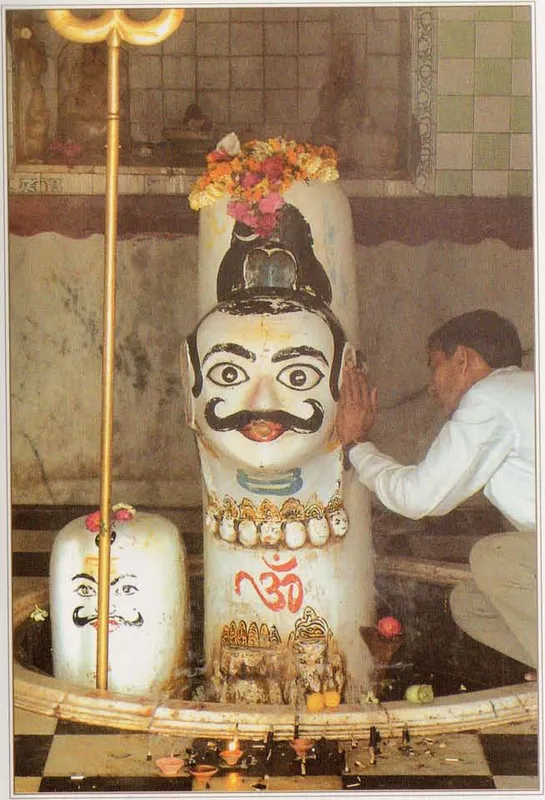
- What it is
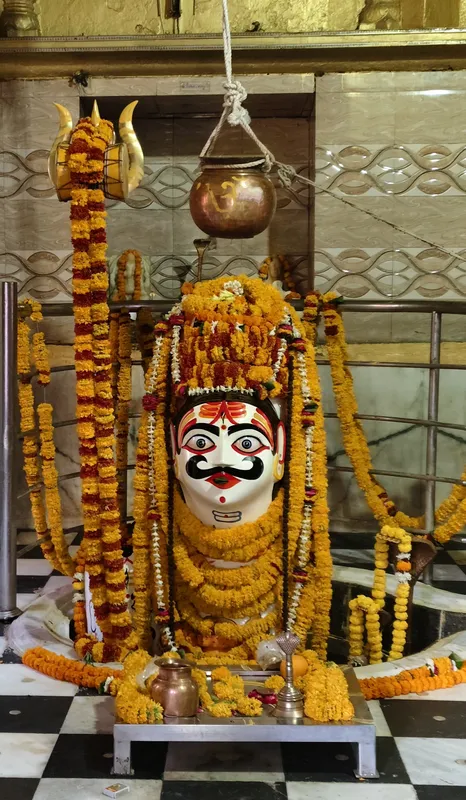
- Bhūteśvara Mahādeva is the Śiva who guards Mathurā.
- Visiting
- Śrī Vraja-maṇḍala Parikramā (2007) brings the pilgrim on Mathurā's ten-mile parikramā from Balabhadra-kuṇḍa to the temple of Bhūteśvara, and Vṛndāvana-Dhāma Ki Jaya!
- Places here
- Pātāla-devī (Mathurā)
In short
Bhūteśvara Mahādeva is the Śiva who guards Mathurā. The Varāha Purāṇa tells how Lord Varāha made him the city's kṣetra-pāla, the protector of the holy field, and the Garga-saṁhitā calls him Mathurā's gate-keeper.[1 +5] In the Padma Purāṇa Kṛṣṇa calls Bhūteśvara most dear to Him and says that one who does not worship him does not see Mathurā.[4 +2] Śrī Caitanya Mahāprabhu visited him, and Śrīla Sanātana Gosvāmī and Śrīla Jīva Gosvāmī identify him with the Śiva of Kaṁsa's bow sacrifice.[8 +5]
Key facts
| Kind | temple |
|---|---|
| Region · area | Mathurā |
| Ācāryas | Śrī Caitanya Mahāprabhu, Śrīla Sanātana Gosvāmī, Śrīla Jīva Gosvāmī, Śrīla Rūpa Gosvāmī, Śrīla Rāghava Paṇḍita Gosvāmī of Govardhana |
Why it is glorified
In the Varāha Purāṇa the Earth asks who guards Mathurā.
The protector of Mathurā
In the Varāha Purāṇa the Earth asks who guards Mathurā. Lord Varāha answers that by seeing the lord of beings one obtains the fruit of Mathurā. After a thousand years of austerity, Hara (Śiva) was satisfied by Him and asked for a place in Mathurā for ever, and Varāha made him its field-protector: when he is seen, the fruit of the Lord's own field is gained (summarised here, not translated).[1 +5] In the Purāṇa's order of the Mathurā parikramā, going to the field-protector Śiva Bhūteśvara makes the whole circuit of the city fruitful.[1 +5] Read more: How Śiva became Bhūteśvara, the guardian of Mathurā →
The Garga-saṁhitā calls "Śiva named Bhūteśvara" the kṣattā, the gate-keeper, of Mathurā.[1 +5] Śrīla Rūpa Gosvāmī's Śrī Mathurā-stava praises Mathurā as the city whose door-keeping is sought by the lords of the gods headed by Śiva, and Śrīla Baladeva Vidyābhūṣaṇa explains that Bhūteśvara and others are its door-keepers (summarised here, not translated).[2 +2] The Nārada Purāṇa says that one who sees and duly worships Bhūteśa, with Raṅgeśa, Mahāvidyā and Bhairava, obtains the fruit of pilgrimage.[16]
Dear to Kṛṣṇa
In the Padma Purāṇa Kṛṣṇa praises Bhūteśvara, the lord of beings, who frees even sinners and who stays in the city for ever out of love for Him. Without honouring Bhūteśvara a pilgrim has not really seen Mathurā, and without worshipping Śiva, Kṛṣṇa's great devotee, no one attains devotion to Kṛṣṇa (summarised here, not translated).[4 +2]
अधना अपि ते धन्या मथुरां ये स्मरंति ते । यत्र भूतेश्वरो देवो मोक्षदः पापिनामपि मम प्रियतमो नित्यं देवो भूतेश्वरः परः । यः कदापि मम प्रीत्यै न संत्यजति तां पुरीम् भूतेश्वरं यो न नमेन्न पूजयेन्न वास्मरेद्दुश्चरितो मनुष्यः । नैनां स पश्येन्मथुरां मदीयां स्वयंप्रकाशां परदेवताख्याम् न कथं मयि भक्तिं स लभते पापपूरुषः । यो मदीयं परं भक्तं शिवं संपूजयेन्नहि मन्मायामोहितधियः प्रायस्ते मानवाधमाः । भूतेश्वरं न नमंति न स्मरंति स्तुवंति ये
adhanā api te dhanyā mathurāṁ ye smaraṁti te
yatra bhūteśvaro devo mokṣadaḥ pāpināmapi mama priyatamo nityaṁ devo bhūteśvaraḥ paraḥ
yaḥ kadāpi mama prītyai na saṁtyajati tāṁ purīm bhūteśvaraṁ yo na namenna pūjayenna vāsmaredduścarito manuṣyaḥ
naināṁ sa paśyenmathurāṁ madīyāṁ svayaṁprakāśāṁ paradevatākhyām na kathaṁ mayi bhaktiṁ sa labhate pāpapūruṣaḥ
yo madīyaṁ paraṁ bhaktaṁ śivaṁ saṁpūjayennahi manmāyāmohitadhiyaḥ prāyaste mānavādhamāḥ
bhūteśvaraṁ na namaṁti na smaraṁti stuvaṁti ye
Śrīla Rūpa Gosvāmī quotes these verses, with Varāha's words of appointment, in a section on Bhūteśvara in his Mathurā-māhātmya (summarised here, not translated).[4 +1] As a general teaching, not about this temple, Śrīla Prabhupāda writes that Vaiṣṇavas accept Lord Śiva as the foremost Vaiṣṇava.[18]
Divine pastimes
Kaṁsa's bow sacrifice
Śrīmad-Bhāgavatam tells that Kaṁsa ordered a bow sacrifice on the Caturdaśī day, with animals offered to the bhūta-rāja, the lord of ghosts, Lord Śiva.[10 +3] The verse names no temple. Śrīla Sanātana Gosvāmī and Śrīla Jīva Gosvāmī explain the bhūta-rāja as Śrī Rudra named Bhūteśvara, the protector of Mathurā; Śrīla Jīva Gosvāmī adds that he was also the presiding deity of the bow (summarised here, not translated).[10 +4] Śrīla Prabhupāda tells Kaṁsa's plan in his Kṛṣṇa book without naming a temple:[10 +3]
General teaching (does not name the place)“Kaṁsa also advised his friends to arrange to worship Lord Śiva by offering animal sacrifices and performing the sacrifice called Dhanur-yajña and the sacrifice performed on the fourteenth day of the moon, known as Caturdaśī. This date falls three days after Ekādaśī, and it is set aside for the worship of Lord Śiva.”
Śrīla Prabhupāda, Kṛṣṇa, the Supreme Personality of Godhead, Chapter 36 · vedabase.io
When Kṛṣṇa came to Mathurā He asked the citizens where the sacrifice was held, found the guarded bow, lifted and strung it, and broke it in half; the Bhāgavatam does not name Bhūteśvara here.[20 +1]
kareṇa vāmena sa-līlam uddhṛtaṃ sajyaṃ ca kṛtvā nimiṣeṇa paśyatām / nṛṇāṃ vikṛṣya prababhañja madhyato yathekṣu-daṇḍaṃ mada-kary urukramaḥ
Easily lifting the bow with His left hand, Lord Urukrama strung it in a fraction of a second as the King’s guards looked on. He then powerfully pulled the string and snapped the bow in half, just as an excited elephant might break a stalk of sugar cane.
Translation: Śrīla Prabhupāda's disciples (BBT)In Śrīla Jīva Gosvāmī's Gopāla-campū, Akrūra tells Kṛṣṇa and Balarāma that Kaṁsa has invited them under the pretext of the great festival of the bow of Bhūta-rāja on the Caturdaśī. Kṛṣṇa replies that He too will come and satisfy Bhūteśa by offering "him", apparently Kaṁsa, as the sacrificial offering (summarised here, not translated).[12 +1]
Kaṁsa-khāta
The Bhāgavatam tells how Kṛṣṇa threw Kaṁsa from his high seat onto the wrestling ground, killed him and dragged his body along the ground before everyone; it names neither Bhūteśvara nor a Kaṁsa-khāta.[22 +2]
taṃ samparetaṃ vicakarṣa bhūmau harir yathebhaṃ jagato vipaśyataḥ / hā heti śabdaḥ su-mahāṃs tadābhūd udīritaḥ sarva-janair narendra
As a lion drags a dead elephant, the Lord then dragged Kaṁsa’s dead body along the ground in full view of everyone present. O King, all the people in the arena tumultuously cried out, “Oh! Oh!”
Translation: Śrīla Prabhupāda's disciples (BBT)Śrīla Sanātana Gosvāmī explains that this dragging made a great ditch, known in Mathurā as Kaṁsa-khāta or Kaṁsa-nadī, which in his day could still be seen joined with Viśrānti-tīrtha. According to Śrīla Nārāyaṇa Bhaṭṭa Gosvāmī's Vraja-bhakti-vilāsa, Bhūteśvara Mahādeva stands at Kaṁsa-khāta, where the gods set him up for the protection of beings after Kṛṣṇa killed Kaṁsa (summarised here, not translated).[25 +2]
Śrī Caitanya Mahāprabhu's visit
The Caitanya-caritāmṛta names Bhūteśvara among the holy places that Śrī Caitanya Mahāprabhu visited in Mathurā after bathing in the twenty-four ghāṭas:[8 +1]
স্বয়ম্ভু, বিশ্রাম, দীর্ঘবিষ্ণু, ভূতেশ্বর ।
মহাবিদ্যা, গোকর্ণাদি দেখিলা বিস্তর ॥ ১৯১ ॥
svayambhu, viśrāma, dīrgha-viṣṇu, bhūteśvara
mahāvidyā, gokarṇādi dekhilā vistara
Śrī Caitanya Mahāprabhu visited all the holy places on the banks of the Yamunā, including Svayambhu, Viśrāma-ghāṭa, Dīrgha Viṣṇu, Bhūteśvara, Mahāvidyā and Gokarṇa.
Translation: Śrīla A.C. Bhaktivedanta Swami PrabhupādaIn the accounts of Śrīla Murāri Gupta and Śrīla Locana dāsa Ṭhākura, His guide Kṛṣṇadāsa shows Him the liṅga of Bhūteśvara north of the Sapta-samudra-kuṇḍa and of the stone made for killing Devakī's sons; neither tells a story of the deity (summarised here, not translated).[28 +1]
Traditional accounts
Three guidebooks, Govardhana Hill (2001), The Colour Guide to Rādhā-kuṇḍa (1999) and The Color Guide to Vṛndāvana (2000), count …
Three guidebooks, Govardhana Hill (2001), The Colour Guide to Rādhā-kuṇḍa (1999) and The Color Guide to Vṛndāvana (2000), count Bhūteśvara of Mathurā among the five Śiva Deities who protect Vraja, with Gopīśvara of Vṛndāvana, Nandīśvara of Nandagrāma, Kāmeśvara of Kāmyavana and Cakaleśvara of Govardhana. The Colour Guide adds that Kṛṣṇa Himself appointed Śiva as the protector of the dhāma, and Śrī Vraja-maṇḍala Parikramā (2007) names Bhūteśvara as one of Mathurā's four field-protectors, with Pīpaleśvara, Raṅgeśvara and Gokarṇa. No scripture or Gosvāmī text found so far gives these groupings.[30 +5]
The Gosvāmīs and ācāryas
According to the Bhakti-ratnākara, Śrīla Rāghava Paṇḍita Gosvāmī of Govardhana, taking Śrīla Śrīnivāsa Ācārya and Śrīla Narottama …
According to the Bhakti-ratnākara, Śrīla Rāghava Paṇḍita Gosvāmī of Govardhana, taking Śrīla Śrīnivāsa Ācārya and Śrīla Narottama dāsa Ṭhākura round Mathurā, showed them "this Mahādeva Bhūteśvara, the field-protector". He said that his mere sight takes away sins and that one who worships him gains devotion to Kṛṣṇa, and he quoted the verses of the Varāha and Padma Purāṇas (summarised here, not translated).[6 +1]
According to the Prema-vilāsa, when Śrīla Narottama dāsa Ṭhākura first reached Mathurā on his way to Vraja, he saw Bhūteśvara before going to the temple of Keśava-rāya and Śrī Kṛṣṇa's birthplace and bathing at Viśrāma-ghāṭa; the Narottama-vilāsa tells the arrival differently (see below).[41 +1]
Śrīla Nārāyaṇa Bhaṭṭa Gosvāmī's Vraja-bhakti-vilāsa gives prayers to Bhūteśvara for the Mathurā parikramā, one of which it ascribes to the Rudra-yāmala: installed by Hari Himself for the protection of beings, always the giver of boons, obeisance to Bhūteśa; it is to be recited eleven times with eleven obeisances (summarised here, not translated).[25 +2]
Visiting today
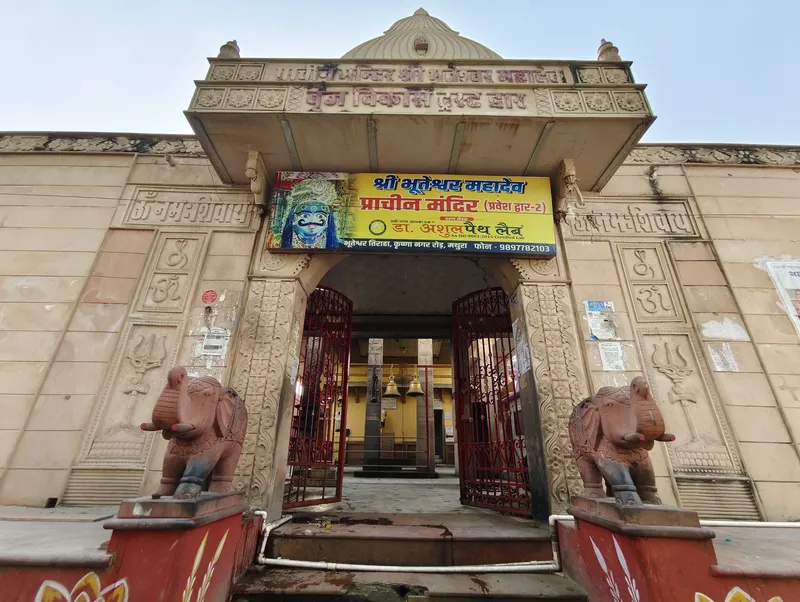
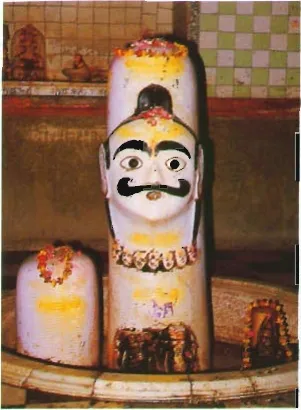
Śrī Vraja-maṇḍala Parikramā (2007) brings the pilgrim on Mathurā's ten-mile parikramā from Balabhadra-kuṇḍa to the temple of Bhūteśvara, and Vṛndāvana-Dhāma Ki Jaya! (c. 1986) says that stairs beside the temple lead down to the shrine of the goddess. Both books print photographs of the liṅga. The present state of the temple has not been checked.[33 +2]
Pātāla-devī
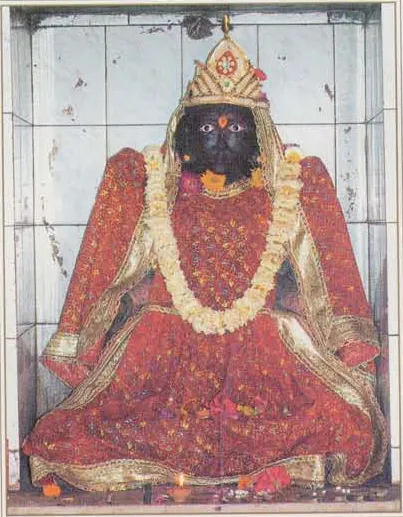
Pātāla-devī, also called Paṭaleśvarī-devī, is a goddess worshipped in a cave in the temple compound.[33 +2] According to the local tradition recorded in Śrī Vraja-maṇḍala Parikramā (2007), Kaṁsa worshipped her, and Vṛndāvana-Dhāma Ki Jaya! (c. 1986) calls her Bhūteśvara's wife; this is not certain, since no scripture or ācārya's work found so far names her.[33 +3] Govardhana Hill (2001) counts her among four important Devī temples of Vraja.[47] The earliest dated mention found is in the Bengali Vṛndāvana-kathā (1920), which notes an image named Pātāla-devī at the temple of Bhairava Bhūteśvara in Mathurā.[48] A goddess of the same name in Vṛndāvana, whom one guidebook calls Yogamāyā, is a different shrine.[47 +1]
Places at Bhūteśvara Mahādeva
1 places
Nearby places
Balabhadra-kuṇḍa (Mathurā) · Kṛṣṇa Janma-sthāna · Jñāna-vāpī · Madhuvana
Pictures
4 pictures
History
In 1883 the historian F. S. Growse described the temple as a quadrangle with a pyramidal tower and cloister, built by the Marāṭhās towards the end of the eighteenth century, above the old Balabhadra-kuṇḍa, and said that the site was once the centre of the town.[36] In 1987 the historian A. W. Entwistle reported that a pilgrim from Bikaner who came to Mathurā in 1656 spoke of a wonderful temple at Bhūteśvara; he and Prabhudayāl Mītal (1966) also give the present temple to the Marāṭhās, without a year, and in 1966 Mītal wrote that its Śiva image was quite old. Entwistle noted that the mound behind the temple has yielded finds of the Maurya, Śuṅga and Kuṣāṇa periods, now in the museum at Mathurā, among them a lintel with a Śiva-liṅga.[37 +2]
Where the sources differ
How Bhūteśvara came to be in Mathurā (who established him).
Accounts differ How Bhūteśvara came to be in Mathurā (who established him).
- Vraja-bhakti-vilāsa, p. 55 (prayer cited from the Rudra-yāmala)Installed by Hari Himself for the protection of beings (स्थापितो हरिणा स्वयम्).
- Vraja-bhakti-vilāsa, p. 64Then the gods came and, for the protection of beings, set up Bhūteśvara Mahādeva, among the tīrthas and deities of the end of the Dvāpara age.
- Garga-saṁhitā, Mathurā-khaṇḍa 25.16 (with 25.9)Bhūteśvara, husband of Satī, performed austerities in Madhuvana and by Kṛṣṇa's grace (became) the kṣattā of Mathurā.
- Varāha Purāṇa 168.3-6 (quoted by Śrīla Rūpa Gosvāmī, Mathurā-māhātmya v.221, and the Bhakti-ratnākara, p. 169)After a thousand years of austerity Hara was satisfied by Me (Varāha), who grants him a place in Mathurā: you will be the field-protector in Mathurā (Śrīla Rūpa Gosvāmī quotes only the appointment, 168.6; the Bhakti-ratnākara quotes the appointment and 168.2).
The wording of these accounts is our summary of the sources, not a published translation.
Accounts differ Whether, and in which form, Kaṁsa worshipped Śiva at Bhūteśvara.
- Vṛndāvana-Dhāma Ki Jaya! (c. 1986), p. 9Says that according to the Skanda Purāṇa Kaṁsa worshipped Lord Śiva here in the form of Bhūteśvara; no such Skanda passage has been found.
- Śrīla Sanātana Gosvāmī and Śrīla Jīva Gosvāmī on ŚB 10.36.26The 'bhūta-rāja' of Kaṁsa's bow sacrifice is Śrī Rudra named Bhūteśvara, the protector of Mathurā (Jīva: the deity of the bow).
- Vaṁśīdhara on Śrīdhara's commentary to ŚB 10.36.26First Rudra bearing a Bhairava form, then the Gosvāmīs' reading (Bhūteśvara, protector of Mathurā).
- Śrīla Prabhupāda, Kṛṣṇa book 36Kaṁsa arranged to worship Lord Śiva with animal sacrifices (Dhanur-yajña, Caturdaśī); the form of Śiva worshipped so by demons is Kālabhairava, and Kaṁsa belonged to that group. No temple is named.
The wording of these accounts is our summary of the sources, not a published translation.
Accounts differ What Śrīla Narottama dāsa Ṭhākura did first on reaching Mathurā (and whether Bhūteśvara is named).
- Prema-vilāsa (Nityānanda dāsa), Eleventh Vilāsa, printed p. 62He came to Mathurā, saw Bhūteśvara, went to Keśo-rāya's door, saw Śrī Kṛṣṇa's birthplace, bathed at Viśrāma and stayed in the town.
- Narottama-vilāsa (Śrīla Narahari Cakravartī), Second Vilāsa 181-182, printed p. 13'First' he went to Śrī Mathurā's Viśrāma-ghāṭa, bathed in the Yamunā and stayed there; Bhūteśvara is not named.
Accounts differ Who the goddess of the Bhūteśvara compound is.
- Śrī Vraja-maṇḍala Parikramā (2007), p. 70Pātāla-devī, 'whom Kaṁsa worshipped' (no further identity).
- Vṛndāvana-Dhāma Ki Jaya! (c. 1986), p. 9Paṭaleśvarī-devī, 'Lord Bhūteśvara's wife'.
- Govardhana Hill: India's Most Sacred Mountain (2001), p. 65Pateleśvarī Devī at Mathurā, one of four Devī temples of Vraja, listed apart from Durgā Devī (Yogamāyā) at Vṛndāvana.
More on this place
How Śiva became Bhūteśvara, the guardian of Mathurā
References
51 references
- Varāha Purāṇa, 168.2-6 (Wikisource numbering; the question is 168.1), Sanskrit Wikisource
- Garga-saṁhitā, Mathurā-khaṇḍa (5) 25.9 (chapter 'Śrī-Mathurā-māhātmya-varṇana'), Sanskrit Wikisource
- Varāha Purāṇa, 160.30-32, Sanskrit Wikisource
- Śrīla Rūpa Gosvāmī, Mathurā-māhātmya v.221-223
- Śrīla Rūpa Gosvāmī, Mathurā-māhātmya v.106
- Śrīla Narahari Cakravartī, Bhakti-ratnākara, Fifth Wave, 1912 ed. pp. 169-170, 2nd ed., 1912
- Padma Purāṇa, Pātāla-khaṇḍa 73.48-52, Sanskrit Wikisource
- Śrīla Kṛṣṇadāsa Kavirāja Gosvāmī, Śrī Caitanya-caritāmṛta, Madhya-līlā 17.191, online edition · vedabase.io
- Śrīla Prabhupāda, Śrī Caitanya-caritāmṛta, Madhya-līlā 17.191, translation · vedabase.io
- Śrīmad-Bhāgavatam 10.36.26, GRETIL
- Bṛhad-vaiṣṇava-toṣaṇī (Śrīla Sanātana Gosvāmī) on Śrīmad-Bhāgavatam: commentary on ŚB 10.36.26, Bhagavata Vidya Pith edition, ed. Bhagavata Rishi and Krishna Shankar Shastri, 1996
- Laghu-vaiṣṇava-toṣaṇī (Śrīla Jīva Gosvāmī) on Śrīmad-Bhāgavatam: commentary on ŚB 10.36.26'), Bhagavata Vidya Pith edition, ed. Bhagavata Rishi and Krishna Shankar Shastri, 1996
- Śrīla Prabhupāda, Kṛṣṇa, the Supreme Personality of Godhead, Chapter 36 · vedabase.io
- Śrīla Rūpa Gosvāmī, Śrī Mathurā-stava v.2, after the edition of Bhakti Saranga Goswami and Purushottam Das, Vrindavan, 1959
- Baladeva Vidyābhūṣaṇa's ṭīkā on Rūpa Gosvāmī's Śrī Mathurā-stava, ṭīkā on Śrī Mathurā-stava v.2, after the edition of Bhakti Saranga Goswami and Purushottam Das, Vrindavan, 1959
- Nārada Purāṇa, उत्तरार्धः/अध्यायः 79 v.79-51: Uttara-bhāga, chapter 79, verse 51
- Padma Purāṇa, Pātāla-khaṇḍa 73.48-52, Sanskrit Wikisource
- Śrīla Prabhupāda, Kṛṣṇa, the Supreme Personality of Godhead, Chapter 34 · vedabase.io
- Śrīla Jīva Gosvāmī, Gopāla-campū, Uttara-campū, Pūraṇa 2, ¶[38]-[41]
- Śrīmad-Bhāgavatam 10.42.17, GRETIL
Show all 51 references
- Śrīla Prabhupāda, Kṛṣṇa, the Supreme Personality of Godhead, Chapter 42 · vedabase.io
- Śrīmad-Bhāgavatam 10.44.37, GRETIL
- Śrīmad-Bhāgavatam 10.44.38, GRETIL
- Śrīla Prabhupāda, Kṛṣṇa, the Supreme Personality of Godhead, Chapter 44 · vedabase.io
- Śrīla Nārāyaṇa Bhaṭṭa, Vraja-bhakti-vilāsa, printed p. 43; text locator (2) dvitīya adhyāya, part 12 v.42, 1st ed., publ. Bābā Kṛṣṇadāsa, Kusuma-sarovara, Saṁvat 2008
- Śrīla Nārāyaṇa Bhaṭṭa, Vraja-bhakti-vilāsa, printed p. 64; text locator (3) dvitīya adhyāya v.35, 1st ed., publ. Bābā Kṛṣṇadāsa, Kusuma-sarovara, Saṁvat 2008
- Bṛhad-vaiṣṇava-toṣaṇī (Śrīla Sanātana Gosvāmī) on Śrīmad-Bhāgavatam: commentary on ŚB 10.44.38'), Bhagavata Vidya Pith edition, ed. Bhagavata Rishi and Krishna Shankar Shastri, 1996
- Kṛṣṇa-caitanya-caritāmṛta of Śrīla Murāri Gupta, prakrama 4, sarga 4, v.21
- Śrīla Locana dāsa Ṭhākura, Caitanya-maṅgala, Śeṣa-khaṇḍa, 1903 ed. p. 171, right column, section headed 'পঠমঞ্জরী রাগ'
- Govardhana Hill: India's Most Sacred Mountain (2001), Rajasekhara dasa Brahmacari, PDF p. 82
- The Colour Guide to Rādhā-kuṇḍa (1999), Rājaśekhara dāsa Brahmacārī, PDF p. 65
- The Color Guide to Vṛndāvana (2000), Written and Photographed by Rājaśekhara dāsa Brahmacārī, PDF p. 100
- Śrī Vraja-maṇḍala Parikramā (2007), PDF p. 48
- Śrī Vraja-maṇḍala Parikramā (2007), PDF p. 42
- Śrī Vraja-maṇḍala Parikramā (2007), PDF p. 43
- Mathurá (1883), F. S. Growse, B.C.S., M.A. Oxon., C.I.E. (as the title page gives him, p. 131
- A. W. Entwistle, ch. 8 ('The pilgrimage itinerary'), §1.17 'Bhuteshwar', printed p. 319, Egbert Forsten, Groningen, 1987
- Prabhudayāl Mītal, first part ('ब्रज-संस्कृति की भूमिका'), section 'Mathurā kī parikramā', entry 'Bhūteśvara Mahādeva', printed p. 154
- A. W. Entwistle, ch. 4 §12 'Finds at other places along the circumambulation of Mathura', printed p. 126, Egbert Forsten, Groningen, 1987
- Śrīla Narahari Cakravartī, Bhakti-ratnākara, Fifth Wave, 1912 ed. p. 165, 2nd ed., 1912
- Prema-vilāsa, Eleventh Vilāsa (একাদশ বিলাস), printed p. 62 of the Kolkata edition of Baṅgābda 1320 (c. 1913), Kolkata, 1913
- Śrīla Narahari Cakravartī, Narottama-vilāsa, Second Vilāsa, vv. 181-182, printed p. 13 of the 1st ed. (Kiśorī dāsa Bābājī, 1314 Baṅgābda), 1st ed., Baṅgābda 1314
- Śrīla Nārāyaṇa Bhaṭṭa, Vraja-bhakti-vilāsa, printed p. 55; text locator (3) dvitīya adhyāya v.4, 1st ed., publ. Bābā Kṛṣṇadāsa, Kusuma-sarovara, Saṁvat 2008
- Śrī Vraja-maṇḍala Parikramā (2007), PDF p. 31
- Vṛndāvana-Dhāma Ki Jaya! (c. 1986), by Dhruva Mahārāja dāsa, PDF p. 27
- Śrī Vraja-maṇḍala Parikramā (2007), PDF p. 49
- Govardhana Hill: India's Most Sacred Mountain (2001), Rajasekhara dasa Brahmacari, PDF p. 79
- Vṛndāvana-kathā, chapter 14 (চতুর্দ্দশ পরিচ্ছেদ), printed pp. 169-170
- Śrī Vraja-maṇḍala Parikramā (2007), PDF p. 345
- Vṛndāvana-Dhāma Ki Jaya! (c. 1986), by Dhruva Mahārāja dāsa, p. 9
- The Colour Guide to Rādhā-kuṇḍa (1999), Rājaśekhara dāsa Brahmacārī, p. 31