Kaṅkālī-devī Mandira
कंकाली-देवी मन्दिर Hindi name proposed
Also called Kaṁsa-kālī
In short
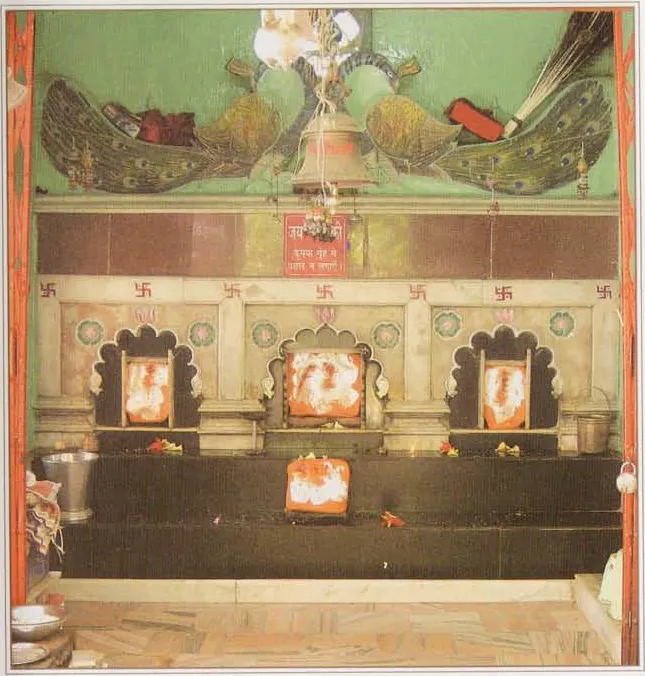
The Kaṅkālī-devī Mandira is a temple of the goddess on Kaṅkālī-ṭīlā, a mound in Mathurā. According to the guidebook Śrī Vraja-maṇḍala Parikramā (2007), she is the eight-armed Durgā whom Kaṁsa tried to kill, thinking that she was Devakī's daughter.[1] Śrīmad-Bhāgavatam tells how the child slipped from Kaṁsa's hands and appeared in the sky as the goddess, but it names no temple and no Kaṅkālī.[2 +3] In 1883 there was only a small shed on top of the mound, and the mound was dug up by archaeologists in 1871 and in 1888-1891.[6 +1] Another guidebook tells the same story under the Mahāvidyā-devī Mandira; the sources differ (see below).
Key facts
| Kind | temple |
|---|---|
| Region · area | Mathurā |
| Ācāryas | Śrīla Narahari Cakravartī Ṭhākura, Śrīla Rāghava Paṇḍita Gosvāmī of Govardhana, Śrīla Śrīnivāsa Ācārya, Śrīla Narottama dāsa Ṭhākura |
Divine pastimes
The goddess who slipped from Kaṁsa's hands
Śrīmad-Bhāgavatam (10.4) tells that Kaṁsa seized Devakī's newborn daughter by the legs and tried to dash her against a stone. She slipped upward from his hands and appeared in the sky as the goddess, the younger sister of Viṣṇu, with eight arms holding weapons.[2 +3]
sā tad-dhastāt samutpatya sadyo devy ambaraṃ gatā / adṛśyatānujā viṣṇoḥ sāyudhāṣṭa-mahābhujā
The child, Yoga-māyā-devī, the younger sister of Lord Viṣṇu, slipped upward from Kaṁsa’s hands and appeared in the sky as Devī, the goddess Durgā, with eight arms, completely equipped with weapons.
Translation: Śrīla A.C. Bhaktivedanta Swami PrabhupādaAbout this place: Does not name the place; it tells the pastime whose goddess Śrī Vraja-maṇḍala Parikramā (2007) identifies with Kaṅkālī-devī (Vṛndāvana-Dhāma Ki Jaya! (c. 1986) tells the same story under Mahāvidyā-devī). When Kaṁsa tried to dash Devakī's newborn daughter against a stone, she slipped upward from his hands and appeared in the sky as the goddess, the younger sister of Viṣṇu, with eight mighty arms holding weapons (ŚB 10.4.8–9).
After speaking to Kaṁsa, the goddess became known on earth by many names in many places.[8 +1] Commenting on that verse, Śrīla Sanātana Gosvāmī says that she came to be worshipped under many names in Śrī Mathurā too, as in Kāśī, Kāmarūpa and other places; he names no shrine in Mathurā (summarised here, not translated).[10]
According to the Bhakti-ratnākara, the places that Śrīla Rāghava Paṇḍita Gosvāmī of Govardhana showed Śrīla Śrīnivāsa Ācārya and Śrīla Narottama dāsa Ṭhākura in Mathurā included the place where Kaṁsa rose to kill the goddess. The book does not say where it was and names no temple.[11 +1]
Traditional accounts
The guidebook Śrī Vraja-maṇḍala Parikramā (2007) says that the temple of Kaṅkālī-devī stands on Kaṅkālī-ṭīlā and that she is the …
The guidebook Śrī Vraja-maṇḍala Parikramā (2007) says that the temple of Kaṅkālī-devī stands on Kaṅkālī-ṭīlā and that she is the same eight-armed Durgā, riding a lion, whom Kaṁsa tried to kill.[1] It also records a local tradition that she is called Kaṁsa-kālī or Kaṅkālī-devī because Kaṁsa worshipped her. No older source for this has been found, so it is not certain; the Bhāgavatam tells only that Kaṁsa tried to kill her.[1 +4]
Śrīla Prabhupāda
No statement of Śrīla Prabhupāda about this temple has been found in the works searched.
No statement of Śrīla Prabhupāda about this temple has been found in the works searched. In a purport to the same chapter of the Bhāgavatam, as a general teaching, he lists some of the names under which the goddess is worshipped in different cities:[8 +1]
General teaching (does not name the place)“The goddess Durgā is celebrated in Calcutta as Kālī, in Bombay as Mumbādevī, in Vārāṇasī as Annapūrṇā, in Cuttack as Bhadrakālī and in Ahmedabad as Bhadrā. Thus in different places she is known by different names.”
Śrīla Prabhupāda, Śrīmad-Bhāgavatam, 10.4.13, purport · vedabase.io
He also explains, as a general teaching, how Vaiṣṇavas regard the energy of the Lord:[14]
General teaching (does not name the place)“Vaiṣṇavas, however, are śuddha-śāktas, or pure bhaktas, because the Hare Kṛṣṇa mahā-mantra indicates worship of the Supreme Lord’s energy, Harā. A Vaiṣṇava prays to the energy of the Lord for the opportunity to serve the Lord along with His spiritual energy.”
Śrīla Prabhupāda, Śrīmad-Bhāgavatam, 10.2.11-12, purport · vedabase.io
Location
| Where it is | on Kaṅkālī-ṭīlā[15] |
|---|
Nearby places
Balabhadra-kuṇḍa (Mathurā)
History
In 1883 Growse described Kaṅkālī-ṭīlā, also called Jainī-ṭīlā, as a large mound beside the Agra-Delhi road between the Bharatpur and Dig gates. On its top a small shed sheltered a piece of a carved pillar, worshipped as the goddess Kaṅkālī, to whom the mound was dedicated. No later date for the present temple has been found.[6]
The district gazetteer of 1911 records that Cunningham (1871) and Führer (1888-1891) excavated the mound and found a Jain stūpa and Jain images with inscriptions of the Kuṣāṇa period.[7] The historian A. W. Entwistle (1987) adds that the mound was once the site of the main Jain stūpa of Mathurā, that nearly all its finds are Jain, from the first century BC to an image dated 1177, and that later digging found a Buddhist establishment and a brick-lined tank of the Kuṣāṇa period.[13]
Where the sources differ
Which Mathurā temple, if any, belongs to the goddess who slipped from Kaṁsa's hands: the guidebooks name two different temples …
Which Mathurā temple, if any, belongs to the goddess who slipped from Kaṁsa's hands: the guidebooks name two different temples, and the older texts name none.
Accounts differ Which Mathurā temple, if any, belongs to the goddess who slipped from Kaṁsa's hands.
- Śrī Vraja-maṇḍala Parikramā (2007) (printed p. 69)Kaṅkālī-devī (Kaṁsa-kālī) on Kaṅkālī-ṭīlā is that eight-armed Durgā.
- Vṛndāvana-Dhāma Ki Jaya! (c. 1986) (1986)Tells her story under 'Mahā-vidyā-devī Mandira', without stating the link.
- Bhakti-ratnākara, printed p. 287Shows the place in Mathurā where Kaṁsa rose to kill the goddess, without naming a temple or Kaṅkālī.
- Varāha 169.38-39; Śrīla Rūpa Gosvāmī v.220; Bhakti-ratnākara p. 169List the goddess Ekānaṁśā beside, not as, Mahāvidyeśvarī among Kṛṣṇa's family; the 1912 Bhakti-ratnākara editor's footnote identifies Ekānaṁśā with Yogamāyā born of Yaśodā.
References
15 references
- Śrī Vraja-maṇḍala Parikramā (2007), PDF p. 47
- Śrīmad-Bhāgavatam 10.4.8, GRETIL
- Śrīmad-Bhāgavatam 10.4.9, GRETIL
- Śrīla Prabhupāda, Śrīmad-Bhāgavatam, 10.4.9, translation · vedabase.io
- Śrīla Prabhupāda, Kṛṣṇa, the Supreme Personality of Godhead, chapter 4 ('Kaṁsa Begins His Persecutions') · vedabase.io
- Mathurá (1883), F. S. Growse, B.C.S., M.A. Oxon., C.I.E. (as the title page gives him, p. 116
- Muttra (1911), D. L. Drake-Brockman, I.C.S. (edited and compiled), p. 291
- Śrīmad-Bhāgavatam 10.4.13, GRETIL
- Śrīla Prabhupāda, Śrīmad-Bhāgavatam, 10.4.13, purport · vedabase.io
- Bṛhad-vaiṣṇava-toṣaṇī (Śrīla Sanātana Gosvāmī) on Bhāgavatam 10.4.13: commentary v.10.4.13, sanātana-gosvāmī (bṛhad-vaiṣṇava-toṣaṇī), Bhagavata Vidya Pith edition, ed. Bhagavata Rishi and Krishna Shankar Shastri, 1996
- Śrīla Narahari Cakravartī, Bhakti-ratnākara, Fifth Wave (pañcama taraṅga), printed p. 287 (1912 ed.), 2nd ed., 1912
- Śrīla Narahari Cakravartī, Bhakti-ratnākara, Fifth Wave (pañcama taraṅga), printed p. 288 (1912 ed.), 2nd ed., 1912
- A. W. Entwistle, ch. 4 §12 'Finds at other places along the circumambulation of Mathura', printed p. 126, Egbert Forsten, Groningen, 1987
- Śrīla Prabhupāda, Śrīmad-Bhāgavatam, 10.2.11-12, purport · vedabase.io
- Śrī Vraja-maṇḍala Parikramā (2007), p. 68-69