Bāṅke-bihārī Mandira (Vṛndāvana)
बाँके बिहारी मन्दिर (वृन्दावन) Hindi name proposed
Also called Bankebihārī Temple, Baṅkī-bihārī
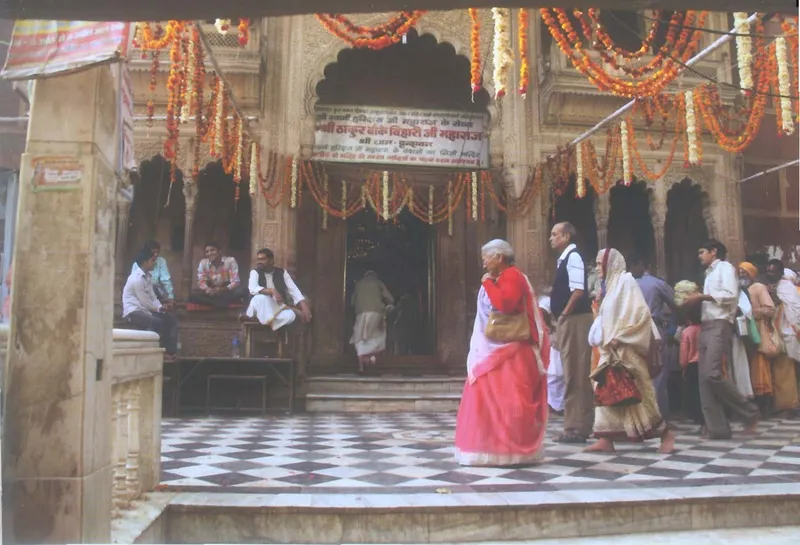
- What it is
- The Bāṅke-bihārī Mandira is a temple of Kṛṣṇa as Śrī Bāṅke-bihārī in Vṛndāvana.
- Visiting
- The Vṛndāvana-kathā (1920) already describes the darśana of Bāṅke-bihārī in short glimpses behind a curtain (jhāṅkī-darśana).
In short
The Bāṅke-bihārī Mandira is a temple of Kṛṣṇa as Śrī Bāṅke-bihārī in Vṛndāvana. The guidebooks say that Śrī Svāmī Haridāsa found the Deity in Nidhuvana, and that He was later brought to this temple.[1 +5] Vṛndāvana, the Playground of God (2010) counts it, with the Kṛṣṇa-Balarāma Mandira, as perhaps the most popular place of worship in the town.[2 +5] The present building dates from 1864, according to two guidebooks and a historian.[3 +4] No scripture or Gosvāmī text speaks of the Deity or the temple.[1 +5]
Key facts
| Kind | temple |
|---|---|
| Region · area | Vṛndāvana |
| Ācāryas | Svāmī Haridāsa (no profile on nandgramdham.org/acharyas/) |
Traditional accounts
The Deity
All the guidebooks say that Śrī Svāmī Haridāsa found the Deity of Bāṅke-bihārī in Nidhuvana; Śrī Vraja-maṇḍala Parikramā (2007) says that he recovered Him from Viśākhā-kuṇḍa there. Where exactly in Nidhuvana is told in different ways (see below).[1 +5] The guidebooks call Śrī Svāmī Haridāsa a follower of the Nimbārka-sampradāya and the teacher of the singer Tānsena; he is not a Gauḍīya ācārya, and his dates have not been checked against any older source.[1 +5]
According to Śrī Vraja-maṇḍala Parikramā, Bāṅke-bihārī first lived in Nidhuvana and then moved to the present temple; the book gives no dates, so this is not certain. The Bengali Vṛndāvana-kathā (1920) says the same.[1 +2]
Śrī Vraja-maṇḍala Parikramā says that there is no Deity of Śrī Rādhā beside Kṛṣṇa in this temple and that His lotus feet can be seen only on Akṣaya-tṛtīyā, in the month of Vaiśākha; Vṛndāvana, the Playground of God says that some take Him to be a combined form of Rādhā and Kṛṣṇa.[1 +2]
The name
The undated parikramā notes Vṛndāvana explain bāṅke as "bent in three places", and Vṛndāvana, the Playground of God explains bihārī as the one who enjoys His pastimes in the forests.[2 +2] Giving the name to a disciple in 1974, Śrīla Prabhupāda explained it; he was not speaking about this temple:[2 +2]
General teaching (does not name the place)Bāṅke means "curved." Kṛṣṇa stands always this. That is Bāṅke-bihārī.
Śrīla Prabhupāda, Initiations, Los Angeles, 10 January 1974 · vedabase.io
Śrīla Prabhupāda
No statement of Śrīla Prabhupāda about this temple has been found in the works searched.
No statement of Śrīla Prabhupāda about this temple has been found in the works searched. In his recorded talks in Vṛndāvana it is mentioned only by disciples: in 1975 about its sale of prasādam, and in 1977 about a kīrtana route through the town.[16]
Visiting today
The Vṛndāvana-kathā (1920) already describes the darśana of Bāṅke-bihārī in short glimpses behind a curtain (jhāṅkī-darśana).[13] The guidebooks say that the curtain is drawn every minute or every few minutes, and they give different stories for this custom:
Accounts differ The story given for the short (jhāṅkī) darśana behind a curtain.
- Śrī Vraja-maṇḍala Parikramā (2007)An eminent devotee gazed at the deity for a long time; Bāṅke-bihārī went with him to his village and was brought back by the temple gosvāmīs, after which the momentary darśana was introduced.
- Vṛndāvana, the Playground of God (2010)The deity used to run out of Svāmī Haridāsa's hut to look for him when he went begging, so Haridāsa closed a curtain before the altar; the pūjārīs now fear He may run out looking for Haridāsa.
The Color Guide to Vṛndāvana (2000) prints morning and evening darśana hours, and Vṛndāvana, the Playground of God (2010) says that the first programme of the day is at 9 a.m. These times may have changed.[2 +5]
Location
| Where it is | map key 22[17] |
|---|
Nearby places
Aṭhkhambā
Pictures
2 pictures
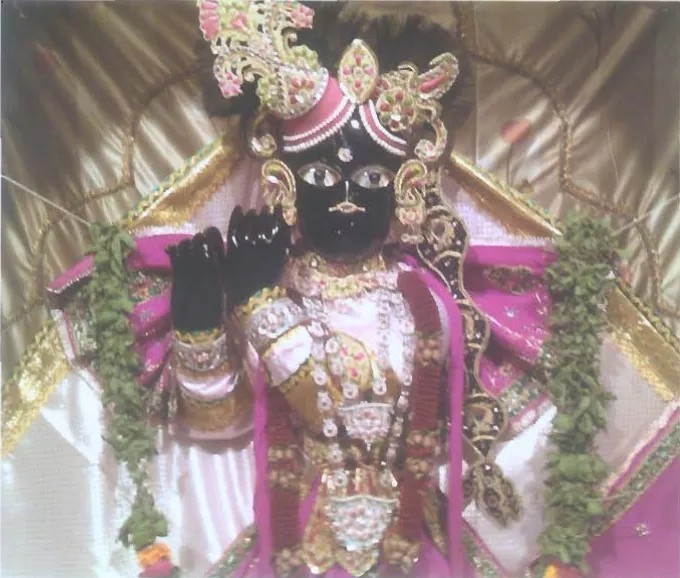
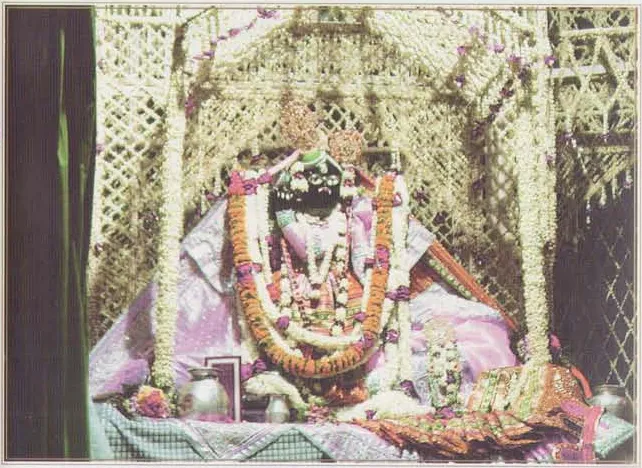
History
The historian A. W. Entwistle (1987) reports that in the late eighteenth century, after a dispute over the Deity, the temple's Gosvāmīs, its hereditary priests, moved Bāṅke-bihārī to the present site, and that they had the present temple built in 1864 in place of a small one. The Color Guide to Vṛndāvana (2000) and the undated parikramā notes Vṛndāvana also give 1864; no inscription or temple record has been seen.[3 +4]
According to the Vṛndāvana-kathā (1920), the Deity's earlier temple stood in the old town on the way to the Madana-mohana temple. When it began to collapse, His wealthy devotees in distant places raised subscriptions and spent about 70,000 rupees on the new temple. The book gives no date and no builder's name.[13]
Where the sources differ
Whether maṅgala-āratī is ever offered to Bāṅke-bihārī.
Accounts differ Whether maṅgala-āratī is ever offered to Bāṅke-bihārī.
- Śrī Vraja-maṇḍala Parikramā (2007)There is no maṅgala-āratī; the temple gosvāmīs say Ṭhākurajī performs rāsa every night and it is improper to wake Him early.
- Vṛndāvana, the Playground of God (2010)Maṅgala-ārati is offered once a year, on Janmāṣṭamī, at about 2.30 am; otherwise the first programme is at 9 am.
Accounts differ Where in Nidhuvana Svāmī Haridāsa found the deity of Śrī Bāṅke-bihārī: in Viśākhā-kuṇḍa, or at a separate spot near the Raṅga Mahal.
- Śrī Vraja-maṇḍala Parikramā (2007)Svāmī Haridāsa 'found the deity of Śrī Bāṅke-bihārī in this same Viśākhā-kuṇḍa'; 'recovered Śrī Bāṅke-bihārī from Viśākhā-kuṇḍa in Nidhuvana'; 'Viśākhā-kuṇḍa, where Śrī Bāṅke-bihārī manifested, is here'.
- Vṛndāvana-kathā (Pulinbihārī Datta, 1920), printed pp. 129 and 196Svāmī Haridāsa obtained Bāṅke-bihārī by digging earth from the Viśākhā-kuṇḍa of Nidhuvana; Haridāsa Svāmī, the guru of Tānsena, obtained Bāṅke-bihārī Ṭhākura here from Viśākhā-kuṇḍa (no source, no date).
- Vṛndāvana, the Playground of God (2010)'Near to the Raṅga Mahal is the place where he located the Deity of Bankebihārī'; Viśākhā-kuṇḍa is described separately on the next page.
- The Color Guide to Vṛndāvana (2000); the undated parikramā notes Vṛndāvana (same wording)The Deity was found in this kuñja by Swami Haridāsa; 'This spot is just near the Rang Mahal'. The plan keys 'Appearance place of Bunke-bihārī' (1) and 'Viśaka Kuṇḍa' (3) as two different spots.
The wording of these accounts is our summary of the sources, not a published translation.
References
17 references
- Śrī Vraja-maṇḍala Parikramā (2007), PDF p. 334
- Vṛndāvana, the Playground of God (2010), Bhakti Caitanya Svāmī, PDF p. 141
- The Color Guide to Vṛndāvana (2000), Written and Photographed by Rājaśekhara dāsa Brahmacārī, PDF p. 68
- The Color Guide to Vṛndāvana (2000), Written and Photographed by Rājaśekhara dāsa Brahmacārī, PDF p. 102
- Vṛndāvana-Dhāma Ki Jaya! (c. 1986), by Dhruva Mahārāja dāsa, PDF p. 69
- the undated parikramā notes Vṛndāvana, ¶94
- Vṛndāvana, the Playground of God (2010), Bhakti Caitanya Svāmī, PDF p. 142
- the undated parikramā notes Vṛndāvana, ¶95
- the undated parikramā notes Vṛndāvana, ¶96
- Śrī Vraja-maṇḍala Parikramā (2007), PDF p. 298
- A. W. Entwistle, ch. 5 §33 'Devotional activity in the latter part of the eighteenth century' (the ascetic followers of Swami Haridas and the conflict over Banke Bihari), printed p. 212, Egbert Forsten, Groningen, 1987
- A. W. Entwistle, ch. 8 §66.4 'Banke Bihari', printed p. 403, Egbert Forsten, Groningen, 1987
- Pulinbihārī Datta, ch. 9 (navama pariccheda), section on Bāṅke-bihārī, printed p. 131
- Śrī Vraja-maṇḍala Parikramā (2007), PDF p. 335
- Śrīla Prabhupāda, Initiations, Los Angeles, 10 January 1974 · vedabase.io
- Śrīla Prabhupāda, Morning Walk, Vṛndāvana, 18 September 1975 · vedabase.io
- Śrī Vraja-maṇḍala Parikramā (2007), p. 642-643