Kāma (village)
कामाँ (गाँव) Hindi name proposed
Also called Kaman
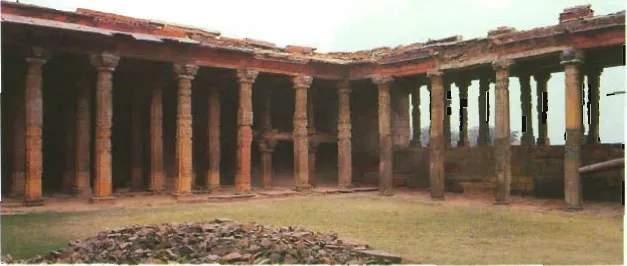
- What it is
- Kāma, also called Kāman, is the town inside the forest of Kāmyavana.
- Visiting
- In 1987 Entwistle found Caurāsī-khambā on the rocky mound above the town, reached by a path from a gateway at the north-west end of the main bazaar, past a Jain temple.
- Places here
- Rāmajī Gate (Kāmyavana), Mathurā Gate (Kāmyavana), Govindadeva Mandira (Kāmyavana), Vimala-kuṇḍa
In short
Kāma, also called Kāman, is the town inside the forest of Kāmyavana. The guidebook Śrī Vraja-maṇḍala Parikramā (2007) uses the village of Kāma as its point of reference for the sites of Kāmyavana, such as Vimala-kuṇḍa to its south-west and the roads of the town's gates; the undated parikramā notes Kāmyavana call it a fairly good-sized town, and Vṛndāvana-Dhāma Ki Jaya! (c. 1986) the town of Kāmyavana.[1 +3] Above the town stands the ruined temple of many pillars called Caurāsī-khambā, the eighty-four pillars.[5 +1]
Key facts
| Kind | town |
|---|---|
| Region · area | Kāmyavana |
Traditional accounts
The eighty-four pillars
Śrīla Nārāyaṇa Bhaṭṭa Gosvāmī's Vraja-bhakti-vilāsa opens its list of the marks of Kāmavana with a verse it ascribes to the Viṣṇu Purāṇa, on eighty-four pillars, and closes the list with them (summarised here, not translated).[6 +1] According to the closing lines, seeing the eighty-four deities of Kāmyavana gives the fruit of bathing in its eighty-four tīrthas (holy waters), and the pilgrimage is complete when one undertakes the eighty-four pillars. The book does not say where the pillars stand.[6]
The tradition and the historians tell differently how many pillars there are and who made them; the accounts are set side by side below.[8 +3]
Visiting today
In 1987 Entwistle found Caurāsī-khambā on the rocky mound above the town, reached by a path from a gateway at the north-west end of the main bazaar, past a Jain temple. Śrī Vraja-maṇḍala Parikramā (2007) lists it among the places of darśana without describing it. How many pillars stand today, and who cares for the site, needs a visit to confirm.[5]
Location
| Where it is | in Kāmyavana[15] |
|---|
Places at Kāma (village)
5 places
- 1Rāmajī Gate (Kāmyavana)gate›
- 2Mathurā Gate (Kāmyavana)gate›
- 3Govindadeva Mandira (Kāmyavana)temple›
- 4Vimala-kuṇḍakuṇḍa›
Also listed here
- Caurāsī-khambā (Kāmyavana) temple
History
The town
The historian A. W. Entwistle (1987) reports that Kāman belonged to Jaipur until it passed to Bharatpur at the end of the eighteenth century, and that it once had a wall with seven gates, some of which still stood in his day. He gives no date or builder for the wall, and no dated record of it has been found.[12] He also reports a ninth-century inscription that may already give the town's name as Kāmyakavana; the inscription itself could not be checked.[13] Prabhudayāl Mītal (1966) wrote that remains of old buildings are found here in large numbers, which probably show that it was once a prosperous town; he gives no year and names no survey.[14]
Caurāsī-khambā
Mītal (1966) described Caurāsī-khambā as the ruin of an ancient, large temple of Viṣṇu on the hill, named after the many pillars of its assembly hall. Entwistle (1987) credited the temple to local rulers of Kāman who called themselves Yādavas.[10 +1] Entwistle reported that the temple was later dismantled and refashioned into a mosque, with over two hundred carved columns, a pulpit and an Arabic inscription naming the sultan Iletmish (1211–1236). He also reported a Sanskrit inscription, perhaps of the eighth century, on a pillar of the eastern wall, which gives the line of a Śūrasena dynasty of local rulers and records that a queen, Vacchikā, built a temple of Viṣṇu. The inscriptions and the survey report he relies on could not be checked.[8 +1]
Where the sources differ
How many pillars the Caurāsī-khambā ('eighty-four pillars') has or had.
Accounts differ How many pillars the Caurāsī-khambā ('eighty-four pillars') has or had.
- Vraja-bhakti-vilāsa ch.2 (verse cited from the 'Viṣṇu-purāṇa')eighty-four pillars made by Kāmasena; a number of one hundred sixty-eight for protection (damaged line); since it came out more or less, the number of pillars cannot be fixed
- Śrī Vraja-maṇḍala Parikramā (2007)eighty-four pillars established by King Kāmasena; the demigods and demons jointly constructed one hundred sixty-eight pillars
- Vṛndāvana-Dhāma Ki Jaya! (c. 1986)the temple has eighty-four carved pillars, each representing 100,000 of the Purāṇas' 8,400,000 species
- A. W. Entwistle (1987), p. 131over two hundred carved columns
The wording of these accounts is our summary of the sources, not a published translation.
Accounts differ What the Caurāsī-khambā was and who built it: tradition (Kāmasena) against the inscriptions and historians.
- Vraja-bhakti-vilāsa ch.2the eighty-four pillars (with eighty-four tīrthas and temples) were made by Kāmasena; demons and gods acted on Viṣṇu's order
- Śrī Vraja-maṇḍala Parikramā (2007)a famous king named Śrī Kāmasena established them all
- Vṛndāvana-Dhāma Ki Jaya! (c. 1986)an ancient temple of extraordinary architecture (no builder named); its pillars are 'similar to the ones in Gokula, still present from Lord Kṛṣṇa's time 5,000 years ago'
- A. W. Entwistle (1987), pp. 131-132, citing Cunningham (ASI XX), Bhagwanlal Indraji and K. C. Jaina Hindu temple dismantled and refashioned into a mosque (an Arabic inscription names Iletmish, AD 1211-1236); a Sanskrit inscription, perhaps of the eighth century, gives a Śūrasena dynasty of seven kings and records a Viṣṇu temple built by queen Vacchikā
References
15 references
- Śrī Vraja-maṇḍala Parikramā (2007), PDF p. 146
- Śrī Vraja-maṇḍala Parikramā (2007), PDF p. 160
- the undated parikramā notes Kāmyavana, ¶4
- Vṛndāvana-Dhāma Ki Jaya! (c. 1986), by Dhruva Mahārāja dāsa, PDF p. 46
- A. W. Entwistle, gazetteer of Kaman (§7.33), entry 9 'Chaurasi Khambha', printed p. 367, Egbert Forsten, Groningen, 1987
- Śrīla Nārāyaṇa Bhaṭṭa Gosvāmī, Vraja-bhakti-vilāsa, chapter 2 part 13 v.53, end of the list of the marks of Kāmavana, printed p.50, 1st ed., publ. Bābā Kṛṣṇadāsa, Kusuma-sarovara, Saṁvat 2008
- Śrīla Nārāyaṇa Bhaṭṭa Gosvāmī, Vraja-bhakti-vilāsa, chapter 2 part 13, opening of the list of the marks (liṅgāni) of Kāmavana, printed p.48, 1st ed., publ. Bābā Kṛṣṇadāsa, Kusuma-sarovara, Saṁvat 2008
- A. W. Entwistle, §4.18 'Finds at Kaman', printed p. 131, Egbert Forsten, Groningen, 1987
- A. W. Entwistle, §4.18 'Finds at Kaman', printed pp. 131-132, Egbert Forsten, Groningen, 1987
- A. W. Entwistle, chapter 4 (Mathurā in the medieval period), printed p. 123, Egbert Forsten, Groningen, 1987
- Prabhudayāl Mītal, Kāmavana section, entry 'चौरासी खभा', printed p. ११७ (117)
- A. W. Entwistle, § 'Kaman', introduction, printed p. 363, Egbert Forsten, Groningen, 1987
- A. W. Entwistle, § 'Kaman', introduction, printed p.363, Egbert Forsten, Groningen, 1987
- Prabhudayāl Mītal, 'Kāmavana', printed p.117, first paragraph
- Śrī Vraja-maṇḍala Parikramā (2007), p. 266-267