Govindadeva Mandira (Kāmyavana)
गोविन्ददेव मन्दिर (काम्यवन) Hindi name proposed
Also called Govinda Ji Mandir
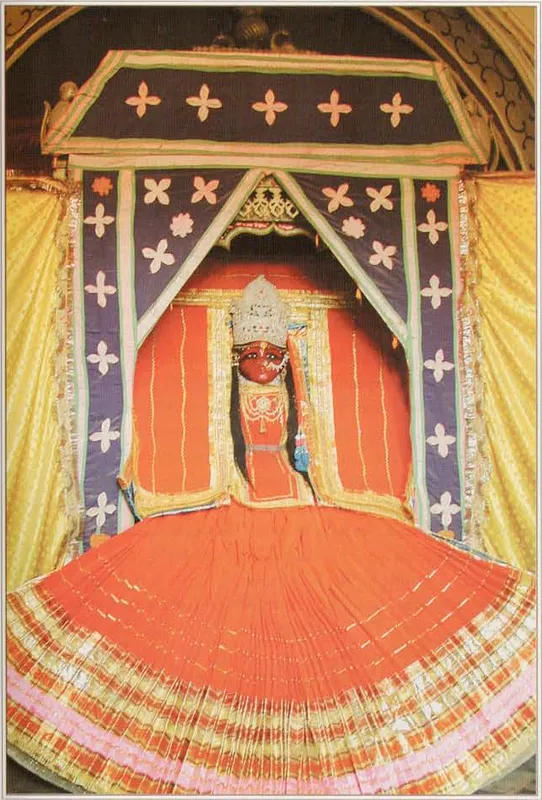
- What it is
- The temple of Śrī Govindadeva and Vṛndā-devī stands in the town of Kāmā, the old Kāmyavana.
- Visiting
- The undated parikramā notes Kāmyavana place the temple in the centre of the town and give darśana hours of 8 am to noon and 5 to 8 pm; these times may have changed.
- Places here
- Viṣṇu-siṁhāsana, Varāha-kūpa
In short
The temple of Śrī Govindadeva and Vṛndā-devī stands in the town of Kāmā, the old Kāmyavana.[1 +2] Śrīla Prabhupāda tells that when Aurangzeb was breaking temples, the king of Jaipur took Govinda, Gopīnātha and Madana-mohana from Vṛndāvana to Jaipur.[4] Historians report that the Deities were first brought to Kāmā, where temples were built for them, and that Vṛndā-devī, brought with Govinda, stayed behind here.[1 +1] The guidebooks tell the journey with differences, and they also disagree on where Vṛndā-devī is now (see below).[3 +1]
Key facts
| Kind | temple |
|---|---|
| Region · area | Kāmyavana · Kāma (village) |
| Ācāryas | Śrīla Rūpa Gosvāmī |
Traditional accounts
Vṛndā-devī
According to the Sādhana-dīpikā of Śrī Rādhā-kṛṣṇa Gosvāmī, the mahānta (head priest) of the Govinda temple, Śrīla Rūpa Gosvāmī manifested the Deity of Vṛndā-devī from near the bank of Brahma-kuṇḍa in Vṛndāvana by the strength of Śrī Caitanya Mahāprabhu's order, and her service was given to the author's guru, Haridāsa (summarised here, not translated).[1 +4] The Sādhana-dīpikā does not mention Kāmyavana; that the Vṛndā-devī of this temple is that Deity is said by later guidebooks and historians, and no source says that Śrīla Rūpa Gosvāmī himself came to this temple.[1 +4]
In his Vraja-vilāsa-stava Śrīla Raghunātha dāsa Gosvāmī takes shelter of her, who decorates each new kuñja with fragrant flowers and arranges a festival for Rādhā and Kṛṣṇa among Their dear friends (summarised here, not translated).[9] Read more: Vṛndā-devī, the goddess of the Vṛndāvana forest →
Govardhana Hill (2001) names Vṛndā-devī at Kāmyavana among the four important temples of the goddess in Vraja, with Pātāleśvarī at Mathurā, Yogamāyā at Vṛndāvana and Mānasī Devī at Govardhana, and records the saying that by praying at their feet one may gain an eternal place in Kṛṣṇa's pastimes in Vṛndāvana; it gives no scriptural source for it.[10]
Vṛndā-devī with Govindajī and the other Deities of the lists
In its list of the places of Kāmyavana, after the five Pāṇḍavas with Draupadī at Kuśa-sthalī, Śrī Vraja-maṇḍala Parikramā (2007) names Vṛndā-devī with Govindajī, Śrī Rādhā-Vallabha, Navanīta-rāya, Gokuleśvara and Śrī Rāmacandra; it does not say whether they stand in one temple.[11 +1] According to Śrīla Nārāyaṇa Bhaṭṭa Gosvāmī's Vraja-bhakti-vilāsa, Govinda with Vṛndā, Rādhāvallabha, Gopīnātha, Navanīta-rāya, Gokuleśvara and Rāmacandra are among the eighty-four deities of Kāmyavana, with a prayer on seeing each of them (summarised here, not translated).[13 +2]
Śrīla Prabhupāda
Śrīla Prabhupāda spoke of the removal of the Deities in a lecture of 14 June 1970; he does not mention Kāmyavana or any stop on …
Śrīla Prabhupāda spoke of the removal of the Deities in a lecture of 14 June 1970; he does not mention Kāmyavana or any stop on the way.[4]
General teaching (does not name the place)“In the Jaipur there is Govinda-seva temple of Govindaji. The king of Jaipur took away, when Aurangzeb was harassing Hindus and he was breaking some of the Hindu temple, at that time from Vṛndāvana the Govinda mūrti—not only Govinda, but Govinda Gopinatha and Madana-mohana—these mūrtis were taken from Vṛndāvana to Jaipur.”
Śrīla Prabhupāda, Śrīla Baladeva Vidyābhūṣaṇa Appearance lecture, Los Angeles, 14 June 1970 · vedabase.io
He writes that the three Deities of Vṛndāvana, Śrī Rādhā-Madana-mohana, Śrī Rādhā-Govindadeva and Śrī Rādhā-Gopīnāthajī, are the life and soul of the Gauḍīya Vaiṣṇavas; this is a general teaching about the Deities, not about Kāmyavana.[16] Read more: The great temple of Śrī Govinda →
Visiting today
The undated parikramā notes Kāmyavana place the temple in the centre of the town and give darśana hours of 8 am to noon and 5 to 8 pm; these times may have changed.[7 +1] The temple of Śrī Gopīnātha is also at Kāmā.[3]
Places at Govindadeva Mandira (Kāmyavana)
3 places
Also described on this page
Nearby places
Caraṇa-kuṇḍa (Kāmyavana)
History
The Bengali Vṛndāvana-kathā (1920) says that probably in 1670 all the Gauḍīya Deities of Vṛndāvana, Govindadeva and Gopīnātha among them, were sent secretly to Jaipur at night in carts covered with cloth, under the protection of Rām Singh, son of Mirzā Rājā Jai Singh I, and that Vṛndā-devī was taken to Kāmyavana. It names no source for this, and does not say that the other Deities stayed here.[5]
The historian Prabhudayāl Mītal (1966) wrote that the image of Vṛndā-devī was brought from Vṛndāvana in the time of the Muslim invasions and installed at Kāmā, and named the temples of Śrī Govindadeva and Śrī Gopīnātha here as examples of the old temple building of Vraja.[3] A. W. Entwistle (1987) reported that the priests of the Gauḍīya temples of Vṛndāvana took their Deities under the protection of the rulers of Amber, that the Deities were first brought to Kāmā and temples were built for them, and that Govinda went on to Amber in or shortly before 1714. Vṛndā-devī, he wrote, was left behind in the temple at Kāmā, where he found her in 1987.[1 +1] No inscription or dated document for the building of the temple has been found.[1 +1] Read more: The temples of Vṛndāvana in Mughal times →
Where the sources differ
Which Deities came to Kāmyavana, how long they stayed and what was built for them.
Which Deities came to Kāmyavana, how long they stayed and what was built for them. Śrī Vraja-maṇḍala Parikramā (2007) says that the Mahārāja of Jaipur rested some days here and that a large temple with a pratibhū-vigraha, a Deity regarded as non-different from the original, was later built where Śrī Rādhā-Govinda had stayed.[18 +2]
Accounts differ Which Vṛndāvana deities came to Kāmyavana, how long they stayed, and what was built for them.
- the undated parikramā notes KāmyavanaRādhā-Madana-mohana, Rādhā-Govinda and Rādhā-Gopīnātha stayed in Kāmyavana for three nights on the way to Jaipur; three temples were established for them; Rādhā-Gopīnātha is worshipped in a householder's house.
- the undated parikramā notes KāmyavanaThe king of Jaipur set out to take Vṛndā-devī, Rādhā-Gopīnātha, Rādhā-Madana-mohana and Rādhā-Govinda to Jaipur; at Kāmyavana Vṛndā-devī refused to go further.
- Śrī Vraja-maṇḍala Parikramā (2007)The Mahārāja of Jaipura brought Śrī Govinda, Śrī Gopīnātha, Śrī Rādhā-Dāmodara and Śrī Rādhā-Mādhava, resting some days in Kāmyavana; later large temples with pratibhū-vigrahas were built where Rādhā-Govinda, Rādhā-Gopīnātha and Rādhā-Madana-mohana had stayed.
- Entwistle (1987), pp. 185, 368Govind Dev, Gopinath, Radhadamodar and Radhavinod were first taken to Kaman and temples were built there for them; Govind Dev went to Amber in or shortly before 1714, Radhadamodar to Jaipur in 1760 (Madanmohan to Karauli in 1728, not said to pass through Kaman).
Where the Deity of Vṛndā-devī is now. Vṛndāvana-Dhāma Ki Jaya! (c. 1986) and the undated notes Kāmyavana say that she could not be moved beyond Kāmyavana and is worshipped in this temple, while the same notes and the 2007 guidebook also say that she now resides in the Rūpa-Sanātana Gauḍīya Maṭha in Vṛndāvana.[7 +6]
Accounts differ Where the deity of Vṛndā-devī is now (the same sources also contradict themselves).
- Śrī Vraja-maṇḍala Parikramā (2007)'Here one can have her special darśana'; she 'came as far as Kāmyavana, but she did not leave Vraja to go further'.
- Śrī Vraja-maṇḍala Parikramā (2007), and the undated parikramā notes Kāmyavana in the same words'She now resides in Śrī Rūpa-Sanātana Gauḍīya Maṭha in Śrī Dhāma Vṛndāvana'.
- the undated parikramā notes KāmyavanaShe 'was installed here with Govinda Ji' (left altar of the temple in Kaman).
- Vṛndāvana-Dhāma Ki Jaya! (c. 1986)She is worshipped in the Rādhā-Govinda temple of Kāmya-vana.
Accounts differ Vṛndā-devī's earlier history in Vṛndāvana.
- Sādhana-dīpikā (Rādhā-kṛṣṇa Gosvāmī), ch. 8Śrī Rūpa manifested Vṛndā-devī from near the bank of Brahma-kuṇḍa by Mahāprabhu's order; her service was given to the author's guru Haridāsa. Nothing is said of an earlier installation.
- the undated parikramā notes KāmyavanaInstalled by Vajranābha 4,900 years ago; rediscovered by Śrīla Rūpa Gosvāmī on the bank of Brahma-kuṇḍa and installed 'in a small temple next to the Radha Govinda Temple'.
- Vṛndāvana-Dhāma Ki Jaya! (c. 1986)'She was previously installed in the Rādhā-Govinda Mandira in Vṛndāvana' (pp. 26–27); at Brahma-kuṇḍa 'Rūpa Gosvāmī discovered the Vṛndā-devī deity' (p. 61). Nothing is said of Vajranābha.
More on this place
The temples of Vṛndāvana in Mughal times · The great temple of Śrī Govinda · Vṛndā-devī, the goddess of the Vṛndāvana forest
References
25 references
- A. W. Entwistle, printed p. 185, Egbert Forsten, Groningen, 1987
- A. W. Entwistle, gazetteer of Kaman (§33), entry 11 'Govind Dev and Gopinath', printed p. 368, Egbert Forsten, Groningen, 1987
- Prabhudayāl Mītal, Kāmavana section, printed p. ११७ (117)
- Śrīla Prabhupāda, Śrīla Baladeva Vidyābhūṣaṇa Appearance lecture, Los Angeles, 14 June 1970 · vedabase.io
- Vṛndāvana-kathā, chapter 19 (ūnaviṁśa pariccheda), printed p. 218
- Śrīla Rādhā-kṛṣṇa Gosvāmī, Sādhana-dīpikā, section (8) ('yāṅhāra prasāde haya abhīṣṭa-pūraṇa'), after v.7
- the undated parikramā notes Kāmyavana, ¶20
- Vṛndāvana-Dhāma Ki Jaya! (c. 1986), by Dhruva Mahārāja dāsa, PDF p. 79
- Śrīla Raghunātha dāsa Gosvāmī, Vraja-vilāsa-stava, Stavāvalī (9) Vraja-vilāsa-stava v.31
- Govardhana Hill: India's Most Sacred Mountain (2001), Rajasekhara dasa Brahmacari, PDF p. 79
- Śrī Vraja-maṇḍala Parikramā (2007), PDF p. 145
- Śrī Vraja-maṇḍala Parikramā (2007), PDF p. 146
- Śrīla Nārāyaṇa Bhaṭṭa Gosvāmī, Vraja-bhakti-vilāsa, ch. 2, list of the marks of Kāmavana, the items after Kuśasthalī (finding aid '(2) [part 13] v.53', after v.69), printed p. 50, 1st ed., publ. Bābā Kṛṣṇadāsa, Kusuma-sarovara, Saṁvat 2008
- Śrīla Nārāyaṇa Bhaṭṭa Gosvāmī, Vraja-bhakti-vilāsa, ch. 9 vv.59, 60, 62 and 63 (beginning), printed p. 201; Grantha Mandira text (9) vv.59-63, 1st ed., publ. Bābā Kṛṣṇadāsa, Kusuma-sarovara, Saṁvat 2008
- Śrīla Nārāyaṇa Bhaṭṭa Gosvāmī, Vraja-bhakti-vilāsa, ch. 9 v.64, printed p. 202; Grantha Mandira text (9) v.64, 1st ed., publ. Bābā Kṛṣṇadāsa, Kusuma-sarovara, Saṁvat 2008
- Śrīla Prabhupāda, Śrī Caitanya-caritāmṛta, Ādi-līlā 1.19, purport · vedabase.io
- the undated parikramā notes Kāmyavana, ¶21
- Śrī Vraja-maṇḍala Parikramā (2007), PDF p. 147
- Śrī Vraja-maṇḍala Parikramā (2007), PDF p. 148
- Śrī Vraja-maṇḍala Parikramā (2007), PDF p. 166
Show all 25 references
- the undated parikramā notes Kāmyavana, ¶19
- Vṛndāvana-Dhāma Ki Jaya! (c. 1986), by Dhruva Mahārāja dāsa, PDF p. 44
- Vṛndāvana-Dhāma Ki Jaya! (c. 1986), by Dhruva Mahārāja dāsa, PDF p. 45
- Śrī Vraja-maṇḍala Parikramā (2007), p. 268-269
- Vṛndāvana-Dhāma Ki Jaya! (c. 1986), by Dhruva Mahārāja dāsa, p. 26