Kṛṣṇa-kuṇḍa (Madhuvana)
कृष्ण-कुण्ड (मधुवन) Hindi name proposed
Also called Kṛṣṇa-Kuṇda, Madhu-kuṇḍa
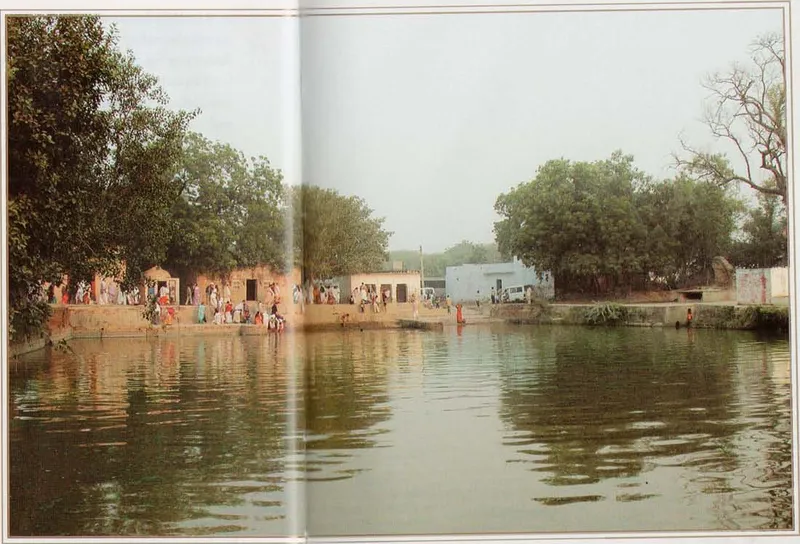
- What it is
- Kṛṣṇa-kuṇḍa, also called Madhu-kuṇḍa, is the kuṇḍa (sacred pond) of Madhuvana.
- Visiting
- Śrī Vraja-maṇḍala Parikramā (2007) places Lavaṇāsura's cave near the kuṇḍa and the temple of Śrī Śatrughna close to it.
- Places here
- Śatrughna Mandira (Madhuvana)
In short
Kṛṣṇa-kuṇḍa, also called Madhu-kuṇḍa, is the kuṇḍa (sacred pond) of Madhuvana. The guidebook Śrī Vraja-maṇḍala Parikramā (2007) calls it Lord Mādhava's dear Madhu-kuṇḍa, now also known as Kṛṣṇa-kuṇḍa, with Lavaṇāsura's cave and a temple of Śrī Śatrughna close by.[1 +5] The guidebooks connect it with an autumn rāsa dance on its bank and a bath of Śrī Caitanya Mahāprabhu.[1 +4] Two of them also say that Kṛṣṇa watered His cows here, which is not certain.[11 +1] The scriptures tell of the cowherding, a rāsa and Mahāprabhu's baths in the forests, but none of them names this kuṇḍa.[10 +4]
Key facts
| Kind | kuṇḍa |
|---|---|
| Region · area | Madhuvana |
| Ācāryas | Śrī Caitanya Mahāprabhu, Śrīla Nārāyaṇa Bhaṭṭa Gosvāmī |
Why it is glorified
The Varāha Purāṇa praises Madhuvana as the delightful and unsurpassed place of Viṣṇu: whoever sees it, it says, attains the goal …
The Varāha Purāṇa praises Madhuvana as the delightful and unsurpassed place of Viṣṇu: whoever sees it, it says, attains the goal of life (summarised here, not translated). It speaks of the forest, not of a kuṇḍa in it.[17] The Purāṇa also names a day for bathing in Madhuvana, and later works give another; the accounts are shown below.
Divine pastimes
Kṛṣṇa with the cows
Śrīmad-Bhāgavatam (10.15) tells how Kṛṣṇa grazed the cows in the forest of Vṛndāvana with the cowherd boys. He imitated the dancing peacocks to make His friends laugh, and in a deep voice called by name the animals that had strayed. The Bhāgavatam names neither Madhuvana nor a kuṇḍa here.[13 +1]
kvacic ca kāla-haṃsānām anukūjati kūjitam / abhinṛtyati nṛtyantaṃ barhiṇaṃ hāsayan kvacit … megha-gambhīrayā vācā nāmabhir dūra-gān paśūn / kvacid āhvayati prītyā go-gopāla-manojñayā
Sometimes He vigorously imitated the dancing of a peacock, making His cowherd boyfriends laugh. Sometimes, with a voice as deep as the rumbling of clouds, He would call out with great affection the names of the animals who had wandered far from the herd, thus enchanting the cows and the cowherd boys.
Translation: Śrīla Prabhupāda's disciples (BBT)Vṛndāvana-Dhāma Ki Jaya! (c. 1986) says that Kṛṣṇa would often bring His cows to the banks of this kuṇḍa to drink, and the undated parikramā notes Madhuvana add that He made the kuṇḍa by striking the ground with His flute. Neither names a source, and none has been found for the making of the kuṇḍa, so this account is not certain.[11 +1]
The rāsa dance
Śrīmad-Bhāgavatam (10.29) tells that on the autumn nights Kṛṣṇa turned His mind to the rāsa dance, His dance with the gopīs, and went with them to the sandy bank of the river, the Yamunā; Śrīla Prabhupāda's Kṛṣṇa book also sets the dance on the Yamunā's bank. Neither names Madhuvana or a kuṇḍa.[18 +2]
Śrī Bādarāyaṇi said: Śrī Kṛṣṇa is the Supreme Personality of Godhead, full in all opulences, yet upon seeing those autumn nights scented with blossoming jasmine flowers, He turned His mind toward loving affairs. To fulfill His purposes He employed His internal potency.
Translation: Śrīla Prabhupāda's disciples (BBT)The Garga-saṁhitā tells of a journey of the rāsa from forest to forest, in which Kṛṣṇa went singing with the gopīs to Madhuvana and danced the rāsa there with Śrī Rādhā. It names no kuṇḍa, and it sets the whole journey in the spring month of Mādhava (Vaiśākha, April–May).[15 +1] The undated notes Madhuvana say that Kṛṣṇa and the gopīs enjoyed the rāsa on the bank of this kuṇḍa in autumn, and Vṛndāvana-Dhāma Ki Jaya! that He would sometimes dance the rāsa here in autumn; neither names a source.[7 +1] A Hindi song in the site's song book also sings of a rāsa in Madhuvana; it names the forest, not the kuṇḍa.[22] Read more: Where the autumn rāsa took place →
Śrī Caitanya Mahāprabhu
The Caitanya-caritāmṛta tells that on His tour of Vraja Śrī Caitanya Mahāprabhu visited Madhuvana and the neighbouring forests and bathed wherever He went. It names no kuṇḍa.[1 +3]
মধুবন, তাল, কুমুদ, বহুলা-বন গেলা ।
তাহাঁ তাহাঁ স্নান করি’ প্রেমাবিষ্ট হৈলা ॥ ১৯৩ ॥
madhu-vana, tāla, kumuda, bahulā-vana gelā
tāhāṅ tāhāṅ snāna kari’ premāviṣṭa hailā
Śrī Caitanya Mahāprabhu visited the different forests, including Madhuvana, Tālavana, Kumudavana and Bahulāvana. Wherever He went, He took His bath with great ecstatic love.
Translation: Śrīla A.C. Bhaktivedanta Swami PrabhupādaAccording to the undated notes Madhuvana, He bathed in this Kṛṣṇa-kuṇḍa during His visit in 1515; the Caitanya-caritāmṛta gives neither the kuṇḍa nor a year there. Śrī Vraja-maṇḍala Parikramā (2007) says that in Madhuvana a sphūrti, a sudden vision, of Kṛṣṇa's pastimes overwhelmed Him.[1 +3]
Traditional accounts
Śrīla Nārāyaṇa Bhaṭṭa Gosvāmī's Vraja-bhakti-vilāsa lists two kuṇḍas among the holy places of Madhuvana: Madhusūdana-kuṇḍa, and …
Śrīla Nārāyaṇa Bhaṭṭa Gosvāmī's Vraja-bhakti-vilāsa lists two kuṇḍas among the holy places of Madhuvana: Madhusūdana-kuṇḍa, and Śatrughna-kuṇḍa with an image of Śatrughna beside it. For the walk around Madhuvana it gives a prayer for bathing in Madhusūdana-kuṇḍa (summarised here, not translated). The book does not use the names Madhu-kuṇḍa or Kṛṣṇa-kuṇḍa, and the kuṇḍa it calls Kṛṣṇa-kuṇḍa belongs to Bahulāvana.[23 +2]
ततो मधुसूदनकुण्डस्नानाचमनप्रार्थनमन्त्रः—
मधुसूदनकुण्डाय तीर्थराज नमोऽस्तु ते । पीतरक्तसितश्यामनिर्म्मलक्षीरपूरितः ॥
…
लवणासुरवधस्थान लवणासुरगुफा शत्रुघ्नकुंड शत्रुघ्नमूर्त्तिप्रार्थनस्नानाचमनं पूर्वोक्तमन्त्रविधानेन कुर्य्यात्॥ इति मधुबनप्रदक्षिणा ॥
tato madhusūdanakuṇḍasnānācamanaprārthanamantraḥ— / madhusūdanakuṇḍāya tīrtharāja namo'stu te
pītaraktasitaśyāmanirmmalakṣīrapūritaḥ
/ … / lavaṇāsuravadhasthāna lavaṇāsuraguphā śatrughnakuṁḍa śatrughnamūrttiprārthanasnānācamanaṁ pūrvoktamantravidhānena kuryyāt|| iti madhubanapradakṣiṇā ||
The guidebooks put the temple of Śrī Śatrughna beside today's kuṇḍa, as the Vraja-bhakti-vilāsa puts Śatrughna's image beside its Śatrughna-kuṇḍa, but the book itself does not say which of its two kuṇḍas is today's Kṛṣṇa-kuṇḍa, so the identification is not certain.[1 +8]
The Bhakti-ratnākara, in its Madhuvana section, quotes a verse on a kuṇḍa of clear water adorned with blue lotuses, where bathing and giving charity bring the result one wishes for; the Varāha Purāṇa and Śrīla Rūpa Gosvāmī give the same verse for Tālavana. The accounts are shown on the page of Balabhadra-kuṇḍa in Tālavana.[27]
Śrīla Prabhupāda
The passages of Śrīla Prabhupāda found for this place speak of Madhuvana and of the pastimes in general, not of the kuṇḍa.
The passages of Śrīla Prabhupāda found for this place speak of Madhuvana and of the pastimes in general, not of the kuṇḍa. In his purport to the Caitanya-caritāmṛta verse above he names Madhuvana among the twelve forests of the Vṛndāvana area.[16] On the time and place of the rāsa dance he gives, in general, Kṛṣṇa's own words to Uddhava:[29]
General teaching (does not name the place)How He could take advantage of a particular time, circumstance and person is expressed by Him while talking to Uddhava about His rāsa dance with the gopīs. He says, “The most opportune time is the full-moon night in autumn, like tonight. The best place within the universe is Vṛndāvana, and the most beautiful girls are the gopīs.”
Śrīla Prabhupāda, The Nectar of Devotion, Chapter 21, 'Qualities of Śrī Kṛṣṇa', section 19, 'Expert judge of time and circumstances' · vedabase.io
Visiting today
Śrī Vraja-maṇḍala Parikramā (2007) places Lavaṇāsura's cave near the kuṇḍa and the temple of Śrī Śatrughna close to it. The undated notes Madhuvana list "Madhu-kuṇḍa or Kṛṣṇa-kuṇḍa" among the places to see in Madhuvana, say that the Madhuvana parikramā passes by it, and place a temple of Balarāma (Dāūjī) right next to it; Vṛndāvana-Dhāma Ki Jaya! (c. 1986) puts the Deity of Śatrughna on its banks.[1 +5]
Places at Kṛṣṇa-kuṇḍa (Madhuvana)
1 places
Nearby places
Lavaṇāsura's cave · Dāūjī Mandira (Madhuvana)
History
F. S. Growse (1883) recorded, by the sacred wood of Madhuban (the village of Maholī), a pond called Madhu-kuṇḍa and a temple of Kṛṣṇa as Caturbhuja, the four-armed Lord, where a fair was held every year on the eleventh day of the dark fortnight of Bhādon (Bhādrapada).[28]
Where the sources differ
Where, and in which season, Kṛṣṇa's rāsa with the gopīs took place (the guidebooks: an autumn rāsa at Kṛṣṇa-kuṇḍa in Madhuvana).
Accounts differ Where, and in which season, Kṛṣṇa's rāsa with the gopīs took place (the guidebooks: an autumn rāsa at Kṛṣṇa-kuṇḍa in Madhuvana).
- Śrīmad-Bhāgavatam 10.29.1, 10.29.45-46 (BBT translation by Śrīla Prabhupāda's disciples)On the autumn nights Kṛṣṇa went with the gopīs to the sandy bank of the river (the Yamunā).
- Śrīla Prabhupāda, Kṛṣṇa book ch. 29The Lord and the gopīs reached the cool, sandy bank of the Yamunā.
- Garga-saṁhitā, Vṛndāvana-khaṇḍa 20.38-39Kṛṣṇa went singing to Madhuvana with the gopīs and performed a rāsa there with Śrī Rādhā (one stage of a rāsa journey through the forests), a journey that the Garga sets in the month of Mādhava (Vaiśākha, April-May; 2.19.2-3).
- the undated parikramā notes MadhuvanaIn the autumn Kṛṣṇa and the gopīs enjoyed the rāsa on the bank of Kṛṣṇa-kuṇḍa (Madhuvana).
On which day one should bathe in Madhuvana.
Accounts differ The day for bathing in Madhuvana (and at its kuṇḍa).
- Varāha Purāṇa 153.34Ekādaśī of the bright fortnight (śukla-pakṣa) of Bhādrapada.
- Vraja-bhakti-vilāsa ch. 10 v.17, citing the 'Vārāha'Ekādaśī of the dark fortnight (kṛṣṇa-pakṣa) of Bhādra, with the bath at Madhusūdana-kuṇḍa.
- Growse (1883), p. 82 (British book, low priority)An annual fair at Madhu-kund on the 11th of the dark fortnight of Bhādon.
- F. S. Growse, Mathurá (1883), a historianGrowse's festival list gives a special pilgrimage to Madhuvana, Tālavana and Kumudavana on the eleventh of the bright half of Bhādra.
More on this place
Where the autumn rāsa took place
References
31 references
- Śrī Vraja-maṇḍala Parikramā (2007), PDF p. 63
- Śrī Vraja-maṇḍala Parikramā (2007), PDF p. 64
- the undated parikramā notes Madhuvana, ¶44
- the undated parikramā notes Madhuvana, ¶9
- the undated parikramā notes Madhuvana, ¶42
- the undated parikramā notes Madhuvana, ¶63
- the undated parikramā notes Madhuvana, ¶5
- Vṛndāvana-Dhāma Ki Jaya! (c. 1986), by Dhruva Mahārāja dāsa, PDF p. 28
- the undated parikramā notes Madhuvana, ¶27
- Śrīla Kṛṣṇadāsa Kavirāja Gosvāmī, Śrī Caitanya-caritāmṛta, CC Madhya-līlā 17.193, online edition · vedabase.io
- the undated parikramā notes Madhuvana, ¶72
- Vṛndāvana-Dhāma Ki Jaya! (c. 1986), by Dhruva Mahārāja dāsa, PDF p. 27
- Śrīmad-Bhāgavatam 10.15.10-12 (vedabase grouping), GRETIL
- Śrīla Prabhupāda, Kṛṣṇa, the Supreme Personality of Godhead, Chapter 15, 'The Killing of Dhenukāsura' · vedabase.io
- Garga-saṁhitā, Vṛndāvana-khaṇḍa (2) 20.38-39 (chapter 'rāsa-krīḍā'), Sanskrit Wikisource
- Śrīla Prabhupāda, Śrī Caitanya-caritāmṛta, Madhya-līlā 17.193, purport · vedabase.io
- Varāha Purāṇa, adhyāya 153, vv.33-34, Sanskrit Wikisource
- Śrīmad-Bhāgavatam 10.29.1, GRETIL
- Śrīmad-Bhāgavatam 10.29.45, GRETIL
- Śrīla Prabhupāda, Kṛṣṇa, the Supreme Personality of Godhead (Kṛṣṇa book), Chapter 29, 'The Rāsa Dance: Introduction' · vedabase.io
Show all 31 references
- Garga-saṁhitā, Vṛndāvana-khaṇḍa (2) 19.2-3, Sanskrit Wikisource
- Sundara Kundala Naina (Vāsudeva Ghoṣa (as the song book credits it)) · song book
- Śrīla Nārāyaṇa Bhaṭṭa, Vraja-bhakti-vilāsa, ch. 2 v.54, printed p. 51, 1st ed., publ. Bābā Kṛṣṇadāsa, Kusuma-sarovara, Saṁvat 2008
- Śrīla Nārāyaṇa Bhaṭṭa, Vraja-bhakti-vilāsa, ch. 10 v.19, printed p. 214, 1st ed., publ. Bābā Kṛṣṇadāsa, Kusuma-sarovara, Saṁvat 2008
- Śrīla Nārāyaṇa Bhaṭṭa, Vraja-bhakti-vilāsa, ch. 10 v.17, printed p. 213, 1st ed., publ. Bābā Kṛṣṇadāsa, Kusuma-sarovara, Saṁvat 2008
- Śrīla Nārāyaṇa Bhaṭṭa, Vraja-bhakti-vilāsa, ch. 10 v.19, printed p. 214, 1st ed., publ. Bābā Kṛṣṇadāsa, Kusuma-sarovara, Saṁvat 2008
- Śrīla Narahari Cakravartī, Bhakti-ratnākara, Fifth Wave (pañcama taraṅga) vv. 401-403, printed p. 185, 2nd ed., 1912
- Mathurá (1883), F. S. Growse, B.C.S., M.A. Oxon., C.I.E. (as the title page gives him, p. 82
- Śrīla Prabhupāda, The Nectar of Devotion, Chapter 21, 'Qualities of Śrī Kṛṣṇa', section 19, 'Expert judge of time and circumstances' · vedabase.io
- Śrī Vraja-maṇḍala Parikramā (2007), p. 100-101
- Vṛndāvana-Dhāma Ki Jaya! (c. 1986), by Dhruva Mahārāja dāsa, p. 9