Mohana Ter-ghāṭa
मोहन टेर-घाट Hindi name proposed
- What it is
- Mohana Ter-ghāṭa is a former bathing place on the old bank of the Yamunā in Vṛndāvana, which the guidebooks list after Varāha-ghāṭa and Gautama Ṛṣi's āśrama.
- Visiting
- The guidebook of 2000 and the undated parikramā notes Vṛndāvana say that a grove used to be here on the Yamunā's bank; the 2010 photograph captioned "Mohana Ter-ghāṭa" shows open, overgrown ground …
In short
Mohana Ter-ghāṭa is a former bathing place on the old bank of the Yamunā in Vṛndāvana, which the guidebooks list after Varāha-ghāṭa and Gautama Ṛṣi's āśrama.[1 +5] According to three guides, Kṛṣṇa danced the rāsa with the gopīs in a grove that used to be here, and Cupid, who came to shoot Him with his arrows, fainted at His beauty; for this reason Kṛṣṇa is called Madana-mohana, the enchanter of Cupid.[3 +2] Śrīmad-Bhāgavatam calls Kṛṣṇa in the rāsa the bewilderer of Cupid himself, and its commentators tell how Cupid was overcome, but none of them names this ghāṭa.[8 +8]
Key facts
| Kind | ghāṭa |
|---|---|
| Region · area | Vṛndāvana |
| Also part of | Yamunā |
Divine pastimes
The rāsa night by the Yamunā
Śrīmad-Bhāgavatam (10.29–10.33) tells the rāsa night on the bank of the Yamunā. When Kṛṣṇa reappears among the gopīs, it calls Him sākṣān manmatha-manmathaḥ, the one who bewilders even Cupid; Śrīla Prabhupāda, quoting the verse in the Caitanya-caritāmṛta (Madhya 8.140), translates that He was attractive even to Cupid.[8 +5]
tāsām āvirabhūc chauriḥ smayamāna-mukhāmbujaḥ / pītāmbara-dharaḥ sragvī sākṣān manmatha-manmathaḥ
Then Lord Kṛṣṇa, a smile on His lotus face, appeared before the gopīs. Wearing a garland and a yellow garment, He directly appeared as one who can bewilder the mind of Cupid, who himself bewilders the minds of ordinary people.
Translation: Śrīla Prabhupāda's disciples (BBT)Through all those nights, the Bhāgavatam says, Kṛṣṇa kept the sex impulse restrained within Himself. It names no ghāṭa and tells of no Cupid coming to shoot Him or fainting.[8 +5]
How Cupid was overcome
The commentators read these verses as Kṛṣṇa's victory over Cupid, each in his own way (summarised here, not translated). Śrīla Śrīdhara Svāmī opens his commentary on the rāsa chapters by praising Kṛṣṇa as the one who destroyed Cupid's pride, and says that the rāsa proclaimed His victory over Kāma, desire. Śrīla Viśvanātha Cakravartī Ṭhākura says that Kandarpa (Cupid) came to bewilder Kṛṣṇa but was himself bewildered: seeing Kṛṣṇa's beauty, he swooned. The Bṛhat-krama-sandarbha, which its available text gives as Śrīla Jīva Gosvāmī's, says in one reading that Kāmadeva came to offer his service and Kṛṣṇa turned him away, and Śrīla Nārāyaṇa Bhaṭṭa Gosvāmī that Kāma stayed inactive for as long as the rāsa lasted. None of them names a place or uses the name Madana-mohana.[14 +2] Read more: Madana-mohana: how Kṛṣṇa overcame Cupid in the rāsa night →
The Caitanya-caritāmṛta explains the name:[17]
চড়ি’ গোপী-মনোরথে, মন্মথের মন মথে,
নাম ধরে ‘মদনমোহন’ ।
জিনি’ পঞ্চশর-দর্প, স্বয়ং নবকন্দর্প,
রাস করে লঞা গোপীগণ ॥ ১০৭ ॥
caḍi’ gopī-manorathe, manmathera mana mathe, nāma dhare ‘madana-mohana’ jini’ pañcaśara-darpa, svayaṁ nava-kandarpa, rāsa kare lañā gopī-gaṇa
Favoring the gopīs, Kṛṣṇa rides on the chariots of their minds, and just to receive loving service from them, He attracts their minds like Cupid. Therefore He is also called Madana-mohana, the attractor of Cupid. Cupid has five arrows, representing form, taste, smell, sound and touch. Kṛṣṇa is the owner of these five arrows, and with His Cupid-like beauty He conquers the minds of the gopīs, though they are very proud of their superexcellent beauty. Becoming a new Cupid, Kṛṣṇa attracts their minds and engages in the rāsa dance.
Translation: Śrīla A.C. Bhaktivedanta Swami PrabhupādaTraditional accounts
Vṛndāvana, the Playground of God (2010), The Color Guide to Vṛndāvana (2000) and the undated parikramā notes Vṛndāvana say that …
Vṛndāvana, the Playground of God (2010), The Color Guide to Vṛndāvana (2000) and the undated parikramā notes Vṛndāvana say that Kṛṣṇa danced the rāsa with the gopīs here, the last two in a grove that used to stand on the Yamunā's bank. Cupid came to shoot Him with his arrows and, overcome by His beauty, fainted (2000) or collapsed (2010), and so Kṛṣṇa is called Madana-mohana. No scripture or work of the ācāryas that was searched tells this story at this place.[3 +2]
Śrīla Prabhupāda
No statement of Śrīla Prabhupāda naming the ghāṭa has been found in the works searched.
No statement of Śrīla Prabhupāda naming the ghāṭa has been found in the works searched. On the point of the guidebooks' story, that Kṛṣṇa danced with the gopīs untouched by desire, his Kṛṣṇa book says (a general teaching):[8 +5]
General teaching (does not name the place)“Sex desire is especially excited in the autumn season, but the wonderful thing about Kṛṣṇa’s association with the gopīs is that there was no question of sex desire. It was, as clearly stated in the Bhāgavata description by Śukadeva Gosvāmī, avaruddha-saurata – the sex impulse was completely controlled.”
Śrīla Prabhupāda, Kṛṣṇa, the Supreme Personality of Godhead (Kṛṣṇa book), Chapter 33, 'Description of the Rāsa Dance' · vedabase.io
Visiting today
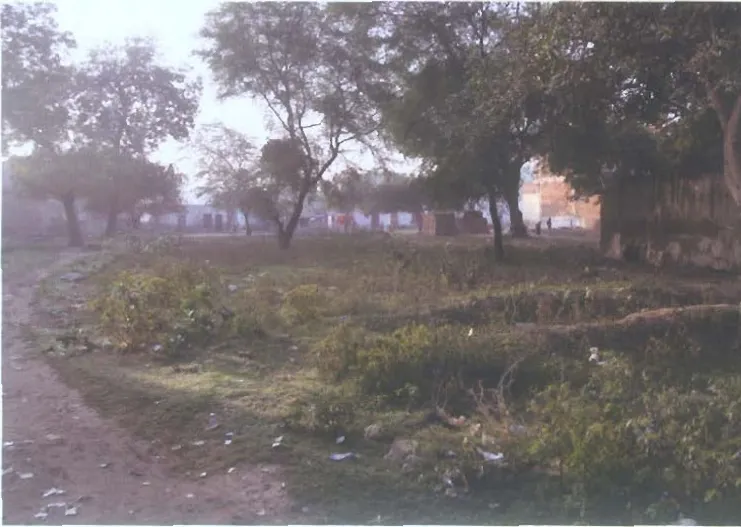
The guidebook of 2000 and the undated parikramā notes Vṛndāvana say that a grove used to be here on the Yamunā's bank; the 2010 photograph captioned "Mohana Ter-ghāṭa" shows open, overgrown ground with low bushes, a dirt path and scattered trees, with no river or steps in sight.[3 +2] In the guidebooks' walks the next stops are Go-ghāṭa or Kāliya-ghāṭa.[1 +5]
Location
| Where it is | on the bank of the Yamunā[20] |
|---|
History
The Bengali Vṛndāvana-kathā (1920) begins its list of Vṛndāvana's ghāṭas with "Mohāntera ghāṭa", the ghāṭa of the mohānta (an abbot), built by Paṇḍita Matilāla, and says that when the ghāṭas were built cannot be told. The Color Guide to Vṛndāvana (2000) gives the same builder, Paṇḍita Moti Lal, for its Mohana Ter Ghāṭa, and Śrī Vraja-maṇḍala Parikramā (2007) calls the same entry Mahāntajī-ghāṭa.[5 +2] The 2000 guide says, without a source, that Vṛndāvana's riverside ghāṭas were built of red sandstone between about 1580 and some time before 1870; it gives no date for this one, which may fall anywhere in that span.[5] No source explains the word "Ter".[5 +2]
Where the sources differ
How Cupid was overcome in the rāsa night: the Bhāgavatam, its commentators and the guidebooks tell it differently and do not …
How Cupid was overcome in the rāsa night: the Bhāgavatam, its commentators and the guidebooks tell it differently and do not refer to each other.[14 +2]
Accounts differ How Cupid was overcome in the rāsa night (the sources do not refer to each other; recorded side by side, not harmonised).
- Śrīmad-Bhāgavatam 10.32.2 and 10.33.25Kṛṣṇa, reappearing among the gopīs, is 'sākṣān manmatha-manmathaḥ', the bewilderer of Cupid himself; through the rāsa nights He kept the sex impulse restrained within Himself. No episode of Cupid attacking Him; no place named.
- Śrīla Viśvanātha Cakravartī, Sārārtha-darśinī on ŚB 10.32.2Kandarpa came to bewilder Kṛṣṇa; Kṛṣṇa brought him into the mood of a woman, and seeing Kṛṣṇa's beauty, struck by Kandarpa's arrows, he swooned. Told in explaining the Bhāgavatam's words for Kṛṣṇa at His reappearance (10.32.2), before the rāsa dance of ŚB 10.33; he does not say when or where Kandarpa came; no place named.
- Bṛhat-krama-sandarbha, on ŚB 10.29.46, one of its readingsKāmadeva came thinking this is my time to serve; Kṛṣṇa stopped him and turned him away (what need is there of you?), and this is His victory over Kāma. The scene is the play on the Yamunā's bank before Kṛṣṇa's disappearance; no place named.
- Śrīla Nārāyaṇa Bhaṭṭa, Rasikāhlādinī on ŚB 10.32.2For as long as Kṛṣṇa performed the rāsa, Kāma was stopped and became inactive, absorbed in Kṛṣṇa's form; Kṛṣṇa bewildered him. No attack is told; no place named.
The wording of these accounts is our summary of the sources, not a published translation.
The name of the ghāṭa built by Paṇḍita Matilāla and what it means: no source says whether "Mohāntera" and "Mohana Ter" are one name.[5 +2]
Accounts differ The name of the ghāṭa built by Paṇḍita Moti Lal (Matilāla) and what it means (recorded side by side, not harmonised).
- Vṛndāvana-kathā (Pulinbihārī Datta, 1920)'১ম, মোহান্তের ঘাট—নির্ম্মাতা পণ্ডিত মতিলাল' (no. 1, Mohāntera ghāṭa, builder Paṇḍita Matilāla); in Bengali মোহান্তের is 'of the mohānta (abbot, Mahant)'.
- Śrī Vraja-maṇḍala Parikramā (2007)'Mahāntajī' is the first of the fourteen further ghāṭas it takes from the Vṛndāvana-kathā.
- The Color Guide to Vṛndāvana (2000), Vṛndāvana, the Playground of God (2010), the undated parikramā notes Vrindavana'Mohana Ter Ghāṭa' / 'Mohan Ter Ghāṭa' (The Color Guide's list no. 2, builder 'Paṇḍita Moti Lal'); The Color Guide, Vṛndāvana, the Playground of God and one set of the notes connect the place with Kṛṣṇa's name Madana-mohana, the enchanter of Cupid, through the story they tell here.
The wording of these accounts is our summary of the sources, not a published translation.
More on this place
Madana-mohana: how Kṛṣṇa overcame Cupid in the rāsa night
References
20 references
- the undated parikramā notes Vṛndāvana, ¶91
- the undated parikramā notes Vṛndāvana, ¶91
- Vṛndāvana, the Playground of God (2010), Bhakti Caitanya Svāmī, PDF p. 123
- The Color Guide to Vṛndāvana (2000), Written and Photographed by Rājaśekhara dāsa Brahmacārī, PDF p. 51
- The Color Guide to Vṛndāvana (2000), Written and Photographed by Rājaśekhara dāsa Brahmacārī, PDF p. 31
- the undated parikramā notes Vṛndāvana, ¶24
- the undated parikramā notes Vṛndāvana, ¶25
- Śrīmad-Bhāgavatam 10.29.1, GRETIL
- Śrīmad-Bhāgavatam 10.29.45–46, GRETIL
- Śrīmad-Bhāgavatam 10.32.2, GRETIL
- Śrīmad-Bhāgavatam 10.32.11-12, GRETIL
- Śrīmad-Bhāgavatam 10.33.2, GRETIL
- Śrīmad-Bhāgavatam 10.33.25, GRETIL
- Śrīdhara Svāmī: commentary introductory verses and comment on ŚB 10.29.1
- Śrīla Viśvanātha Cakravartī Ṭhākura: commentary on ŚB 10.32.2
- Bṛhat-krama-sandarbha: commentary on ŚB 10.29.46, last part of the comment
- Śrīla Kṛṣṇadāsa Kavirāja Gosvāmī, Śrī Caitanya-caritāmṛta, Madhya-līlā 21.107, online edition · vedabase.io
- Pulinbihārī Datta, ch. 23 (upasaṁhāra, 'conclusion'), list of Vṛndāvana's ghāṭas and their builders, introduction and nos. 1-2, printed p. 274
- Śrī Vraja-maṇḍala Parikramā (2007), PDF p. 344
- The Color Guide to Vṛndāvana (2000), Written and Photographed by Rājaśekhara dāsa Brahmacārī, p. 37