Madana-mohana: how Kṛṣṇa overcame Cupid in the rāsa night
मदनमोहन: रास की रात्रि में कृष्ण ने कामदेव को कैसे जीता
In short
Madana-mohana means "the one who enchants Madana", Cupid. Śrīmad-Bhāgavatam calls Kṛṣṇa the bewilderer of Cupid himself when He reappears among the gopīs (the cowherd girls) in the night of the rāsa, His circle dance. Its commentators read the rāsa as His victory over Cupid. The guidebooks set Cupid's defeat at Mohana Ter-ghāṭa, a former bathing place in Vṛndāvana.[1–7]
On this page
At a glance
- The words: sākṣān manmatha-manmathaḥ, Śrīmad-Bhāgavatam 10.32.2.[1]
- Śrīla Prabhupāda's teaching: in the rāsa there was no question of mundane desire.[8]
- The Caitanya-caritāmṛta: Kṛṣṇa is called Madana-mohana because He attracts even Cupid.[9]
- The commentators: Śrīla Śrīdhara Svāmī, Śrīla Viśvanātha Cakravartī Ṭhākura and others each explain Cupid's defeat in their own way.[2–4]
- The place: three guidebooks tell the story at Mohana Ter-ghāṭa. No older text names a ghāṭa.[5–7]
- The Deity: Śrīla Sanātana Gosvāmī's Madana-mohana. Śrīla Kṛṣṇadāsa Kavirāja Gosvāmī calls Him the Cupid of Cupids.[10–13]
What does Madana-mohana mean?
Madana is one of the names of Kāmadeva, or Cupid, the god who stirs desire in the world. Mohana means one who enchants or bewilders. The Caitanya-caritāmṛta explains the name in a single verse. Here it is in Śrīla Prabhupāda's translation:[9]
চড়ি’ গোপী-মনোরথে, মন্মথের মন মথে,
নাম ধরে ‘মদনমোহন’ ।
জিনি’ পঞ্চশর-দর্প, স্বয়ং নবকন্দর্প,
রাস করে লঞা গোপীগণ ॥ ১০৭ ॥
caḍi’ gopī-manorathe, manmathera mana mathe, nāma dhare ‘madana-mohana’ jini’ pañcaśara-darpa, svayaṁ nava-kandarpa, rāsa kare lañā gopī-gaṇa
Favoring the gopīs, Kṛṣṇa rides on the chariots of their minds, and just to receive loving service from them, He attracts their minds like Cupid. Therefore He is also called Madana-mohana, the attractor of Cupid. Cupid has five arrows, representing form, taste, smell, sound and touch. Kṛṣṇa is the owner of these five arrows, and with His Cupid-like beauty He conquers the minds of the gopīs, though they are very proud of their superexcellent beauty. Becoming a new Cupid, Kṛṣṇa attracts their minds and engages in the rāsa dance.
Translation: Śrīla A.C. Bhaktivedanta Swami PrabhupādaThe verse is a general statement about the name, and it names no place.[9] In his purport (explanation) to Caitanya-caritāmṛta Ādi 1.19, Śrīla Prabhupāda also tells what the worship of Madana-mohana means for a devotee who is just beginning:[14–17]
General teaching (does not name the place)“Worship of Madana-mohana is on the platform of reestablishing our forgotten relationship with the Personality of Godhead.”
Śrīla Prabhupāda, Śrī Caitanya-caritāmṛta, Ādi-līlā 1.19, purport · vedabase.io
Śrīla Sanātana Gosvāmī gives one more explanation, in his comment on Śrīmad-Bhāgavatam 10.55.1 (summarised here, not translated). Kāma, desire, maddens the world only through one drop of Kṛṣṇa's power. So the Lord Himself is the great Madana. Texts such as the Trailokya-sammohana-tantra call Him Madana-gopāla.[18]
Where does the Bhāgavatam call Kṛṣṇa the enchanter of Cupid?
Śrīmad-Bhāgavatam tells of the rāsa night in five chapters, 10.29 to 10.33. The rāsa is Kṛṣṇa's circle dance with the gopīs, the cowherd girls of Vraja, on the bank of the Yamunā.[1 +5] The first verse already gives the key. On the autumn nights, it says, Kṛṣṇa turned His mind to these pastimes with the help of His internal potency (His own spiritual energy).[1 +5]
Śrī Bādarāyaṇi said: Śrī Kṛṣṇa is the Supreme Personality of Godhead, full in all opulences, yet upon seeing those autumn nights scented with blossoming jasmine flowers, He turned His mind toward loving affairs. To fulfill His purposes He employed His internal potency.
Translation: Śrīla Prabhupāda's disciples (BBT)Śrīla Prabhupāda explains the words of that verse, yogamāyām upāśritaḥ:[1 +5]
General teaching (does not name the place)“The specific words used in Śrīmad-Bhāgavatam are yogamāyām upāśritaḥ, which mean that this dancing with the gopīs is on the platform of yogamāyā, not mahāmāyā. … The rāsa dance of Kṛṣṇa with the gopīs is on the platform of yogamāyā.”
Śrīla Prabhupāda, Kṛṣṇa, the Supreme Personality of Godhead, Chapter 29, 'The Rāsa Dance: Introduction' · vedabase.io
The phrase that gives Kṛṣṇa the name comes later. Kṛṣṇa leaves the gopīs for a time, and then He returns to them. Here the Bhāgavatam calls Him sākṣān manmatha-manmathaḥ, the one who bewilders even Cupid. Śrīla Prabhupāda quotes the verse in the Caitanya-caritāmṛta (Madhya 8.140) and translates that He was attractive even to Cupid.[1]
tāsām āvirabhūc chauriḥ smayamāna-mukhāmbujaḥ / pītāmbara-dharaḥ sragvī sākṣān manmatha-manmathaḥ
Then Lord Kṛṣṇa, a smile on His lotus face, appeared before the gopīs. Wearing a garland and a yellow garment, He directly appeared as one who can bewilder the mind of Cupid, who himself bewilders the minds of ordinary people.
Translation: Śrīla Prabhupāda's disciples (BBT)Śrīla Prabhupāda tells this moment in his own words in his Kṛṣṇa book. He dwells on Kṛṣṇa's beauty and on where He then led the gopīs:[24]
General teaching (does not name the place)“When Lord Kṛṣṇa finally reappeared among the assembled gopīs, He looked very beautiful, just befitting a person with all kinds of opulences. … Kṛṣṇa took them hand in hand on the bank of the Yamunā.”
Śrīla Prabhupāda, Kṛṣṇa, the Supreme Personality of Godhead (Kṛṣṇa book), Chapter 32, 'Kṛṣṇa Returns to the Gopīs' (opening) · vedabase.io
The Bhāgavatam describes that bank of the Kālindī, which is the Yamunā. Her waves had heaped up soft sand, the breeze was fragrant with flowers, and the autumn moon was bright. There, it says, the rāsa dance began.[1 +5] Read more: Where the autumn rāsa took place →
At the end of the five chapters, Śukadeva Gosvāmī sums up the nights of the rāsa. Kṛṣṇa, he says, kept the sex impulse restrained within Himself. The translation says that He was not internally affected by any mundane sex desire.[1 +5]
evaṃ śaśāṅkāṃśu-virājitā niśāḥ sa satya-kāmo 'nuratābalā-gaṇaḥ / siṣeva ātmany avaruddha-saurataḥ sarvāḥ śarat-kāvya-kathā-rasāśrayāḥ
Although the gopīs were firmly attached to Lord Kṛṣṇa, whose desires are always fulfilled, the Lord was not internally affected by any mundane sex desire. Still, to perform His pastimes the Lord took advantage of all those moonlit autumn nights, which inspire poetic descriptions of transcendental affairs.
Translation: Śrīla Prabhupāda's disciples (BBT)The Bhāgavatam names no ghāṭa (bathing place). It tells of no Cupid who comes to shoot Kṛṣṇa, or who faints. Its words make Kṛṣṇa the bewilderer of Cupid. The story of how Cupid was overcome comes from the commentators and the guidebooks.[1 +5]
What does Śrīla Prabhupāda say about the rāsa dance and lust?
In his Kṛṣṇa book Śrīla Prabhupāda returns again and again to the point that the guidebooks' story also makes. In the chapter on the rāsa dance itself he writes:[1 +5]
General teaching (does not name the place)“Sex desire is especially excited in the autumn season, but the wonderful thing about Kṛṣṇa’s association with the gopīs is that there was no question of sex desire. It was, as clearly stated in the Bhāgavata description by Śukadeva Gosvāmī, avaruddha-saurata – the sex impulse was completely controlled.”
Śrīla Prabhupāda, Kṛṣṇa, the Supreme Personality of Godhead (Kṛṣṇa book), Chapter 33, 'Description of the Rāsa Dance' · vedabase.io
At the end of the opening chapter he says the same of the gopīs. They enjoyed Kṛṣṇa's company without a tinge of mundane sex life.[26]
General teaching (does not name the place)“In this way the Lord and the gopīs reached the cool, sandy bank of the Yamunā, where there were lilies and lotus flowers. … Thus the gopīs were blessed with all mercy by the Supreme Personality of Godhead, for they enjoyed His company without a tinge of mundane sex life.”
Śrīla Prabhupāda, Kṛṣṇa, the Supreme Personality of Godhead (Kṛṣṇa book), Chapter 29, 'The Rāsa Dance: Introduction' (end) · vedabase.io
These are general teachings, and they name no place. In the same book he explains that the dance took place on the platform of yogamāyā, the Lord's internal energy. It was not on the platform of mahāmāyā, the external energy.[1 +6]
How did the commentators explain Cupid's defeat?
The commentators on the Tenth Canto read the rāsa as Kṛṣṇa's victory over Cupid, each in his own way. None of them names a place or uses the name Madana-mohana (all summarised here, not translated).[2–4]
Śrīla Śrīdhara Svāmī
Śrīla Śrīdhara Svāmī opens his commentary on the rāsa chapters with praise of the Lord. He praises Him as the one who destroyed the pride of Kandarpa, Cupid. That pride had grown from conquering Brahmā and the other gods.[2]
Someone might object that such pastimes would show Cupid's victory instead. Śrīla Śrīdhara Svāmī answers that the Bhāgavatam itself stresses the Lord's independence, with words such as yoga-māyām upāśritaḥ and sākṣān manmatha-manmathaḥ. The rāsa, he says, was performed to proclaim His victory over Kāma.[2]
He says the same of the Bhāgavatam's summing-up words at 10.33.25, which he calls a statement of victory over Kāma. The commentator Vaṁśīdhara ends his note on that verse in the same way.[23] At the close of the rāsa chapters, Śrīla Śrīdhara Svāmī again calls the whole pastime a victory over Kāma.[2–4]
Śrīla Viśvanātha Cakravartī Ṭhākura
On ŚB 10.32.2, Śrīla Viśvanātha Cakravartī Ṭhākura explains that Kṛṣṇa churns the mind even of Manmatha, the god of desire for the whole world. Kandarpa came to bewilder Kṛṣṇa, he says, but he was bewildered himself: seeing Kṛṣṇa's beauty, he swooned. Śrīla Viśvanātha tells this to explain the Bhāgavatam's words at Kṛṣṇa's return to the gopīs. He does not say where it happened.[3]
The Bṛhat-krama-sandarbha and Śrīla Nārāyaṇa Bhaṭṭa Gosvāmī
The Bṛhat-krama-sandarbha has a third reading. (One edition gives this work as Śrīla Jīva Gosvāmī's.) Kāmadeva came, thinking that it was his time to serve. Kṛṣṇa stopped him and turned him away, since the pastime is sweet by itself and needs no helper. That, the commentary says, is His victory over Kāma. Earlier in the same comment it states that the Kāma of these verses is not material.[4]
According to Śrīla Nārāyaṇa Bhaṭṭa Gosvāmī, Kāma was stopped and stayed inactive for as long as Kṛṣṇa performed the rāsa.[2–4]
What happened at Mohana Ter-ghāṭa, according to the guidebooks?
Mohana Ter-ghāṭa is a former bathing place on the old bank of the Yamunā in Vṛndāvana. In the guidebooks' walks it comes after Varāha-ghāṭa and Gautama Ṛṣi's āśrama (a sage's hermitage).[5 +5]
According to three guidebooks, Kṛṣṇa danced the rāsa with the gopīs here. Two of them say it was in a grove that used to stand on the river bank. Cupid came to shoot Him with his arrows. Overcome by His beauty, Cupid fainted (in the 2000 book) or collapsed (in the 2010 book), and for this reason Kṛṣṇa is called Madana-mohana.[5–7]
Vṛndāvana, the Playground of God (2010) tells it at more length. Cupid was angry that Kṛṣṇa could dance with the young girls untouched by desire. He tried to aim at Him but could not, because He danced so fast. At last Cupid collapsed and dropped his bow and arrows.[5–7, 23] In the guidebooks' walks the next stops are Go-ghāṭa or Kāliya-ghāṭa.[5 +5]
No scripture or work of the ācāryas (the spiritual teachers) tells this story at this place.[5–7] The guidebooks' Cupid who faints is closest to Śrīla Viśvanātha Cakravartī Ṭhākura's reading, but he names no ghāṭa.[2–4] The Bhāgavatam, the commentators and the guidebooks differ, and they are set side by side here:
Accounts differ How Cupid was overcome in the rāsa night (the sources do not refer to each other; recorded side by side, not harmonised).
- Śrīmad-Bhāgavatam 10.32.2 and 10.33.25Kṛṣṇa, reappearing among the gopīs, is 'sākṣān manmatha-manmathaḥ', the bewilderer of Cupid himself; through the rāsa nights He kept the sex impulse restrained within Himself. No episode of Cupid attacking Him; no place named.
- Śrīla Viśvanātha Cakravartī, Sārārtha-darśinī on ŚB 10.32.2Kandarpa came to bewilder Kṛṣṇa; Kṛṣṇa brought him into the mood of a woman, and seeing Kṛṣṇa's beauty, struck by Kandarpa's arrows, he swooned. Told in explaining the Bhāgavatam's words for Kṛṣṇa at His reappearance (10.32.2), before the rāsa dance of ŚB 10.33; he does not say when or where Kandarpa came; no place named.
- Bṛhat-krama-sandarbha, on ŚB 10.29.46, one of its readingsKāmadeva came thinking this is my time to serve; Kṛṣṇa stopped him and turned him away (what need is there of you?), and this is His victory over Kāma. The scene is the play on the Yamunā's bank before Kṛṣṇa's disappearance; no place named.
- Śrīla Nārāyaṇa Bhaṭṭa, Rasikāhlādinī on ŚB 10.32.2For as long as Kṛṣṇa performed the rāsa, Kāma was stopped and became inactive, absorbed in Kṛṣṇa's form; Kṛṣṇa bewildered him. No attack is told; no place named.
The wording of these accounts is our summary of the sources, not a published translation.
The ghāṭa itself has a plainer history. The Bengali book Vṛndāvana-kathā (1920) begins its list of Vṛndāvana's ghāṭas with one built by Paṇḍita Matilāla. The Color Guide to Vṛndāvana (2000) gives the same builder for its Mohana Ter Ghāṭa. The 1920 book says that no one can tell when the ghāṭas were built, and no source explains the word "Ter".[30 +2]
The guidebooks of 2000 and the undated notes speak of a grove that used to be here. A photograph of 2010 shows open, overgrown ground, with no river or steps in sight.[5–7]
Madana-mohana, the Deity of Vṛndāvana
Śrīla Kṛṣṇadāsa Kavirāja Gosvāmī applies the Bhāgavatam's words to the Deity (the sacred form of the Lord in the temple) that he saw in Vṛndāvana. He calls Madana-gopāla the chief Deity of Vṛndāvana and the enjoyer of the rāsa dance. He quotes ŚB 10.32.2 to show that He is the Cupid of Cupids. He adds that, with Śrī Rādhā and Lalitā serving Him on His two sides, He attracts the hearts of all.[10–13]
বৃন্দাবন–পুরন্দর শ্রীমদনগোপাল ।
রাসবিলাসী সাক্ষাৎ ব্রজেন্দ্রকুমার ॥ ২১২ ॥
vṛndāvana-purandara śrī-madana-gopāla
rāsa-vilāsī sākṣāt vrajendra-kumāra
Lord Madana Gopāla, the chief Deity of Vṛndāvana, is the enjoyer of the rāsa dance and is directly the son of the King of Vraja.
Translation: Śrīla A.C. Bhaktivedanta Swami PrabhupādaHe does not say that the rāsa took place at the Deity's temple or on its hill.[10–13] Śrīla Sanātana Gosvāmī served this Deity. He opens his commentary on the Tenth Canto, the Bṛhad-vaiṣṇava-toṣaṇī, by taking shelter of Śrī Madana-gopāla, the chief of the Vṛndā forest, and of Śrī Govinda. Śrīla Jīva Gosvāmī opens his own commentary with the same verse.[13 +2] How this Deity came to Śrīla Sanātana Gosvāmī, and how His temple was built, is told in its own article. Read more: How Madana-mohana came to Śrīla Sanātana Gosvāmī →
Places in this article
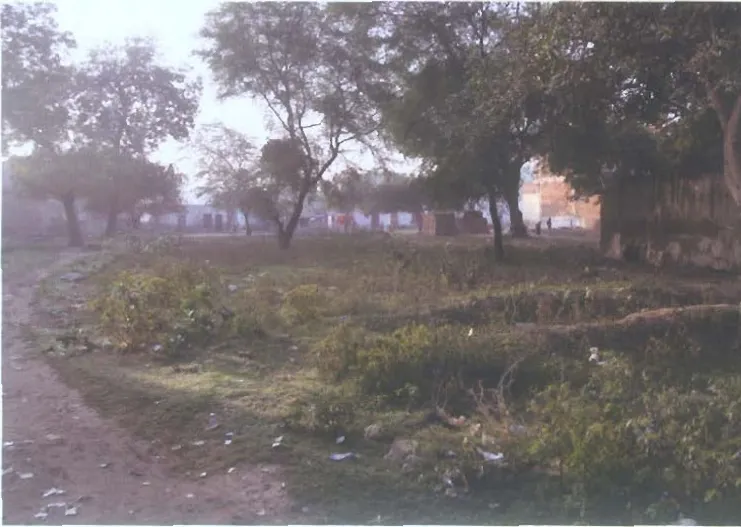
Mohana Ter-ghāṭa
मोहन टेर-घाटMohana Ter-ghāṭa is a former bathing place on the old bank of the Yamunā in Vṛndāvana, which the guidebooks list after Varāha-ghāṭa and Gautama Ṛṣi's āśrama.
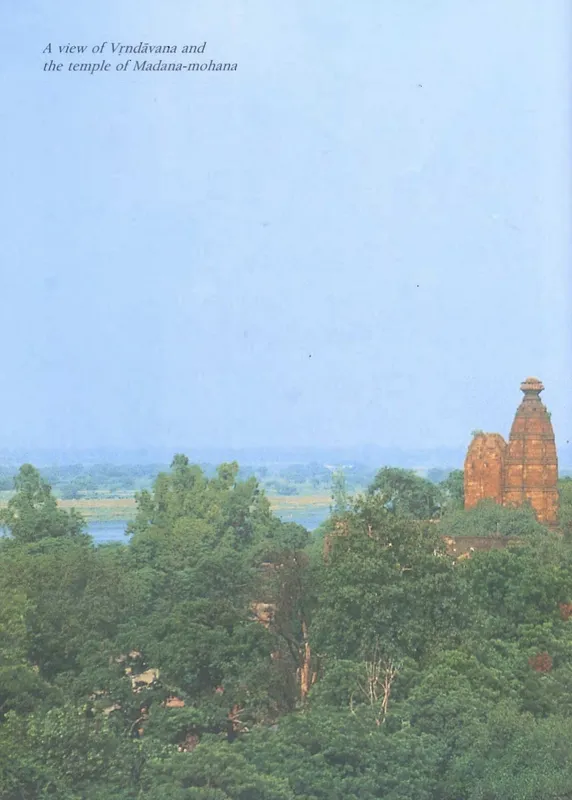
Rādhā-Madana-mohana Mandira (Vṛndāvana, old)
राधा-मदनमोहन मन्दिर (वृन्दावन, पुराना)The old Rādhā-Madana-mohana Mandira is the temple of Madana-mohana, also called Madana-gopāla, the Deity whose service Śrīla Sanātana Gosvāmī began in Vṛndāvana.
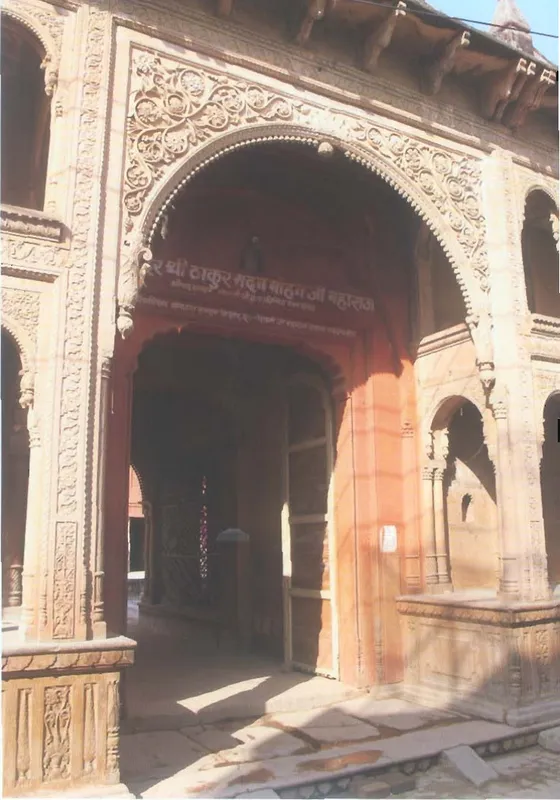
Madana-mohana Mandira (Vṛndāvana, new)
मदनमोहन मन्दिर (वृन्दावन, नया)The new Madana-mohana Mandira stands immediately beside the old Madana-mohana temple of Śrīla Sanātana Gosvāmī in Vṛndāvana.
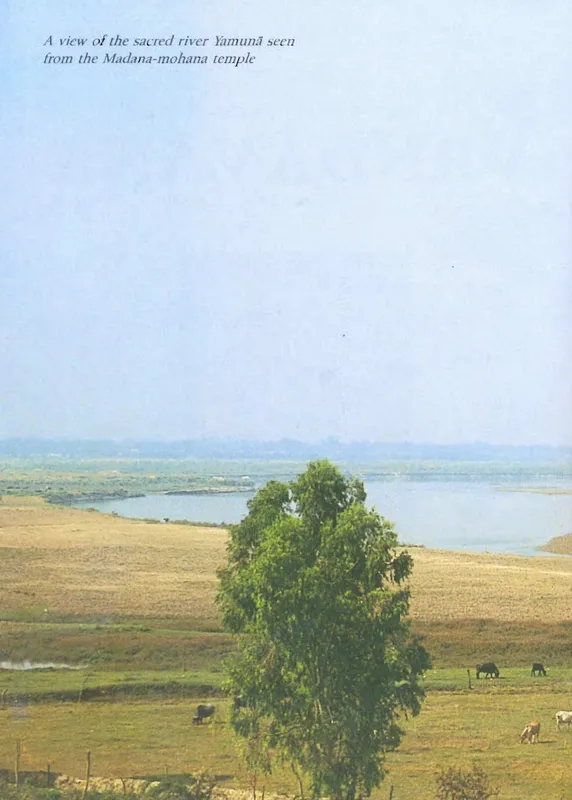
Yamunā
यमुनाThe Yamunā, also called the Kālindī, is the river that runs through Vraja-maṇḍala.
Vṛndāvana
वृन्दावनVṛndāvana is the forest on the bank of the Yamunā where Kṛṣṇa spent His childhood and youth, and the town of temples that stands in that forest today.
Go-ghāṭa (Vṛndāvana)
गो-घाट (वृन्दावन)Go-ghāṭa, also called Ram-Gol Ghāṭa, is a bathing ghāṭa on the Yamunā in Vṛndāvana, between Mohana Ter-ghāṭa and Kāliya-ghāṭa.

Kāliya-ghāṭa
कालिय-घाटKāliya-ghāṭa is the bathing place on the old bank of the Yamunā in Vṛndāvana that marks Kāliya's lake, the Kāliya-hrada of the scriptures, today called Kāliya-daha.
Questions and answers
It means the enchanter of Madana, Cupid. The Caitanya-caritāmṛta says that Kṛṣṇa is called Madana-mohana, the attractor of Cupid, because He conquers the minds of the gopīs like a new Cupid.[9]
In ŚB 10.32.2. When Kṛṣṇa reappears among the gopīs during the rāsa night, it calls Him sākṣān manmatha-manmathaḥ, the bewilderer of Cupid himself.[1]
No. The Bhāgavatam says that Kṛṣṇa kept the sex impulse restrained within Himself. Śrīla Prabhupāda writes that in the rāsa there was no question of sex desire.[1 +6]
Three guidebooks say that Kṛṣṇa danced the rāsa here. Cupid came to shoot Him and fainted at His beauty, which is why He is called Madana-mohana. No older text tells the story at this ghāṭa.[5–7]
Śrīla Śrīdhara Svāmī calls the rāsa Kṛṣṇa's victory over Kāma. Śrīla Viśvanātha Cakravartī Ṭhākura says that Cupid came to bewilder Kṛṣṇa and swooned. The Bṛhat-krama-sandarbha says he came to serve and was turned away.[2–4]
The Caitanya-caritāmṛta says that Cupid's five arrows are form, taste, smell, sound and touch, and that Kṛṣṇa is their owner.[9]
Sources
- Śrīmad-Bhāgavatam 10.32.2, GRETIL
- Śrīdhara Svāmī: commentary introductory verses and comment on ŚB 10.29.1
- Śrīla Viśvanātha Cakravartī Ṭhākura: commentary on ŚB 10.32.2
- Bṛhat-krama-sandarbha: commentary on ŚB 10.29.46, last part of the comment
- Vṛndāvana, the Playground of God (2010), Bhakti Caitanya Svāmī, PDF p. 123
- The Color Guide to Vṛndāvana (2000), Written and Photographed by Rājaśekhara dāsa Brahmacārī, PDF p. 51
- the undated parikramā notes Vṛndāvana, ¶25
- Śrīla Prabhupāda, Kṛṣṇa, the Supreme Personality of Godhead (Kṛṣṇa book), Chapter 33, 'Description of the Rāsa Dance' · vedabase.io
- Śrīla Kṛṣṇadāsa Kavirāja Gosvāmī, Śrī Caitanya-caritāmṛta, Madhya-līlā 21.107, online edition · vedabase.io
- Śrīla Kṛṣṇadāsa Kavirāja Gosvāmī, Śrī Caitanya-caritāmṛta, Ādi-līlā 5.213, online edition · vedabase.io
- Śrīla Kṛṣṇadāsa Kavirāja Gosvāmī, Śrī Caitanya-caritāmṛta, Ādi-līlā 5.214 (quoting ŚB 10.32.2), online edition · vedabase.io
- Śrīla Kṛṣṇadāsa Kavirāja Gosvāmī, Śrī Caitanya-caritāmṛta, Ādi-līlā 5.215, online edition · vedabase.io
- Śrīla Kṛṣṇadāsa Kavirāja Gosvāmī, Śrī Caitanya-caritāmṛta, Ādi-līlā 5.212, online edition · vedabase.io
- Śrīla Prabhupāda, Śrī Caitanya-caritāmṛta, Ādi-līlā 1.19, purport · vedabase.io
- Śrīla Prabhupāda, Śrī Caitanya-caritāmṛta, Ādi-līlā 1.47, purport · vedabase.io
- Śrīla Kṛṣṇadāsa Kavirāja Gosvāmī, Śrī Caitanya-caritāmṛta, Ādi-līlā 1.15, online edition · vedabase.io
- Vṛndāvana, the Playground of God (2010), Bhakti Caitanya Svāmī, PDF p. 17
- Śrīla Sanātana Gosvāmī: commentary on ŚB 10.55.1, Bhagavata Vidya Pith edition, ed. Bhagavata Rishi and Krishna Shankar Shastri, 1996
- Śrīmad-Bhāgavatam 10.29.1, GRETIL
- Śrīmad-Bhāgavatam 10.29.45–46, GRETIL
Show all 35 references
- Śrīmad-Bhāgavatam 10.32.11-12, GRETIL
- Śrīmad-Bhāgavatam 10.33.2, GRETIL
- Śrīmad-Bhāgavatam 10.33.25, GRETIL
- Śrīla Prabhupāda, Kṛṣṇa, the Supreme Personality of Godhead (Kṛṣṇa book), Chapter 32, 'Kṛṣṇa Returns to the Gopīs' (opening) · vedabase.io
- Śrīmad-Bhāgavatam 10.33.25, GRETIL
- Śrīla Prabhupāda, Kṛṣṇa, the Supreme Personality of Godhead (Kṛṣṇa book), Chapter 29, 'The Rāsa Dance: Introduction' (end) · vedabase.io
- Śrīla Prabhupāda, Kṛṣṇa, the Supreme Personality of Godhead, Chapter 29, 'The Rāsa Dance: Introduction' · vedabase.io
- the undated parikramā notes Vṛndāvana, ¶91
- the undated parikramā notes Vṛndāvana, ¶91
- The Color Guide to Vṛndāvana (2000), Written and Photographed by Rājaśekhara dāsa Brahmacārī, PDF p. 31
- the undated parikramā notes Vṛndāvana, ¶24
- Pulinbihārī Datta, ch. 23 (upasaṁhāra, 'conclusion'), list of Vṛndāvana's ghāṭas and their builders, introduction and nos. 1-2, printed p. 274
- Śrī Vraja-maṇḍala Parikramā (2007), PDF p. 344
- Śrīla Sanātana Gosvāmī: commentary opening verses (maṅgalācaraṇa) v.1, printed before the comment on ŚB 10.1.1, Bhagavata Vidya Pith edition, ed. Bhagavata Rishi and Krishna Shankar Shastri, 1996
- Śrīla Kṛṣṇadāsa Kavirāja Gosvāmī, Śrī Caitanya-caritāmṛta, Antya-līlā 4.222, online edition · vedabase.io
Further sources
- Śrīmad-Bhāgavatam 10.29–10.33, translation by the disciples of Śrīla Prabhupāda (BBT); ŚB 10.32.2 in Śrīla Prabhupāda's own translation in the Caitanya-caritāmṛta.
- Śrīla Prabhupāda, Kṛṣṇa, the Supreme Personality of Godhead, chapters 29 and 33; Śrī Caitanya-caritāmṛta with his translation and purports (BBT).
- The Canto 10 commentaries of Śrīla Śrīdhara Svāmī, Śrīla Viśvanātha Cakravartī Ṭhākura and Śrīla Nārāyaṇa Bhaṭṭa Gosvāmī and the Bṛhat-krama-sandarbha (Sanskrit), summarised, not translated.