Potrā-kuṇḍa
पोतरा-कुण्ड Hindi name proposed
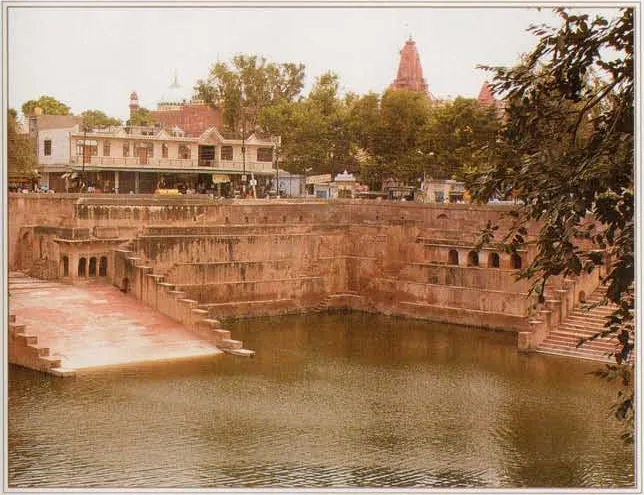
- What it is
- Potrā-kuṇḍa is a large stepped pond near Śrī Kṛṣṇa's birthplace in the Mallapurā quarter of Mathurā.
- Visiting
- Śrī Vraja-maṇḍala Parikramā (2007) prints a photograph of the pond as a large stepped tank near the birthplace.
In short
Potrā-kuṇḍa is a large stepped pond near Śrī Kṛṣṇa's birthplace in the Mallapurā quarter of Mathurā.[1 +3] According to the local tradition recorded in the guidebook Śrī Vraja-maṇḍala Parikramā (2007), it lay inside the walls of Kaṁsa's prison, Vasudeva and Devakī bathed in it, and its old name was Pavitrā-kuṇḍa, "the pure pond"; no scripture or ācārya text found so far names it, so the tradition is not certain.[1 +1] The historians date its masonry steps to the time of Mahādajī Sindhiyā, in 1782.[6 +3]
Key facts
| Kind | kuṇḍa |
|---|---|
| Region · area | Mathurā |
Divine pastimes
Śrīmad-Bhāgavatam tells how Kaṁsa, fearing death, put Devakī and Vasudeva in iron chains and killed each son born to them, and how Kṛṣṇa at last appeared from Devakī at midnight. The Bhāgavatam mentions no pond, no bath and no washing of clothes.[10 +2]
devakīṃ vasudevaṃ ca nigṛhya nigaḍair gṛhe / jātaṃ jātam ahan putraṃ tayor ajana-śaṅkayā
Fearing his death, Kaṁsa arrested Vasudeva and Devakī and chained them with iron shackles. Suspecting each of the children to be Viṣṇu, Kaṁsa killed them one after another because of the prophecy that Viṣṇu would kill him.
Translation: Śrīla A.C. Bhaktivedanta Swami PrabhupādaTraditional accounts
According to the local tradition recorded in the guidebook Śrī Vraja-maṇḍala Parikramā (2007), the pond was within the walls of …
According to the local tradition recorded in the guidebook Śrī Vraja-maṇḍala Parikramā (2007), the pond was within the walls of Kaṁsa's huge prison and Vasudeva and Devakī used to bathe in it. The book adds that Devakī's clothes were washed here after the birth of her sons, and that the pond was called Pavitrā-kuṇḍa and in time became known as Potrā-kuṇḍa. No older source for any of this has been found, so it is not certain.[1 +1]
Śrīla Prabhupāda
In his Kṛṣṇa book Śrīla Prabhupāda tells Kṛṣṇa's birth in Kaṁsa's prison; he does not speak of the pond.
In his Kṛṣṇa book Śrīla Prabhupāda tells Kṛṣṇa's birth in Kaṁsa's prison; he does not speak of the pond.[12]
General teaching (does not name the place)“Vasudeva wanted to perform a charitable ceremony to celebrate Kṛṣṇa’s appearance, but because he was shackled within the walls of Kaṁsa’s prison, this was not possible.”
Śrīla Prabhupāda, Kṛṣṇa, the Supreme Personality of Godhead, chapter 3 ('The Birth of Lord Kṛṣṇa') · vedabase.io
Visiting today
Śrī Vraja-maṇḍala Parikramā (2007) prints a photograph of the pond as a large stepped tank near the birthplace. On Mathurā's parikramā it comes after Bhūteśvara and Pātāla-devī and before Ādikeśava and the Janma-sthāna. Its present state has not been checked.[1 +3]
Location
| Where it is | near the birthplace, Mallapurā[15] 'originally within the walls of Kaṁsa's gigantic prison'; 'near here' (the birthplace, Mallapurā)[15] |
|---|
Nearby places
Kṛṣṇa Janma-sthāna · Bhūteśvara Mahādeva
History
According to the historian A. W. Entwistle (1987), Mahādajī Sindhiyā built the flights of steps round the pond in 1782, and his descendants restored them in 1850. The historian Prabhudayāl Mītal (1966) wrote that the kuṇḍa had been unpaved until Mahādajī rebuilt it in masonry, on a large scale, in Saṁvat 1839.[6 +3]
In 1883 F. S. Growse recorded that the tank had last been restored, at great cost, in 1850 by the Kāmdār of the Gwalior state. In his day its porous soil let the water drain away, so that the steps were dry except in the rains, and a small cell on its edge was called Kārā-grah, the prison-house, or Janm-bhūmi, the birthplace.[13 +1]
References
15 references
- Śrī Vraja-maṇḍala Parikramā (2007), PDF p. 34
- Śrī Vraja-maṇḍala Parikramā (2007), PDF p. 31
- Śrī Vraja-maṇḍala Parikramā (2007), PDF p. 48
- Vṛndāvana-Dhāma Ki Jaya! (c. 1986), by Dhruva Mahārāja dāsa, PDF p. 99
- the undated parikramā notes Mathurā, ¶69
- A. W. Entwistle, ch. 8 ('The pilgrimage itinerary'), §1.18 'Potarakund', printed p. 319, Egbert Forsten, Groningen, 1987
- Prabhudayāl Mītal, first part ('ब्रज-संस्कृति की भूमिका'), section 'Mathurā kī parikramā', entry 'Potarā kuṇḍ', printed p. 154
- Prabhudayāl Mītal, history part ('ब्रज का इतिहास'), Jāṭ-Marāṭhā period, the paragraph on Mādhavajī (Mahādajī) Sindhiyā (running heads 'Himmatabahādur' and 'Jāṭ-marahaṭhā kāl'), printed p. 253
- A. W. Entwistle, ch. 5, the paragraph on the Marāṭhās in Braj (late eighteenth century), printed p. 211, Egbert Forsten, Groningen, 1987
- Śrīmad-Bhāgavatam 10.1.66, GRETIL
- Śrīmad-Bhāgavatam 10.3.8, GRETIL
- Śrīla Prabhupāda, Kṛṣṇa, the Supreme Personality of Godhead, chapter 3 ('The Birth of Lord Kṛṣṇa') · vedabase.io
- Mathurá (1883), F. S. Growse, B.C.S., M.A. Oxon., C.I.E. (as the title page gives him, p. 131
- Muttra (1911), D. L. Drake-Brockman, I.C.S. (edited and compiled), p. 296
- Śrī Vraja-maṇḍala Parikramā (2007), p. 42-43