Ādikeśava Mandira (Mallapurā)
आदिकेशव मन्दिर (मल्लपुरा) Hindi name proposed
Also called Adikesava Temple
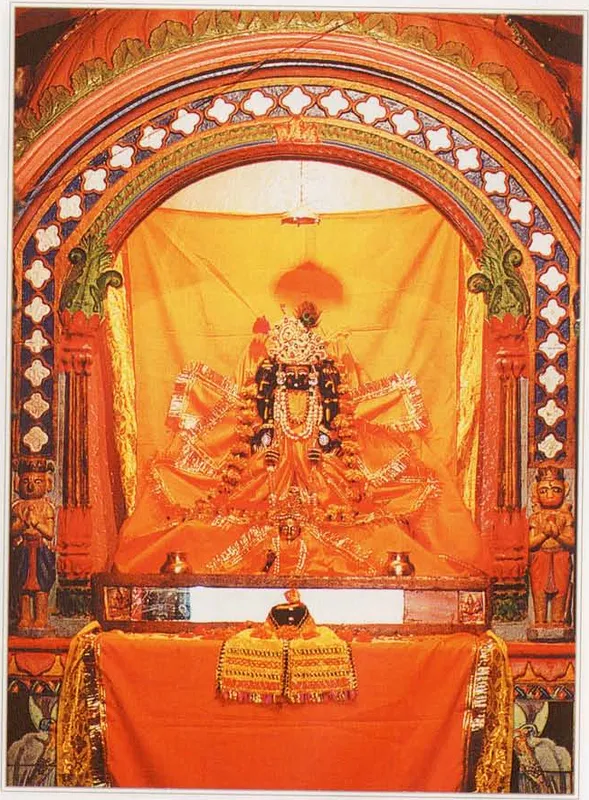
- What it is
- The Ādikeśava Mandira stands in the Mallapurā quarter of Mathurā, behind the present Kṛṣṇa Janma-sthāna, Kṛṣṇa's birthplace.
- Visiting
- Only the 2007 guidebook describes the image itself: according to it, this is the only image decorated with the symbols of the twenty-four incarnations of the Lord.
In short
The Ādikeśava Mandira stands in the Mallapurā quarter of Mathurā, behind the present Kṛṣṇa Janma-sthāna, Kṛṣṇa's birthplace.[1 +1] According to the guidebook Śrī Vraja-maṇḍala Parikramā (2007), a pratibhū-vigraha of Śrī Ādikeśava is worshipped here: an image that stands in for the original Deity and is considered non-different from it. Vaiṣṇavas visit the temple for this reason.[1 +3] Keśava is the Lord of Mathurā in the Garga-saṁhitā, and Śrī Caitanya Mahāprabhu saw the Deity Keśava at the birthplace; neither text names this temple or its image.[5 +1]
Key facts
| Kind | temple |
|---|---|
| Region · area | Mathurā |
| Also part of | Mallapurā |
| Ācāryas | Śrīla Nārāyaṇa Bhaṭṭa Gosvāmī |
Why it is glorified
In the Garga-saṁhitā the sage Nārada is asked who the Deity of Mathurā is.
In the Garga-saṁhitā the sage Nārada is asked who the Deity of Mathurā is. He answers that Śrī Kṛṣṇa Himself, the Lord Hari, is the Lord of Mathurā, Keśava, who takes away distress (summarised here, not translated). The verse names no temple or image.[5]
श्रीनारद उवाच - परिपूर्णतमः साक्षाच्छ्रीकृष्णो भगवान् हरिः । स्वयं हि मथुरानाथः केशवः क्लेशनाशनः ॥ 3 ॥
śrīnārada uvāca - paripūrṇatamaḥ sākṣācchrīkṛṣṇo bhagavān hariḥ
svayaṁ hi mathurānāthaḥ keśavaḥ kleśanāśanaḥ
Śrīla Nārāyaṇa Bhaṭṭa Gosvāmī's Vraja-bhakti-vilāsa names an Ādikeśava among Mathurā's tīrtha-Deities. After a prayer to Dīrgha-keśava the pilgrim offers four obeisances to Ādikeśava, and the book explains that Hari, called Keśava because He killed the horse-demon Keśī, abides as Ādikeśava (summarised here, not translated). It gives no site, so it cannot be tied to this temple.[7]
The Gosvāmīs and ācāryas
The Caitanya-caritāmṛta tells that when Śrī Caitanya Mahāprabhu came to Mathurā He bathed at Viśrāma-ghāṭa, went to Kṛṣṇa's birthplace and offered His obeisances to the Deity Keśava there.[6] The verse says nothing about later images or temples.
মথুরা আসিয়া কৈলা ‘বিশ্রান্তি-তীর্থে’ স্নান ।
‘জন্মস্থানে’ ‘কেশব’ দেখি’ করিলা প্রণাম ॥ ১৫৬ ॥
mathurā āsiyā kailā ‘viśrānti-tīrthe’ snāna
‘janma-sthāne’ ‘keśava’ dekhi’ karilā praṇāma
When Śrī Caitanya Mahāprabhu entered the city of Mathurā, He took His bath at Viśrāma-ghāṭa. He then visited the birthplace of Kṛṣṇa and saw the Deity named Keśavajī. He offered His respectful obeisances to this Deity.
Translation: Śrīla A.C. Bhaktivedanta Swami PrabhupādaVisiting today
Only the 2007 guidebook describes the image itself: according to it, this is the only image decorated with the symbols of the twenty-four incarnations of the Lord. This is not certain: it has not been checked at the temple.[1] No source gives the year the temple was founded or who founded it.
Location
| Where it is | 'in Mallapurā, behind the present Janma-sthāna'[12] in Mallapura, behind the present Janma-Sthana[2] |
|---|
Nearby places
Kṛṣṇa Janma-sthāna · Bhūteśvara Mahādeva
History
Śrīla Prabhupāda writes that the emperor Aurangzeb attacked the Keśavajī temple at the birthplace and built a large mosque there. The guidebook Śrī Vraja-maṇḍala Parikramā (2007) says that the temple he destroyed was built for Ādikeśava by Vīrasiṁhadeva of Orchhā in A.D. 1610, at a cost of thirty-three lakh rupees, and that it was destroyed in A.D. 1669.[1 +2] Read more: The temples at Śrī Kṛṣṇa's birthplace in Mathurā →
General teaching (does not name the place)“At one time, Keśavajī-mandira was attacked by the emperor Aurangzeb, who constructed such a big mosque there that the temple of Keśavajī was insignificant in comparison. But with the help of many rich Marwaris, the temple has been improved, and a very large temple is now being constructed so that the mosque is now appearing diminished in comparison.”
Śrīla Prabhupāda, Śrī Caitanya-caritāmṛta, Madhya-līlā 17.156, purport · vedabase.io
The same guidebook calls the image in Mallapurā a substitute for the ancient one.[1 +3] F. S. Growse's Mathurá (1883) describes a newer temple of Keśava Deva at the back of the Katra, a cloistered square near the Potarā-kuṇḍa, little visited except on special days and kept up by an endowment from the village of Undi. No source says whether it is the temple the guidebook calls the Ādikeśava temple, and it may not be.[10 +1]
More on this place
The temples at Śrī Kṛṣṇa's birthplace in Mathurā
References
12 references
- Śrī Vraja-maṇḍala Parikramā (2007), PDF p. 33
- the undated parikramā notes Mathurā, ¶67
- Śrī Vraja-maṇḍala Parikramā (2007), PDF p. 34
- Śrī Vraja-maṇḍala Parikramā (2007), PDF p. 58
- Garga-saṁhitā, Mathurā-khaṇḍa (5) 25.3 ('śrī-mathurā-māhātmya-varṇana'), Sanskrit Wikisource
- Śrīla Kṛṣṇadāsa Kavirāja Gosvāmī, Śrī Caitanya-caritāmṛta, Madhya-līlā 17.156, online edition · vedabase.io
- Śrīla Nārāyaṇa Bhaṭṭa, Vraja-bhakti-vilāsa, Mathurā circuit, verse numbered 3, 1st ed., publ. Bābā Kṛṣṇadāsa, Kusuma-sarovara, Saṁvat 2008
- Śrīla Prabhupāda, Śrī Caitanya-caritāmṛta, Madhya-līlā 17.156, purport · vedabase.io
- Mathurá (1883), F. S. Growse, B.C.S., M.A. Oxon., C.I.E. (as the title page gives him, p. 37
- Mathurá (1883), F. S. Growse, B.C.S., M.A. Oxon., C.I.E. (as the title page gives him
- Muttra (1911), D. L. Drake-Brockman, I.C.S. (edited and compiled)
- Śrī Vraja-maṇḍala Parikramā (2007), p. 40-41