Śāhajī Mandira
शाहजी मन्दिर Hindi name proposed
Also called Śāhajī Temple
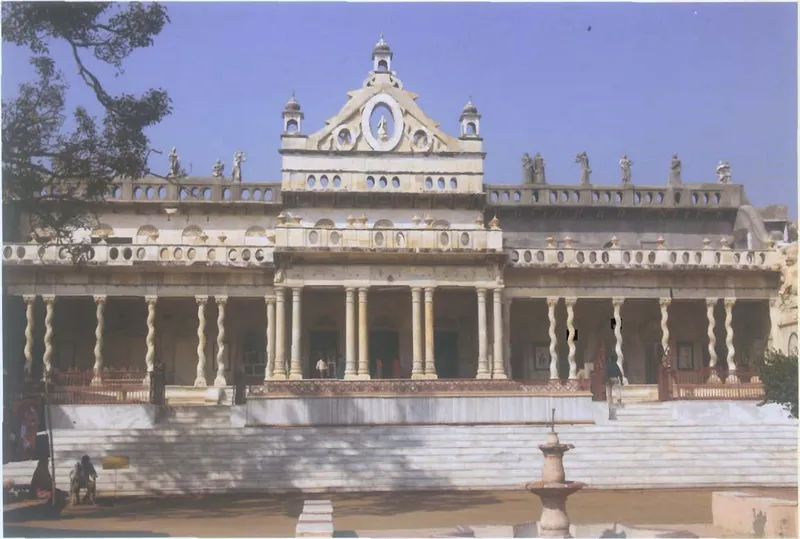
- What it is
- The Śāhajī Mandira is a large white-marble temple in Vṛndāvana, a short distance from the Rādhā-Ramaṇa temple.
- Visiting
- Vṛndāvana, the Playground of God (2010) places the temple a short distance from the Rādhā-Ramaṇa temple and describes twelve carved marble pillars, four metres tall, each made from a single piece of …
- Places here
- Vasanti Kamrā (Śāhajī Mandira)
In short
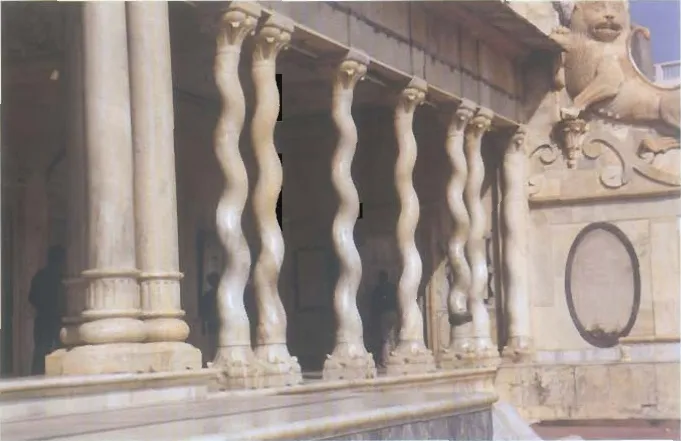
The Śāhajī Mandira is a large white-marble temple in Vṛndāvana, a short distance from the Rādhā-Ramaṇa temple. Its front is a colonnade of twisted marble pillars, each cut from a single stone.[1 +7] It was built by Śāh Kundanlāl (Shah Kundan Lal), a wealthy jeweller from Lucknow.[1 +4] Two guidebooks say that it was meant for the Deity of Rādhā-Ramaṇa, who was not moved from His temple, so other Deities, called Choṭā (small) Rādhā-Ramaṇa, are worshipped here.[1 +2] The historians date the building to 1868, while the guidebooks give other years. No scripture or Gosvāmī text describes it: it is a temple of the nineteenth century.[11 +2]
Key facts
| Kind | temple |
|---|---|
| Region · area | Vṛndāvana |
Traditional accounts
According to the local tradition recorded in Vṛndāvana, the Playground of God (2010), the Deity of Rādhā-Ramaṇa refused to come to the new temple; according to The Color Guide to Vṛndāvana (2000), the gosvāmīs of His temple decided not to move Him. So the Deities known as Choṭā Rādhā-Ramaṇa were installed here instead.[1 +2]
The guidebooks describe the founder in different words, without giving a source: "an unalloyed devotee of Śrī Caitanya Mahāprabhu" (Śrī Vraja-maṇḍala Parikramā, 2007), connected with the gosvāmī families of the Rādhā-Ramaṇa temple (Vṛndāvana, the Playground of God), and a disciple of the Gosāīṁ of Rādhā-Ramaṇa (The Color Guide). These descriptions may not be certain, but they do not contradict one another.[1 +2]
Śrīla Prabhupāda
No statement of Śrīla Prabhupāda about the temple has been found in the works searched.
No statement of Śrīla Prabhupāda about the temple has been found in the works searched. In a letter of 19 January 1974 about money for the Krishna-Balaram temple, he addressed the Vṛndāvana branch of the Punjab National Bank at "Sahji's Temple", the name of its locality.[16]
Visiting today
Vṛndāvana, the Playground of God (2010) places the temple a short distance from the Rādhā-Ramaṇa temple and describes twelve carved marble pillars, four metres tall, each made from a single piece of stone.[1 +7]
The Spring Room
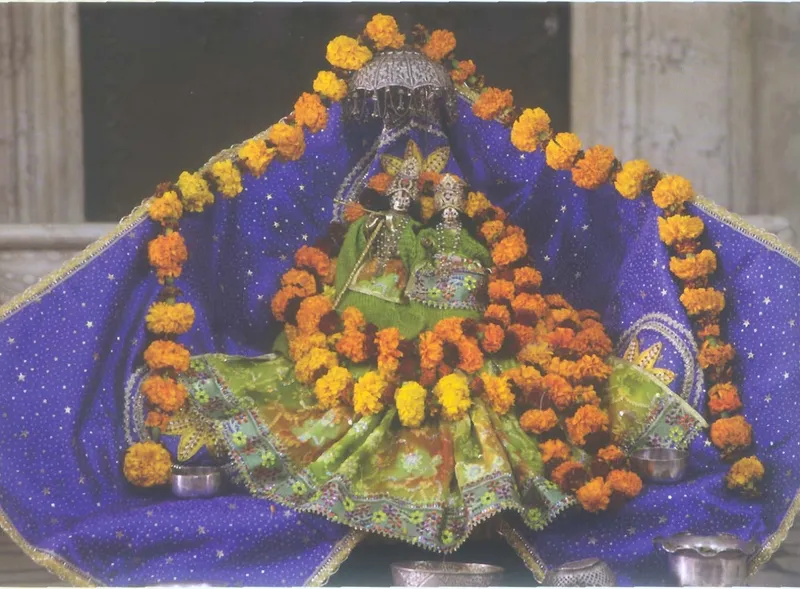
The same book says that, besides the temple room, there is a special room called the Vasanti Kamrā, the "Spring Room", where the Deities stay for two days a year around Vasanta-pañcamī, the day on which spring begins by the lunar calendar; no other source mentions the room, so this is not certain.[1 +1] It says that the old Belgian chandeliers and light fittings are lit for the Deities only on those two days, and that thousands of people come from all over Vraja for this darśana. Whether the custom is still kept has not been checked, so it is not certain today.[5]
Location
| Where it is | 'a short distance' from Rādhā-Ramaṇa[17] |
|---|
Places at Śāhajī Mandira
1 places
Nearby places
Rādhā-Ramaṇa Mandira (Vṛndāvana)
Pictures
4 pictures
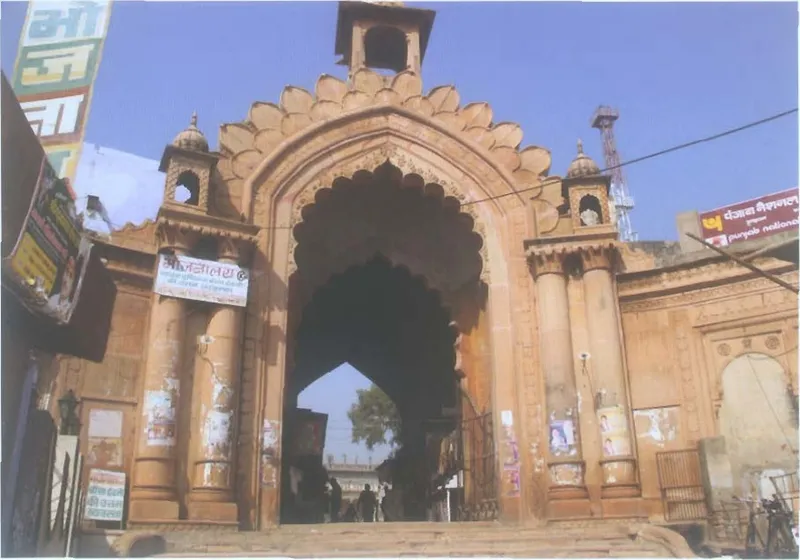
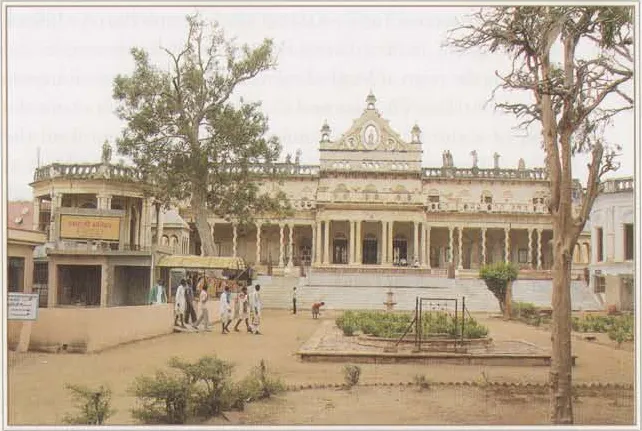
History
F. S. Growse's book on Mathurā (1883) and the district gazetteer of 1911 name the founder, Shah Kundan Lal of Lucknow, and describe the temple: costly white marble, a design taken from the modern secular buildings of Lucknow, and a colonnade of spiral marble pillars, each of one piece. Growse gives the cost, as it was reported to him, as ten lakhs of rupees.[1 +8]
The historian A. W. Entwistle (1987) says that the temple was built in 1868 by Kundanlāl, a grandson of Shah Biharilal of Lucknow, who had settled in Vṛndāvana in 1856 with his brother Phundanlāl and taken the name Lalitkiśorī.[11 +1] The historian Prabhudayāl Mītal (1966) gives Saṁvat 1925, that is 1868–69; he adds that Kundanlāl's pen-name was Lalita Kiśorī and that the temple was named Lalita-kuñja, though people know it as Śāh jī's temple.[13] The guidebooks give 1835 or 1876, and the 1911 gazetteer says it was completed about 1876 (see below).
The Bengali Vṛndāvana-kathā (1920) says that the temple stands on Govinda-ghāṭa, on the bank of the Yamunā, where two warrior sannyāsīs, Himmat Bāhādur and Gaṇeśa Giri, once lived, and that a Śiva temple they founded still stood beside the ghāṭa.[7 +2]
The Color Guide (2000) says that Shah Kundan Lal also built the Rādhā-Ramaṇa temple; the other sources name him with his brother or their grandfather (see below).[1 +4]
Where the sources differ
The year the Śāhajī temple was built.
Accounts differ The year the Śāhajī temple was built.
- Śrī Vraja-maṇḍala Parikramā (2007)'Constructed … in 1835 AD.'
- Vṛndāvana, the Playground of God (2010)'Built in 1876.'
- The Color Guide to Vṛndāvana (2000)'Designed and built in 1876.'
- F. S. Growse, Mathurá: A District Memoir (3rd ed., 1883)'Completed within the last few years'; a footnote adds that the Śāhajāpura temple of Rādhā-Gopāla was built 'in imitation of the bad example thus set' in 1873, which implies that this temple's design was known before 1873.
Accounts differ Who built the present temple of Śrī Rādhāramaṇa (Śrī Gopāla Bhaṭṭa Gosvāmī's Deity), which The Color Guide to Vṛndāvana (2000) credits to the builder of the Śāhajī temple.
- The Color Guide to Vṛndāvana (2000), p. 87Shah Kundan Lal 'also built the temple of Rādhāramaṇa' (no date).
- Pulinbihārī Datta, Vṛndāvana-kathā (Bengali, 1920), printed p. 91This new temple (of Rādhāramaṇa) was built at the expense of Sāh Kundan of Lucknow and his brother (no date).
- Prabhudayāl Mītal (1966), part 1 p. 137 (historian)The present temple was built by Śāh Kundanlāl of Lucknow and his brother Śāh Phundanlāl (no date).
- A. W. Entwistle (1987), pp. 219 and 413 (historian)The present temple was built in 1826 by Shah Biharilal of Lucknow, grandfather of Kundanlal and Phundanlal, the founders of the Śāhajī temple (his sources: Kapur vol. 3).
The wording of these accounts is our summary of the sources, not a published translation.
References
17 references
- Vṛndāvana, the Playground of God (2010), Bhakti Caitanya Svāmī, PDF p. 170
- Śrī Vraja-maṇḍala Parikramā (2007), PDF p. 322
- Growse
- Muttra gazetteer
- Vṛndāvana, the Playground of God (2010), Bhakti Caitanya Svāmī, PDF p. 172
- Śrī Vraja-maṇḍala Parikramā (2007), PDF p. 335
- Vṛndāvana, the Playground of God (2010), Bhakti Caitanya Svāmī, PDF p. 171
- The Color Guide to Vṛndāvana (2000), Written and Photographed by Rājaśekhara dāsa Brahmacārī, PDF p. 101
- F. S. Growse, Mathurá: A District Memoir, 3rd ed
- Muttra: A Gazetteer
- A. W. Entwistle, ch. 5 §36 'The Gaudiya Sampraday in modern times', printed p. 219, Egbert Forsten, Groningen, 1987
- A. W. Entwistle, ch. 8 §66.23 'Shahji Mandir', printed pp. 408–409, Egbert Forsten, Groningen, 1987
- Prabhudayāl Mītal, part 1 ('ब्रज-संस्कृति की भूमिका'), 'Braj-yātrā', Vṛndāvana: 'Śāh jī kā mandir', printed p. 140
- Vṛndāvana-kathā, ch. 22 (dvāviṁśa pariccheda), 'Sāhajīr mandira', printed p. 267
- Vṛndāvana, the Playground of God (2010), Bhakti Caitanya Svāmī, PDF p. 173
- Śrīla Prabhupāda, Letter to: Manager of Punjab National Bank, Letter 74-01-19 (address block), January 19th 1974 · vedabase.io
- Vṛndāvana, the Playground of God (2010), Bhakti Caitanya Svāmī, p. 170