Savāmana Śālagrāma Mandira
सवामन शालग्राम मन्दिर Hindi name proposed
- What it is
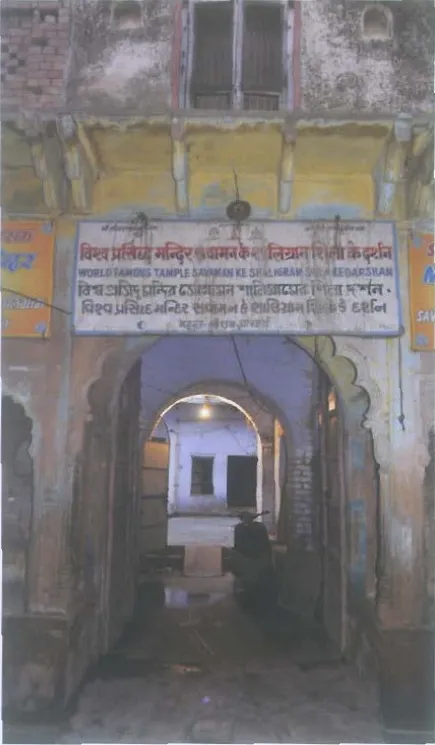
- The Savāmana Śālagrāma Mandira is a two-storey temple at the corner of Loī-bāzār in Vṛndāvana, opposite the Śrī Śyāmasundara temple.
- Visiting
- Śrī Vraja-maṇḍala Parikramā (2007) says that the huge Savāmana Śālagrāma presides in the temple with Deities of Śrī Sītā-Rāma.
In short
The Savāmana Śālagrāma Mandira is a two-storey temple at the corner of Loī-bāzār in Vṛndāvana, opposite the Śrī Śyāmasundara temple. It is named after a very large śālagrāma-śilā, a sacred stone worshipped as the Lord, of savāmana weight; Śrī Vraja-maṇḍala Parikramā (2007) explains the word as nearly forty-seven kilos. Deities of Śrī Sītā-Rāma stand on its altar.[1 +2] No scripture concerns the temple itself, Śrīla Prabhupāda does not speak of it by name, and no date of building is known.[4 +2]
Key facts
| Kind | temple |
|---|---|
| Region · area | Vṛndāvana |
Why it is glorified
The Bhāgavatam (5.7.10) describes the Gaṇḍakī River at Pulaha-āśrama, whose stones are marked with circles like navels.
The Bhāgavatam (5.7.10) describes the Gaṇḍakī River at Pulaha-āśrama, whose stones are marked with circles like navels. In general, without naming this temple, Śrīla Prabhupāda explains that these are the śālagrāma-śilās and that they are found in the Gaṇḍakī.[4 +1]
yatrāśrama-padāny ubhayato nābhibhir dṛṣac-cakraiś cakra-nadī nāma sarit-pravarā sarvataḥ pavitrī-karoti
In Pulaha-āśrama is the Gaṇḍakī River, which is the best of all rivers. The śālagrāma-śilā, the marble pebbles, purify all those places. On each and every marble pebble, up and down, circles like navels are visible.
Translation: Śrīla A.C. Bhaktivedanta Swami PrabhupādaGeneral teaching (does not name the place)“Śālagrāma-śilā refers to pebbles that appear like stones with circles marked up and down. These are available in the river known as Gaṇḍakī-nadī. Wherever the waters of this river flow, the place becomes immediately sanctified.”
Śrīla Prabhupāda, Śrīmad-Bhāgavatam, 5.7.10, purport · vedabase.io
Visiting today
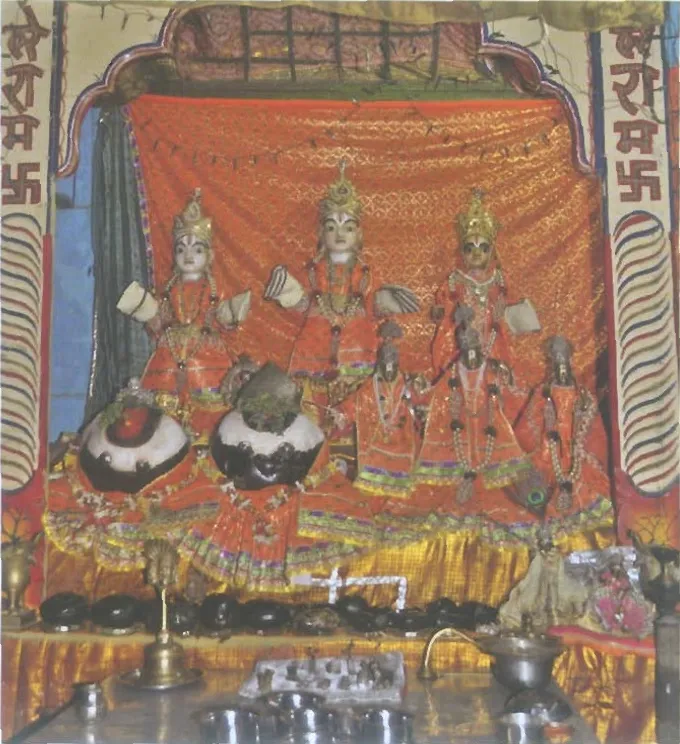
Śrī Vraja-maṇḍala Parikramā (2007) says that the huge Savāmana Śālagrāma presides in the temple with Deities of Śrī Sītā-Rāma.[1] The guidebook Vṛndāvana, the Playground of God (2010) calls it the Śālagrāma Temple and places it almost opposite the entrance of the Śyāmasundara temple, a little further towards Loī-bāzār. It describes very large śālagrāma-śilās from the Gaṇḍakī River in Nepal on the lowest level of the altar, with Deities of Sītā, Rāma, Lakṣmaṇa and Hanumān; in winter the Deities wear gloves against the cold.[2 +1] These descriptions are as of 2007 and 2010.
Location
| Where it is | corner of Loī-bāzār, opposite the Śyāmasundara temple[8] 'almost opposite the entrance to the Śyāmasundara temple, slightly further up the road towards Loi Bazaar'[9] |
|---|
Nearby places
Rādhā-Śyāmasundara Mandira (Vṛndāvana) · Loī-bāzār · Śyāmānanda Tilaka-sthāna
Pictures
1 pictures
History
The oldest printed record of the temple found so far is a Hindi edition of Śrīla Nārāyaṇa Bhaṭṭa Gosvāmī's Vraja-bhakti-vilāsa, whose translation was completed in about 1947. It names as the first place to buy the book a shop below the Savāmana Śālagrāmajī temple in Loī Bāzār, so the temple stood there under this name when that edition was printed.[6]
The historian A. W. Entwistle (1987) reports, after Gopāla Kavi, who described Vṛndāvana in the early nineteenth century, that the śālagrāma was brought from Hyderabad by Seṭh Snehī Rām Fatehpuriyā, and that the Seṭh's son built the temple. He gives no year, and Gopāla Kavi's own text could not be checked, so the account is not certain.[7]
Where the sources differ
How many very large śālagrāmas the temple has: one according to Śrī Vraja-maṇḍala Parikramā (2007), which places another in the …
How many very large śālagrāmas the temple has: one according to Śrī Vraja-maṇḍala Parikramā (2007), which places another in the old Govindajī temple, and two according to Vṛndāvana, the Playground of God (2010), which photographs them side by side.[1 +2]
Accounts differ How many very large śālagrāmas the temple has.
- Śrī Vraja-maṇḍala Parikramā (2007)one huge Savāmana Śālagrāma here; 'another' savāmana śālagrāma is in the old Govindajī temple.
- Vṛndāvana, the Playground of God (2010)two very large śālagrāma-śilās here (photographed side by side).
References
9 references
- Śrī Vraja-maṇḍala Parikramā (2007), PDF p. 337
- Vṛndāvana, the Playground of God (2010), Bhakti Caitanya Svāmī, PDF p. 162
- Vṛndāvana, the Playground of God (2010), Bhakti Caitanya Svāmī, PDF p. 163
- Śrīmad-Bhāgavatam 5.7.10, GRETIL
- Śrīla Prabhupāda, Śrīmad-Bhāgavatam, 5.7.10, purport · vedabase.io
- Śrīla Nārāyaṇa Bhaṭṭa, Vraja-bhakti-vilāsa, 1st ed., publ. Bābā Kṛṣṇadāsa, Kusuma-sarovara, Saṁvat 2008
- A. W. Entwistle, ch. 8 §66.18 'Savaman Shalagram', printed pp. 407–408, Egbert Forsten, Groningen, 1987
- Śrī Vraja-maṇḍala Parikramā (2007), p. 648-649
- Vṛndāvana, the Playground of God (2010), Bhakti Caitanya Svāmī, p. 162